Delivered Project · Beauty Retail · United States
Pearlescent Acrylic Wall Display Program
A US indie beauty brand asked us for a pearlescent acrylic wall display for its lipstick line.
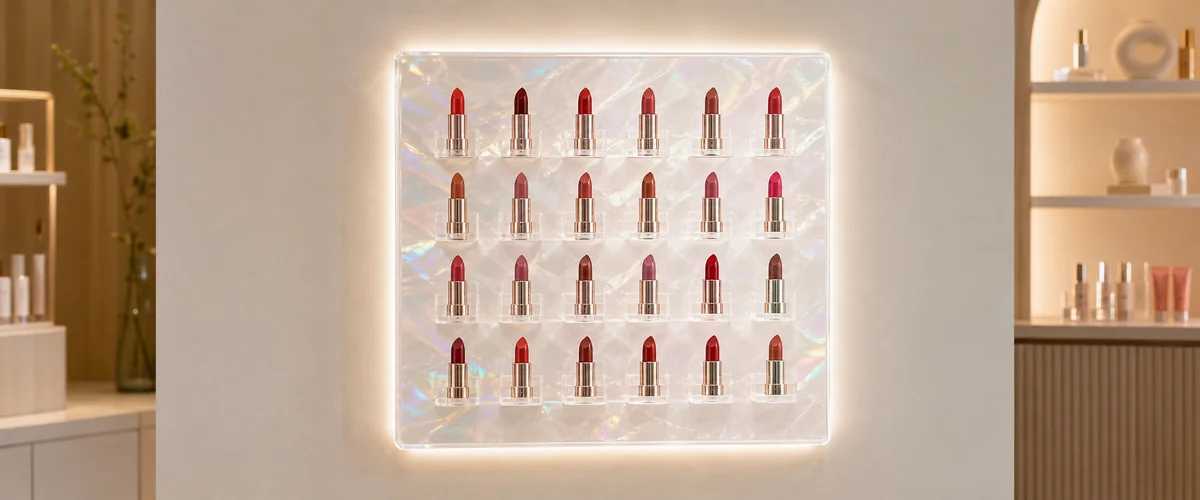
We delivered the non-electrical acrylic components: a cast-in pearlescent backplate and clear cradles fitted to the brand's own lipsticks, approved on a paid sample before production.
Ordering a similar project
MOQ is 100 pieces per design. A paid sample takes 3–5 days, is paid separately and is never credited. Standard production is 15–20 days after approvals, and we reply to a complete brief within 24 hours.
Closest published price: the acrylic display manufacturer page publishes a two-tier countertop stand 250 × 180 × 220 mm, 5 mm clear, one-color UV logo: $28 each at 100 pcs, $16 at 500, $12 at 1,000 (FOB Shenzhen, published reference). This wall display was a different build and was quoted from its own drawing, sheet and cradle count.
Key Takeaways
- A US indie beauty brand needed a pearlescent acrylic wall display for its lipstick line, sized to its own products and its store wall space.
- We made the backplate from a cast-in pearlescent sheet the brand approved on a production-material sample under its store lighting.
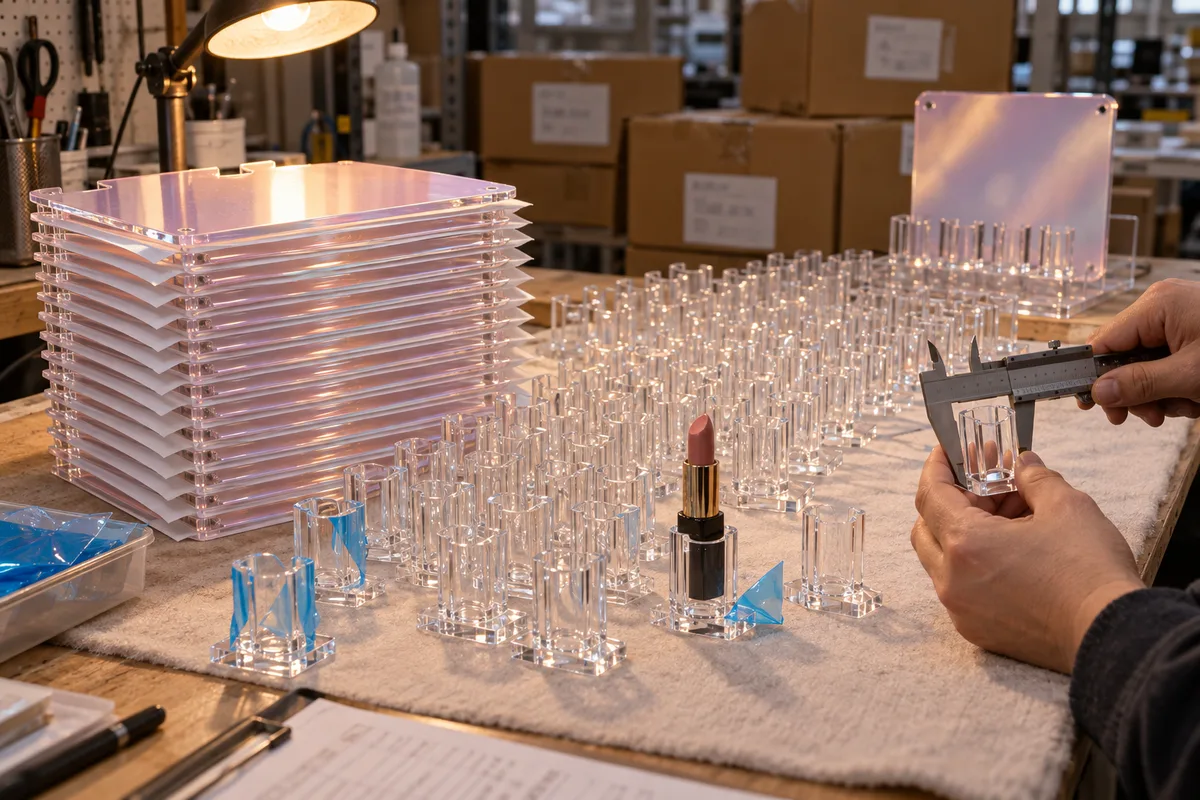
- We measured the brand's actual lipsticks and machined clear cradles to that profile, then checked fit and removal on 1 approved fixture sample.
- We supplied non-electrical acrylic components only; the brand's local installer mounted the fixtures and a separate contractor handled the store lighting.
The Buyer's Brief
The brand came to us with its lipstick assortment, the wall position it wanted in store, its brand finish and its store lighting. It sent actual product samples, an approved product map and a drawing of the available wall area. Store count and campaign timing set our packing and logistics.
The brand wanted a pearlescent look. That can come from a specialty sheet, a printed layer or a film, so we compared them on production-material samples under the brand's own lighting instead of ranking them on general claims. Our quote named the chosen material, the approved sample, the inspection method and the permitted variation. It also set our scope as the non-electrical acrylic parts; wall preparation, lighting, wiring, drivers and installation stayed with the brand and its local contractors.
Our Approach
We chose the finish by sample comparison and supplier documentation. The review covered appearance under the brand's lighting, edge treatment, cleaning, batch identification and replacement.
Surface-applied finishes we compared
A printed ink or metallized film depends on the ink or film lot, deposition, cure and edge exposure. We reviewed both routes against the named supplier documentation for appearance, edges and cleaning.
The specialty pearlescent sheet we used
The brand chose a cast-in pearlescent sheet. Its color is controlled by the sheet maker's product code, lot documentation and the approved sample, so we recorded all three and kept the signed sample as the visual reference. Related material questions are covered in ouriridescent acrylic sheet buyer guide.
| Finish method | Initial cost | Batch consistency (3 batches) | Cleaning durability |
|---|---|---|---|
| Printed metallic ink | Priced after artwork and process review | Needed a production-material sample and comparison method | Checked against system documentation and a cleaning sample |
| Cast-in pearlescent (chosen) | Priced on the named sheet and quantity | Product code, lot and approved visual reference recorded | Checked against sheet documentation and a fabricated sample |
| Vacuum-metallized film | Priced after film and edge-detail review | Needed an approved film and production sample | Edge detail and cleaning method tested |
Spec Breakdown
The fixture drawing covered the backplate, the product cradles and the mounting interface. Counts, dimensions and layout came from the brand's actual assortment and wall area.
Backplate: named sheet, approved sample
We set sheet thickness and grade once the finished size, cradle layout, load and mounting support were known. The brand approved the sheet and edge finish on the physical sample.
Cradles: fitted to the actual lipsticks
We measured the brand's lipstick samples and sent a cradle drawing for approval. On the fixture sample we checked clearance, label visibility, removal access and orientation with the real products.
Wall mount: approved by the local installer
The panel hung on a concealed aluminum bracket. The brand's local installer approved the actual wall, fasteners, load path, access and removal method.
Production and Quality Control
We recorded each checkpoint from material approval through final packing.
- Incoming material. We verified the named sheet, product code, lot record, protective masking and visual reference.
- Fabrication. We cut and finished the sheet to controlled drawing revisions and kept the identification that traced each part back to its lot.
- Cradle and assembly. We machined cradles to the approved lipstick profile, assembled to the signed sample, and checked clearance and removal with the brand's products.
- Final inspection and packing. We inspected to the agreed sampling plan, lighting, drawing and signed sample, then packed to the approved packing specification.
Any part that did not match was set aside and reviewed against the agreed acceptance criteria before shipment.
Installation and Delivery
Before release, the brand confirmed store quantities, packing labels and the freight route. We quoted freight on the actual carton plan, route and delivery terms. The brand's local installer confirmed the wall condition, bracket, fasteners, load and access and mounted the fixtures, and a lighting contractor handled the store lighting. The brand checked the finish sample under each of its lighting setups and recorded its visual acceptance.
We approved the pearlescent sheet, the lipstick fit and the wall interface before production, and those signed records are the reference for any repeat order.
If You're Planning Something Similar
Send your actual products, artwork, lighting details, available wall area and store quantities. We fit cradles to the real product and approve the finish on production material, and you arrange wall mounting and any lighting locally. For a repeat order we reuse the drawings and inspection records, review fit for any new product, and reprice material, labor, setup and freight for the current specification; a changed sheet lot may need a new sample approval. See custom acrylic displays.
Need a cosmetics wall display made to your products?
Send the product samples, brand guide, fixture sketch, intended lighting information, wall interface, and quantity per design. We will reply with drawing and sample questions and a written quote within 24 hours.
Paid sample in 3–5 days, paid separately and never credited · Production in 15–20 days · MOQ 100 pieces per design