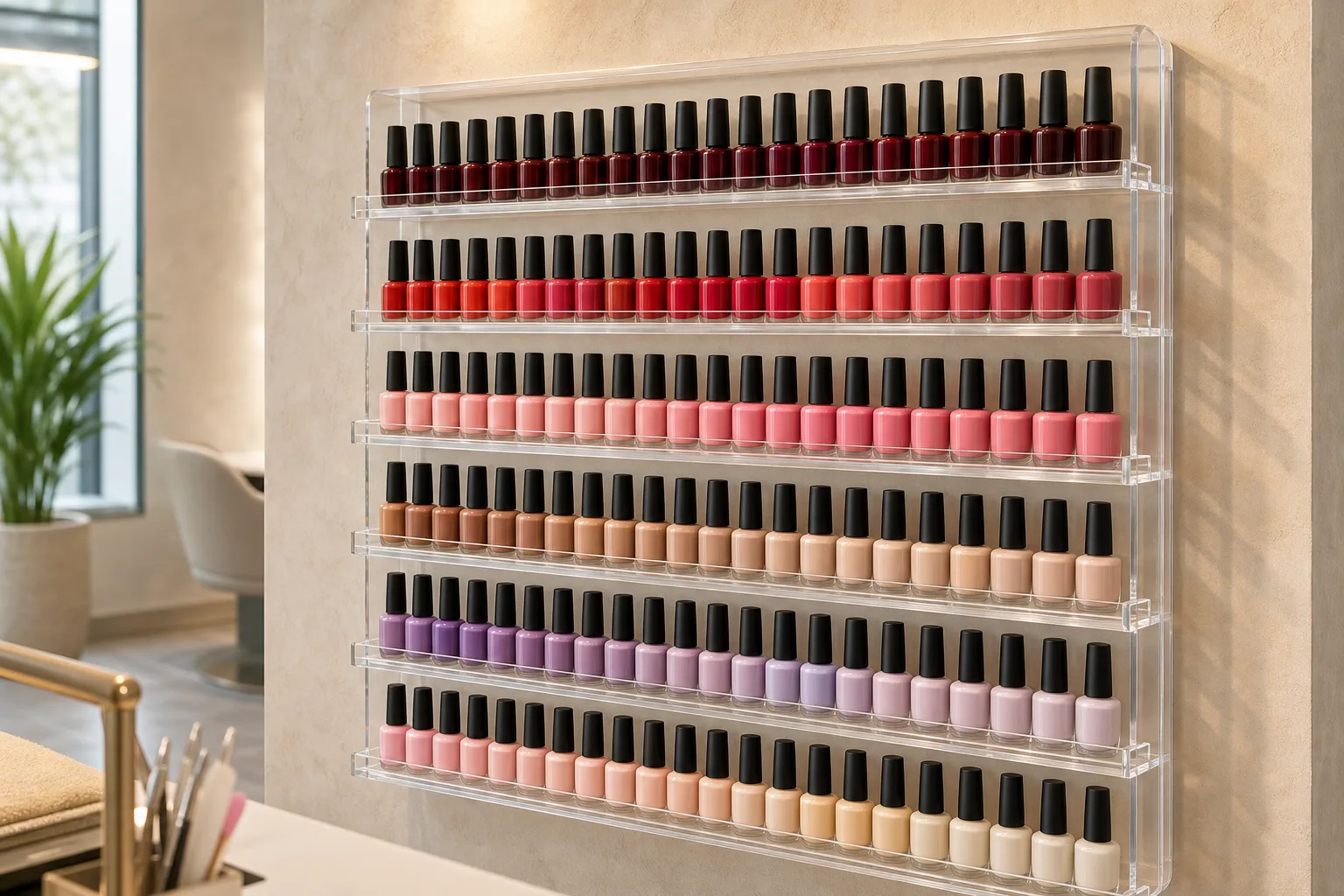
Acrylic Nail Polish Displays
Slots cut to your bottle, not to a catalog average — so nothing rattles, leans, or walks off the tier.
A nail polish display is a tiered acrylic fixture that holds polish bottles upright and visible, sorted by color family. Wetop Acrylic manufactures custom nail polish displays as wall-mounted racks, countertop stands, dust-proof cabinets, and branded POP units. MOQ is 100 pieces, samples take 3–5 days, and production runs 15–20 days.
Also searched as nail polish racks, polish organizers, and nail polish display stands. Built for salon chains, beauty retailers, and polish brands placing product into retail doors.
ISO 9001 Certified Since 2008 · 2,000+ Custom Projects · MOQ 100 pcs · 100% Inspection · Samples in 3–5 Days
Find Your Nail Polish Display Format
Four fixture formats, plus the two things salons usually order in the same run. Capacities assume 15 ml bottles at a 32 mm slot pitch.
Wall-Mounted Racks
Stepped tiers on a flush French-cleat mount. Uses vertical wall space, leaves the counter clear, and carries the widest color range per square meter.
32–128 bottles
Countertop Stepped Stands
Free-standing risers for a reception desk, checkout counter, or manicure station. Nothing gets drilled, and the stand moves with the merchandising plan.
24–60 bottles
Dust-Proof Cabinets
Hinged clear front door over stacked shelves. Keeps filing debris and salon dust off the caps, and puts the most bottles in the smallest floor footprint.
96–216 bottles
Branded POP Displays
Header-card units for polish brands placing product into salons and beauty retail. UV-printed artwork, your bottle pitch, identical across every door.
12–48 bottles
Nail Tool & Station Caddies
Open-well caddies for files, buffers, cuticle tools, and cotton at the manicure station — usually ordered alongside the polish display in the same run.
Custom wells
Need makeup storage too?
Lipstick grids, brush cups, palette shelves, and multi-compartment counter units — same factory, same run, same packing list.
See sibling page
Featured Nail Polish Display Types
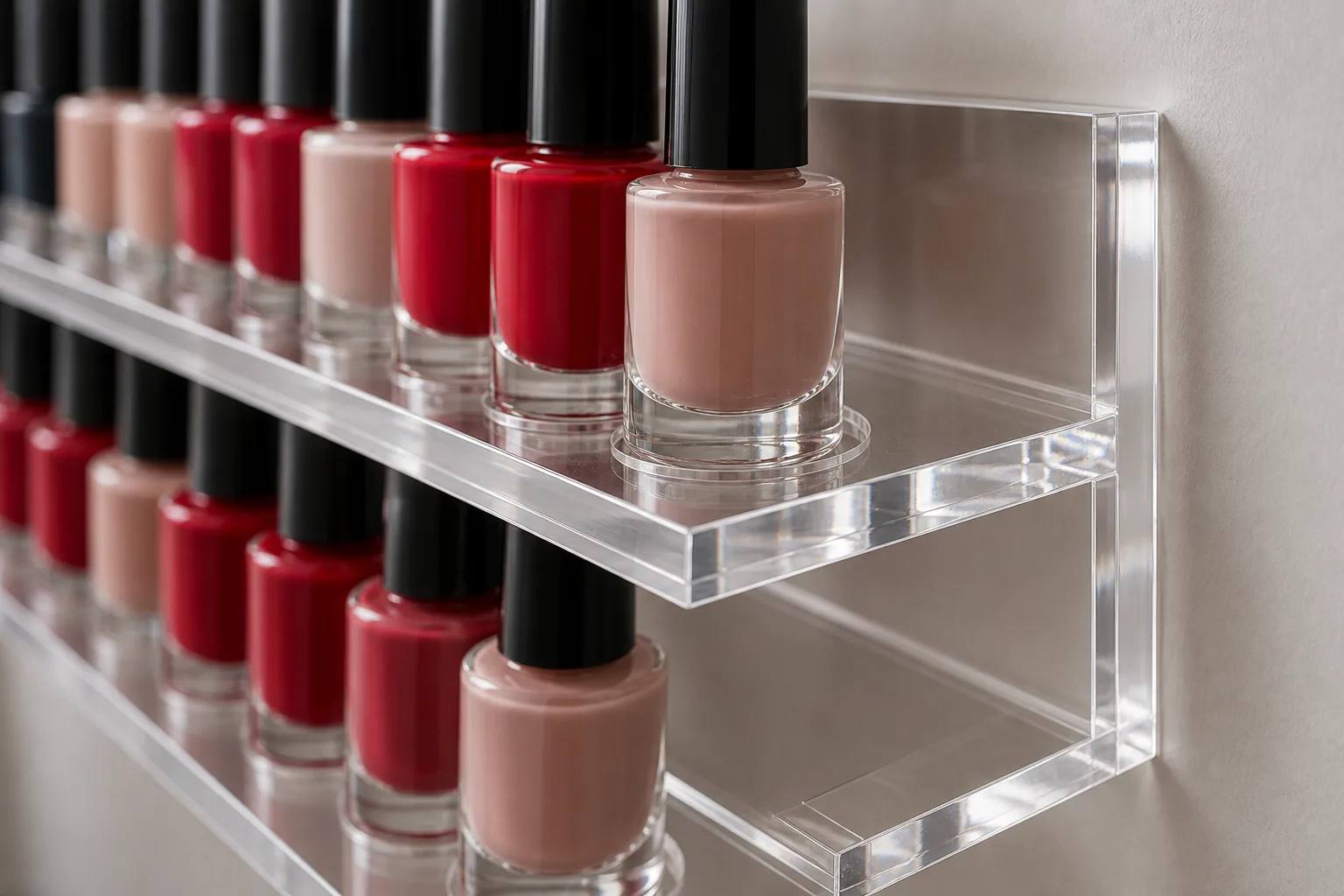
Wall-Mounted Nail Polish Racks
An acrylic nail polish wall rack is a stepped-tier fixture that mounts flush to a retail wall and holds bottles upright with the caps facing the customer. Wetop builds wall racks in 4 to 8 tiers, 32 to 128 bottle capacity, with a routed retention recess in each tier and a hidden French-cleat mount that shows no screw heads.
A salon wall is not a still environment. HVAC cycles, front doors, and stylists dragging carts along the same wall all put vibration into the fixture, and on a flat tier a front-row bottle walks forward a fraction of a millimeter at a time until it goes over the edge. We route a shallow retention recess into each tier so every bottle seats in place — a stylist still lifts it out one-handed, but the bottle has nowhere to walk to.
Color-family labels go into the acrylic rather than onto it. Laser etching at 0.3 mm depth, UV-filled for contrast, stays legible under salon lighting and survives the acetone-based cleaner staff wipe the tiers with. Vinyl labels in that same environment peel at the corners within months.
| Configuration | Bottles | Width × Projection | Height | Loaded weight |
|---|---|---|---|---|
| 4-tier compact | 32 | 280 × 150mm | 340mm | ~4 kg |
| 6-tier standard | 48 | 280 × 210mm | 480mm | ~6 kg |
| 6-tier wide | 96 | 540 × 210mm | 480mm | ~11 kg |
| 8-tier wide | 128 | 540 × 270mm | 620mm | ~15 kg |
Popular with: Nail salon chains · Beauty supply stores · Polish brands · Pro retailers
MOQ: 100 pieces · Sample: 3–5 days · Production: 15–20 days
Get a Wall Rack QuoteMounting a Loaded Polish Wall: Hardware and Substrate
A 48-bottle acrylic nail polish rack weighs roughly 6 kg once it is loaded, so the wall joint is a structural detail, not an afterthought. Our default is a hidden French-cleat rail: an aluminum cleat takes M4 fixings into the wall, and a 5 mm groove routed into the 10 mm acrylic back panel drops over it. We pull-test the cleat interface at 80 N before shipping.
The cleat does the load work and the routed recess does the retention work. Neither is visible from the customer side, which is the point — the fixture reads as a clean sheet of acrylic holding color.
Which fixing for which wall
| Wall substrate | Fixing we supply | What to check before install |
|---|---|---|
| Timber stud behind plasterboard | M4 wood screws through the cleat into the stud | Locate the stud centers — the cleat is drilled with slotted holes so the centers can shift |
| Plasterboard, no stud available | M4 into hollow-wall toggle anchors | The anchor's rated pull-out load has to carry the loaded fixture weight on our spec sheet with margin |
| Solid brick or block | M4 into nylon wall plugs | Drill into the brick body, not the mortar joint |
| Slatwall panel | Slatwall hooks bonded to the acrylic back panel | Confirm the slat pitch so we set the hook spacing before production |
| Glass, tile, or a leased shopfront you cannot drill | None — take the countertop stand instead | Counter depth available, since the stepped stand projects further than a wall rack |
We ship the cleat, fixings, and a one-page install sheet with every wall unit. The wall anchor itself is the installer's side of the joint — sized against the loaded weight in the configuration table above.
Countertop Stepped Polish Stands
A countertop nail polish display stand is a free-standing stepped riser that sits on a reception desk, checkout counter, or manicure station. Wetop builds them in 3 to 5 tiers, 24 to 60 bottle capacity, solvent-bonded from clear cast acrylic with non-slip feet — no wall drilling and no fixed position.
Counter stands earn their place in two situations: a leased space where nothing can be drilled into the wall, and a merchandising plan that moves. A stand goes to the till during a promotion, back to the station wall after, and to a trade show in a padded case — a wall rack does none of that.
Each step rises 45 mm, which clears the cap of a 15 ml bottle on the tier in front. Drop that step height and the back row disappears behind the front row; raise it and the stand gets tall enough to block sightlines across the counter.
| Configuration | Bottles | Footprint (W × D) | Height |
|---|---|---|---|
| 3-tier compact | 24 | 280 × 130mm | 150mm |
| 4-tier standard | 32 | 280 × 175mm | 195mm |
| 5-tier wide | 60 | 420 × 220mm | 240mm |
| 4-tier rotating base | 48 | 260 × 260mm | 210mm |
Popular with: Independent salons · Hotel nail bars · Spas · Trade show stands · Beauty counters
MOQ: 100 pieces · Sample: 3–5 days · Production: 15–20 days
Get a Countertop Display Quote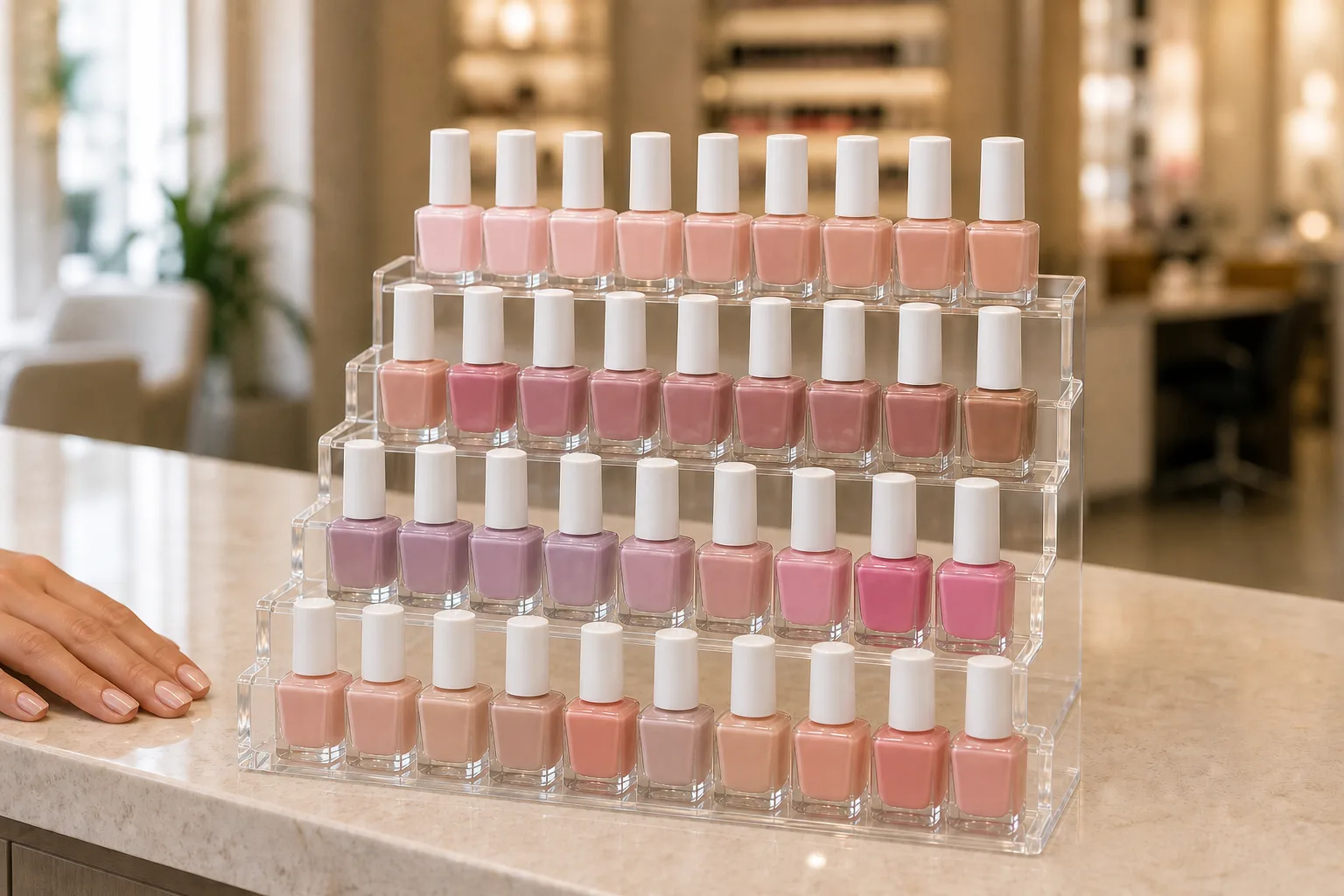
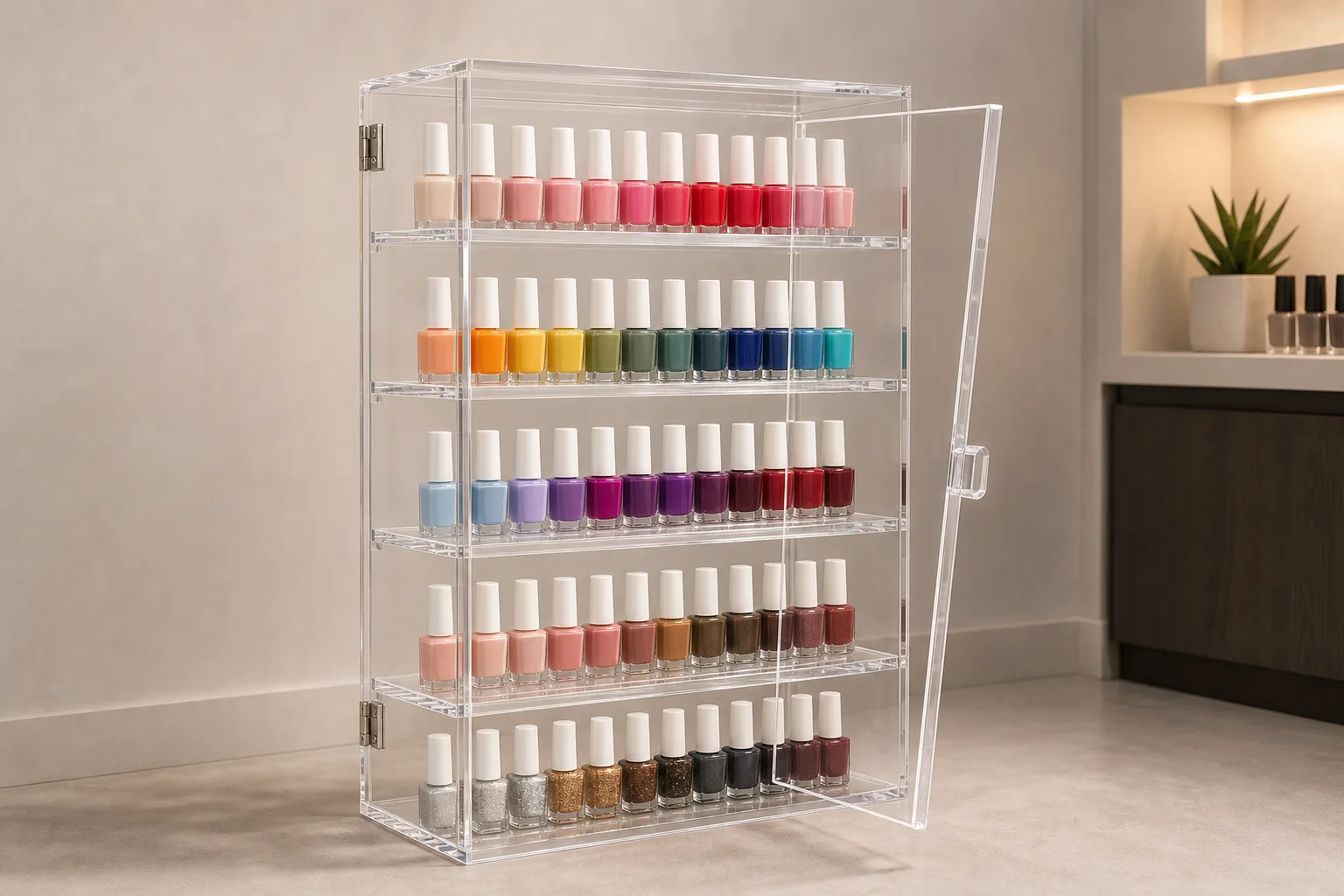
Dust-Proof Nail Polish Display Cabinets
A nail polish display cabinet is an enclosed acrylic unit with a hinged clear front door over stacked shelves. Wetop builds cabinets in 4 to 6 shelves, 96 to 216 bottle capacity, with flush-seated hinges, a polished acrylic pull handle, and an optional keyed cam lock for open-floor retail.
Filing dust is the reason salons ask for a door. Acrylic filing debris settles on the cap shoulders of every bottle on an open wall, and staff end up wiping stock instead of serving clients. A closed cabinet takes that job off the rota.
Cabinets also win on density. Because the shelves stack vertically instead of stepping back like tiers, a 400 × 200 mm cabinet footprint holds two rows of bottles per shelf — around three times what the same footprint holds as a stepped countertop stand. That matters most in beauty supply retail, where linear meters of wall are the scarce resource.
| Configuration | Rows deep | Bottles | Footprint (W × D) | Height |
|---|---|---|---|---|
| 4-shelf countertop | 2 | 96 | 400 × 200mm | 480mm |
| 5-shelf counter/floor | 2 | 120 | 400 × 200mm | 700mm |
| 6-shelf deep | 3 | 216 | 400 × 300mm | 900mm |
Popular with: Beauty supply stores · Salon retail corners · Spas · Pro distributors
MOQ: 100 pieces · Sample: 3–5 days · Production: 15–20 days
Get a Dust-Proof Cabinet QuoteBranded POP Displays for Polish Brands
A branded nail polish POP display is a compact acrylic unit with a printed header card, built for a polish brand placing product into salon and retail doors. Wetop builds them at 12 to 48 bottle capacity with UV-printed, silk-screened, laser-engraved, or hot-stamped branding. Minimum is 100 pieces per branded design.
The brand-side job is different from the retailer-side job. A salon buys one fixture for its own wall; a brand buys several hundred identical units that have to look the same in every door, across reorders, for years. That makes repeatability the specification — same slot pitch, same header geometry, same print file, same carton.
We keep the routing program and the print artwork on file against your part number. A reorder eighteen months later comes off the same program, so units from two different runs sit side by side on one shelf without a visible mismatch.
| Branding method | Best for | Durability in a salon |
|---|---|---|
| UV printing | Full-color artwork, gradients, product photography | Good — sits on the surface, keep it off wipe-down zones |
| Silk-screen printing | Flat 1–2 color logos at volume | Good — lowest per-unit cost above 500 pieces |
| Laser engraving (0.3 mm, UV-filled) | Color-family labels, tier edges, permanent marks | Best — cannot peel or dissolve under acetone-based cleaner |
| Hot stamping | Metallic gold or silver on a premium line | Good — keep off high-contact edges |
Popular with: Nail polish brands · Gel systems · Private label sellers · Distributors
MOQ: 100 pieces per branded design · Sample: 3–5 days
Get a Branded POP Display QuotePolish and Beauty Displays We've Built
Documented programs and conditional manufacturing examples from our Shenzhen factory; each card states its evidence class.
Nail-Polish Wall Display Manufacturing Plan
Bottle-sample-controlled tier spacing · drawing-defined retention detail · buyer-selected mounting interface · approved artwork and packout
Countertop New-Arrivals Display Plan
Prospective two-tier corner geometry · bottle pitch and planogram released from the buyer's sample and drawing
Velvet-Inset Cosmetic Organizers
Recessed velvet-lined wells bonded into clear acrylic bodies · hot-stamped brand mark · retail-boxed per unit
Salon Multi-Compartment Station Units
300 units · combined lipstick grid, brush cups, and palette shelf · clear acrylic with frosted dividers · silk-screen logo · bulk packed in 10s
The nail-polish wall-display manufacturing plan above shows how bottle fit, artwork, mounting, inspection and packing are approved without presenting the plan as a completed salon rollout.
Quote a Similar ProjectThe first samples came back with the slot pitch cut to our own bottle, not to something close enough. That is what sold us — we had spent a year with racks that let bottles lean. Phase 2 went in four weeks after the first delivery.
Wall Rack, Countertop Stand, or Cabinet?
Choose by the space you have and the handling the display will take. Wall racks carry the widest color range and free the counter; countertop stands need no drilling and move with the merchandising plan; cabinets keep dust and hands off the stock and hold the most bottles per footprint.
| Factor | Wall-Mounted Rack | Countertop Stand | Dust-Proof Cabinet |
|---|---|---|---|
| Typical capacity | 32–128 bottles | 24–60 bottles | 96–216 bottles |
| Space it consumes | Wall only — counter stays clear | Counter footprint 280–420mm wide | Floor or counter, 400mm wide |
| Installation | Cleat + M4 fixings, under 10 minutes | None — set it down | None, or wall-anchored if tall |
| Can it move? | No, once mounted | Yes — station to till to trade show | Rarely, once loaded |
| Dust and handling | Open — caps need periodic wiping | Open — caps need periodic wiping | Enclosed — door keeps debris off |
| Theft exposure | Open access | Open access | Optional keyed cam lock |
| Leased space, no drilling | Not workable | Workable | Workable |
| Best fit | Salon chains, beauty supply walls | Independent salons, hotel nail bars, shows | Retail floors, pro distributors, spas |
Most salon rollouts we quote end up with a wall rack for the core range and a countertop stand for new arrivals at the till. For the material argument behind all three formats, see our guide on why beauty brands choose acrylic displays; if you are weighing acrylic against a lower-cost board build, read acrylic vs melamine for cosmetics displays.
Bottle Fit, Materials, and Finishes
Slot pitch is the specification that decides whether a nail polish display works. We cut it to your bottle: send one sample bottle or a dimensioned drawing, and the routing program is written around that footprint rather than a catalog average.
Slot pitch by bottle format
| Bottle format | Base dimension | Slot pitch we cut | Bottles per 280mm tier |
|---|---|---|---|
| 10 ml slim | 22–26mm | 28mm | 9 |
| 15 ml standard round or square | 28–32mm | 32mm | 8 |
| 15 ml gel, tall opaque bottle | 28–32mm | 32mm | 8 |
| 18 ml wide-body | 34–38mm | 40mm | 6 |
| Mixed range on one fixture | Varies | Different pitch per tier | Quoted per drawing |
Capacities elsewhere on this page assume the 15 ml standard row — 8 bottles on a 280 mm tier, with 12 mm of margin at each end.
Materials and thicknesses
| Component | Standard spec | Options |
|---|---|---|
| Tier shelves | 6mm clear cast acrylic | 5mm on compact stands, 8mm on wide 540mm tiers |
| Back panel | 10mm clear cast acrylic | Frosted, white, black, or mirrored back for contrast behind bottles |
| Cabinet door | 5mm clear cast acrylic | Flush-seated hinges, polished pull handle, optional keyed cam lock |
| Joints | Solvent-bonded | Seamless bonded corners, no visible fasteners or glue lines |
| Edges | Diamond-polished | Flame-polished, or matte-sanded where a softer edge suits the brand |
| Wall hardware | Aluminum French cleat, M4 | Keyhole slots, through-hole mounting, slatwall hooks |
| Branding | Your choice of four methods | UV print, silk-screen, laser engraving (0.3mm, UV-filled), hot stamping |
Cast acrylic, not extruded, on every structural panel — it machines cleanly at the routed retention recess and takes a diamond polish without crazing at the bonded joints.
What Moves the Price of a Nail Polish Display?
We do not publish a fixed price because every fixture is cut to a different bottle and a different wall. Four things move the number: capacity and panel area, format complexity, branding method, and order quantity. Here is how each one behaves so you can plan a budget before you ask for a quote.
Capacity & Panel Area
A 128-bottle 8-tier wall rack uses roughly three times the acrylic of a 32-bottle 4-tier unit, and three times the bonding and polishing time. Capacity is the first number we ask for because it sets the material cost floor.
Format Complexity
An open countertop riser is the simplest build. A wall rack adds routed retention recesses and a cleat groove. A cabinet adds a hinged door, hinge seating, a handle, and an optional lock — each one a separate operation on the bench.
Branding & Finish
Clear acrylic with no branding is the baseline. Frosted, black, white, and mirrored back panels cost more than clear. Laser-etched and UV-filled labels cost more than a single silk-screen pass; hot-stamped foil is the premium option.
Order Quantity
MOQ is 100 pieces per design. The routing program, print screens, and bench setup are written once and spread across the run, so the steepest per-unit drop sits between 100 and 500 pieces. Above 500, material becomes the dominant cost.
A clear 3-tier countertop stand is the most affordable build on this page. A 6-shelf locking cabinet with etched labels and a printed header is the premium end. Send us your bottle dimensions, capacity target, and quantity, and we come back with an exact number — FOB Shenzhen, with CIF and DDP quoted on request.
Get Your Per-Unit Pricewe respond within 24 hoursWho Orders Custom Nail Polish Displays?
Nail polish displays are ordered by salon chains standardizing a retail wall, polish and gel brands placing branded units into doors, beauty supply retailers merchandising several hundred SKUs, and spas and hotel nail bars fitting out small treatment rooms. Wetop has built custom acrylic fixtures for buyers across 25+ countries since 2008.
Nail Salon Chains
A multi-location plan can hold one buyer-approved fixture specification across every site. Bottle fit, mounting, label method, cleaning exposure and packout stay drawing- and sample-controlled before production release.
Nail Polish & Gel Brands
Branded POP units placed into salon and retail doors. We hold your bottle pitch and your header artwork across every reorder, so display units from different runs still line up on the same shelf.
See salon retail displays ›Beauty Supply & Pro Retailers
High-density wall racks and cabinets for stores carrying several hundred SKUs. Shelf capacity per linear meter is the number that decides the fixture, so we quote it on the spec sheet.
Department Store Beauty Counters
Compact branded units that share a counter with skincare and fragrance. Mirrored or frosted back panels tie the polish block into the surrounding counter architecture.
Spas & Hotel Nail Bars
Smaller-footprint cabinets and countertop stands for treatment rooms and hotel nail bars, where the display has to look finished from every angle in a small room.
E-Commerce & Private Label Sellers
Retail-packaged polish organizers sold as consumer products. We produce and pack to your carton spec; you brand, list, and ship.
How to Order Custom Nail Polish Displays
From your bottle dimensions to fixtures on the wall — 3 steps.
Send Your Bottle and Your Space
Give us the bottle (a photo with a ruler, a drawing, or one physical sample), the wall or counter you are filling, the capacity you want, and the quantity. If you are not sure which format fits, tell us the space and we will propose one.
We respond within 24 hoursApprove a Loaded Sample
We build a production-quality sample with your slot pitch, mount, and branding. Load it with your real bottles on your real wall before you approve it. What you approve is what we produce. Sample fees are quoted and paid separately, not credited to the production order.
Sample ready in 3–5 daysReceive the Run
Every fixture passes 100% inspection against your approved sample — slot pitch, bonding, edge polish, etch legibility, and cleat fit on every piece, not spot checks. Payment is 30% deposit and 70% before shipment. FOB Shenzhen; CIF and DDP available.
Production in 15–20 daysFrequently Asked Questions
What size nail polish bottles do your displays fit?
We size every slot to the bottle you actually sell. Send us one sample bottle or a dimensioned drawing and we cut the slot pitch to match. Common formats we build for: 10 ml slim bottles (22–26 mm base, 28 mm pitch), 15 ml standard round or square bottles (28–32 mm base, 32 mm pitch), 15 ml gel polish in tall opaque bottles (32 mm pitch), and 18 ml wide-body bottles (34–38 mm base, 40 mm pitch). Mixed-format displays are possible — we can run different pitches on different tiers of the same unit.
How many bottles does an acrylic nail polish display hold?
Capacity depends on format and footprint. Our standard wall racks run 32 bottles (4 tiers) to 128 bottles (8 wide tiers). Countertop stepped stands run 24 to 60 bottles. Dust-proof cabinets hold the most in the smallest floor footprint — 96 to 216 bottles across 4 to 6 shelves, because the shelves are stacked vertically rather than stepped back. All figures assume 15 ml bottles at a 32 mm slot pitch; slim 10 ml bottles fit roughly 12% more per tier.
How does a wall-mounted nail polish rack attach to the wall?
Our default is a hidden French-cleat rail: an extruded aluminum cleat screws to the wall with M4 fixings, and a matching 5 mm groove routed into the 10 mm acrylic back panel drops over it. The fixture self-seats, no screw heads show on the customer-facing side, and a salon owner with a drill installs a unit in under 10 minutes. We pull-test the cleat interface at 80 N before shipping. Keyhole slots and through-hole mounting are available if your installers prefer them.
Can you print our brand logo on the display?
Yes — four methods, all done in-house. UV printing gives full-color, photographic-quality artwork on a header card or back panel. Silk-screen printing suits flat one- or two-color logos at volume. Laser engraving cuts the mark into the acrylic itself at 0.3 mm depth, optionally UV-filled for contrast — this is what we use for color-family labels, because unlike vinyl stickers an etched label cannot peel or dissolve when staff wipe the tier with acetone-based cleaner. Hot stamping adds metallic gold or silver foil. Minimum is 100 pieces per branded design.
What is the minimum order quantity and how long does production take?
MOQ is 100 pieces per design. Samples take 3–5 days and production runs 15–20 days after you approve the sample. Sample fees are quoted and paid separately and are not credited against the production order. We respond to quote requests within 24 hours.
Should I choose a wall rack, a countertop stand, or a cabinet?
Match the format to the wall and counter space you actually have. A wall rack uses vertical space and keeps the counter clear — best when you carry a wide color range and have an open retail wall. A countertop stepped stand travels between stations and works on a reception desk or a checkout counter where nothing can be drilled. A cabinet with a hinged front door is the choice when dust, product handling, or theft is the concern — nail polish sitting open on a salon wall collects dust and filing debris on the cap shoulders. Reception-desk formats that hold pens, cards and consumables beside the polish stand are covered under acrylic desk organizers.
Do you quote FOB only, or can you handle door delivery?
Our standard quote is FOB Shenzhen. We also quote CIF to your nearest port and DDP to your door when you would rather not manage freight and customs yourself. Tell us the destination city and whether you have a forwarder, and we will price the option that fits. Payment terms are 30% deposit and 70% before shipment, by T/T, PayPal, or Western Union.
Is the slot pitch cut in your own plant?
We are the factory. Wetop Acrylic has manufactured in Shenzhen since 2008 — today a 5,000 m² ISO 9001 certified plant, with 65+ workers running CNC routing, laser cutting, diamond polishing, solvent bonding, and printing under one roof. That is why we can cut a custom slot pitch for your bottle at 100 pieces without tooling charges — the routing program is a file, not a mold. Every piece passes 100% inspection against your approved sample before packing.
Have a Polish Range to Merchandise? Let's Spec the Display.
Send us your bottle dimensions (or one sample bottle), the wall or counter space you're working with, and your quantity. We come back within 24 hours with a slot pitch, a capacity figure, a mounting spec, and a price. No commitment required. Sample before you commit to production.