Buyer Guide

Acrylic Mahjong Display Case — OEM Buyer Spec Guide for 2026

You ordered the tile set. Now your retail or club program needs the case it lives in. Six spec axes decide whether the case lifts perceived value or undermines a premium tile set the day it lands on a shelf.

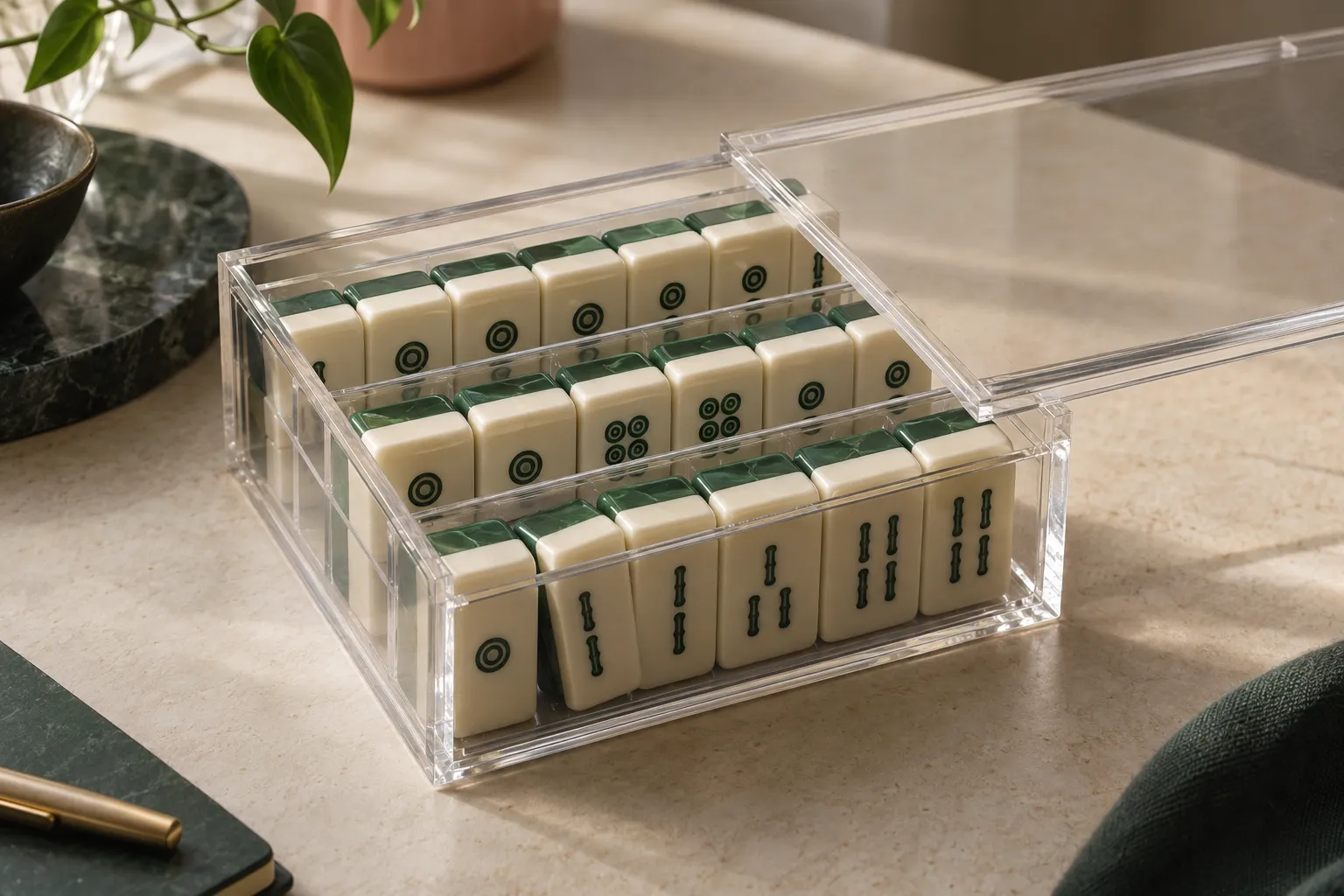
Closed acrylic mahjong display case on a walnut surface with one lid open showing 144 cast PMMA tiles in a silicone-cradle insert, soft directional studio light

Key Takeaways

  1. Buyers who already source tile sets need to spec the case as its own SKU — wall thickness 4–6 mm, latch type, UV block percentage, and gasket material decide whether the case lifts or drags the tile-set retail price.
  2. Magnetic-only latches lose holding force over repeated use and freight cycling; mechanical-interlock or combination latches are the durable choice for shipped goods. The per-unit upgrade is roughly a dollar and heads off freight-loss returns.
  3. UV-filtering cast PMMA is the spec to ask for if your tile set ships with brand color or printed faces — grades without a UV stabilizer let indoor lounge LED and daylight yellow printed surfaces over time.
  4. MOQ for a custom case build is 50 pieces (Wetop's standard floor); below that, a stock-format case with custom branding is the better commercial path. Production runs 15–20 days, samples 3–5 days.
  5. Travel-grade cases need silicone-cradle inserts tuned to the real tile body plus a packaging protocol referenced to ISTA 3A; foam and rigid-divider alternatives leave tiles free to shift and chip in transit, wiping out unit-cost savings.
On this page
  1. Six spec axes turn a tile-set accessory into retail merchandise
  2. 1. Wall thickness — what 4, 5, and 6 mm actually buy you
  3. 2. Latch type — magnetic, mechanical, or combination
  4. 3. UV block — when the UV-filtering grade is non-negotiable
  5. 4. Insert geometry — silicone cradle vs foam vs rigid divider
  6. 5. MOQ, lead time, and the 50-unit floor
  7. 6. Pairing the case with the tile-set spec — questions to bring to your RFQ
  8. 7. Packaging and freight survival
  9. 8. From RFQ to first 50 units — what to send and what to expect back

Six spec axes turn a tile-set accessory into retail merchandise

A custom acrylic mahjong display case is a buyer’s procurement scope, not just a tile-set accessory — six spec axes (thickness, latch, UV block, gasket, insert geometry, and finishing) decide whether the case adds or subtracts from the perceived value of the tile set inside. For OEM retail or club rollouts, the right acrylic mahjong display case is the one whose spec sheet reads like a piece of merchandise, not a generic clamshell. Production runs 15–20 days against a 50-unit MOQ. Samples land in 3–5 days.

This is a category we field regularly from buyers who already source the tiles and now need to spec the case as a paired SKU. The brief usually arrives with a photo of a competitor’s case and the line “match this.” The eight sections below are the spec sheet to quote against something defensible.


Six Buyer Spec Axes for an Acrylic Mahjong Display Case Six spec decision axes a procurement buyer settles before sending an RFQ for a custom acrylic mahjong display case. Wall thickness 4 to 6 mm sets perceived weight and impact resistance. Latch type chooses among magnetic only, mechanical interlock, or combination. UV grade from standard cast to UV-filtering decides yellowing risk on printed surfaces. Gasket material EPDM, silicone, or none decides dust seal life. Insert geometry silicone cradle, foam, or rigid divider decides freight survival. Finish diamond polished or flame polished decides edge clarity under directional retail lighting. Six spec axes for an acrylic mahjong display case 1. Wall thickness 4 mm budget 5 mm standard 6 mm premium Spec 5 mm retail tier Sets perceived weight + impact resistance 2. Latch type Magnetic only Mechanical lock Combination Spec combo on $80+ retail Magnetic-only pops under freight load 3. UV block Standard cast UV-stabilized UV-filter grade Spec UV grade on printed tiles Stops yellowing of brand colors over time 4. Gasket None Silicone strip EPDM full perim Spec EPDM on hinged lids Decides dust seal life over 5+ years 5. Insert Rigid divider Foam recess Silicone cradle Spec silicone on freight units Foam lets tiles shift; cradle holds them 6. Edge polish Saw-cut Flame Diamond Spec diamond on visible bezel Flame stress reads as defect at retail light
Six spec axes a buyer settles before issuing an RFQ for a custom acrylic mahjong display case — recommended pick is highlighted on each axis.

1. Wall thickness — what 4, 5, and 6 mm actually buy you

Spec 5 mm cast PMMA wall thickness as your default for a retail-tier acrylic mahjong display case; drop to 4 mm only on a budget program where unit price is the gating factor; move to 6 mm for premium boxed-gift or collector tiers. The thickness directly drives perceived weight in the buyer’s hand and the case’s impact resistance under freight and household drops.

Wall thickness is the spec buyers undershoot most often. The 4 mm wall keeps unit cost down, but a 144-tile mahjong set weighs roughly 800–1,400 g depending on tile material, and a 4 mm acrylic shell carrying that load deflects visibly when you pick the case up by one corner. End buyers describe the feel as “flimsy” before they can name what’s wrong. 5 mm carries the load with no visible deflection, lands at the perceived weight that signals “this is a real product,” and adds roughly 9–12% to unit material cost — which usually rounds to one to two dollars at typical OEM volumes. 6 mm adds another 9–12% for diminishing returns on weight perception but is the right call when the tile set retails above $200 and the case is part of the brand impression.

If you are quoting against a competitor sample, measure their wall thickness with a caliper before you spec yours. Buyers asking us to “match this case” frequently arrive with a 3 mm or 4 mm sample and a 5 mm price expectation — the spec mismatch is where the next quarter’s margin gets eaten.

2. Latch type — magnetic, mechanical, or combination

The latch is the single highest-ROI spec upgrade on the entire case and the one buyers most often skip to save margin. Three latch families ship in this category and the failure modes are predictable.

Magnetic-only latch. Two rare-earth magnets, one in the lid and one in the case body, holding the lid closed by attraction alone. Cost: cheapest option, roughly $0.60–$1.10 per case in latch hardware. Failure mode: the holding force is fixed by the magnets and the air gap, with no mechanical engagement to back it up — so once seating tolerances loosen with use, or freight vibration adds a transient load larger than the static pull, the lid can pop. The case loses its dust seal; on travel-grade cases the lid opens during shipping and the tiles inside take chip damage from the case moving against them. This is the single most common warranty item we see returned on lidded cases.

Mechanical-interlock latch. A sprung detent that physically clicks into a recessed receiver in the case body. Hardware makers rate these detents in the thousands of open/close cycles, and because closure is a positive mechanical engagement rather than a magnetic pull, it holds the lid shut under freight vibration and impact loads regardless of gap tolerance. Cost: roughly $1.40–$2.10 per case in hardware.

Combination magnetic + mechanical. The mechanical interlock provides the freight-handling security; the magnetic component provides the audible “click” of closure that buyers expect from a premium product. This is the production-grade default for any case retailing above $80 or shipping internationally. Cost: roughly $1.80–$2.80 per case in hardware — a $1.20 premium over magnetic-only and a no-question call on premium tiers.

For a 200-unit retail order, the latch-upgrade delta over magnetic-only is about $240. A single freight-loss return on a $120 retail case is $120 of replacement cost plus the freight loop plus the buyer relationship hit. The math on the upgrade is not close.

3. UV block — when the UV-filtering grade is non-negotiable

Spec UV-filtering cast PMMA on any acrylic mahjong display case where the tile set has UV-printed faces, brand-color suit graphics, or any colored surface that needs to hold for the life of the case. Plain cast PMMA already absorbs most short-wave UV, but UV-stabilized grades are formulated to cut UVA transmission far further — producers publish UV-filtering acrylic (e.g. Röhm PLEXIGLAS and Plaskolite OPTIX lines) at well above 95% UV block on the relevant band — for roughly 8–14% more in material.1 Accelerated-weathering practices such as ASTM D4329 and ASTM G154 are what let a producer put a UV-resistance grade behind that claim; the payoff is that the printed surfaces inside don’t yellow under years of indoor LED and ambient daylight.

The buyer-side question is what’s inside the case, not the case material itself. If you ship a tile set with character laser-etched into the tile body (no printed color), then standard cast PMMA is sufficient — the engraving lives in the acrylic, not on it, and won’t yellow. If your tile set uses UV-printed suit colors (萬 in red, 條 in green, 筒 in blue) or brand-color overlays, then the case acrylic is the only thing standing between the tile printing and the indoor lighting it sits under for years. Even lounge and club display lighting (warm-white LEDs) and ambient daylight carry enough UV to drift unprotected printed colors visibly over time — the pigments most at risk are the reds and magentas that fade first under UV exposure.

The premium UV-filter spec is a hard line item on collectible-edition sets, casino and club gifts, and any retail program where the buyer warrants color stability past one year. We pull the upgraded cast from supplier datasheets that list ISO 13468 transmission and ASTM G154 weathering data, and we attach the mill cert to the case sample for buyer sign-off. For deeper context on the UV-protection spec hierarchy, see our museum-grade acrylic display cases UV spec guide — the protocol scales down cleanly from a museum exhibit case to a 280 × 200 mm tile-set case.

4. Insert geometry — silicone cradle vs foam vs rigid divider

The insert tray that holds the tiles inside the case is where the most freight-related returns come from on this category. Three insert types ship and the failure modes scale with shipping distance.

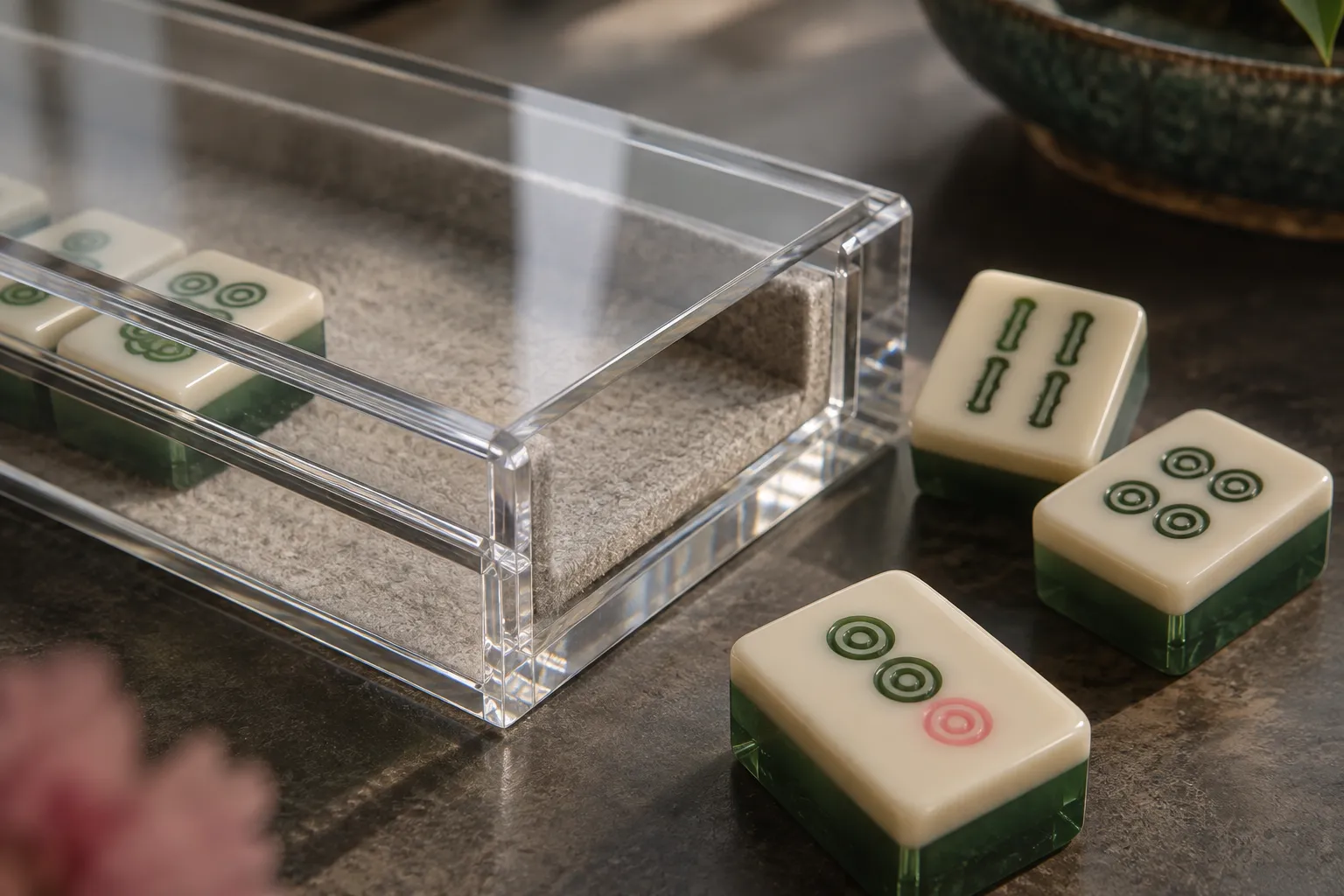
Silicone-cradle insert. Each tile sits in an individual recessed cradle in a silicone insert tray, with the cradle dimensions tuned tightly against the actual tile body. Because each tile is captured on all sides, tiles cannot rattle laterally under freight handling — there is no free travel for one tile to strike another, which is the mechanism behind almost all in-transit chipping. Silicone also holds its shape rather than taking a compression set, so the fit that ships is the fit years later. Cost: $8–$12 per case to add.

Foam recess insert. Cut from open-cell foam matched to tile dimensions, with a recess pattern at the surface. It initially holds tiles in place, but open-cell foam takes a compression set under sustained load and heat — and a shipping container in summer sun bakes to well above ambient — so the recesses relax and stop gripping the tiles. Once the fit loosens, tiles are free to shift and chip.

Rigid-divider grid. Plastic or acrylic divider grids that organize tiles into individual cells without contoured contact. The cell is larger than the tile, so tiles rattle within each cell under freight vibration, producing tile-on-tile and tile-on-divider contact damage. Same root cause as loosened foam: free travel inside the case.

The cost math: silicone-cradle adds $8–$12 per case to production cost. Set against a 144-tile set worth $80 or more, a single freight leg’s worth of chipped tiles — plus the customer-reported damage and replacement units that follow — erases that saving quickly. For travel-grade (tournament-circuit) and ocean-freight cases, the silicone-cradle insert is non-negotiable. For shelf-stable display cases that don’t move after delivery, foam or rigid-divider can work as cost-saving alternatives. Building the packaging to the ISTA 3A parcel-shipment protocol, plus a simple in-house drop-check on a loaded sample before bulk shipment, is how insert fit gets caught before a run ships.2

5. MOQ, lead time, and the 50-unit floor

We get the MOQ question on every first inquiry. Our floor for a fully custom acrylic mahjong display case build (your dimensions, your latch, your branding, your insert tooling) is 50 pieces. Below 50, the tooling amortization for the silicone insert and the brand-color UV print pre-production proof makes the per-unit cost worse than going with a stock-format case and adding a custom UV-printed lid panel.

The order shape that maps cleanly onto our production line is:

Order tierVolumeBest pathLead time
Boutique gift run12–25 casesStock format + custom UV print on lidSample 5–7 days, production 12–15 days
Standard custom50–200 casesFully custom, single colorwaySample 3–5 days, production 15–20 days
Multi-colorway200–1,000 casesCustom + UV-printed colorway proof on the frontSample 3–5 days, production 18–24 days
Retail rollout1,000+ casesCustom + multi-batch production schedulingSample 3–5 days, production 25–35 days

Sample turn is 3–5 days on standard formats and 5–7 days when we are tooling a new silicone-cradle insert against your tile dimensions. Production runs 15–20 days for any single-colorway run up to 500 units. Multi-colorway runs add 14 days on the front for the pre-production color proof and the spectrophotometer sign-off (ΔE ≤ 2 against the supplied Pantone reference). Sea freight from Shenzhen to US west coast runs 14–18 days; to Northern Europe 28–35 days. Total order-to-warehouse for a US buyer on a standard 200-unit run: roughly 5–7 weeks.

For under-50 boutique runs, we keep a few stock case formats tooled and run custom UV-printed lid panels against them at sample-tier per-unit pricing. The path is documented at the acrylic cases hub — pick the format closest to your tile dimensions and we quote a UV-print package on top.

6. Pairing the case with the tile-set spec — questions to bring to your RFQ

A custom mahjong case is engineered against the tile dimensions, not the other way around. The first thing I confirm on any inquiry is sample tile dimensions to ±0.5 mm — ideally 6–8 sample tiles shipped to us for direct caliper measurement, otherwise CAD plus a high-resolution photo with a metric ruler in frame. A buyer who specs “300 × 200 mm case” without confirming the underlying tile dimensions risks either an oversized case (excess footprint, looks underfilled) or, worse, a too-small case where 144 American-size tiles do not fit in the planned grid layout.

Bring these tile-set facts to the RFQ before we quote:

  • Tile dimensions (length × width × thickness in mm, ±0.1 mm). American sets typically run 30 × 22 × 16 mm; Chinese sets 25 × 19 × 14 mm; Japanese sets 22 × 17 × 13 mm. Tile manufacturers run their own tolerance bands (typically ±0.3–0.5 mm), so we dimension the silicone insert against actual sample tiles rather than nominal specs.
  • Tile material and engraving method (cast PMMA / melamine / bone; laser-etched / UV-printed / CNC-engraved). Material and surface finish drive the UV-block decision on the case acrylic.
  • Layout preference (4×36 traditional grid / 8×18 compact / nested-tray premium). Each layout drives a different case footprint and different insert tooling.
  • Display vs travel use (shelf-stable / shipped between events / household play). Use case decides the insert type and the latch tier.
  • Branding artwork (vector logo, Pantone-matched suit colors, hot-stamp foil). UV-printed branding needs a pre-production color proof on the case face before bulk run.

If you already have the tile-set spec sheet from an existing supplier, send that in the first email — it shortens the back-and-forth to one round of clarifying questions and a quote. For a deeper engineering view on the tile side, our companion custom acrylic mahjong tiles spec guide covers the four tile-side decisions (cast vs extruded, engraving method, edge bevel, color register) that pair directly with the case decisions on this page. The mahjong tile engraving comparison covers the engraving method tradeoffs that drive your UV-block call here.

7. Packaging and freight survival

A premium-spec’d case fails the program if it lands at the buyer’s distribution warehouse with chip damage. The packaging spec is line-itemed alongside the case spec and is not optional on any order shipping more than a single freight leg.

The production-grade packaging stack for a 200-unit OEM run looks like this:

  • Inner shell. Each case is bagged in an antistatic poly bag against scuff and abrasion, then seated in a molded-pulp or EVA inner tray that holds the case body and lid in fixed position so they cannot shift during transit.
  • Foam corner protection. Four EVA corner blocks at the base corners absorb the drop loads that account for most freight damage on this category. Packaging-engineering practice — and the drop-orientation sequence in the ISTA parcel protocols — treats corner and edge impacts as the worst case a parcel sees, because the energy concentrates on the smallest contact area; the corner blocks shift that load away from the latch and lid edges where damage produces visible failures.
  • Outer carton. Single-wall corrugated carton at 5 mm flute thickness for sub-200 mm cases; double-wall at 7 mm flute for cases above 200 mm or above 1.5 kg unit weight. Carton sized to a 5 mm gap between the inner tray and the carton wall — too tight and impact loads transmit straight through; too loose and the case shifts and accumulates surface marks.
  • Master carton. 12–24 cases per master carton depending on case size. Master cartons palletized and shrink-wrapped; pallets stacked no more than 2 high in container.
  • Drop-check before shipment. We build the packaging against the ISTA 3A parcel-shipment protocol and run a simple in-house drop-check on a loaded sample case before a run leaves the floor — a quick, low-cost catch for any case where the latch or insert fit drifted in production.2

The full packaging line item runs 8–12% of unit cost and is non-negotiable on international freight. For ground delivery within China at lower-volume orders, the line drops to 4–6% with a simpler corrugated-only stack — but for any OEM buyer shipping the cases onward, the production-grade stack is what protects the program.

8. From RFQ to first 50 units — what to send and what to expect back

The cleanest first inquiry I see lands with: tile dimensions, layout preference, latch tier, target retail price (so we know which acrylic grade to spec), unit volume, target lead time, and any branding artwork. With those facts, we send back a quote inside 24 hours covering acrylic grade, latch hardware, insert specification, packaging line item, sample lead time, production lead time, and unit pricing across 50 / 100 / 250 / 500 / 1,000 unit tiers.

Expect a sample inside 5 business days from sample-fee receipt. The sample comes with a spec sheet documenting the actual measurements (wall thickness verified by caliper, the latch checked for solid closure, insert fit checked against your sample tile body) so you can sign off against measured numbers, not vibes. On request we can also load one sample case with sample tiles, pack it to production-grade spec, and do a simple drop-check on it so you can see how the loaded case survives a knock before you commit to the run.

Once the sample is signed off, production runs 15–20 days for a 50-to-500 unit order. We hold the silicone insert tooling for 24 months at no charge so reorders skip the tooling lead time. For programs that move into multi-colorway expansion or seasonal limited editions, we keep the production drawings, the Pantone color sign-off, and the QC inspection records on file so a reorder is “same as last time” and not a rebuild from zero.

For a worked example of how an OEM custom-case program runs at production scale — including the sample-to-bulk flow, the QC checkpoints, and the freight survival result on a 320-unit collectible launch — see our Lego Speed Champions custom display case case study. The production scale and case-engineering decisions are directly comparable to what an acrylic mahjong display case program looks like.

When you are ready to spec a custom acrylic mahjong display case, send the brief over to our team and we will come back with a quote, a sample plan, and the production timeline for your unit volume. For the full custom mahjong case product line — six core formats (single-set travel, member-locker grid, boxed-gift presentation, lockable retail, stackable storage, branded-edition) — see our acrylic mahjong display cases product page and the parent acrylic mahjong accessories hub. For US mahjong brand owners and clubs sourcing OEM, the mahjong manufacturing industry page covers the audience-tier specifics. For a real-world implementation, see the boutique mahjong club 60-member locker display case study.

Footnotes

  1. ASTM D4329 — Standard Practice for Fluorescent Ultraviolet (UV) Lamp Apparatus Exposure of Plastics — the fluorescent-UV weathering protocol that defines how the UV resistance of cast PMMA case panels is accelerated-tested before a UV-filtering grade is specified.

  2. International Safe Transit Association. ISTA 3A — Procedure for Packaged-Products for Parcel Delivery System Shipments. Drop, vibration, and atmospheric conditioning protocol for parcel-shipped goods. https://ista.org/test_procedures.php 2

Share this guide

Frequently Asked Questions

What's the minimum order quantity for a custom acrylic mahjong display case?

Our MOQ is 50 cases for a fully custom build (your dimensions, your latch, your branding). Below 50, a stock-format case with custom UV-printed branding is usually the better commercial path — we hold a few standard footprints in cast PMMA and can run a 144-tile insert against any of them with 5–7 day sample turn. For boutique gift programs at 12–25 units we quote sample-tier per unit, not production-tier. See the [acrylic cases hub](/products/acrylic-cases/) for the case formats we keep tooled.

How long from order to delivery for 200 mahjong cases?

Sample in 3–5 days against your tile dimensions. Once the sample is signed off, production for a 200-unit OEM run is 15–20 days. Sea freight from Shenzhen to US west coast runs 14–18 days; to Northern Europe 28–35 days. Total order-to-warehouse for a US buyer: roughly 5–7 weeks. Add 14 days on the front if your tile set ships in a custom Pantone colorway requiring a UV-printed lid panel that needs a pre-production proof.

Can you produce the case to match a tile set we already manufacture elsewhere?

Yes — and this is most of what we ship in this category. Send us a sample tile set (or 6–8 tiles plus exact CAD if shipping is impractical), and we measure to ±0.1 mm before drawing the silicone-cradle insert. The cradle fit tolerance is referenced from your actual tile body, not the nominal spec — tile manufacturers run their own ±0.3–0.5 mm tolerance bands, so the case has to be dimensioned against the real tiles to avoid binding or rattle.

What latch types work, and which one should I spec?

Three latch families ship in this category: magnetic-only (cheapest, but holding force fades under repeated use and freight vibration), mechanical interlock (a sprung detent rated by its hardware maker for thousands of open/close cycles, freight-secure), and combination magnetic + mechanical (production-grade default for premium cases). Spec the combination latch on anything retailing above $80 or shipping internationally. The cost premium over magnetic-only is roughly $1.20–$1.80 per case — far below the cost of a single freight-loss return.

How is a custom mahjong case packaged for sea freight?

Each case ships in an individual molded-pulp or EVA inner tray inside a corrugated outer carton, with foam corner protection at the four base corners (where drop loads land first). Master cartons hold 12–24 cases depending on size. We design the packaging against the ISTA 3A parcel-shipment protocol and do a simple in-house drop-check on a loaded sample case before a run leaves the floor — a quick catch for any case where the latch or insert fit drifted in production. The packaging line item runs 8–12% of unit cost.

Have specs in hand? Get a quote for your specific project.

Send us your drawings, reference photos, or a description of what you're making. We reply within 24 hours with a material recommendation, thickness, fabrication method, and a per-unit quote.