

UV Protection Acrylic for Trading Cards — Spec Guide
Most UV acrylic marketing claims are meaningless. '99% UV protection' tells you nothing about card safety. Here's what actually matters.
Need this made?Trading card display cases →
Key Takeaways
- UV-filtering cast acrylic absorbs most of the UV that standard clear acrylic lets through, and it looks just as clear. Grades differ, so the number that matters is the sheet maker's transmission data for the named grade.
- '99% UV protection' means nothing without a wavelength range. UV-A (315–400 nm) is the band that reaches an indoor shelf and fades card ink.
- UV-filtering adds about 15–25% over standard clear acrylic, and it is a material cost only: cutting, polishing and assembly do not change.
On this page
- Why UV matters for graded cards
- “99% UV protection” is a marketing claim, not a spec — what to ask instead
- Standard cast vs UV-filtering cast vs a nominated premium grade
- The slab is not the UV barrier
- Accelerated aging — what weathering tests can and cannot tell you
- Cost impact — when UV filtering is worth it
Why UV matters for graded cards
UV protection acrylic is the part of a graded-card display case that decides whether the card keeps its color under store lighting or near a window. UV-A radiation (315–400 nm) is the band that reaches an indoor shelf, and it is the main driver of ink fading on printed cards. Standard clear acrylic filters some UV as a property of the material, but it still lets part of the UV-A band through. UV-filtering cast acrylic carries a UV absorber compounded into the sheet, which is why sheet makers such as Röhm (PLEXIGLAS) and Plaskolite (OPTIX) sell UV-filtering grades separately from their clear sheet1.
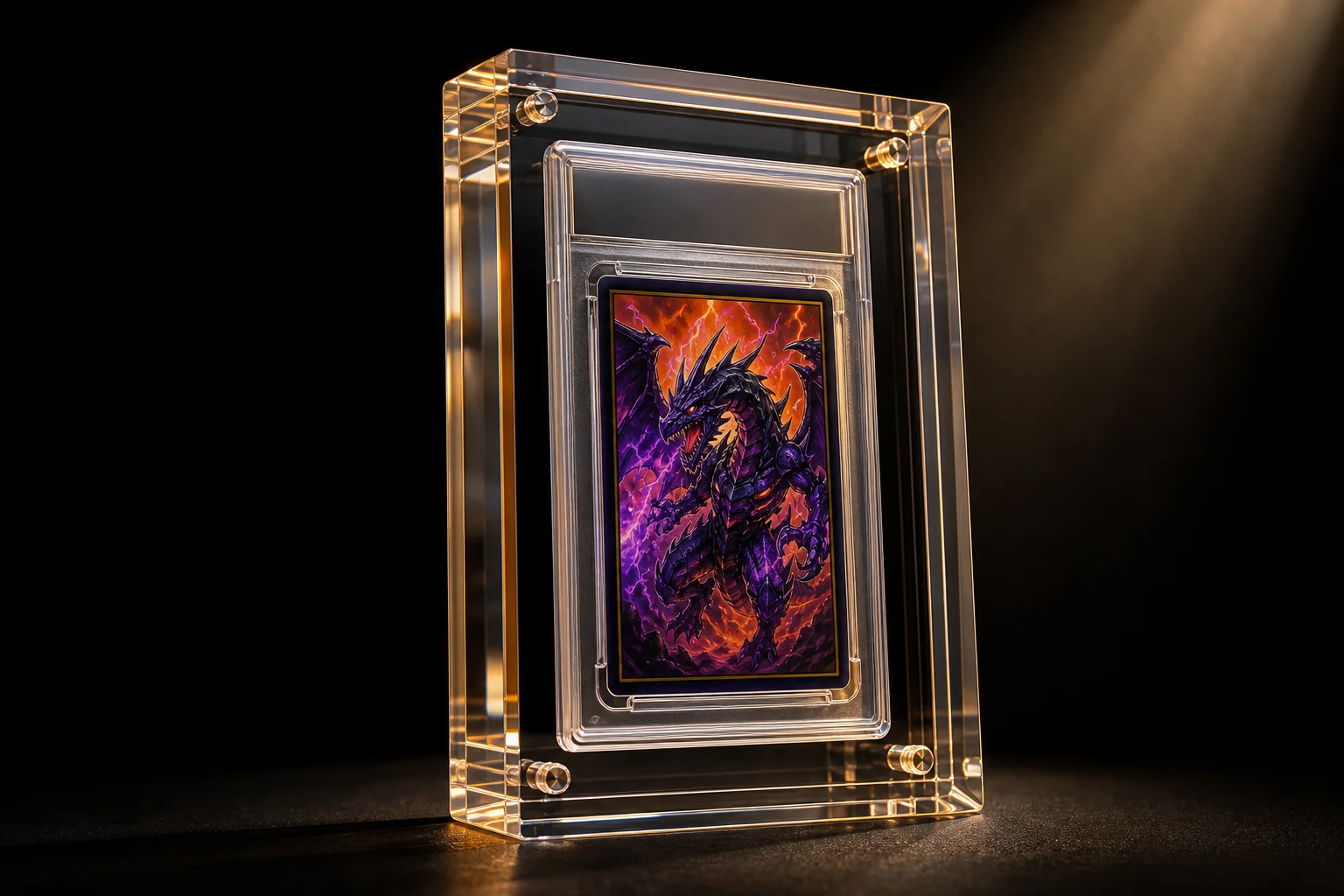
The damage is cumulative. A PSA, BGS, SGC or CGC slab is sealed, so a faded card cannot be restored without breaking the slab and losing the grade. The outer display case is the layer you can specify, which is why the graded card display case we build starts with the sheet grade rather than treating UV filtering as an afterthought.
“99% UV protection” is a marketing claim, not a spec — what to ask instead
The phrase “99% UV protection” tells you nothing about card safety unless it names the wavelengths. A filter can block nearly all UV-C and UV-B and still pass a large share of UV-A, and UV-C never reaches an indoor shelf anyway. The only band worth arguing about for card display is UV-A, 315–400 nm.
Ask any fabricator three questions before you accept a UV claim:
- Which sheet grade, from which maker? A UV-filtering claim belongs to a named grade. If the supplier cannot name the sheet, you are buying a label, not a material.
- Where is the transmission data? Ask for the sheet maker’s published UV transmission curve or datasheet for that grade and thickness, and compare it with standard clear sheet of the same thickness. We send the sheet maker’s UV data with our quote.
- What test method is behind it? Exposure and transmission claims should point to a standard method, such as ASTM D4329 for fluorescent UV exposure of plastics2. A supplier who cannot name a method is repeating marketing copy.
If the answer to any of these is “it’s just UV acrylic,” treat the case as standard clear.
Standard cast vs UV-filtering cast vs a nominated premium grade
All three look identical as clear sheet. You cannot tell them apart by eye; only the sheet maker’s data, or an instrument reading, shows the difference below 400 nm.
| Grade | What it does with UV | When to choose it |
|---|---|---|
| Standard clear cast PMMA | Filters some UV as a property of the polymer; part of the UV-A band still gets through | Cases kept in drawers, closed cabinets or low light |
| UV-filtering cast PMMA (named grade) | UV absorber compounded into the sheet; absorbs most of the UV that standard clear transmits | Card-shop counters, wall displays, shelves near windows |
| Nominated premium grade (for example Mitsubishi Shinkolite) | The sheet maker’s own UV-absorbing grade, specified by name | Larger runs where the order meets that sheet’s minimum, or where the buyer requires a named brand |
The visible clarity is the same across all three, so the cards look the same through every grade. What changes is how much UV-A reaches the card, and that is why the grade, not the word “UV,” goes on the drawing and the quote.
The slab is not the UV barrier
A PSA slab is about 6.5 mm thick and a BGS slab about 8 mm; SGC and CGC slabs sit near 7.9 mm. Grading companies do not publish slab material or UV data, so treat the slab as tamper protection and structure, not as a UV filter. The outer case is the barrier you can specify and verify.
That gives a simple rule for card cases. If the case will sit under lights for hours a day or anywhere near window light, specify a UV-filtering grade. If it will live in a drawer, a closed cabinet or a dark stockroom, standard clear acrylic is usually enough. Either way, keep high-value cards out of direct sun: no case material makes a card fade-proof.
Accelerated aging — what weathering tests can and cannot tell you
Accelerated weathering is how the industry compares materials without waiting years. The common protocols are xenon-arc exposure per ASTM G155 and fluorescent-UV exposure per ASTM G154 / ASTM D4329, with color change tracked as ΔE2. Weathering labs such as Q-Lab publish how exposure hours relate to service conditions3, and sheet makers publish weathering data for their UV-filtering grades.
ΔE is the number to understand. A ΔE around 1 is below what most viewers notice; around 3 is where a non-expert starts to see a change. In weathering tests the material that passes more UV-A lets the printed sample cross that visible line sooner, which is the same ordering as the table above.
Treat any hours-to-years conversion as an order of magnitude, not a promise. Real service life depends on distance from the light source, the lamp’s spectrum and the hours per day. That is why we do not put a fade-free lifetime on a card case; we put a named sheet grade on it and send the data that grade is sold on.
Cost impact — when UV filtering is worth it
UV-filtering acrylic adds about 15–25% over standard clear. The premium is the sheet: the UV absorber is compounded into the PMMA when it is cast. Our laser cutting, CNC machining, polishing and assembly are the same for either grade, so the fabrication part of the price does not move.
For scale, our published reference for a standard graded-card case is $5.90 per unit at 100+ pieces, FOB Shenzhen, on the graded card display case page. The UV upgrade is quoted on top of the case you specify, from 100 pieces per design. A nominated premium grade such as Shinkolite is quoted only when the order is large enough to meet that sheet’s minimum.
When standard cast is fine
Standard acrylic is adequate for cases stored in drawers, closets or closed cabinets where light exposure is minimal. If your cards never sit under sustained light, the UV premium buys little.
When to specify UV filtering
Specify a UV-filtering grade for any case displayed under sustained light: card-shop counters, wall displays, shelves near windows and trade-show booths. For case construction beyond UV, see our UV-protected acrylic display case guide for retail.
If a customer asks about fading, the defensible answer is the grade and its data: “UV-filtering cast acrylic, grade named on the quote, sheet maker’s UV data attached.” That claim holds up because the buyer can check it.
To compare grades before you commit, send us a message with the case format and quantity; we quote the named grade with its data, and a paid sample lets you check fit and clarity with your own slabs. For a real program, the triple PSA slab display case study covers slot fit, magnetic closure and the production runs.
Footnotes
-
ACRYLITE Gallery UV Filtering (OP-3) — product documentation — an example of a sheet maker selling a named UV-filtering acrylic grade with its own UV data, separate from clear sheet. ↩
-
ASTM D4329 — Standard Practice for Fluorescent Ultraviolet (UV) Lamp Apparatus Exposure of Plastics — defines the lamp exposure protocol used to test UV resistance of acrylic and other plastics in accelerated aging tests. ↩ ↩2
-
ASTM G154 fluorescent UV weathering protocol — Q-Lab — weathering-test authority describing the ASTM G154 protocol used to compare plastics under accelerated UV exposure. ↩
Frequently Asked Questions
Does acrylic protect trading cards from UV?
Standard clear acrylic filters some UV on its own, but it still lets through part of the UV-A that fades card ink. UV-filtering cast acrylic absorbs most of the UV that standard clear transmits while looking identical. Grades differ, so we quote a named sheet grade and send the sheet maker's UV data with the quote.
What is the best acrylic for graded card display cases?
UV-filtering cell-cast PMMA from a named sheet grade with published UV transmission data. A premium grade such as Mitsubishi Shinkolite can be nominated when the order is large enough to meet that sheet's minimum. Avoid unnamed 'UV acrylic' with no data behind it.
How long do trading cards last in an acrylic display case?
It depends on the light, not only the case: distance from windows, lamp type and hours per day decide how much UV reaches the card. A UV-filtering case slows ink fading under store or window light; it does not make a card fade-proof, so keep high-value cards out of direct sun.
Is UV acrylic worth the extra cost for card display cases?
For any case that sits under store lighting or near a window, yes. UV-filtering adds about 15–25% over standard clear acrylic, and only the sheet cost changes. For cases kept in drawers or dark cabinets, standard clear acrylic is usually enough.
Have specs in hand? Get a quote for your specific project.
Send us your drawings, reference photos, or a description of what you're making. We reply within 24 hours with a material recommendation, thickness, fabrication method, and a per-unit quote.