


Case Study · TCG & Collectibles · United States
Triple PSA Slab Display Cases for a US Graded-Card Retailer
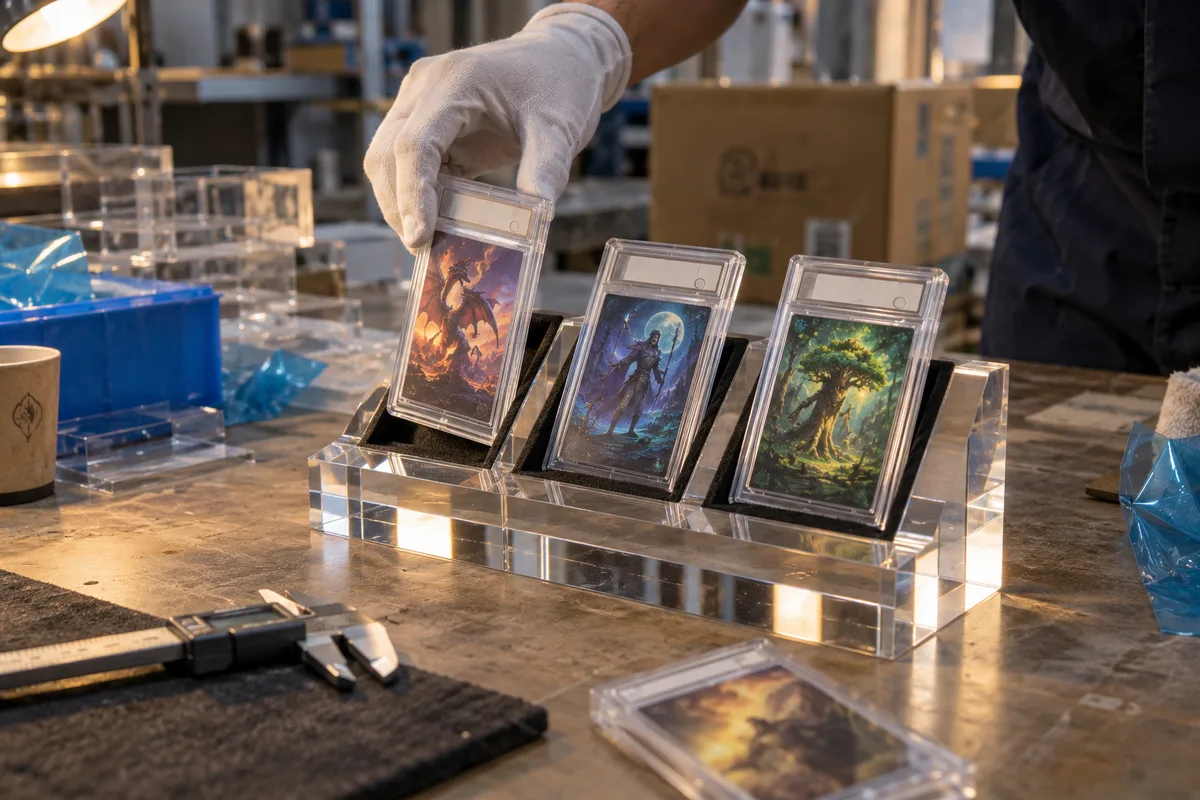
A US graded-card and collectibles retailer wanted one signature counter piece: a clear acrylic block that holds three PSA slabs at an angle.
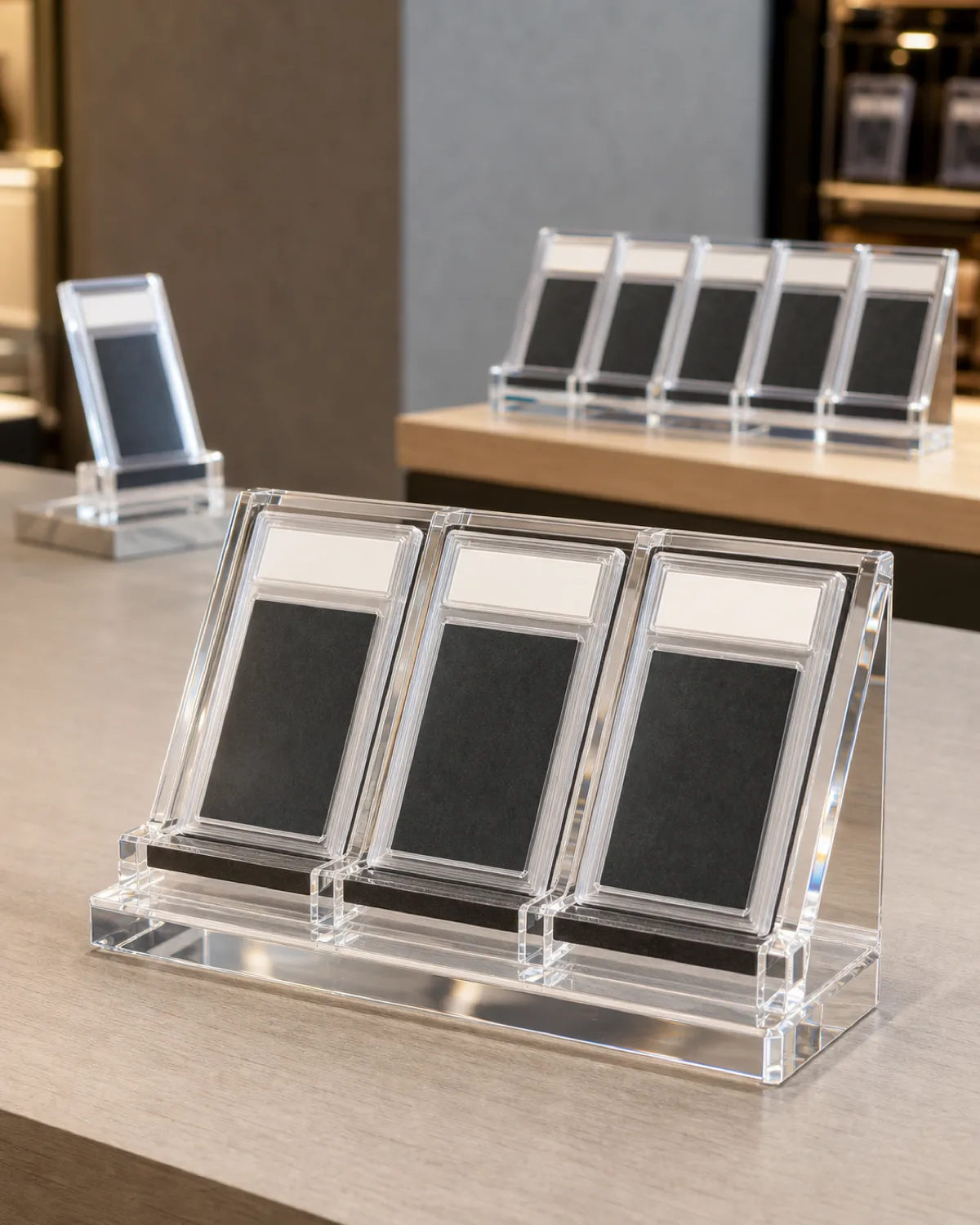
It is cut to the exact slab and UV-filtering, with the slabs reading clean under store lights. We built a Triple PSA Slab display: 800 units in the first run, 20 production days, 16 days on each reorder. Eighteen months and four reorders later, the program covers five slab-case formats.
- flagship Phase 1
- 800
- slab-case formats
- 5
- first run → reorders
- 20 → 16 days
- reorders to date
- 4
Key Takeaways
- The Triple PSA Slab block holds three encapsulated PSA slabs in individual angled slots — each slot cut from the actual slab the retailer mailed us, not a catalog number, so a slab seats with about 0.5mm of clearance and stays put when the block is handled at the counter.
- A test order is the right way to start a slab-case program: the retailer placed 800 units of the flagship Triple PSA design, ran it through one holiday selling season, then came back four times over roughly 18 months — including formats we did not make in the first run.
- Grade-specified UV-filtering acrylic plus diamond-polished edges is what separates a slab display from a slab storage box — the case is the merchandising, so the card has to read clean under store lighting and the edges cannot show saw marks.
- Felt-lined slot recesses do two jobs: they keep a slab from rattling against bare acrylic, and they hide the small dimensional difference between PSA generations so one slot tolerance covers the retailer's whole inventory.
- Because we keep the cutting program and slot tooling on file after the first run, each reorder ships in 16 production days instead of the 20 the flagship took — and a new slab format added to the program is just a new slot profile on the same proven block geometry.
The Brief
Most slab-case requests we get are for one design and one quantity. This one was framed as a program from the first email. The buyer runs a graded-card and collectibles retail business in the US — a storefront plus an online side — and the cards on display are professionally graded PSA slabs, the rigid encapsulated holders collectors know by sight. What they wanted was a signature counter piece: a clear acrylic block that holds three PSA slabs at a slight angle, side by side, so a customer at the counter sees three graded cards presented as a set rather than three loose slabs in a pile.
They had tried generic slab stands before — the kind sized to "fit most PSA slabs." Close enough is not good enough on a retail counter: a slab that rocks in the slot looks cheap, and a slot cut a hair too tight chews the slab label every time a customer pulls it out to look. They also wanted UV-filtering acrylic, because a card that sits in a window or under bright store lighting for months is a card whose value the retailer is responsible for protecting. And they wanted the option to put their shop mark on it later, once the design proved out.
- Cut to the actual slab, not a catalog dimension. PSA slab dimensions drift slightly between grading-service generations. The retailer wanted the slot cut from a real slab so every card in their inventory seats the same way.
- A display, not a storage box. The block is the merchandising. Edges had to be diamond-polished, the acrylic had to be optically clean, and the angle had to present the cards — not just hold them upright.
- Start small, then scale. They wanted to put a real quantity of the flagship Triple PSA design on their counters for a full selling season before committing to the rest of the program — and they wanted the option to add other slab formats later without re-engineering the block.
Our Recommendation
We came back with three decisions before quoting. None of them were exotic — what mattered was that the flagship Triple PSA block was built so the rest of the program could bolt onto it later without starting over.
Slot cut from the slab they mailed us
The retailer mailed us a PSA slab — one they were comfortable being a sacrificial reference. Our toolroom measured the encapsulation envelope directly, including the slight crown on the slab face, and we cut the slot to that envelope plus about 0.5mm of clearance. That clearance is the difference between a slab that drops in clean and one that binds at the corners. We confirmed the fit on a production sample against the same slab before approving the run — what they approved is what we cut for all 800 units.
UV-filtering acrylic and diamond-polished edges
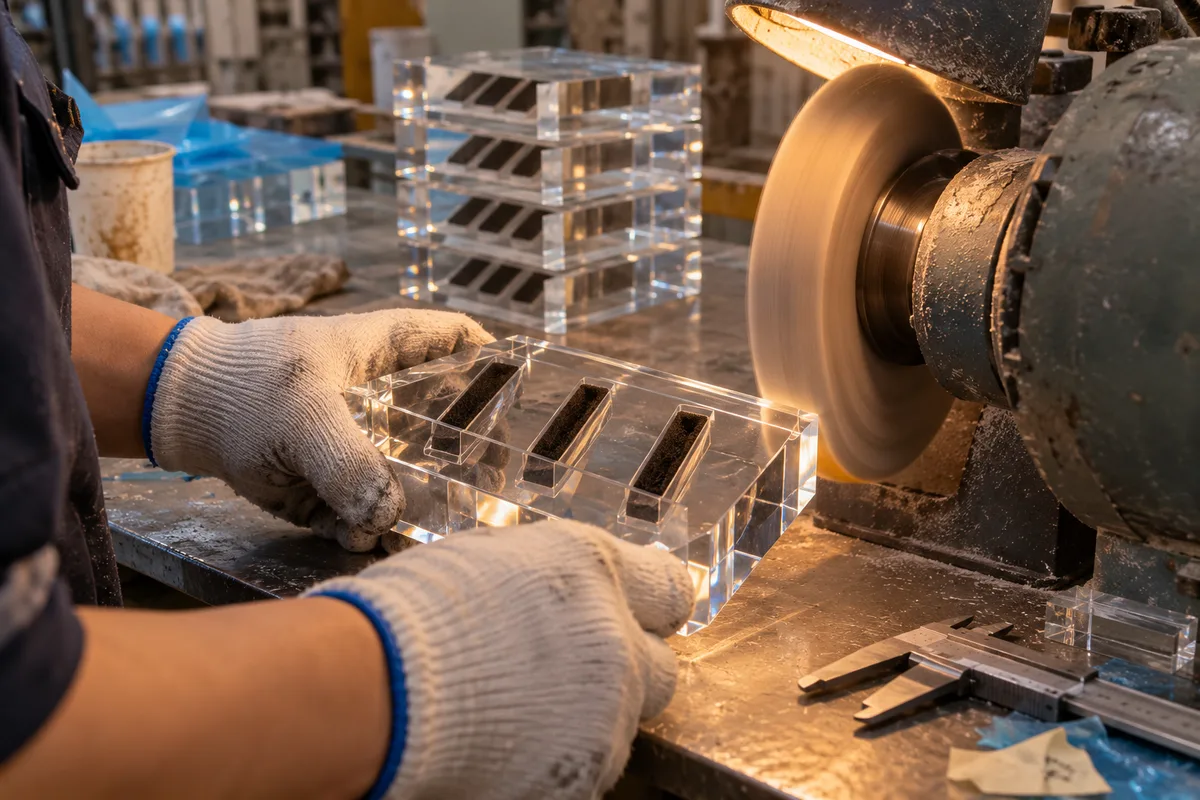
For the block body we specified UV-filtering acrylic — a documented grade selected for collectibles and museum-adjacent work — so a slab on display is not slowly losing color to store lighting or a sunny window. Then diamond-polished edges on every visible face. Saw-cut edges read as a storage product; a counter display has to look like the card is the most valuable thing on the counter, and that starts with the acrylic being optically clean from any angle a customer stands at.
Felt-lined slot recesses and a branding zone for later
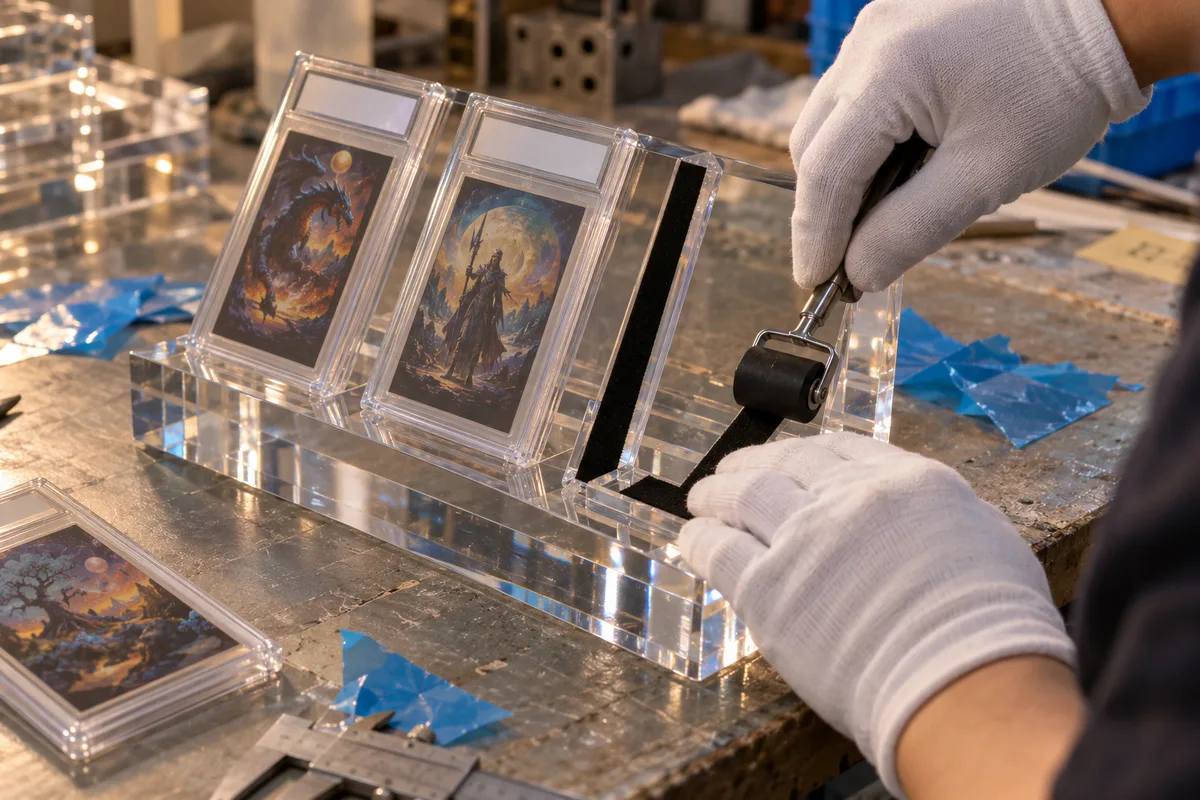
We lined each of the three slot recesses with felt. That stops the slab from rattling against bare acrylic when the block is moved, and — the part that mattered for the program — the felt absorbs the small dimensional spread between PSA slab generations, so one slot tolerance covers their whole inventory instead of forcing a per-generation tooling change. We also left a flat zone on the block base for a laser-engraved shop mark, which they did not order on the first run but added later, exactly as planned.
| Decision | Generic slab stand | What we built | Why it mattered for the program |
|---|---|---|---|
| Slot fit | Sized to "fit most PSA slabs" | Cut from the actual mailed slab + ~0.5mm clearance | Slab seats clean across PSA generations; no rocking, no label wear |
| Acrylic grade | Standard clear acrylic | UV-filtering acrylic (documented grade) | Card value protected under store lighting and window light |
| Edge finish | Saw-cut or flame-polished | Diamond-polished on every visible face | Reads as merchandising, not storage |
| Slot lining | Bare acrylic | Felt-lined recesses + flat branding zone on the base | One slot tolerance for the whole inventory; shop mark addable later |
Spec Breakdown
Three details on the Triple PSA block do most of the work. I want to walk you through each one, because if you are sourcing a slab display for a graded-card retail counter — PSA, BGS, SGC, or CGC — these are the parts your customers judge after the first time they pick a slab up off the block.
The three-slot angled geometry
The three slots sit at a shallow back-tilt — enough that a customer standing at the counter sees the full card face on each slab without the block being tall enough to topple. The slots are spaced so two slabs never touch even at the widest PSA generation in the retailer's inventory, and the back wall of each recess is the depth stop, so a slab cannot be pushed too far in. The block is solid enough at the base that three loaded slabs do not tip it — the load math here is about base footprint and center of gravity, not wall thickness.
The slab-fit tolerance
The number that defines this product is the slot clearance: roughly 0.5mm around the encapsulation envelope. Tighter than that and a slab binds and scuffs its label on the way out. Looser than that and the slab rocks. We get there by cutting the slot from a measured real slab rather than a nominal dimension, and we verify it on a production sample against the same slab before the run starts. On a slab-case program, the slot tolerance is the spec your customers will actually feel — everything else is the part they only see.
This is also why we ask for a slab in the mail when we can get one. PSA, BGS, SGC, and CGC slabs are not interchangeable — they differ in overall thickness and edge profile, and within a single grading service the dimensions have shifted across generations. A slot cut to a published nominal dimension is a slot cut to an average; a slot cut to the slab the retailer actually stocks is a slot cut to their inventory. If you want the full picture of how slab profiles differ and which case format suits each one, ourbulk graded card display cases guide walks through PSA, BGS, SGC, and CGC side by side.
UV protection on a display, not in a vault
A graded slab in a safe does not need UV-filtering acrylic. A graded slab on a retail counter does — that is the whole point of putting it on display. We specified a UV-filtering grade with documented performance across the damaging band, the same grade we use on collectibles and exhibit-adjacent work. It does not make the block bulletproof; it makes the case the retailer can stand behind when a customer asks whether a card that has been on the counter for six months is the same card it was when it went up. The grade selection logic — what the selected UV-filtering grade covers, and when standard acrylic is enough — is documented in ourUV-filtering acrylic for trading cards guide.
Production and Reorder Economics
The flagship Triple PSA run took 20 production days from approved sample to 800 finished units. The reason the reorders run in 16 is that we keep the cutting program and the slot tooling on file after the first run. A reorder is not a fresh setup — it is a re-run of a proven program, checked at final inspection against the same approved sample.
Here is what the flagship 20 days looked like inside our shop:
- Days 1–3 — Material release and slot programming. UV-filtering acrylic sheet release-checked for clarity and edge quality; the slot profile programmed from the toolroom's measurement of the slab the retailer mailed us.
- Days 4–12 — Block fabrication, all 800 in batches. CNC cutting of the body and the three slot recesses, then bonding and the diamond-polishing pass on every visible face. Edge finish is the slowest single step on this part — a slab display lives or dies on it.
- Days 13–16 — Felt lining and (later runs) engraving. Felt cut and seated into each of the three recesses; on the reorders that carried the shop mark, laser engraving on the base branding zone in the same pass.
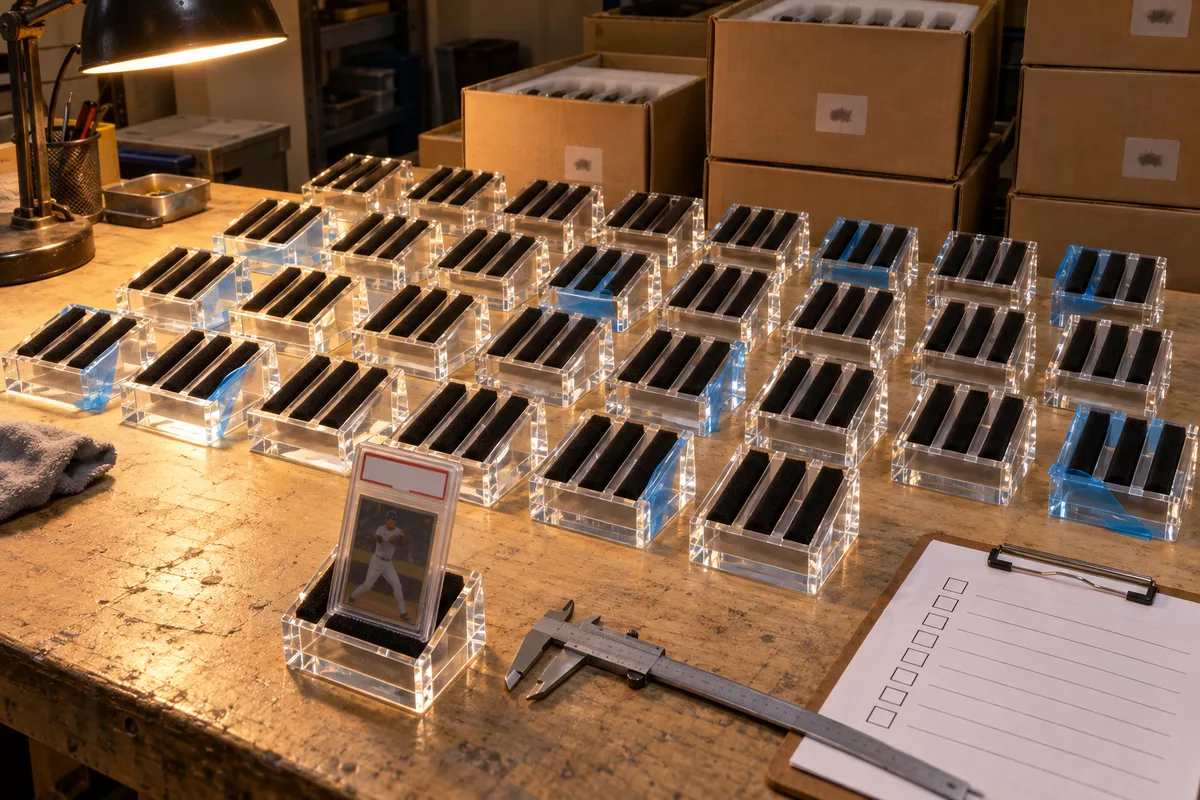
- Days 17–19 — Final assembly and fit QC. Every block fit-checked against the reference slab profile, plus the standard 100% visual inspection for edge clarity, slot finish, and felt seating.
- Day 20 — Pack and palletize. Each block packed individually so a counter-display product arrives with display-grade edges intact.
When the retailer came back for other slab formats — a single-slab desktop stand, a 6-slot block, a wide-channel version for thicker BGS slabs, and a wall-mount slab rack — each one was a new slot profile on the same proven block thinking, not a new product from a blank sheet. That is what kept the program moving at one reorder roughly every few months instead of restarting the design conversation each time.
The Results
The flagship Triple PSA design shipped 800 units in the first run at a 20-day lead time, and the four reorders since have run in 16 production days each. The program now spans five slab-case formats and carries the retailer's laser-engraved shop mark on the later runs.
The reorders are the result that matters here. In B2B work, the first order is the test — the retailer put 800 Triple PSA blocks on their counters and ran them through a full selling season before deciding what came next. Four reorders over roughly 18 months, including formats that were not in the first run, is a buyer telling us the product holds up to daily counter handling and that the slot tolerance and edge finish were right. It is also a buyer who no longer has to re-explain the spec — the program file does that.
"We mailed them one PSA slab and the slot fit every card in the case — no rocking, no chewed labels. The Triple block has been on our counter for over a year; reorders land in about two weeks. We are five formats deep now and they all match."
What This Means for Your Project
If you are a graded-card retailer or a TCG and collectibles distributor sourcing slab cases, the two decisions that most affect whether a slab display works on your counter are slot fit andedge finish. Generic "fits most slabs" stands and saw-cut edges look fine in a product photo; they diverge from a proper display the first week a customer handles them. Cut the slot from a real slab, diamond-polish the visible faces, and the case stops being storage and starts being merchandising.
The other decision is whether to treat it as one order or a program. We see retailers spec a single slab case, like it, then start the whole conversation over for the next format. If you expect to add formats — single-slab, multi-slot, a wide-channel version for thick BGS or CGC slabs, a wall-mount rack — say so up front. We build the first block so the rest of the program runs as new slot profiles on proven geometry, which is what gets a reorder out in 16 days instead of 20 and keeps every format in the lineup looking like it belongs to the same family. And if a slab display is not what you need — sealed product like booster boxes, ETBs, or UPC boxes — that is a different case entirely, and we build those too.
One thing worth doing before you spec anything: confirm you are choosing the right display type in the first place. A slab holder, a sealed-booster-box case, and a raw-card sleeve stand share almost no geometry — the most common setup mistake we see on graded-card inquiries is picking a format that does not match what is actually being protected. Our bulk graded card display cases guide walks through that decision (PSA, BGS, SGC, and CGC slab specs, sealed-product cases, and gallery walls), and the graded card display cases page covers the full slab-format range — single-slab stands, multi-slot blocks, wall-mount racks, and lockable counter cases. Bring us the slab profile and the quantity, and we will quote it within 24 hours.
Sourcing a graded-card slab display program?
Mail us one slab — PSA, BGS, SGC, or CGC — or send a photo with the slab profile, slot count, and run size. We will come back with a fit recommendation, a slab-case format plan, and a quote. Sample before you commit to production.
Sample in 3–5 days · Production in 15–20 days · 16 days on tooling-preserved reorders · MOQ 100 pcs