

Industry

Trading Card Display Case Guide: Slab, Sealed, Gallery Wall

Most display mistakes I see aren't about quality — they're about choosing the wrong display type for what you're actually protecting.

A gallery wall of PSA-graded Pokémon, sports, and Magic trading cards in acrylic display cases

Key Takeaways

  1. UV-filtering acrylic blocks 92%+ UV; raw acrylic only 45% — the difference is 6-month visible fade on pigmented cards
  2. 3mm suffices for slab holders; 5-8mm required for sealed booster box cases under drop load
  3. PSA and BGS slabs differ by 2.3mm in thickness — a universal case cannot hold both
  4. Gallery walls of 24+ pieces are always cheaper custom than sourcing 24 matching stock cases
  5. Sealed booster box displays should never use flame-polished edges — thermal stress around the lock zone risks crazing
On this page
  1. Why Display Choice Matters More Than Buyers Think
  2. The 5 Types of Trading Card Display Cases
  3. Graded Slab Display (PSA / BGS / SGC / CGC)
  4. Sealed Booster Box & ETB Display
  5. Raw Card Sleeve Stands & Binder Page Frames
  6. Gallery Wall & High-End Collection Display
  7. Materials & Thickness Spec Cheatsheet
  8. Custom vs Stock: When Each Makes Sense for Card Displays

Why Display Choice Matters More Than Buyers Think

The right graded card display does four things: it blocks UV radiation before it fades pigment, seals out the dust that abrades surfaces over years of handling, absorbs impact from the accidental drop, and signals preservation-grade intent to anyone evaluating the collection for resale. Miss one of those four jobs and the display is decorative — not protective. Most buyers searching for how to display trading cards focus on aesthetics first; the collectors who have owned a faded PSA 10 know that protection is the real decision.

UV damage is the one I explain most often. Standard cast acrylic transmits roughly 45% of incoming UVA radiation — the wavelength range from 280–400nm that bleaches printed ink on cards. A UV-filtering grade like Plaskolite OP3 drops that transmission to under 8% — a 92%+ block across the damage range. That difference shows up visibly on a Charizard PSA 10 within six months of window-adjacent display, and every collector who has experienced it once becomes a UV-filtering buyer forever. Dust ingress is subtler but equally destructive at the slab level: dust particles accumulate between slab and case interior, and they abrade the slab surface during every handling cycle. Sealed-friction or magnetic closures minimize that exposure; open-front stands do not. The drop risk is structural — a 3mm case that holds a PSA slab on a shelf is fine until someone knocks it over and the wall is 3 feet away. At 5mm, the same case survives that impact without cracking at the corner joint.

Preservation-grade standards matter to resale buyers more than most sellers expect. Professional evaluators who quote values on graded card collections look at display environment as part of condition maintenance history. A UV-filtering, sealed case is evidence the owner took the preservation seriously — and that signals higher ask prices at auction.


The 5 Types of Trading Card Display Cases

There are five distinct display formats for trading cards and sealed product, each solving a different storage, access, and presentation problem. Choosing the wrong type is the most common setup error I see on card shop and collector inquiries — not because the buyer didn’t know quality existed, but because they picked a slab display case or a booster enclosure without first mapping it to what they were actually protecting. The decision matters differently for a PSA slab display versus a sealed product versus raw sleeves.

The five types are: slab holders (rigid cases sized for graded slabs), slab jackets (soft-shell protective sleeves for individual slabs), sealed booster box cases (enclosures for entire intact booster boxes or ETBs), sleeve stands (open stands for top-loaded or sleeved individual raw cards), and gallery walls (modular wall-mounted systems for 12 to 200+ graded or sleeved cards). The table below is the master reference — use it to match your collection format to the right display type before specifying anything else.

Trading Card Display Type Comparison

TypeUse CaseAcrylic ThicknessLock MechanismTypical MOQPrice Range (custom)Best For
Slab holder (single)Individual PSA / BGS / SGC / CGC graded card3mm wallsFriction fit or magnetic lid50 pcs$4–$12/pcCountertop hero display, desk showcase
Slab jacketTransport and soft protection for individual slabsN/A (soft)Zipper or snapN/A$1–$4/pcTravel, storage rotation
Sealed booster box caseFull intact booster box, ETB, or UPC box5–8mm wallsMagnetic latch or snap-lock50 pcs$8–$22/pcCard shop display, collector shelf
Sleeve standUn-graded raw cards in penny sleeve + top loader2–3mmOpen stand, no closure50 pcs$2–$6/pcRotating sales display, fan display
Gallery wallMulti-slab or multi-sleeve wall system5mm panels + standoffsWall-mount hardwareCustom (24+)$15–$40/panelPermanent collection wall, shop feature wall
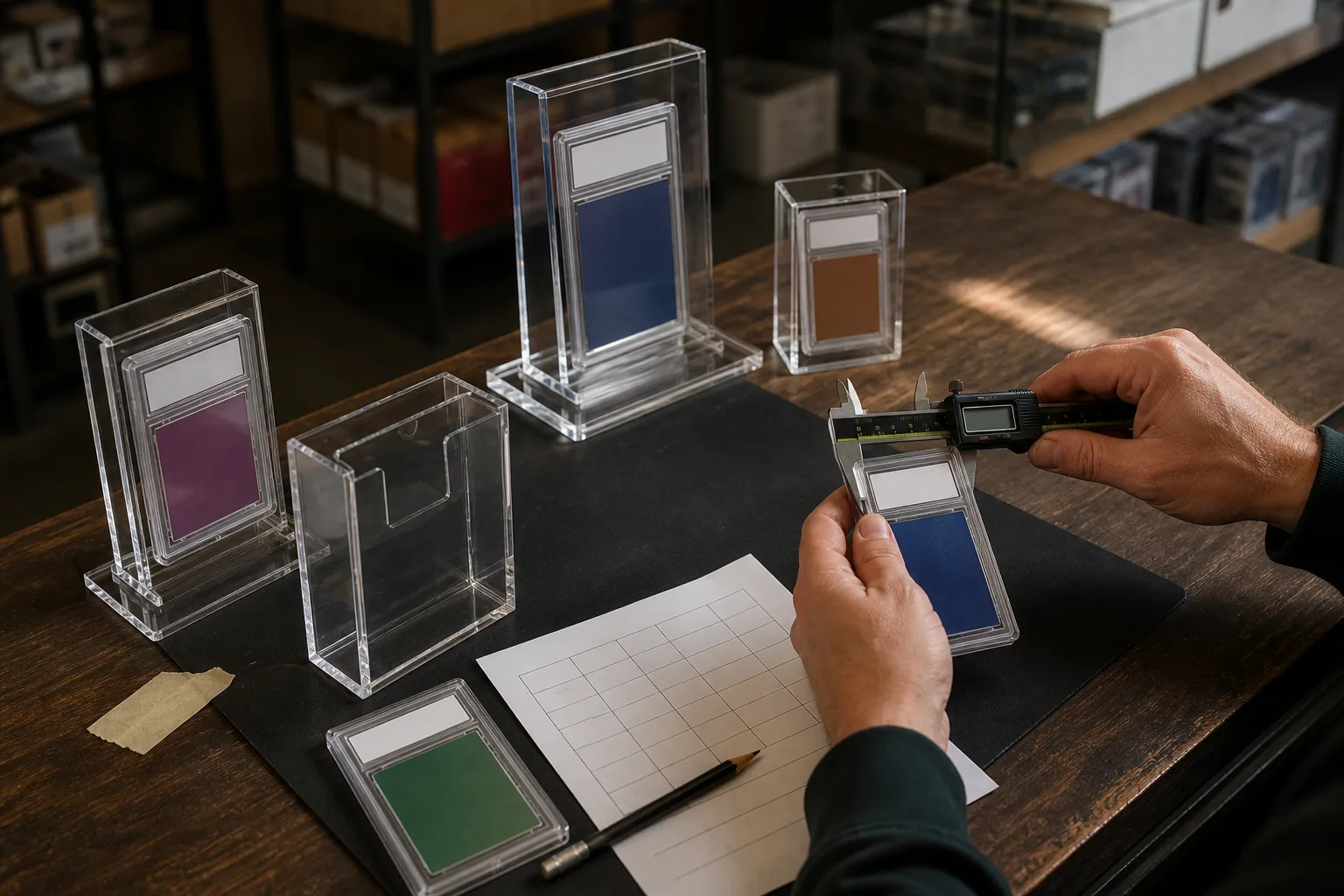
Three clear acrylic (PMMA plexiglass) trading card display types side by side on a neutral collector's desk - a graded slab holder with a generic graded card, a sealed booster-box-sized enclosure, and a sleeve stand with a sleeved card. No actual brand artwork on cards.
Three of the five display types in one frame. The geometry difference is bigger than most buyers realize - a slab holder and a sleeve stand share almost no parts in common, despite both being called "card displays."

Graded Slab Display (PSA / BGS / SGC / CGC)

The single non-negotiable for a PSA slab display, a BGS slab display, or any graded card display case is slab geometry: each grading company uses different external dimensions and different case thicknesses. A case built for one company will not hold another’s slab without lateral play, which leads to vibration, slab-to-case abrasion, and — at worst — the slab sliding free of the holder during handling. Specify by grading company first, always.

PSA slabs measure approximately 88mm × 63mm in face dimension with a case thickness of approximately 3.0mm (0.118 inch). BGS (Beckett) slabs are larger — approximately 94mm × 67mm face with a much thicker case profile of approximately 5.3mm (0.21 inch). SGC slabs are close to PSA in face size but slightly different in corner radius, with a case thickness near 3.0mm. CGC (Certified Guaranty Company, which now grades trading cards) runs approximately 3.8mm case thickness. The 2.3mm gap between PSA and BGS is not subtle — you feel it immediately when you try to seat one in a holder designed for the other.

Fixation methods vary by display format. The best slab holders use friction brackets: two parallel acrylic rails machined to a tolerance of ±0.1mm against the slab thickness, creating a secure press fit that holds without adhesive or hardware. The alternative is a magnetic clamp — two neodymium magnets embedded in the front face and the back panel, holding the slab flat between them. Magnetic clamp systems allow tool-free removal for slab access, making them the choice for rotating display or retail-floor collections where cards are swapped frequently. Slot-fit designs (a simple routed channel) are the lowest-cost option but offer the weakest hold — I see slot-fit cases tip forward and drop slabs on angled shelves more than any other design.

UV protection at the graded card display level is where most slab display decisions go wrong. The grading company’s own slab case (PSA’s standard plastic holder, for example) offers minimal UV resistance — the plastic is not UV-stabilized. Once a graded card lives in a display case rather than a storage binder, it is exposed to ambient light for hours per day. At window-adjacent positions, that exposure adds up to meaningful UV dosage inside a single season.

Examples that illustrate why this matters: a Charizard Base Set PSA 10 in a standard acrylic case near a west-facing window will show measurable yellowing in the card substrate within 3–6 months. A Tom Brady Topps Finest rookie in a BGS 9.5 holder will lose label clarity from UV degradation faster than it loses value from market fluctuations — and faded labels reduce grade confidence at resale. Alpha and Beta Magic: The Gathering cards grade in small numbers, but their card stock (which uses different dye lots than modern TCG printing) is particularly susceptible to the 320–380nm UVA band. UV-filtering acrylic is not optional for any collection with long-term value at stake.

Grading slab thickness — PSA, BGS, SGC, CGC Dimensional comparison of the four major trading card grading company slab profiles: PSA at 3.0mm, BGS (Beckett) at 5.3mm, SGC at 3.0mm, CGC at 3.8mm. Each slab requires a case built to its specific interior depth — a PSA holder will not securely hold a BGS slab, and vice versa. Grading Company Slab Thickness — All Four Require Different Case Depths 3.0mm PSA 3.0mm ±0.1mm gap 5.3mm BGS 5.3mm ±0.1mm gap 3.0mm SGC 3.0mm ±0.1mm gap 3.8mm CGC 3.8mm ±0.1mm gap Slab face: 120×180px shown. Side view thickness scaled 1mm = 2.7px. U-bracket = acrylic case cross-section.
Source: PSA.com, BGS.com, SGC, CGC official slab dimension specs (2024).

For a purpose-built card display case designed to match specific slab dimensions, specify the grading company at inquiry stage. We hold tolerances to ±0.1mm on friction-bracket slab holders across 2,000+ B2B production runs.


Sealed Booster Box & ETB Display

The fundamental rule for displaying sealed product — Pokémon booster boxes, Magic Draft Booster boxes, Sports hobby boxes — is that the case must hold the box without lateral play. Lateral play means the sealed product shifts inside the case with every handling event, and sealed booster boxes are heavier than they look: a standard Pokémon 36-count booster box runs approximately 800g–1.0 kg; an Elite Trainer Box (ETB) runs 1.2–1.5 kg. That weight over a 5mm acrylic wall that was sized with 10mm of lateral clearance creates a rocking load that stresses corner joints over time.

Standard booster box dimensions by product type: Pokémon 36-count booster boxes measure approximately 275mm × 185mm × 50mm. ETBs are taller and heavier at approximately 370mm × 270mm × 90mm. Magic: The Gathering Draft Booster boxes (36-count) measure approximately 307mm × 210mm × 72mm. Sports hobby boxes vary widely — a Topps Chrome 12-pack hobby box is approximately 220mm × 150mm × 60mm, while a Panini Prizm basketball box runs closer to 330mm × 230mm × 75mm. The case interior must match the specific product’s footprint, not a generic “booster box” dimension. I build product-specific dimension tables into every sealed-product inquiry response before cutting a single panel.

The lock mechanism on a sealed booster box case matters for anti-theft in retail environments. Friction fit — a lid that slides into a wall recess with 3–5mm of overlap — is the fastest to open and close, which makes it the wrong choice for a shop floor where the display case is accessible to customers. Magnetic latch uses embedded N42 neodymium magnets that require deliberate two-handed pressure to open, slowing casual access without requiring a key. Snap-lock ridge (a positive click from a ridge on the lid engaging a slot on the wall) provides audible confirmation of closure and resists accidental opening from shelf vibration.

One process note on sealed booster box cases specifically: do not use flame polishing on the edges of a case with an integrated lock zone. Flame polishing raises the acrylic surface temperature to 160–200°C in a narrow band — that thermal gradient, applied near a friction-fit lid channel or a snap-lock ridge, introduces internal stress that shows up as crazing (fine surface cracking) within weeks of use. Diamond polishing — which removes material by abrasion without heat — is the correct edge treatment for any case with a precision lid fit. See our diamond vs flame polishing guide for the full process comparison. We use diamond polishing as standard on all sealed-product display cases we produce.

Booster box case lock types — security vs accessibility Three lock mechanism options for sealed booster box display cases: friction fit (fastest access, lowest security), magnetic latch (one-handed open, medium security), and key-lock (maximum security, slowest to access). Each carries a different tradeoff between display-case accessibility and theft deterrence for collector shops and trade show booths. Booster Box Case Lock Types — Security vs Accessibility Tradeoff 3–5mm overlap Friction Fit Fast, no hardware. Can loosen over 50+ open cycles. N42 neodymium Magnetic Latch Deliberate two-hand open. Retail-safe. Magnet strength degrades in high heat. ridge slot Snap-Lock Ridge Tactile close. Vibration-resistant. Requires diamond polish — never flame. 5mm wall shown. Lock zone engagement depth: 3–5mm depending on mechanism.
Booster box case lock types — cross-section view showing lid-to-wall engagement zone. Snap-lock ridge requires diamond polishing; flame polishing near this zone risks crazing.

Raw Card Sleeve Stands & Binder Page Frames

For un-graded hero cards — your personal collection pulls, showcase pieces, subscriber swap cards — sleeved stands let you display and rotate without disassembly. That is the key differentiator from a sealed case: a sleeve stand is designed for access, not protection from air. You pull the card when you want to show it, trade it, or move it to a binder.

The standard architecture for a raw card sleeve stand is three layers: a penny sleeve (polyethylene, anti-static, approximately 0.05mm wall), a top loader (rigid PVC shell, standard 3×4 inch for most modern cards), and an acrylic stand with a slot routed to the top loader’s width. The acrylic stand keeps the card vertical and angled for visibility without any closure mechanism — the opposite of a graded card display, which is designed to seal. These stands come in single-card, 3-card, and 9-card configurations. The 9-card version — a clear acrylic frame that holds a 3×3 grid of top-loaded cards — is popular for displaying trading card display ideas like a complete set of all nine Pokémon starters from a generation, or all 16 base set Kanto cards in format. For Magic: The Gathering, the 9-card frame shows a complete planeswalker set side-by-side. For collectors thinking about how to display trading cards without committing to grading, the sleeve stand is the zero-friction starting point.

Binder page frames take a different approach: a 3mm cast acrylic frame the exact dimensions of a standard 9-pocket binder page (approximately 280mm × 260mm), with a slot around the perimeter for the page to slide in. The binder page itself — loaded with sleeved cards — becomes the display. This works for rotating subscriber swap boxes, fan art card collections, and teaching collections that need to be updated without recutting the display. One-card magnetic holders (the flat, screwdown-style clear acrylic holders) are the third format in this category — correct for a single raw centerpiece card that benefits from the museum-object presentation of a floating, frameless enclosure.


A gallery wall of 24 or more graded cards is never a stock product decision — it is always a custom project, and the hardware system is as important as the acrylic panels themselves. I get this question from card shop owners every Q4: “we have 48 PSA 10 pulls from this year’s season, what’s the cheapest way to wall-mount them?” The answer, in every case, is a custom modular graded card display system — not 48 individual stock cases zip-tied to a board. The answer depends entirely on whether this is a permanent installation or a rotating display.

For a permanent installation, the standoff system — the metal hardware that holds each acrylic panel 15–25mm off the wall surface — determines the serviceability of the entire wall. Standoffs spaced correctly (centered on wall studs at 400mm or 600mm centers, depending on drywall construction) allow each panel to be removed and replaced independently without disturbing adjacent panels. The wrong spacing means that swapping one panel requires unloading the entire row. We design gallery wall standoff layouts from the stud map the client provides — not from a standard grid — because real walls are never as modular as design drawings.

LED integration is the most requested gallery wall upgrade and also the most misunderstood cost driver. The LED cost itself — a strip of 24V warm-white LED running behind each panel — is modest, under $15 per panel in component cost. The structural and electrical integration cost is the real driver: routing channels in the acrylic panels, waterfall power connections between panels, and the dimmer controller add design and assembly time that typically triples the LED line item versus what buyers expect. My recommendation is to add LED provisions (routed channels, power entry holes) during the original build and add the LED strips as a separate later step — it is far cheaper to route during fabrication than to re-drill finished panels.

The UV glass vs UV-filtering acrylic decision at gallery wall scale is worth discussing separately. Museum-grade UV glass blocks 99%+ of UV in the 280–400nm damage range, but at gallery wall scale (24 panels of 300mm × 400mm each, for example), the material cost difference is substantial — UV glass runs approximately 4–6× more per panel than UV-filtering cast acrylic at equivalent dimensions. UV-filtering acrylic at 98%+ UVA blocking is sufficient for any non-museum-grade application. The glass option becomes relevant only for single-card frame museum installations with irreplaceable collectibles. Budget breakpoints for gallery walls: a 24-piece wall runs $1,200–$2,400 in panels plus $400–$800 in standoff hardware; a 48-piece wall roughly doubles those figures; a 100-piece feature wall for a card shop typically runs $5,000–$9,000 for the acrylic and hardware system, depending on panel size and LED integration.

For gallery wall and collectible display case work, see our trading card display application page for the full range of formats we’ve built for card shops, resellers, and collectors.


Materials & Thickness Spec Cheatsheet

The thickness rule for every graded card display case is simple: 3mm cast acrylic for slab holders, 5mm for single booster box cases, 8mm for ETB cases or multi-box configurations, and 5mm panels for gallery wall frames. Deviating below these floors introduces structural risk under drop and shipping loads — deviating above adds cost without adding meaningful protection.

Why cast over extruded? Cast acrylic (cell-cast PMMA) is made by polymerizing liquid monomer between glass plates, producing a sheet with high molecular weight and excellent optical clarity. Extruded acrylic is pushed through a die in a continuous process — cheaper per sheet, but with lower molecular weight, internal stress patterns visible under polishing, and a tendency to craze (develop fine surface cracks) when machined near lock zones. For any display case where the edge will be polished and visible, cast is the only correct choice. Extruded acrylic will show micro-stress fractures at corner joints within months of use on a case that gets regular handling. The PMMA material property database from major suppliers1 documents the molecular weight and flexural modulus differences between cast and extruded that underpin this recommendation.

UV-filtering grade explained: standard cast acrylic transmits approximately 45% of incoming UVA (280–400nm range). UV-filtering acrylic — Plaskolite OP3 or Evonik PLEXIGLAS UV XT grades2 — incorporates UV-stabilizing additives during the casting process, reducing UVA transmission to under 2% and UVB to under 1%. The filtering does not affect optical clarity in the visible range — a UV-filtering panel looks identical to a standard panel in normal lighting. The cost premium for UV-filtering over standard cast is approximately 15–25% on raw material. For any trading card display with long-term value at stake, that premium is the lowest-cost preservation investment available.

Anti-static treatment is the least discussed and most frequently overlooked specification for card display cases. Acrylic builds up static charge from air movement and handling, which attracts airborne dust particles to the inner surface — those particles then abrade card sleeves and slab surfaces during access. Anti-static acrylic incorporates surface-active agents that dissipate static charge continuously. It is available in standard and UV-filtering grades and adds approximately 10–15% to material cost. For shop-floor displays accessed multiple times daily, anti-static is worth specifying.

Trading Card Display Thickness + Material Spec Table

Display TypeAcrylic GradeThicknessUV-FilteringAnti-StaticNotes
Single slab holderCast PMMA3mmRecommendedOptionalFriction bracket tolerance ±0.1mm
Multi-slab stand (3–9 slabs)Cast PMMA3–5mmRecommendedRecommendedStep up to 5mm for wall-mounted
Single booster box caseCast PMMA5mm walls / 5mm baseRecommendedOptionalNo flame polish on lid zone
ETB or multi-box caseCast PMMA8mm walls / 8mm baseRequiredOptionalHigher load from ETB weight
Gallery wall panelCast PMMA5mmRequiredOptionalStandoff holes diamond-drilled
Sleeve stand (raw cards)Cast or extruded3mmOptionalRecommendedOpen design; static matters more

RFQ Spec Language for Custom Orders

When sending an inquiry for custom trading card display cases, include: (1) grading company and slab dimensions if ordering slab holders, (2) exact product dimensions if ordering sealed-product cases (measure the actual box — don’t rely on published dimensions, which are often rounded), (3) whether UV-filtering acrylic is required, (4) lock mechanism preference (friction / magnetic / snap-lock), (5) edge treatment preference (diamond polished standard), (6) quantity.

UV blocking by display material — 280-400nm damage range Chart of UV transmission blocking across the 280-400nm wavelength range that damages pigmented trading card art and causes fade. Standard cast acrylic blocks partial UV-B, poor UV-A. UV-filtering acrylic blocks near-complete across the full range. Museum-grade UV glass blocks the full range. Relevant for graded card displays and long-term collection storage near windows or under spot lighting. UV Blocking by Material — 280–400nm is the Damage Range for Pigmented Cards 280nm 320nm (UVB/UVA boundary) 400nm (UV/visible boundary) Standard Cast Acrylic (no UV additive) Blocks ~45% UVA · ~65% UVB 45% UVA block UV-Filtering Cast Acrylic (Plaskolite OP3 or equivalent) Blocks ~92%+ UV (280–400nm) 92%+ UV block Museum-Grade UV Glass Blocks ~99%+ UVA · ~99%+ UVB · 4–6× material cost vs UV-filtering acrylic 99% UVA block UVB: 280–320nm · UVA: 320–400nm · Damage range for printed card pigments confirmed across wavelength
UV Blocking by Material — 280–400nm is the Damage Range for Pigmented Cards. Standard cast acrylic provides insufficient protection for long-term display of valuable cards near light sources.

For the full thickness and cast vs extruded breakdown across product types, see the acrylic thickness guide — the load and span tables there apply directly to multi-box ETB cases and gallery wall panel sizing. For finish selection (glossy polished vs satin vs clear coating options), see the clear vs frosted vs colored acrylic guide.

UV resistance and weathering behavior of acrylic under extended UV exposure is documented by ASTM G154, the standard UV fluorescent lamp exposure protocol for plastics3. That standard underpins the weathering claims made by UV-filtering acrylic manufacturers and is the test we request from suppliers when qualifying a new UV-filtering material lot.


Custom vs Stock: When Each Makes Sense for Card Displays

Below 50 pieces, stock acrylic slab holders from a US distributor are almost always the right call — no minimum order, ships in 2–5 days, and the per-piece cost is difficult for a custom fabricator to match at that volume. Above 200 pieces, custom becomes cost-competitive and delivers a graded card display with dimensions matched to your exact slab geometry, UV-filtering material, anti-static treatment, and branding. Gallery walls are always custom — there is no stock product that handles a 48-slab wall with matched standoffs and UV-filtering panels. The slab display case market at scale is a custom market.

The break-even analysis for trading card display cases follows the same logic as any other custom acrylic product. A Wetop custom slab holder at 50 pieces runs approximately 40–60% higher per unit than comparable stock, because the one-time setup cost ($80–$150 for CNC programming and jig fabrication) is spread across a small run. At 200 pieces, that setup premium drops to under 10%. At 500 pieces, custom often meets or beats the effective landed cost of imported stock, because you control the transit and eliminate the distributor margin. The lead time difference is real: stock ships in 3–7 days from US distributors; Wetop custom production runs 15–25 days from spec approval, plus 3–5 days for sample review before production begins.

Custom vs Stock Decision Matrix — Trading Card Display Cases

ScenarioRecommendationWhy
< 50 pieces, standard PSA or BGS slabStockSetup cost makes custom uneconomical
50–199 pieces, UV-filtering requiredCustomUV-filtering stock is rare; custom gives material control
50–199 pieces, standard clear OKEitherCompare total landed cost including freight
200–400 pieces, any specCustomBreak-even zone; custom wins on dimension accuracy
400+ piecesCustomSetup cost is noise; custom is cheaper total landed
Gallery wall (24+ pieces)Always customNo stock product exists for modular gallery wall systems
Branded (logo, laser engraving)Always customStock cannot deliver branding
Sealed ETB or non-standard boxAlways customStock slab cases don’t fit ETB dimensions

For the full framework on when custom acrylic display cases make financial sense versus stock, see the custom vs stock acrylic displays guide — the cost math in Section 2 applies directly to graded card display and sealed-product case decisions.

We’ve shipped trading card display cases to card shops, resellers, and collectors across 25+ countries — the acrylic display cases hub covers the full range of case types and lid mechanisms we manufacture. For a custom quote, send your slab dimensions or product box dimensions, quantity, and UV-filtering preference to inquiry@wetopacrylic.com — we respond within 24 hours.

Footnotes

  1. MatWeb PMMA (acrylic) material property database — aggregates flexural modulus, molecular weight, and optical property data for cast and extruded PMMA from manufacturer datasheets. The ~3,100 MPa flexural modulus baseline for cast acrylic referenced in this guide is drawn from this database.

  2. Plaskolite UV-filtering cast acrylic technical resources — US-based PMMA sheet manufacturer. Their OP3 UV-filtering grade is one of the specifications we qualify against for trading card display cases requiring 92%+ UV blocking. Datasheet available in their technical downloads section.

  3. ASTM G154 — Standard Practice for Operating Fluorescent Ultraviolet Lamp Apparatus for UV Exposure of Nonmetallic Materials — the standard UV weathering test protocol used by acrylic manufacturers to document UV-blocking performance. We request G154 test results from UV-filtering acrylic suppliers as part of material qualification.

Share this guide

Frequently Asked Questions

What's the difference between a PSA and BGS slab display case?

PSA slabs measure approximately 3.0mm thick; BGS slabs are approximately 5.3mm thick — a 2.3mm gap that prevents any universal fit. A case built for PSA will let a BGS slab wobble; a case sized for BGS will leave a PSA slab loose enough to shift and scratch. Specify which grading company's slab the case is designed for before ordering.

Can I display graded cards in direct sunlight?

No. Standard cast acrylic blocks only ~45% of UVA radiation — not enough to protect printed card pigments at window-level UV exposure. UV-filtering acrylic (Plaskolite OP3 or equivalent) blocks 92%+ of UV across the 280–400nm damage range. Pigment fade on raw-acrylic cases positioned near windows begins showing visibly within 3–6 months. Use UV-filtering acrylic for any display within 10 feet of a window or in a skylit room.

What thickness of acrylic do I need for a sealed booster box case?

5mm minimum for single booster box cases; 8mm for Elite Trainer Box (ETB) cases or any case holding multiple boxes stacked. The higher load of a sealed ETB — typically 1.2–1.5 kg — plus transit stress requires the extra structural margin. 3mm walls will flex and can crack at corner joints under booster box weight.

How many graded cards can fit on one wall display?

A standard 8-panel gallery wall module holds 8 PSA slab displays in a 2×4 grid, measuring roughly 600mm × 900mm. Scaling to 48 slabs requires a 6-module system. The practical limit on a single unbraced drywall section is 24 slabs without additional wall anchoring. Beyond that, we design the standoff system to distribute load across multiple studs.

What's the minimum order for custom trading card display cases?

Our MOQ is 50 pieces for custom acrylic trading card display cases — whether slab holders, booster box cases, or ETB enclosures. For quantities below 50, stock clear acrylic slab cases from a US distributor are the economical choice. At 50 pieces and above, custom dimensions, UV-filtering acrylic, and branded finishes all become cost-effective at Wetop's factory-direct pricing.

Have specs in hand? Get a quote for your specific project.

Send us your drawings, reference photos, or a description of what you're making. We reply within 24 hours with a material recommendation, thickness, fabrication method, and a per-unit quote.