
Acrylic Box Wall Thickness — 1/8" vs 3/16" vs 1/4" vs 3/8"
A product packaging buyer sends their RFQ with 'clear acrylic box, 8x6x4 inches.' We write back with one question: how thick?
Need this made?Custom acrylic boxes →
Key Takeaways
- At 3mm (1/8"), an 8x6" acrylic box panel deflects ~2mm under a 5 lb stacking load — acceptable for lightweight cosmetics packaging, too much for anything heavier.
- 5mm (3/16") is the workhorse: rigid enough for retail display, light enough to ship economically, and the most cost-effective thickness at MOQ 500+.
- Going from 3mm to 5mm adds ~$1.50-2.50 per unit at MOQ 500. Going from 5mm to 6mm adds ~$0.80-1.20. The per-unit cost curve flattens as thickness increases.
On this page
- Why thickness is the spec most buyers get wrong
- The physics — PMMA density, flexural strength, and what drives deflection
- 1/8” (3mm) — when thin walls make sense (and when they shatter)
- 3/16” (5mm) — the workhorse thickness for retail display boxes
- 1/4” (6mm) — premium-feel boxes for jewelry and electronics
- 3/8” (10mm) — museum-grade, load-bearing, and oversized boxes
- Cost impact — how 1mm changes your per-unit price at MOQ 100/500/5,000
- Choosing the right thickness — four scenarios
Why thickness is the spec most buyers get wrong
Acrylic box wall thickness determines whether a box holds its shape on a retail shelf, survives stacking in transit, and feels like a premium product in the buyer’s hands. Most RFQs specify dimensions and clarity but leave thickness to the fabricator’s default — which means the buyer gets whatever is cheapest to cut, not whatever is right for the application.
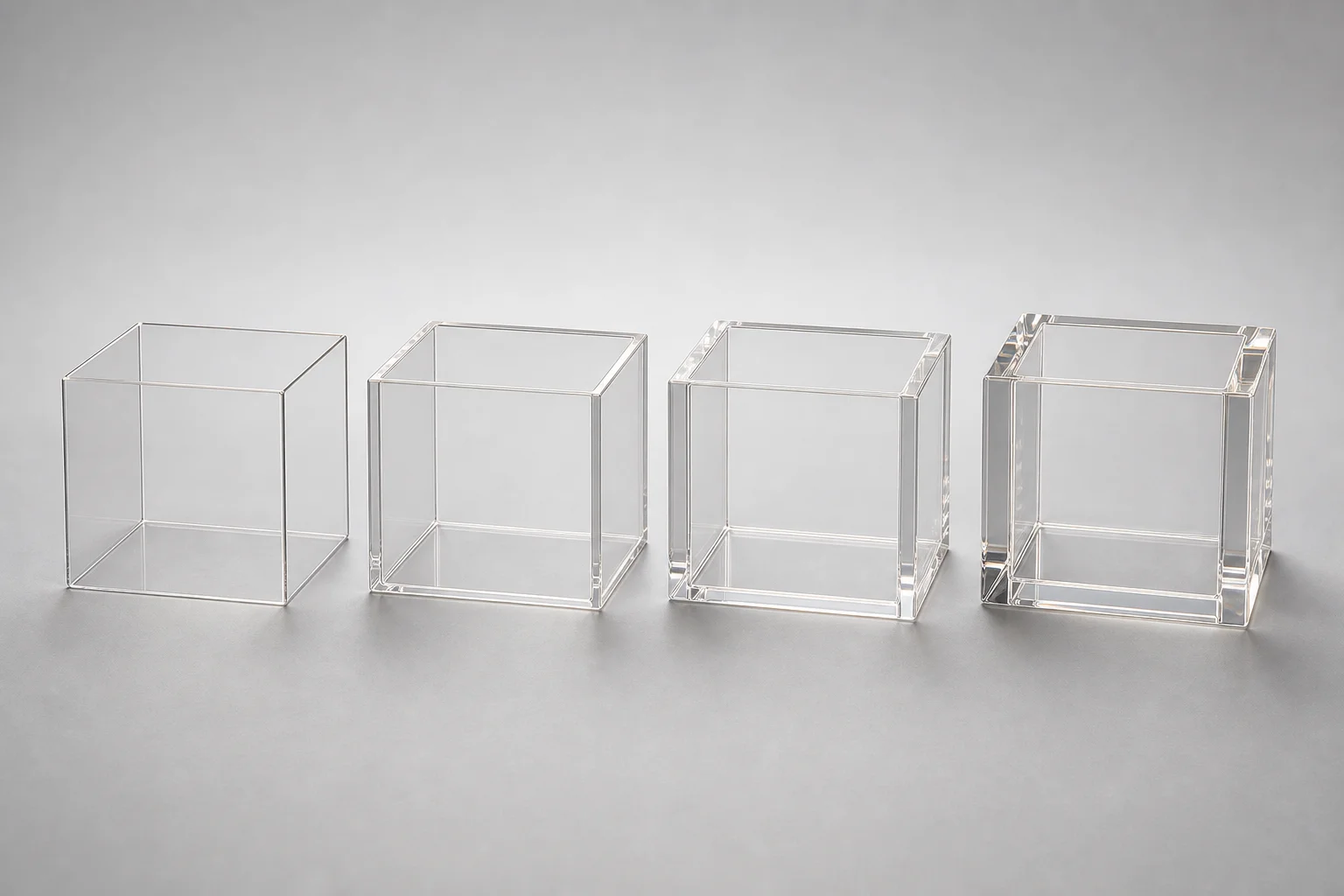
I open every box RFQ by checking three things: the heaviest item going inside, the maximum stacking height during shipping and display, and whether the box needs to feel substantial in hand. Those three variables narrow the wall thickness to one of four standard options — 3mm (1/8”), 5mm (3/16”), 6mm (1/4”), or 10mm (3/8”). Pick wrong and the box either deflects visibly under load, costs more than it needs to, or cracks in transit because a thin wall took a point impact it was never sized for.
The pattern I see most often: a buyer specifies 3mm because it’s the cheapest option, then comes back six weeks after delivery asking why the boxes are bowing on the shelf. The second order ships at 5mm. This guide is how you skip that first order and land on the right thickness from the start.
The physics — PMMA density, flexural strength, and what drives deflection
PMMA (polymethyl methacrylate) has a density of 1.18 g/cm3, a flexural strength of approximately 100 MPa, and a flexural modulus (E) of 3.2 GPa.1 Those three numbers govern everything about how an acrylic box wall behaves under load.
The relationship between wall thickness and deflection follows a cubic law. Panel deflection under a distributed load is governed by the standard beam formula: the maximum deflection equals (5 x w x L to the fourth) / (384 x E x I), where w is the load per unit length, L is the unsupported span, E is the flexural modulus, and I is the moment of inertia. The critical variable is I, which for a rectangular cross-section equals (b x t cubed) / 12 — meaning deflection drops with the cube of wall thickness. Doubling thickness from 3mm to 6mm cuts deflection by a factor of eight, not two.
This cubic relationship is why the jump from 3mm to 5mm is the single most impactful spec change on any box RFQ. The material cost increase is roughly linear with thickness, but the stiffness gain is exponential. A 5mm wall is 4.6 times stiffer than a 3mm wall. A 6mm wall is 8 times stiffer. That non-linear physics is what makes 5mm the default workhorse — you get a disproportionate stiffness gain for a modest cost increase.
Weight scales linearly with thickness. An 8 x 6 x 4 inch box (203 x 152 x 102 mm) with 3mm walls weighs approximately 430 g. The same box at 5mm weighs about 700 g. At 6mm, roughly 830 g. At 10mm, around 1,340 g. Shipping cost follows weight, so the jump to 10mm has real freight implications at volume.
1/8” (3mm) — when thin walls make sense (and when they shatter)
A 3mm acrylic box wall thickness is the right call for lightweight, small-footprint applications where the box protects a product from dust and fingerprints, not from stacking loads or impact. Cosmetics inserts, candy packaging, small gift boxes under 6 inches on any side — 3mm works. Anything heavier or larger, it does not. The boutique gift-box project shows how thickness, span, joint, closure, insert, and packing stayed drawing-specific across the size family.
The math: an 8 x 6 inch panel at 3mm thickness, supported at two edges, deflects approximately 2mm under a 5 lb (2.3 kg) distributed load. That 2mm bow is visible to the naked eye from three feet away. Stack two filled boxes and the bottom box’s top panel shows a noticeable dip. For a retail shelf where the box is the product display, that dip reads as cheap.
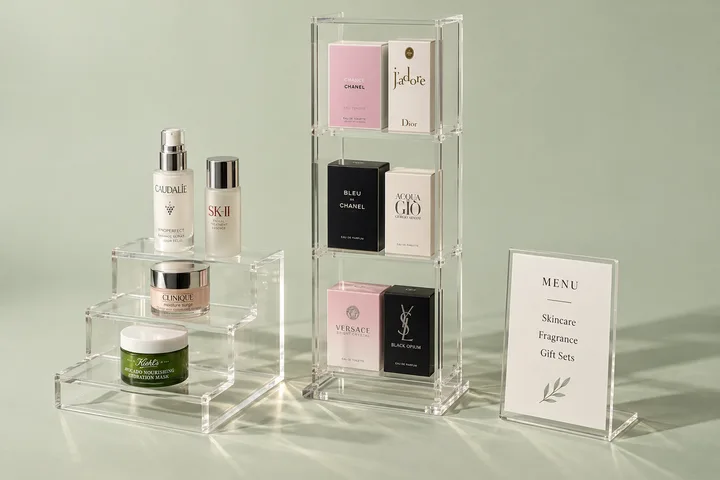
Where 3mm works well: single-unit cosmetics boxes that sit on a vanity, small retail boxes that hold products under 1 lb, promotional packaging that ships once and lives indoors. The material cost savings are real — a 3mm box uses 60% of the acrylic that a 5mm box does, and CNC cutting time is shorter on thinner stock.
Where 3mm fails: any box that will be stacked more than two units high, any box holding a product over 2 lb, any box with a span exceeding 8 inches on the unsupported top panel, and any box that ships without custom foam inserts. I have seen 3mm boxes arrive with hairline cracks along the bonding seams after container transit — the point impacts from adjacent cartons are enough to propagate a fracture in thin-wall PMMA.
Feel in hand: a 3mm box feels light and somewhat fragile. Tapping the wall produces a higher-pitched sound compared to thicker options. For a cosmetics buyer, that’s acceptable. For a jewelry buyer, it undermines the premium perception before the customer even opens the lid.
3/16” (5mm) — the workhorse thickness for retail display boxes
Five-millimeter acrylic is the default wall thickness for retail display boxes, and for good reason. A 5mm wall on the same 8 x 6 inch panel deflects under 0.5mm at 5 lb — functionally invisible. It handles 4-6 units stacked without visible bowing, ships without cracking under normal freight conditions, and feels solid when a retail buyer picks it up.
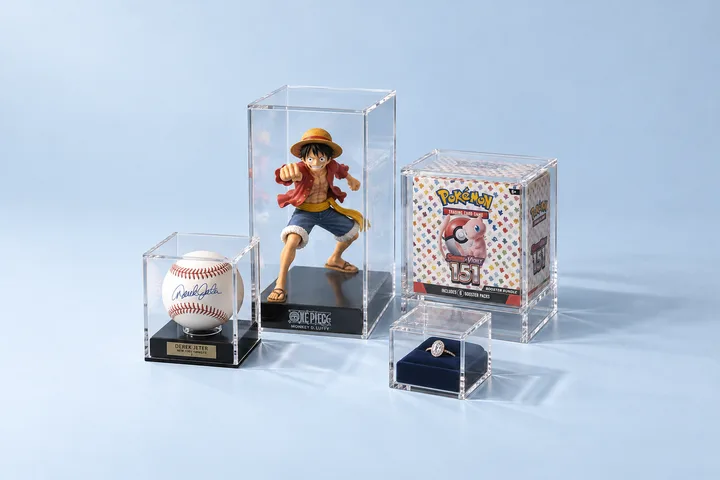
We run more 5mm box orders than all other thicknesses combined. About 60-65% of our box production in any given quarter is 5mm wall stock. The applications cover the full range of retail display: product showcase boxes for cosmetics counters, collectible display boxes for trading cards and memorabilia, countertop organizer boxes for electronics accessories, and branded packaging boxes for mid-range consumer goods. A reusable acrylic ballot box that is set up and transported for every vote belongs here too.
The stiffness-to-cost ratio at 5mm hits a sweet spot. You get 4.6 times the stiffness of 3mm for roughly 65% more material cost. At MOQ 500, the per-unit premium over 3mm is typically $1.50-2.50 depending on box dimensions and finishing requirements. For most retail applications, that premium pays for itself by eliminating the deflection complaints and breakage returns that 3mm generates.
Where 5mm is not enough: boxes with any single dimension exceeding 14 inches (the unsupported span gets too long and deflection returns), boxes that need to support more than 8 stacked units on a retail shelf, and premium packaging where the buyer expects the box itself to feel like a luxury object. In those cases, step up to 6mm.
Feel in hand: a 5mm box feels solid and purposeful. There is no flex when you press the top panel with a thumb. The weight is noticeable but not heavy — a retail buyer registers “quality packaging” without registering “expensive to ship.”
1/4” (6mm) — premium-feel boxes for jewelry and electronics
Six-millimeter wall thickness is where an acrylic box stops feeling like packaging and starts feeling like a display piece. The 8 times stiffness gain over 3mm means the panels have zero perceptible flex under any normal handling or stacking load. The extra weight — roughly 830 g for an 8 x 6 x 4 inch box — registers as substance when you pick it up.
I recommend 6mm for three specific categories. First, jewelry display boxes where the box is part of the presentation — engagement ring boxes, watch display cases, branded jewelry packaging that stays on a dresser or in a retail case. The rigidity and heft match the product value. Second, electronics packaging for premium accessories — headphone cases, VR headset display boxes, branded tech-accessory packaging where the unboxing experience matters. Third, any box with a dimension between 14 and 18 inches where 5mm starts showing deflection under stacking.
The cost step from 5mm to 6mm is smaller than most buyers expect. Material weight increases by roughly 20%, and CNC cutting time increases modestly. At MOQ 500, the per-unit premium over 5mm is typically $0.80-1.20. Compared to the 3mm-to-5mm jump, the 5mm-to-6mm step is an easy decision for any buyer whose product price point supports premium packaging.
Where 6mm is overkill: standard cosmetics boxes, lightweight promotional packaging, high-volume boxes where shipping weight directly affects landed cost, and any application where the box is disposable rather than retained. At 830 g per box and MOQ 5,000, the difference between 5mm and 6mm is roughly 650 kg of additional shipping weight — that matters on a container.
Feel in hand: a 6mm box feels substantial and premium. The walls do not flex at all under thumb pressure. The weight is immediately noticeable on pickup. Retail buyers in jewelry and electronics consistently describe 6mm boxes as “feeling expensive,” which is exactly what you want when the box is part of the brand experience.
3/8” (10mm) — museum-grade, load-bearing, and oversized boxes
Ten-millimeter walls are not standard packaging — they are structural acrylic for applications where the box must support significant weight, span large dimensions without any deflection, or meet museum-grade conservation requirements. This is a different product category from the three thicknesses above.
At 10mm, the moment of inertia of the wall cross-section is 37 times that of a 3mm wall. Deflection under load is negligible at any practical box dimension up to 24 inches. The box feels closer to glass furniture than packaging — at 1,340 g for an 8 x 6 x 4 inch box, the weight is immediately and unmistakably present.
Where 10mm is the right call: museum display cases for artifacts and collectibles (where the box may sit untouched for years under controlled lighting), oversized boxes with any dimension exceeding 18 inches, load-bearing display pedestals where other products sit on top of the box, and any application where the box itself functions as furniture or architecture rather than packaging.
We fabricate 10mm boxes primarily with CNC routing rather than laser cutting, because the kerf width and heat-affected zone on a laser pass at 10mm degrades edge clarity.2 CNC routing followed by diamond polishing gives cleaner edges at this thickness. The fabrication switch means longer production time — typically 2-3 additional days in our scheduling — and higher per-unit cost from the machining time alone, separate from the material premium.
Where 10mm is wrong: any application where the box needs to be moved frequently (the weight fatigues retail staff), any high-volume order where shipping weight drives landed cost, and any application where 6mm provides adequate rigidity. I have had buyers request 10mm “because they want the best” without understanding the cost and weight implications. For a standard retail display box, 10mm is overbuilt.
Feel in hand: a 10mm box feels like a piece of furniture. The walls do not flex under any hand pressure. The weight is significant — roughly three times a 3mm box. Setting one down on a glass counter produces a solid, audible contact. For a museum curator or a luxury brand using the box as a permanent display case, that heft is a feature. For a retail buyer moving 50 boxes onto a shelf every morning, it is a problem.
Cost impact — how 1mm changes your per-unit price at MOQ 100/500/5,000
The per-unit cost of an acrylic box is driven by three variables that all scale with wall thickness: raw material weight, CNC or laser cutting time, and diamond-polishing time on visible edges. Material is roughly 50-60% of unit cost at MOQ 500, fabrication is 30-35%, and finishing is 10-15%.
Material cost scales linearly with thickness because PMMA is sold by weight. A 5mm box uses 67% more acrylic than a 3mm box of identical dimensions. But fabrication cost does not scale linearly — cutting and polishing a 5mm panel takes only 10-15% longer than a 3mm panel on our equipment. This is why the per-unit cost increase from 3mm to 5mm is smaller than the material increase alone would suggest.
At MOQ 500 for an 8 x 6 x 4 inch box with four polished edges and UV-bonded seams, the approximate per-unit cost structure across thicknesses:
| Wall thickness | Material cost | Fabrication | Finishing | Total per unit | vs 3mm |
|---|---|---|---|---|---|
| 3mm (1/8”) | $3.20 | $2.80 | $1.00 | $7.00 | — |
| 5mm (3/16”) | $5.30 | $3.10 | $1.10 | $9.50 | +$2.50 |
| 6mm (1/4”) | $6.40 | $3.30 | $1.20 | $10.90 | +$3.90 |
| 10mm (3/8”) | $10.60 | $4.80 | $1.60 | $17.00 | +$10.00 |
These are FOB Shenzhen directional figures for a standard clear cast PMMA box, not a fixed quote — your actual pricing depends on complexity, printing, and finishing requirements. The key pattern to read from the table: the 3mm-to-5mm jump is $2.50 per unit for a 4.6x stiffness gain. The 5mm-to-6mm jump is $1.40 for an additional 1.7x stiffness gain. The 6mm-to-10mm jump is $6.10 and shifts from laser to CNC fabrication.
Volume pricing compresses the gap. At MOQ 5,000, the per-unit cost drops 25-35% across all thicknesses, but thicker walls benefit slightly more from volume because the material purchasing discount at higher PMMA weight is steeper than the fabrication-time discount. At MOQ 100 (our minimum), per-unit cost runs roughly 40-60% higher than the MOQ 500 figures above, with setup and tooling amortization dominating the premium.
For a detailed quote from a custom acrylic box manufacturer tailored to your dimensions and volume, send us your RFQ with the product weight and stacking requirements — we will recommend the right thickness before quoting.
Choosing the right thickness — four scenarios
Every acrylic box thickness decision maps to a combination of product weight, box dimensions, stacking requirement, and perceived value. Here are the four scenarios I walk buyers through most often.
Scenario 1: Cosmetics counter display. A skincare brand needs 500 clear acrylic boxes to display serums on a retail counter. Product weight: 3 oz per bottle. Box size: 4 x 3 x 5 inches. No stacking. Recommendation: 3mm. The product is light, the dimensions are small, and the box is single-unit display. Cost savings of $2.50 per unit over 5mm, totaling $1,250 at MOQ 500.
Scenario 2: Trading card display box. A collectibles retailer needs 200 display boxes for graded card slabs. Product weight: 2 oz per slab, but the boxes will be stacked 4-6 units high on retail shelving. Box size: 6 x 4 x 2 inches. Recommendation: 5mm. The stacking requirement rules out 3mm even though the product is light. The 5mm wall handles 6-unit stacking without visible deflection on a 6-inch span.
Scenario 3: Premium jewelry packaging. A jewelry brand needs 100 boxes for a limited-edition watch launch. The box stays with the product permanently. Box size: 10 x 8 x 4 inches. Recommendation: 6mm. The box is the brand experience. The buyer’s customer will pick up and handle the box repeatedly. The 6mm heft reads as luxury, and the 10-inch span needs the stiffness margin that 5mm cannot guarantee over time.
Scenario 4: Museum artifact case. A museum gift shop needs 50 custom display cases for artifact reproductions. Box size: 16 x 12 x 10 inches. The cases sit on permanent display shelving and will not be moved after placement. Recommendation: 10mm. The 16-inch span requires 10mm to eliminate any deflection. The weight is acceptable because the case will be placed once and left. CNC-routed edges with diamond polish give the optical clarity a museum application demands.
For any scenario not covered here, send us your RFQ with the product weight, box dimensions, and stacking requirements. We will recommend the thickness before quoting.
If you are comparing acrylic boxes to other clear packaging materials, our acrylic vs polycarbonate vs PETG guide covers the material decision. For boxes with lids, our acrylic box vs lidded display case comparison walks through the structural differences. The acrylic sign-holder project shows how a flat-panel brief routed thickness, mounting, packing, and sample approval.
Footnotes
-
Evonik PLEXIGLAS material data sheets — PMMA density 1.18 g/cm3, flexural strength 100-115 MPa, flexural modulus 3.0-3.3 GPa. Manufacturer-published values for cast PMMA used in Wetop’s standard box fabrication. ↩
-
Cast acrylic flexural strength ~110 MPa and elastic modulus ~3.2 GPa, per ASTM D790 (MakeItFrom PMMA data) — materials database listing the cast PMMA flexural strength and modulus values that feed the deflection calculations in this guide. ↩
Frequently Asked Questions
What thickness acrylic is best for display boxes?
5mm (3/16 inch) is the standard for retail display boxes — it provides enough rigidity for products up to 5 lb, resists shelf-stacking deflection, and keeps per-unit cost reasonable at volume. For premium jewelry or electronics packaging, step up to 6mm. For museum-grade or oversized boxes (any dimension over 18 inches), use 8-10mm.
Does thicker acrylic cost much more?
The cost increase is roughly proportional to material weight. A 5mm box costs ~40-60% more than a 3mm box of the same dimensions at MOQ 500. But the curve flattens: 6mm is only 15-20% more than 5mm. The real cost jump is at 10mm, where both material and CNC machining time increase significantly.
Can you stack acrylic boxes on top of each other?
Yes, but wall thickness determines how many. A 3mm-wall box supports 1-2 units stacked before visible deflection. A 5mm-wall box supports 4-6 units. For retail shelf stacking of 8+ units, use 6mm minimum with a reinforced base. We test stacking loads during QC for all box orders above MOQ 200.
What is the thinnest acrylic for a custom box?
We can fabricate boxes with 2mm walls, but only for small dimensions (under 4 inches on any side) and non-structural applications like candy packaging or cosmetics inserts. Below 3mm, acrylic boxes feel flimsy and risk cracking during shipping. Our recommended minimum for any retail-quality box is 3mm.
Have specs in hand? Get a quote for your specific project.
Send us your drawings, reference photos, or a description of what you're making. We reply within 24 hours with a material recommendation, thickness, fabrication method, and a per-unit quote.