Acrylic vs Cardboard Gift Box: Which to Buy?
Cardboard is lighter and has a common paper-recycling route. Acrylic can be specified as a reusable display or storage object.
Need this made?Acrylic gift boxes →
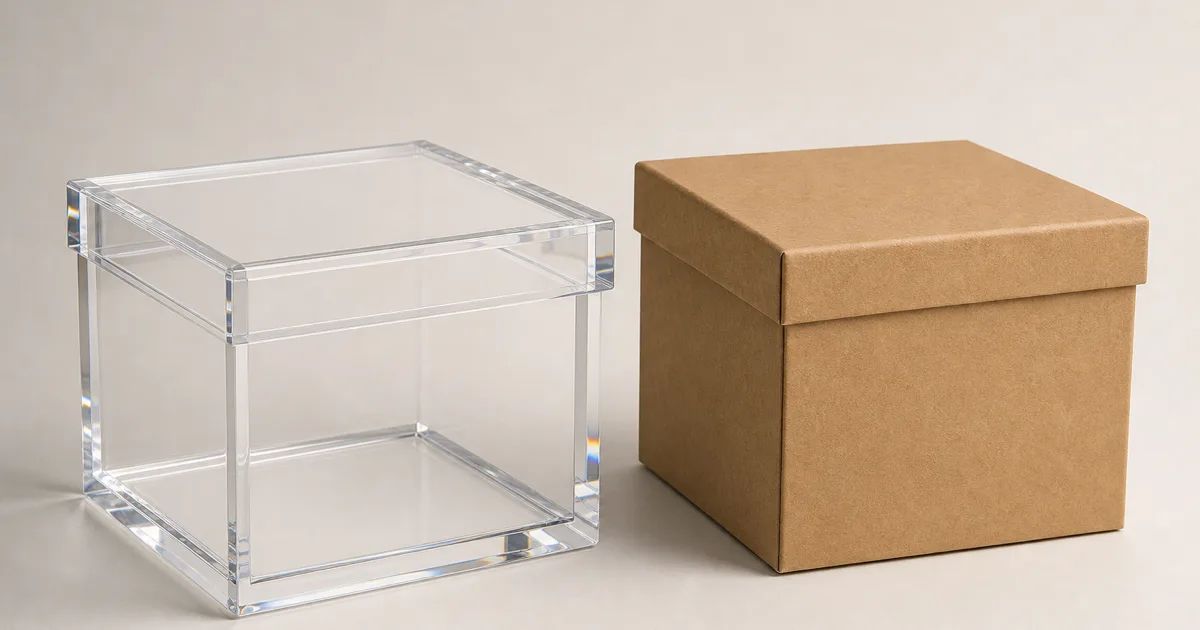
The right call depends on the program brief and measured end-of-use path.
Key Takeaways
- Cardboard supports lower weight and a common paper-recycling route; acrylic supports visibility, rigidity and a reusable-object design. The deciding question is what the approved program requires after opening.
- A rigid cardboard box can be specified for the unboxing and recycling route; an acrylic box can be specified as a reusable object, but reuse must be part of the actual program rather than assumed.
- Cardboard is far lighter — paperboard runs roughly 0.6–0.8 g/cm³ versus cast acrylic near 1.2 g/cm³ — so acrylic boxes cost more to ship, a real line item on any volume gifting program.
- On sustainability cardboard leads clearly: US paper and paperboard recycle at about 68%, the highest of any packaging material, while cast acrylic is technically recyclable but rarely collected curbside — reusability is acrylic's honest green argument, not recycling.
- For a luxury keepsake, corporate gift or retail hero box with a documented reuse function, custom acrylic can protect second-surface print or laser etching behind a clear wall; the made-to-order path runs a 100-piece MOQ, samples in 3–5 days and production in 15–20 days.
On this page
- Is an Acrylic or Cardboard Gift Box Better for a Premium Product?
- Quick-reference comparison table
- What each material actually is
- Cost — delivered unit vs. measured reuse cycle
- Premium feel — where each material earns its shelf presence
- Reusability and keepsake value — define the program
- Durability and moisture — how each material fails
- Custom branding — different strengths, not a clear winner
- Weight and shipping cost — cardboard’s quiet advantage
- Sustainability — an honest tradeoff, not a slogan
- The unboxing moment — where cardboard is genuinely strong
- Where rigid plastic and wood fit
- Decision framework — which box for which gift
- How to spec a custom acrylic gift box if that is your pick
- How we sourced this comparison
Is an Acrylic or Cardboard Gift Box Better for a Premium Product?
In the acrylic vs cardboard gift box decision, acrylic is a candidate when visibility, rigid protection and planned reuse matter, while cardboard is a candidate when lower weight, a paper-recycling route and full-surface print matter more.
Acrylic commonly starts around 3 mm wall thickness and stays rigid around the product; cardboard is a lighter paperboard structure that can be wrapped or printed across every face. Compare the two on approved internal dimensions, insert fit, branding, packed volume and the job the box must do after opening rather than on material price alone.
If several rigid boxes must ship or display in a column, use the stackable acrylic boxes guide to approve the load path and interface separately from the gift-packaging decision.
The sharper question is what the approved program asks the box to do after opening. Cardboard can follow a paper-recycling route; acrylic can be designed for storage or display. Neither outcome is automatic, so the brief should state the intended reuse, return or disposal path and compare cost, branding, weight, packing, moisture and recovery on that basis.
Quick-reference comparison table
Acrylic and cardboard sit at opposite ends of the gift-box tradeoff: cardboard is the low-cost, lightweight, recyclable packaging; acrylic is the premium, reusable keepsake. The table below lines up the two head-to-head across the nine decision axes packaging and gifting buyers actually weigh, with the third-party-sourced numbers that back the material rows. Read it top to bottom, then jump to the section that decides your program.
| Decision axis | Acrylic (cast PMMA) | Cardboard (rigid paperboard) |
|---|---|---|
| Unit cost | Higher — cut, polished, printed, assembled | Lower — inexpensive paperboard, high-speed folding |
| Premium feel | Glass-like clarity, weight, polished edge | Rich when rigid + foil/emboss; still opaque paper |
| Reuse or recovery path | Can be designed for measured reuse or contracted PMMA recovery | Can be designed for reuse or a documented paper-recycling route |
| Weight | Heavier; density about 1.2 g/cm³1 | Much lighter; paperboard roughly 0.6–0.8 g/cm³2 |
| Durability | Rigid, moisture-resistant; can crack on hard drop | Dents, crushes, and absorbs moisture over time |
| Custom branding | Second-surface print + laser etch under a clear wall | Full-surface offset/digital print, foil, emboss3 |
| Shipping cost | Higher — heavier, needs more protection | Lower — light and flat-packable before assembly |
| Recyclability | Thermoplastic, remeltable but rarely curbside | Widely recycled — US paper/paperboard about 68%4 |
| Sustainability angle | Program-specific reuse or contracted recovery | Paper-recycling route + renewable fiber |
| Best fit | Luxury keepsake, corporate gift, retail hero, display | Volume promo, disposable premium unboxing, e-commerce |
The table does not predict a winner. Match the material to the approved dimensions, branding, packing, recovery route and any measured reuse requirement rather than to a generic “more premium” instinct.
What each material actually is
Acrylic and cardboard are unrelated materials that fail in opposite ways. Acrylic is polymethyl methacrylate (PMMA), a rigid, optically clear thermoplastic that can be cut, polished, and thermoformed into a box that holds its shape and clarity for years. Cardboard gift boxes are made of paperboard — compressed cellulose fiber, conventionally defined in the paper industry as paper with a grammage above 250 g/m² — usually wrapped or printed and assembled into a rigid “set-up” box. One is a durable plastic; the other is a fiber product that is light, renewable, and recyclable but sensitive to moisture and impact.
Acrylic (PMMA) is the same polymer sold under the trade names Plexiglas, Perspex, and Lucite.5 It is optically clear, takes a diamond-polished edge, and can be cast in thick gauges — the reason a quality acrylic gift box has that heavy, glass-like presence a recipient notices in the hand. Rigid cardboard, by contrast, gets its premium feel from construction rather than the material itself: a chipboard or greyboard core wrapped in printed paper, often with foil stamping or embossing, folded and glued into a box that looks and feels far more expensive than the fiber it is made from. Neither material is “better” as a substance — they are built for different jobs. When a buyer tells me the box is a promotional insert or an e-commerce mailer meant to be opened once, rigid cardboard is often the honest answer even though we do not make it; when the box is meant to be kept on a shelf and reused, acrylic is the one that earns its cost.
Cost — delivered unit vs. measured reuse cycle
Compare current quotes on the same internal size, insert, artwork, packing quantity and delivery term. If the program includes measured reuse, include the confirmed number of use cycles in its cost model; otherwise compare the boxes as one delivered unit without inventing future impressions.
Separate packaging-first programs from reuse-first programs. In the second case, document the reuse function, cleaning method and end-of-use route rather than treating the word keepsake as evidence. Acrylic pricing depends on size, wall thickness, decoration, packing and quantity—the same variables listed in the custom acrylic boxes hub—and freight should be compared on the same delivery basis.
If a buyer wants to model brand exposure, use measured retention or reuse data from that program. Without it, do not assign acrylic hundreds of impressions or cardboard one use; compare the specified product, packing and recovery plan directly.
Premium feel — where each material earns its shelf presence
Both materials can be specified for a premium presentation through different construction choices. A rigid cardboard gift box uses its core, paper wrap, foil, embossing and closure; an acrylic box uses optical clarity, polished edges, wall gauge and protected print. Approve the intended presentation and use-cycle requirement on physical samples.
Do not turn material choice into an assumed behavior curve. A packaging-first program can specify cardboard for a controlled reveal and a paper-recycling route. A reuse-first program can specify acrylic for a storage or display function, but the buyer must define expected cycles and measure retention before claiming continuing exposure.
Reusability and keepsake value — define the program
For a reuse-first program, acrylic can be engineered as a display case, desk organizer or storage box. A rigid cardboard box can also be reused, but moisture, dents and edge wear may set different acceptance limits. Specify the function, cleaning method, expected cycles and end-of-use route for either material, then measure the actual outcome.
Unit price does not establish useful life. A packaging-first brief may favor cardboard, while a reuse-first brief may favor a rigid acrylic object; the buyer should define the intended function, acceptance criteria and end-of-use route instead of predicting what every recipient will keep.
If brand exposure is part of the business case, define how retention or reuse will be measured. Do not assign impressions to a desk, shelf or counter without program data. Our custom acrylic gift boxes can be designed around an approved display or storage function, but the buyer’s records—not the material name—support any later exposure claim.
Durability and moisture — how each material fails
Cardboard fails to moisture and impact; acrylic fails to hard drops. Paperboard is a fiber product, so it absorbs humidity, warps in damp storage, softens at the edges, and crushes or dents under impact — which is why a cardboard box that traveled through a humid supply chain can arrive looking tired. Cast acrylic is rigid and moisture-resistant, so it shrugs off humidity and holds its shape, but it is a brittle thermoplastic that can crack or chip on a hard fall. The materials fail in opposite directions, and the right one depends on what your box has to survive.
Treat environment and expected use as buyer inputs. If the program specifies one presentation followed by a documented paper-recycling route, test cardboard against the shipping and handling cycle. If it specifies repeated storage or display in a humid setting, test both materials against the stated duration, cleaning and appearance criteria. Acrylic can crack on a hard fall while cardboard can dent or lose stiffness with moisture, so neither outcome should be predicted without the actual route and use conditions. Approve wall thickness and drop or packing checks for the selected construction; the acrylic box wall thickness guide explains the geometry inputs.
Custom branding — different strengths, not a clear winner
Both materials support different decoration routes. Cardboard accepts full-surface offset or digital printing, foil, embossing and spot varnish;3 acrylic supports second-surface printing viewed through a clear wall or laser engraving. Approve abrasion, adhesion and appearance on the actual sample rather than promising that any decoration can never scuff.
This is the axis where the honest answer is “it depends on whether the box is kept.” When the box is disposable, cardboard’s decoration options are genuinely excellent and cheaper — the print only has to look perfect once, at unboxing, and full-surface offset with foil delivers a luxurious result at a fraction of acrylic’s cost. But when the box is a kept object, cardboard’s branding ages with the box: the printed wrap scuffs at the corners, foil rubs, and edges soften, so the branding degrades exactly as the recipient is meant to keep looking at it. Acrylic’s decoration is in a different class for that long-life case:
- Second-surface printing. Full-color artwork sealed under the clear wall, viewed through the acrylic, giving a glossy depth effect that survives handling and daily display intact — the reason it dominates our keepsake and corporate-gift orders.
- Laser etching. A frosted logo cut into the surface that reads as understated and premium precisely because it does not shout, and cannot rub off the way foil can.
- Color and finish. Beyond clear, acrylic runs frosted, tinted, or mirrored to match a brand palette while still carrying a printed or etched mark.
- Interchangeable inserts. A printed insert that drops behind a clear wall, so seasonal or campaign artwork can change without re-tooling the box.
Cardboard’s branding, by contrast, is superb at the moment of the reveal and fades with the box. So the branding verdict tracks the same question as everything else: for a disposable premium unboxing, cardboard’s print options win on cost and richness; for a kept keepsake, acrylic protects the branding for the life of the object. The acrylic gift-box project shows how we controlled a multi-format program through drawings, closure samples, artwork approval, insert fit, and packing release.
Weight and shipping cost — cardboard’s quiet advantage
Cardboard is far lighter, and that shows up on every freight invoice. Paperboard runs roughly 0.6–0.8 g/cm³ depending on grade,2 while cast acrylic sits near 1.2 g/cm³,1 so a comparable acrylic box weighs more — often substantially more once you account for the thicker walls acrylic needs for rigidity. On top of raw density, cardboard ships flat and is assembled later, while acrylic ships as a finished rigid object that needs more protective packing. For a high-volume gifting program, that weight difference is a real, recurring cost line, not a rounding error.
Compare packed dimensions, gross weight and current freight quotes for the same internal size and quantity. Acrylic’s higher density and rigid shipped form can increase freight, while wall thickness affects both stiffness and weight. Approve the minimum suitable gauge on the sample instead of assigning an assumed useful life or reuse value to offset freight. The custom acrylic boxes hub treats wall gauge as a spec decision rather than a “more is better” default.
Sustainability — an honest tradeoff, not a slogan
On sustainability, cardboard leads on recycling and acrylic leads on reuse — and buyers should not conflate the two. Cardboard’s case is strong and verifiable: US paper and paperboard are recycled at about 68%, the highest recycling rate of any packaging material,4 and paperboard is made from a renewable fiber and is widely accepted curbside. Cast acrylic is a thermoplastic that can technically be remelted, but it is rarely collected in curbside recycling programs, so in practice most acrylic is not recycled. If curbside recyclability and renewable material are the buyer’s priority, cardboard is the honest answer.
Acrylic’s possible sustainability argument is measured reuse and displacement, not a blanket recycling claim. It applies only when program records show that repeated use displaced otherwise required packaging. If the brief depends on a common municipal paper-recycling route, cardboard is easier to document; if it depends on repeated use, define and measure the cycles before making the claim.
The unboxing moment — where cardboard is genuinely strong
For a one-time unboxing built around the reveal, cardboard is often the better tool, and I say so without hedging. A rigid cardboard box with a magnetic lid, a tissue liner, and a foil-stamped inner wrap delivers a theatrical open — the lid lifts, the tissue parts, the product is revealed — that is genuinely hard to beat, and it is cheap enough to run at volume. For e-commerce brands whose unboxing is content, for subscription boxes, and for seasonal retail where the box is opened once and photographed, cardboard’s staged reveal is exactly the right instrument, and acrylic’s clarity actually works against it because a clear box shows the product before the open.
“Premium” and “unboxing experience” are not the same requirement. Cardboard can hide, layer and stage the contents; clear acrylic can expose the product before opening. If the brief also requires a display or storage function after opening, evaluate acrylic against that explicit requirement rather than assuming the recipient will keep it.
Where rigid plastic and wood fit
Acrylic and cardboard are two of several gift-box materials; rigid non-acrylic plastics and wood round out the premium field. Other clear plastics — PETG and polycarbonate — can also make a see-through gift box: PETG is a lower-cost, easier-to-form clear plastic, and polycarbonate is a tougher, more impact-resistant one, but neither matches cast acrylic’s optical clarity and polished-edge premium look. Wood reads warm and natural like a high-end keepsake, but is heavier, costlier to finish, and harder to make in complex clear-window forms.
Slotting these together makes the acrylic-vs-cardboard choice clearer by showing what each material is really for. PETG and polycarbonate are the clear-plastic alternatives when cost or impact resistance outranks premium clarity — a fuller comparison of those against acrylic is in our cast acrylic vs PETG vs polycarbonate guide. Wood is the artisanal keepsake choice for a rustic or heritage-brand feel, accepting the weight and cost for the natural look. Cardboard is the light, recyclable, low-cost packaging for disposable premium unboxing and volume programs. Acrylic is the clear, brandable, reusable keepsake for luxury gifts, corporate gifting, and retail hero boxes where the box is meant to be kept. If your shortlist has come down to acrylic vs. cardboard specifically, you have usually already decided the box is either premium-disposable or premium-keepsake — and the earlier sections settle which material serves that intent.
Decision framework — which box for which gift
Match the material to the program’s documented path after opening. A paper-recycling route can favor cardboard’s low weight and fiber recovery. A measured display or storage function can favor acrylic’s visibility, rigidity and moisture resistance.
I run new buyers through the same five questions, and they settle the choice in about a minute:
- What must the box do after opening? Define a recycling, return, storage or display path rather than predicting recipient behavior.
- What are the matched delivered costs? Compare the same internal size, insert, artwork, packing quantity and delivery term.
- Is a municipal paper-recycling route required? Verify local acceptance and document the selected paperboard construction.
- Is repeated use part of the brief? State the function, expected cycles, cleaning method and measurement plan.
- What must the branding withstand? Approve abrasion and cleaning on the physical sample for the required cycles.
When the answers split, prototype the two relevant constructions and compare fit, appearance, packing and the documented end-of-use plan. Once the brief narrows to acrylic, send us your gift-box brief to pressure-test the spec.
How to spec a custom acrylic gift box if that is your pick
If the decision lands on acrylic, seven spec lines turn a vague request into an accurate quote. Most box quotes stall on missing basics rather than hard questions, so pinning them down before writing to any factory produces a faster, tighter, comparable quote — and protects a buyer from a supplier quoting a cheaper build than they pictured.
The seven lines that matter:
- Dimensions, and which kind. State outside or inside dimensions explicitly — a box that must hold a 200 mm item is a different object than one that measures 200 mm. The gift-box internal-size chart shows how to translate product clearance into the box brief.
- Wall thickness. This drives both the premium feel and the shipping weight; state the number rather than “thick,” and see the acrylic box wall thickness guide for the tradeoffs.
- Material grade. Specify cast acrylic — it polishes to a cleaner edge and comes in the thick gauges a substantial keepsake box needs.
- Lid and closure. Slide-on, hinged, magnetic, or friction-fit — each changes tooling, cost, and the unboxing feel.
- Decoration. Second-surface print, laser etch, insert, or plain clear — with vector artwork if a logo is involved.
- Quantity and cadence. Against our 100-piece MOQ, and whether this is a one-off test or a repeating program.
- Destination and terms. So the quote can include freight from day one, on a landed basis you can compare like-for-like — which matters more on heavy acrylic than on light cardboard.
The made-to-order path itself is shorter than most first-time buyers expect: a 100-piece MOQ per design, samples in 3–5 days, and production in 15–20 days, with every piece inspected before packing under our ISO 9001 quality system. The sample stage is where these programs are actually decided — it is the one moment a buyer holds the exact corner joint, edge polish, print quality, and clarity the production run will be measured against. For a branded keepsake program especially, I tell buyers to approve nothing from a render; the physical sample is the whole point of the exercise, and we ship it in days.
How we sourced this comparison
The material claims in this guide are drawn from third-party standards, regulatory data, and materials references — not from internal Wetop testing. Acrylic’s density (about 1.2 g/cm³) comes from published PMMA material data;1 paperboard’s density range from paper-industry material references;2 the paper and paperboard recycling rate (about 68%, highest of any packaging material) from US EPA municipal-waste data;4 and cardboard’s decoration options (offset and digital printing, foil, emboss) from printing-process references.3 Acrylic’s food-adjacent and thermoplastic properties, and its trade-name lineage, come from published PMMA references.5
Where the material behavior is settled — paperboard absorbs moisture and is widely recycled, cast acrylic is rigid and moisture-resistant — we state it directly. Where a number depends on grade or program, we give a range and cite the source so you can verify it against your own conditions. Wetop does not run a materials test lab; we manufacture custom acrylic boxes and inspect every order piece-by-piece before ship, and our contribution to this comparison is the buyer-facing pattern of which material fits which gift, learned across 2,000+ custom projects for buyers in 25+ countries. We review this guide against its cited sources quarterly and update it when a figure or standard changes.
Footnotes
-
PMMA (Acrylic) material properties — MakeItFrom — displays the density (about 1.2 g/cm³) cited for cast acrylic gift boxes. ↩ ↩2 ↩3
-
Density of Paper and Paperboard — PaperOnWeb — paper-industry reference table giving paper and paperboard densities (roughly 0.5–0.8 g/cm³ for common board grades), cited for paperboard’s low density relative to acrylic. ↩ ↩2 ↩3
-
How Does Offset Printing Work? A Guide for Packaging and High-Volume Printing — Meyers — printing-industry explainer of the offset lithography process used for high-quality, cost-effective full-surface printing on paperboard packaging, cited for cardboard’s low-cost decoration options. ↩ ↩2 ↩3
-
Paper and Paperboard: Material-Specific Data — U.S. Environmental Protection Agency — reports the US paper and paperboard recycling rate of about 68%, the highest of any material in municipal solid waste, cited for cardboard’s recyclability advantage. ↩ ↩2 ↩3
-
Poly(methyl methacrylate) — Wikipedia — trade-name lineage of PMMA (Plexiglas, Perspex, Lucite) and its thermoplastic clarity, cited for the material identity of acrylic. ↩ ↩2
Frequently Asked Questions
Acrylic vs cardboard gift box: which is better for a premium product?
It depends on what the approved brief requires. Rigid cardboard supports a lightweight, print-rich unboxing format and a common paper-recycling route; acrylic supports visibility, rigidity and a reusable-object design. Do not assume that a recipient will keep either box—state reuse, return or recycling in the program plan.
How much more expensive is an acrylic gift box than cardboard?
Acrylic commonly costs more per delivered unit because it is cut, polished, printed or etched, assembled and protected for freight. The exact gap depends on matched dimensions, wall thickness, decoration, packing and quantity. Include reuse cycles only when the program measures them; otherwise compare one delivered box against one delivered box.
Which gift box material is more sustainable, acrylic or cardboard?
Cardboard has the stronger documented municipal-recycling route: US EPA data report paper and paperboard at about 68%, while local acceptance still varies. PMMA recovery depends on a suitable local or contracted stream. A reuse benefit can be claimed only when the program actually tracks repeated use or displacement.
Can a cardboard gift box be reused like an acrylic one?
Either material can be assigned a reuse function, but the brief must define and test it. Paperboard is sensitive to moisture, dents and edge wear; acrylic is moisture-resistant and rigid but can scratch or crack. Compare required use cycles and acceptance checks instead of predicting what recipients will do.
Which material takes custom branding better for a gift box?
Both brand differently. Cardboard accepts full-surface offset or digital printing, foil stamping and embossing. Acrylic can place print on the second surface or laser-etch a logo. Approve abrasion, cleaning and use-cycle requirements on the sample rather than assuming either decoration lasts for an undefined product life.
What information is needed to quote an acrylic gift box?
Send the required internal dimensions, product weight, quantity per design, lid or closure, insert, artwork, packing requirement and destination. Those inputs separate the product price from freight and prevent an outer-dimension assumption from creating a fit problem.
Should a gift-box drawing use inner or outer dimensions?
Use internal dimensions for product and insert fit, then show the wall thickness and resulting external dimensions separately. Approve both on the drawing because freight cartons and shelf space depend on the outer size.
Can I approve an acrylic gift box sample before the MOQ?
Yes. Wetop makes a paid sample before the 100-piece production MOQ per design so the product fit, lid action, insert, branding and packing can be approved. Sample fees are paid separately and are not credited to production.
Does each gift-box size or artwork have its own MOQ?
Yes. Each distinct size, construction or artwork version is treated as its own design for the 100-piece production MOQ unless the written quote explicitly groups shared components.
How should magnetic lids and inserts be approved?
Approve the opening force, magnet position, polarity, insert clearance and product removal on the physical sample. The drawing should control the geometry, while the approved sample controls the feel of the closure and fit.
How are rigid acrylic gift boxes protected in freight?
Specify surface film, interleaving or sleeves, corner protection, inner-carton count and master-carton limits in the packing plan. The quote should show product and freight separately because rigid acrylic boxes do not ship flat like folded cardboard.
Compare one gift-box brief in acrylic and cardboard
Send the internal dimensions, product weight, quantity per design, closure, insert, branding, packing and destination for a line-item acrylic quote and paid-sample plan. Sample fees are paid separately and are not credited to production.