Acrylic vs Wood Jewelry Display: Brand-Fit Guide
One material disappears so the stones can work; the other frames them in warmth. The right answer follows your brand's voice — and often uses both.
Need this made?Acrylic jewelry displays →
Key Takeaways
- Acrylic disappears and passes light — about 92% transmission — so the jewelry does the selling; wood frames pieces in warmth and texture and sells a brand story alongside them.
- Brand tone is the real decision axis: minimal, modern, and fine-jewelry positioning leans acrylic; heritage, artisan, and organic positioning leans wood — and the strongest counters often mix both.
- Daily care splits sharply — acrylic wipes clean with a soft cloth and mild soap (never ammonia or alcohol cleaners), while wood finishes wear at touch points and need periodic refinishing.
- The mix-and-match build — a wood base under clear acrylic risers or a bonded acrylic cover — delivers warmth plus sparkle in one fixture, and we build the acrylic side to mate with specified bases.
- Custom acrylic jewelry displays run at a 100-piece MOQ with 3-5 day samples and 15-20 day production, with no tooling fee on most custom shapes because every piece is CNC- or laser-cut.
On this page
- What each material does to the jewelry
- Brand tone decides more than material specs
- Light and sparkle: the working difference
- Daily wear: cleaning, scratches, and refinishing
- Cost over the fixture’s life
- The mix-and-match build: wood warmth, acrylic optics
- How we build the acrylic side
- Decision rules and ordering
What each material does to the jewelry
The acrylic vs wood jewelry display choice comes down to what carries the counter: acrylic passes about 92% of light so the piece sells itself, wood frames it in brand warmth — and the strongest counter programs mix both on purpose.
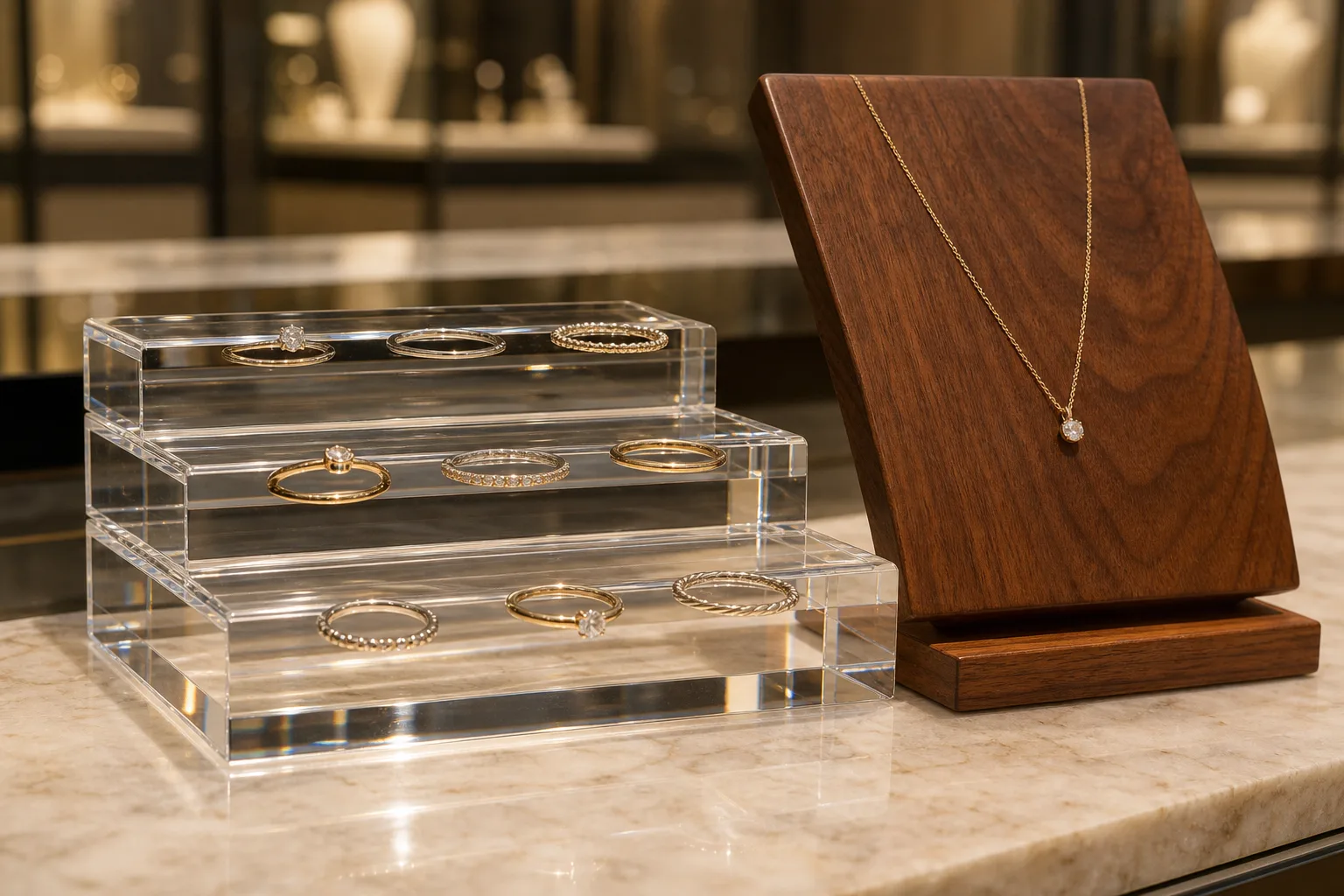
Stand at a jewelry counter and watch the two materials work. On the clear acrylic risers, the rings seem to float — light comes through the fixture, hits the stones from below and behind, and the metal is the brightest thing in the case. On the walnut stand beside them, the same rings sit inside a warmer picture: grain, weight, craft. Neither counter is wrong. They are telling two different stories, and the acrylic vs wood jewelry display decision is really about which story is yours.
The physics underneath the impression is simple. Cast acrylic transmits about 92% of visible light,1 so a polished riser adds almost nothing between the shopper and the piece — no shadow under the shank, no competing texture, no color cast on a white diamond. Wood does the opposite on purpose: it absorbs light, contributes its own color and grain, and frames the piece the way a gallery frames a painting.
The briefs that go smoothly are the ones that name the story first and the material second — a pattern six-plus years of coordinating jewelry display orders keeps confirming. The sections below give the comparison the way I walk buyers through it: brand fit, light, daily wear, cost over time — and the mixed build that takes both materials’ wins in one fixture.
Brand tone decides more than material specs
Match the fixture to the brand voice: minimal, modern, and fine-jewelry positioning leans acrylic, because the fixture’s silence reads as confidence. Heritage, artisan, organic, and sustainable positioning leans wood, because the material itself testifies to the story. The fixture is packaging the shopper never takes home — it still has to speak the brand’s language.
| Brand positioning | Lead material | Why it reads right |
|---|---|---|
| Fine jewelry / diamonds | Clear acrylic | Nothing competes with the stone; maximum light |
| Minimal / modern / lab-grown | Clear or frosted acrylic | Clean geometry matches the design language |
| Heritage / craft / artisan | Wood (walnut, oak) | Material warmth echoes the making story |
| Organic / sustainable | Wood or wood + acrylic mix | Natural texture supports the positioning |
| Fashion / color-led | Colored or frosted acrylic | Sheet color becomes part of the visual identity |
| Luxury boutique, mixed lines | Wood base + acrylic tops | Warm architecture, invisible product support |
Reading the table top-down hides one nuance worth pulling out: positioning is about the whole counter, not each fixture. A heritage brand does not need walnut under every ring — it needs the counter’s architecture to say heritage while each stone still gets its light. That is why the last row exists and why it wins so many briefs.
Two practical notes from the order files. First, colored acrylic widens this map more than buyers expect: frosted sheet reads soft and gallery-like, black acrylic reads sharply modern, and a custom Pantone-matched color ($200-300 one-time per color) can put the brand’s exact identity into the fixture material itself — a move wood cannot make. Second, consistency beats novelty: a brand whose e-commerce photography is all white-and-light will make its counters look wrong on walnut, however handsome the walnut is. The counter, the campaign, and the packaging should agree. For a broader tour of fixture formats before you lock a material, our jewelry display ideas guide maps the standard forms.
Light and sparkle: the working difference
Jewelry retail is a light business, and the materials handle light in opposite ways. Clear acrylic passes it — through the riser, under the piece, into the pavilion of a stone — while wood absorbs it and returns warmth instead. For brilliance-led product, the transparent fixture is measurably the better lightbox.
This is the section where I stop being neutral for one product category: diamonds and white metals. Sparkle is scattered light, and a stone on a clear riser inside a well-lit case receives light from more directions than the same stone on an opaque block, which shadows it from below. The mirror-finish shoe display project covers the base finish, viewing conditions, product fit, and packing as buyer-approved inputs. Warm-toned pieces complicate the rule pleasantly: gold, amber, pearl, and enamel can read richer against wood’s warmth, the way they do against a velvet pad. If your line spans both, that is not a dilemma; it is an argument for zoning the counter — transparent fixtures where brilliance sells, wood where warmth does.
Whatever the material, height discipline matters more than material for sightlines: tiered risers that lift back rows into view do more for sales per square meter than any finish choice. Our acrylic risers page covers the standard tiered forms jewelry counters build on.
Daily wear: cleaning, scratches, and refinishing
Acrylic’s care routine is short: soft cloth, mild soap, water — and strictly no ammonia- or alcohol-based cleaners, which chemically attack the surface and cause fine cracking (crazing) over time.2 Wood’s routine is longer-term: finishes wear at exactly the spots staff and shoppers touch, and a serious fixture eventually needs refinishing.
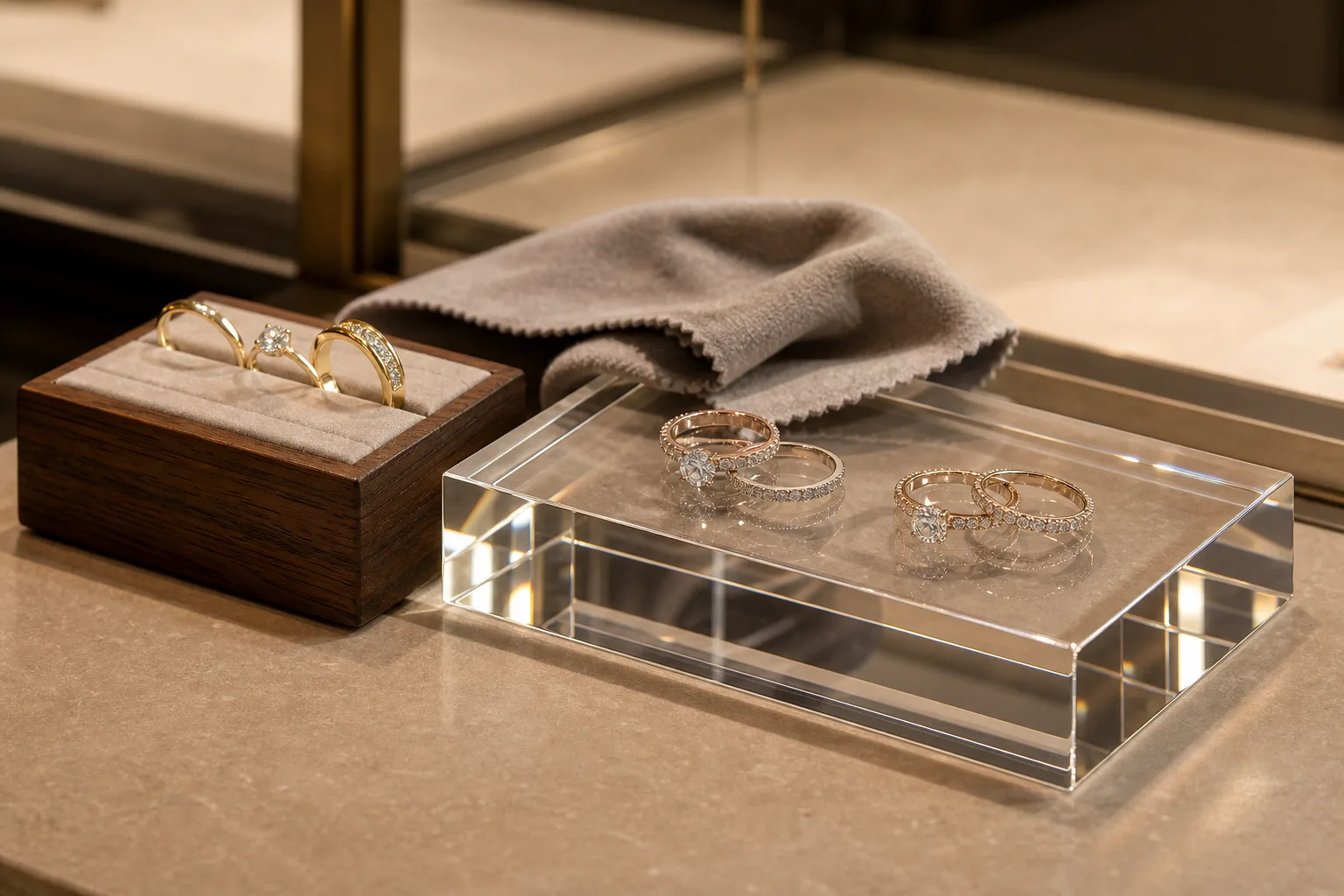
Jewelry fixtures lead a harder life than most retail hardware because they are handled constantly — every try-on, every restage, every evening lock-up moves product across the surface. On acrylic that traffic eventually writes fine hairlines you manage with good habits (damp cloth, never dry-dusting grit across the surface) and, when needed, a light repolish. On wood the same traffic wears the lacquer or oil finish through at the contact points, and a worn patch on a display in a luxury case is surprisingly loud. Neither material is delicate; they just fail differently — acrylic cosmetically and slowly, wood finish locally and visibly.
One jewelry-specific caution belongs on the record: keep silver away from prolonged contact with bare, unsealed wood. Some woods and finishes give off traces of acids that accelerate silver tarnish in enclosed cases — the reason museum conservators are picky about display-case materials. Sealed, cured finishes and ventilated cases manage the risk, and acrylic sidesteps it entirely; it is one more quiet reason the material took over the inside of jewelry cases even at stores whose architecture is all wood.
Cost over the fixture’s life
The acrylic vs wood jewelry display invoice overlaps more than buyers expect — quality wood fixtures and custom acrylic fixtures land in similar bands, with acrylic usually the economical pick at volume because CNC-cut sheet carries no tooling fee on most designs. The larger cost difference accrues later: refinishing, replacement of worn wood pieces, and the freight weight of solid timber.
A grounded way to compare, using the structure rather than fake precision: an acrylic riser set is thin-walled cut sheet, so a 50-store program ships light and reorders only for expansion; solid wood stands ship heavy and their finish, not their structure, sets the replacement clock. On multi-year programs I coordinate, the acrylic line item behaves like capital equipment — bought once, expanded occasionally — while wood fixtures behave more like maintenance, with refinishing or replacement riding each major reset. If the brand story pays for wood, that maintenance is money well spent; the mistake is not budgeting it at all because the invoice looked comparable.
Ordering economics also differ at the sample stage. A standard-form acrylic sample ships in 3-5 days, while complex one-off builds take longer because of the added programming and finishing. Both sample types are paid separately and are not credited to production. Either way the sample settles the material debate faster than any rendering — put your actual pieces on the actual fixture under your counter’s actual lighting, and the acrylic vs wood jewelry display question usually answers itself in an afternoon.
The mix-and-match build: wood warmth, acrylic optics
The strongest jewelry counters often refuse the either-or: a wood base carries the brand warmth and architecture, while clear acrylic risers, busts, and covers do the invisible work of holding pieces in the light. One fixture family, both stories — and each material doing only the job it is best at.
The classic builds we quote, in rough order of frequency: clear acrylic tiered risers standing on a walnut or oak plinth; a bonded five-sided acrylic cover over a wood-based presentation tray, turning it into a dust-protected case; acrylic ring wedges and earring stands sitting inside a wood-framed showcase; and engraved acrylic sign blocks matching a wood counter’s brand plaque. The engineering is in the mating detail — a recess, a locating pin, or a bonded fit that keeps the acrylic registered on the base without visible hardware — and we cut the acrylic side to your base’s measured dimensions.
Practically, brands solve the two-material supply chain in one of two ways: send us the wood base’s drawings (or a physical base) and we engineer the acrylic to fit, or have us coordinate the full assembly through our own sourcing so the program arrives as one SKU. Both paths run through the same 3-5 day sample gate, and the sample is where fit tolerances get proven before the run.
Transitions between materials also phase more gently than buyers fear. When I coordinate a program replacing tired wood fixtures across a boutique chain, we rarely flip every door at once — the usual pattern is one flagship counter first, photographed and reviewed against sales, then the rollout follows in waves on reorders from the same archived cutting files. Because most acrylic designs carry no tooling fee, wave two costs the same per piece as wave one, and the program can adjust sizes between waves without penalty. That phasing is harder on the wood side, where a joiner’s setup and finish matching across batches are their own project. If your line is transitioning the other direction — replacing tired wood fixtures with acrylic while keeping brand warmth — frosted and bronze-tinted acrylic are the halfway materials worth sampling; the full range of forms lives on our jewelry display applications page.
How we build the acrylic side
We cut every jewelry fixture from cast acrylic sheet on CNC and laser lines, polish the edges by diamond machine or flame, and finish with engraving, UV print, or bonded assembly — the same production path our custom acrylic displays work has followed across 2,000+ projects. Because nothing is molded, custom shapes and sizes carry no tooling fee on most designs.
The jewelry fixture family we produce most often: tiered ring risers and ring wedges, necklace busts and easels, earring stands with drilled or slotted hangs, bracelet ramps and T-bars, presentation trays with routed recesses, and five-sided covers that turn any tray into a dust-protected case. Each form comes in the full material range — water-clear, frosted, black, white, bronze-tinted, mirror-finish, or a custom Pantone-matched color — and we pair routed recesses with velvet or felt inserts where pieces need cushioning against hard surfaces. Branding rides the same run: laser engraving cuts a permanent frosted mark into the surface, and UV print lays full-color logos onto bases and headers.
Two production details matter specifically for jewelry programs. First, edge quality is not cosmetic at this scale — a counter fixture sits centimeters from a shopper’s eye next to polished metal, so we diamond-polish the visible edges on jewelry work rather than leaving saw-finish faces that read cloudy at close range. Second, tolerances on mating parts are tighter than general retail work: a ring slot a half-millimeter too wide lets the ring lean, and a bust’s necklace groove has to hold a chain’s fall exactly where the merchandiser set it. Both are settled at the sample stage, on your actual pieces, before the run cuts.
We also inspect every piece against the approved sample before packing — our factory has run ISO 9001 quality management since 2008, and jewelry fixtures get the piece-by-piece treatment because a single cloudy edge in a fifty-riser program is the one the boutique manager will notice.
Decision rules and ordering
Choose acrylic when brilliance-led product, minimal branding, heavy daily cleaning, or program scale leads the brief. Choose wood when material warmth is the brand story and the maintenance budget is real. Choose the mixed build when you want both — it is the option most premium briefs actually end at.
The short checklist I send buyers who are stuck:
- What does your product photography look like? The counter should match it.
- Diamonds and white metals front and center? Clear acrylic under them, whatever else you do.
- Is warmth a brand asset or an accessory? Asset → wood leads. Accessory → wood base, acrylic tops.
- Who maintains the fixtures, and how often? No refinishing budget → acrylic.
- How many doors? Volume rollouts favor acrylic’s no-mold cutting and lighter freight.
To quote a program, send the fixture list (risers, busts, trays, covers), sizes or the pieces they hold, material and finish preferences, quantities, and any wood-base drawings through our contact form — we respond within 24 hours. Samples in 3-5 days, production in 15-20 days at a 100-piece MOQ from our ISO 9001-certified factory, 30% deposit with the balance before shipment, and 100% inspection against your approved sample. Whether the counter ends up clear, warm, or both, the fixture should be a decision — not a default.
Footnotes
-
OPTIX acrylic sheet datasheet — Plaskolite — manufacturer datasheet listing acrylic total light transmission at 92% per ASTM D1003, the transparency figure behind the light-through-the-fixture claim. ↩
-
Technical support and processing guidance — Röhm PLEXIGLAS polymers — the PMMA manufacturer’s technical guidance on chemical compatibility, documenting the solvent- and alcohol-induced surface crazing behavior behind the no-ammonia, no-alcohol cleaning rule. ↩
Frequently Asked Questions
Is acrylic or wood better for jewelry displays?
It depends on what should carry the counter. Acrylic is nearly invisible and passes light through the piece, so stones and metal do the selling — the default for fine and minimalist brands. Wood adds warmth and texture that suit artisan and heritage positioning. Many strong counters mix both: wood for tone, acrylic for the pieces that need light.
Does jewelry look more expensive on acrylic or wood?
Diamonds and polished metals usually read best on clear acrylic or white surfaces, because nothing competes with the piece and light reaches it from more angles. Gold, amber, and organic materials like pearl can read richer against warm wood. Test with your actual product photography — the counter should agree with the campaign imagery.
How do you clean acrylic jewelry displays without scratching them?
Soft microfiber cloth, mild soap, water — and never ammonia- or alcohol-based glass cleaners, which attack acrylic's surface and cause fine cracking over time. Dust with a damp cloth rather than a dry one to avoid dragging grit. Handled that way, a polished acrylic display keeps its clarity through years of daily counter cleaning.
Can you combine a wood base with acrylic jewelry displays?
Yes — wood-base-plus-acrylic-top is one of the most requested jewelry fixture builds we quote. We produce the acrylic components (risers, busts, covers, trays) engineered to mate with a wood base by recess, pin, or bonded fit, and can coordinate dimensions with your woodworker or supply the assembly through our own sourcing.
What is the minimum order for custom jewelry displays?
100 pieces per design — sized for boutique chains, brand rollouts, and production programs rather than single-store one-offs. Samples ship in 3-5 days, production runs 15-20 days from our ISO 9001-certified factory, and terms are a 30% deposit with the balance before shipment. Custom sizes and shapes usually add no tooling fee.
Explore Custom Acrylic Products
Browse product categories to compare formats, materials, and customization options before choosing the closest fit for your project.