Acrylic Box Insert Options Comparison
The insert must hold the real product through presentation and transport without scratching it or making removal difficult.
Need this made?Custom acrylic boxes →
Key Takeaways
- Acrylic inserts create precise visible structure; foam absorbs variation and impact; velvet changes touch and presentation; card reduces weight and supports printed instructions.
- The actual product, accessories, protective films, and final packout sample must control cavity geometry.
- Retention and removal are separate requirements: a tight cavity can protect poorly if users cannot lift the product safely.
- Contact surfaces need an abrasion and material-compatibility review for the named product finish.
- Approve the complete box, insert, product, accessories, and carton as one paid sample.
On this page
- Choose the insert by function
- Compare five construction routes
- Use acrylic for visible precision
- Use foam for cushioning and variation
- Use velvet for presentation surfaces
- Use card for lightweight printed structure
- Control retention and removal separately
- Review abrasion and compatibility
- Approve the complete packout
- Send an insert-ready RFQ
- Compare lifetime and replacement strategy
Choose the insert by function
Acrylic box insert options should be chosen from the functions the insert must perform: locate the product, absorb variation, resist movement, protect surfaces, present accessories, support removal, and survive packout. No single material is best at every job, so hybrid inserts are common when presentation and transport need different behavior.
Start with the actual product, accessories, labels, caps, sleeves, cables, and protective films. A clean CAD envelope can miss flexible, protruding, or variable features. Provide approved minimum and maximum dimensions when products vary.
Use the custom acrylic boxes hub to select the enclosure and closure. The insert depends on available internal dimensions, lid movement, access direction, and whether the box is a retail package, display case, gift box, or reusable organizer.
I first ask how the user removes the product. That question prevents a cavity from being optimized only for retention while ignoring fingers, lifting force, and fragile contact points.
Compare five construction routes
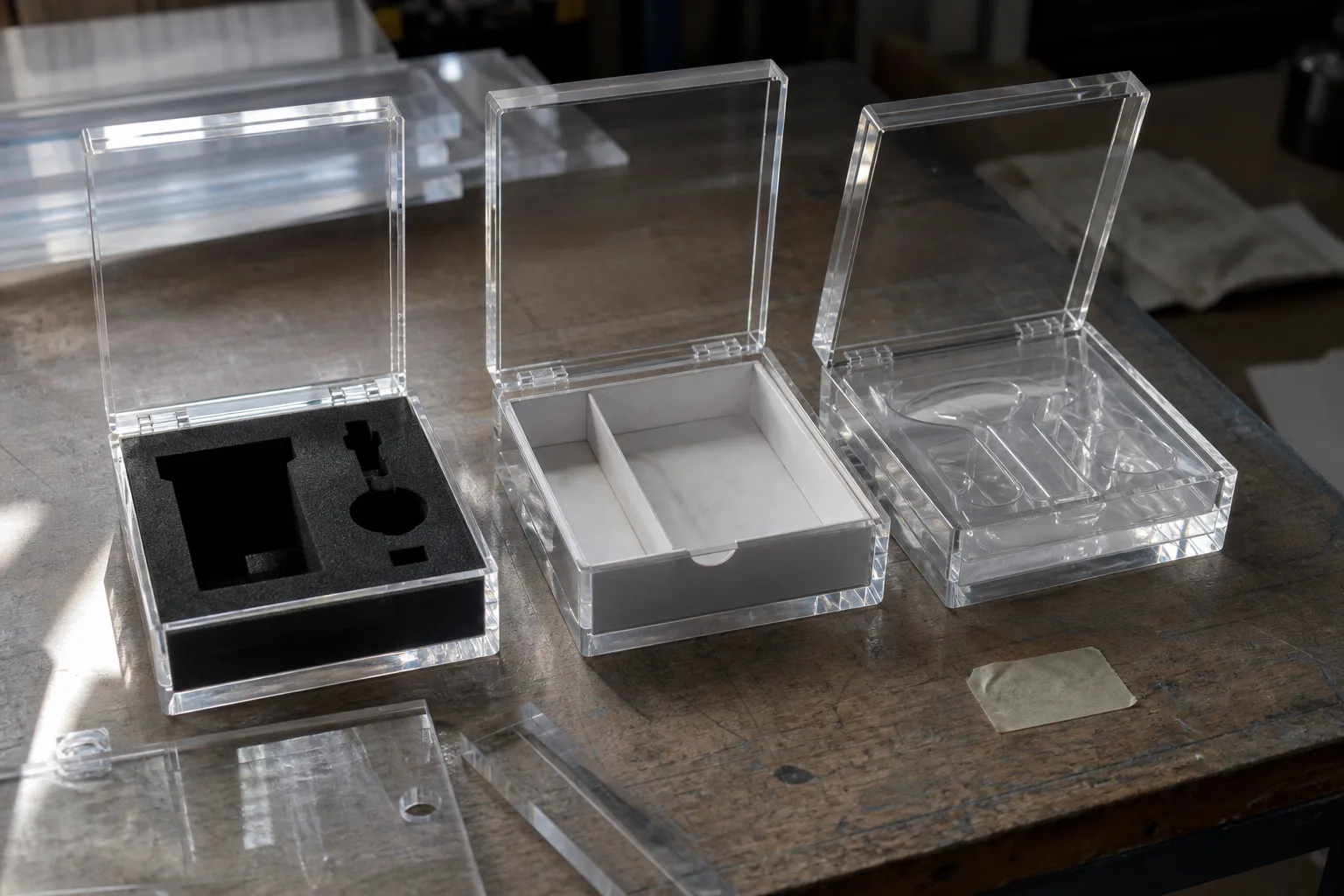
Clear acrylic inserts give precise visible structure. Foam provides cushioning and absorbs dimensional variation. Velvet adds a soft presentation surface. Printed card supports lightweight partitions and instructions. Hybrid inserts combine functions, such as a foam core with velvet wrap or an acrylic tray over a card information layer.
| Insert | Strong fit | Main control | Common limitation |
|---|---|---|---|
| Acrylic | Visible geometry, reusable dividers, rigid location | Finished dimensions and polished contact edges | Less tolerance absorption |
| Foam | Cushioning, irregular products, transport restraint | Density, recovery, cavity shape | Can hide product and collect particles |
| Velvet wrap | Jewelry, gifts, premium touch points | Fabric, color, adhesive, wrap quality | Adds thickness and seam direction |
| Printed card | Instructions, light dividers, campaign graphics | Board grade, print, fold and slot | Lower moisture and repeated-use tolerance |
| Hybrid | Multiple functions in one pack | Interface between materials | More parts and approval points |
Quote the complete insert rather than comparing raw material price. Cutting, machining, wrapping, printing, assembly, inspection, and packing determine the commercial result.
Use acrylic for visible precision
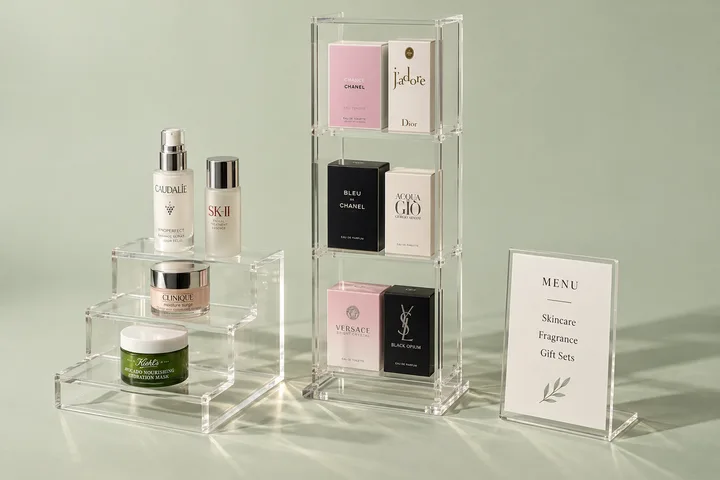
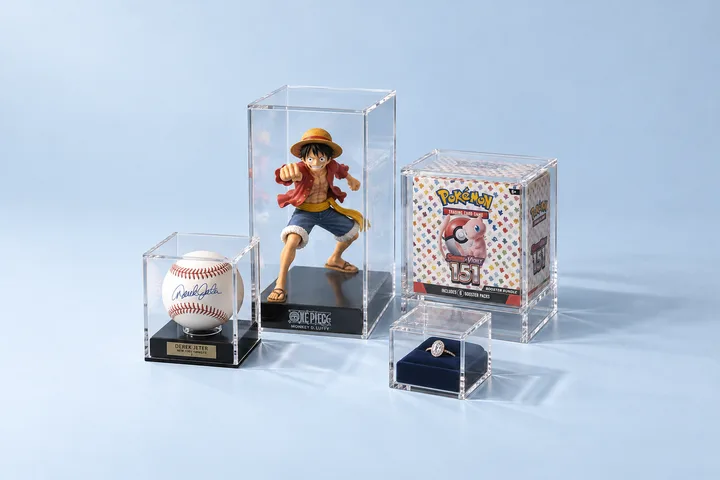
An acrylic insert suits products that should remain visible and precisely arranged. It can form compartments, ledges, platforms, dividers, holes, pockets, and removable trays. Clear material keeps sight lines open; colored or frosted layers can support brand presentation.
Dimension every product interface and polish show edges that users touch or see. Internal pockets, small radii, and narrow slots need a process route compatible with the geometry. Do not specify the same edge finish for accessible outside edges and deep internal features without review.
Acrylic absorbs less dimensional variation than foam. If the product changes by mold lot, label, cap, or sleeve, build buyer-approved clearance into the cavity and test the boundary samples.
Use finger notches, lift ribbons, eject holes, removable trays, or open sides when the product must be lifted. The insertion and removal path belongs on the drawing.
Use foam for cushioning and variation
Foam can restrain products, cushion impact, absorb dimensional variation, and reduce contact between the item and rigid box. The buyer should specify or approve foam family, density or performance requirement, color, thickness, odor expectation, surface, and cavity process.
Closed-cell and open-cell foams behave differently around dust, liquids, compression, and recovery. Ask the foam producer for current datasheet information when a performance property matters. Do not infer transport protection from color or a generic “high density” label.
Cavity geometry must avoid concentrating force on fragile controls, caps, corners, labels, finishes, or seals. Test insertion, retention, removal, and recovery with actual product boundary samples.
If the foam is visible, approve color consistency, cut edge, surface texture, seams, and adhesive. If it is hidden, still control particles, odor, compression, and long-term contact with the named product finish.
Use velvet for presentation surfaces
Velvet or similar fabric wrap changes touch, color, and perceived presentation. It is usually a covering over foam, board, or another shaped core rather than the complete structural insert.
Approve fabric type, direction, color target, backing, adhesive, seam location, edge wrap, and cavity size after wrapping. Fabric thickness reduces the final opening, so geometry should not be released from the uncovered core alone.
Check lint, particles, dye transfer, adhesive visibility, and contact with polished, painted, plated, printed, or soft-touch product surfaces. The named product and sample define compatibility; a blanket “scratch-free” statement does not.
Plan replacement or cleaning realistically. A reusable presentation box may need a removable wrapped tray, while a one-time gift pack can use a permanently bonded insert.
Use card for lightweight printed structure
Printed card inserts support partitions, platforms, sleeves, instructions, legal copy, and campaign graphics with low weight. They can be die-cut, folded, slotted, laminated, or combined with foam and acrylic.
Define board grade, thickness, flute or fiber direction where relevant, print construction, coating, fold, slot, glue, visible edge, and moisture exposure. A paper prototype can confirm assembly logic but may not represent final stiffness and print finish.
Card is useful when information changes more often than the acrylic box. Keep the box drawing stable and issue a controlled card artwork and cut revision for each campaign.
Test the complete packout for movement and crushing. A card platform that looks stable on a desk may buckle when accessories shift or master cartons stack.
Control retention and removal separately
Retention prevents unwanted movement; removal lets the user lift the product without damage or frustration. Define both. A buyer may require the product to remain seated during normal handling while still being removable with one hand at the display counter.
Name permitted movement, orientation, contact zones, opening sequence, lifting point, and any force or functional check the buyer requires. Use actual products at the accepted dimensional limits.
Finger notches, ribbons, removable covers, spring features, magnets, and eject holes can assist removal. Keep them away from fragile surfaces and visible artwork. Approve loose accessories and instructions in the same opening sequence.
Do not make the product itself carry the load of closing the lid. Confirm lid clearance, compression, and contact after the box is fully assembled.
Review abrasion and compatibility
Every product-contact surface needs review. Polished acrylic, foam, fabric, board, adhesive, ink, protective film, and cleaning residue can interact with painted, plated, printed, coated, optical, or soft-touch finishes.
Ask the product owner to name prohibited contacts and cleaning chemicals. Use supplier datasheets where available and approve a production-representative sample for the intended contact period and environment.
ASTM packaging standards provide test methods that a buyer may nominate for a defined product and route.1 ISTA also publishes packaged-product procedures for specified distribution environments.2 Neither source creates a universal pass result for an unspecified insert.
Avoid unsupported claims such as archival, food-safe, medical-grade, anti-static, or chemical-resistant. Those terms require named materials, documents, jurisdictions, and buyer acceptance criteria.
For valuable or sensitive products, the buyer can nominate independent compatibility or transport testing. ASTM publishes packaging and distribution test standards, but the selected method and acceptance criteria must fit the program.1
Approve the complete packout
The sample should include the production box, insert, product, accessories, graphics, protective films, labels, inner packing, and master-carton assumptions. Test opening, presentation, retention, removal, reassembly, and movement.
Wetop paid samples take 3–5 days, are paid separately, and are never credited to production. Production MOQ is 100 pieces per design. Standard production takes 15–20 days after approvals.
Record the drawing revision, materials, product sample, cavity fit, contact restrictions, visible boundary, assembly sequence, packing, and accepted deviations. Photograph each layer as the box opens.
If the product changes after approval, repeat the affected fit and packout review. Do not assume a revised cap, label, sleeve, or accessory remains inside the old cavity.
Send an insert-ready RFQ
Send actual products and accessories, boundary dimensions, product finishes, box format, orientation, retention and removal needs, material restrictions, quantity, packout, destination, and required date. Mark which inputs are fixed and which can be engineered.
Ask the supplier to return materials, construction, cavity assumptions, contact surfaces, removal features, assembly, sample, unit price, packing, carton data, Incoterm, and freight.
Use the box insert quote form to upload the brief. We reply to complete files within 24 hours with a recommended insert and sample plan.
The custom packaging insert project shows how product geometry, insert material, sample approval, and final packout are handled. Use the workflow with your actual product and distribution test.
For artwork-led packaging, the metallic-gold acrylic box project shows how one box geometry can carry separate insert, proof, quantity, and carton controls for each SKU.
The tray logo and insert options guide adds useful questions for removable printed or decorative layers. A box insert often needs those same controls plus closure clearance and transport restraint.
Keep the approved product sample, box drawing, insert drawing, material specifications, artwork, packout, and acceptance record together. That set becomes the release file for repeat orders.
Compare lifetime and replacement strategy
An insert can be permanent, removable, replaceable, or campaign-specific. Define that lifecycle in the drawing. A permanently bonded foam or velvet insert may suit a one-time presentation box, while a removable acrylic tray or card insert can support product changes and cleaning.
Replacement affects access and spare-part control. Give the insert its own part number and revision when it may be reordered separately. State whether staff can replace it without tools, whether magnets or fasteners remain captured, and how the correct version is labeled.
Compare the cost of replacing only the insert with replacing the complete box. A more expensive removable insert may extend the useful life of the acrylic enclosure when products, artwork, or accessory packs change. Conversely, a disposable campaign pack may not justify a complex serviceable system.
Add cleaning and storage instructions for spare inserts. Protect show surfaces, fabric, and adhesive from dust, heat, moisture, abrasion, and mixed versions. The reorder file should link the active insert to the compatible box and product revisions.
Match the insert to the acrylic boxes hub and custom acrylic box constructions. Retail programs can use the POP and POS manufacturing route to align the insert, product, artwork, and store packout.
Footnotes
-
ASTM packaging standards — ASTM lists packaging and distribution standards that buyers can nominate for defined products and routes. ↩ ↩2
-
ISTA test procedures — ISTA provides packaged-product test procedures for buyer-selected distribution environments. ↩
Frequently Asked Questions
What is the best insert for an acrylic box?
Use acrylic for visible precision, foam for cushioning and tolerance absorption, velvet for presentation surfaces, card for lightweight printed structures, or a hybrid when the product needs more than one function.
Should the product fit tightly in the insert?
It should meet buyer-approved retention without scratching, deforming, or blocking removal. Fit must include actual product variation, labels, caps, sleeves, and protective films.
Can velvet cover a foam insert?
Yes. Approve the foam density, fabric, color, adhesive, seam or wrap direction, edge finish, and contact with the named product on the physical sample.
How is a removable insert held inside an acrylic box?
Common routes include friction, tabs, ledges, magnets, screws, adhesive, or a captured base. The drawing should define removal access and whether replacement is intended.
What should an insert RFQ include?
Send the actual product and accessories, product variation, box drawing, orientation, retention and removal needs, contact restrictions, packing, quantity, and destination.
Test the Product Inside the Complete Box
Send the product, accessories, box format, presentation brief, quantity, and packing route. We will return an insert and sample plan within 24 hours.