Acrylic vs Crystal Awards: Buyer Guide
Crystal earns its place on the CEO's shelf. Acrylic wins the 200-piece recognition program. The mistake is buying one job with the other material's award.
Need this made?Custom acrylic awards →
Key Takeaways
- Crystal can suit a flagship piece and acrylic can suit a repeat program, but both need like-for-like quotes on the same size, decoration, packing and quantity.
- Acrylic is roughly half the weight of glass-family materials — about 1.2 g/cm³ versus about 2.5 g/cm³ — which cuts both freight cost and transit breakage on shipped award programs.
- Acrylic and glass-family awards fail differently; approve the finished construction and packing rather than assuming a dropped carton needs only cosmetic work.
- Custom shapes favor acrylic: CNC-cut awards carry no tooling fee on most designs, while a custom crystal form usually needs a mold and the setup cost that comes with it.
- Branding freedom differs — crystal is limited mostly to etching, while acrylic accepts laser engraving, full-color UV print, tinted and frosted sheet, and custom Pantone color at a $200-300 one-time match fee.
On this page
Acrylic vs Crystal Awards: Which Fits the Program?
100 pieces per design, a paid sample in 3–5 days, 15–20 production days, an 8–20 mm illustrative acrylic thickness range, and a ±0.2 mm standard working tolerance frame the acrylic vs crystal awards comparison; the approved geometry and process set final tolerances.
| Published acrylic price reference | Quantity | Single cost point |
|---|---|---|
| 5 × 7 inch flat plaque · 8 mm clear acrylic · logo + name + year engraving | 100 units | $14.20 each FOB Shenzhen · published reference, not a quote — see custom acrylic awards |
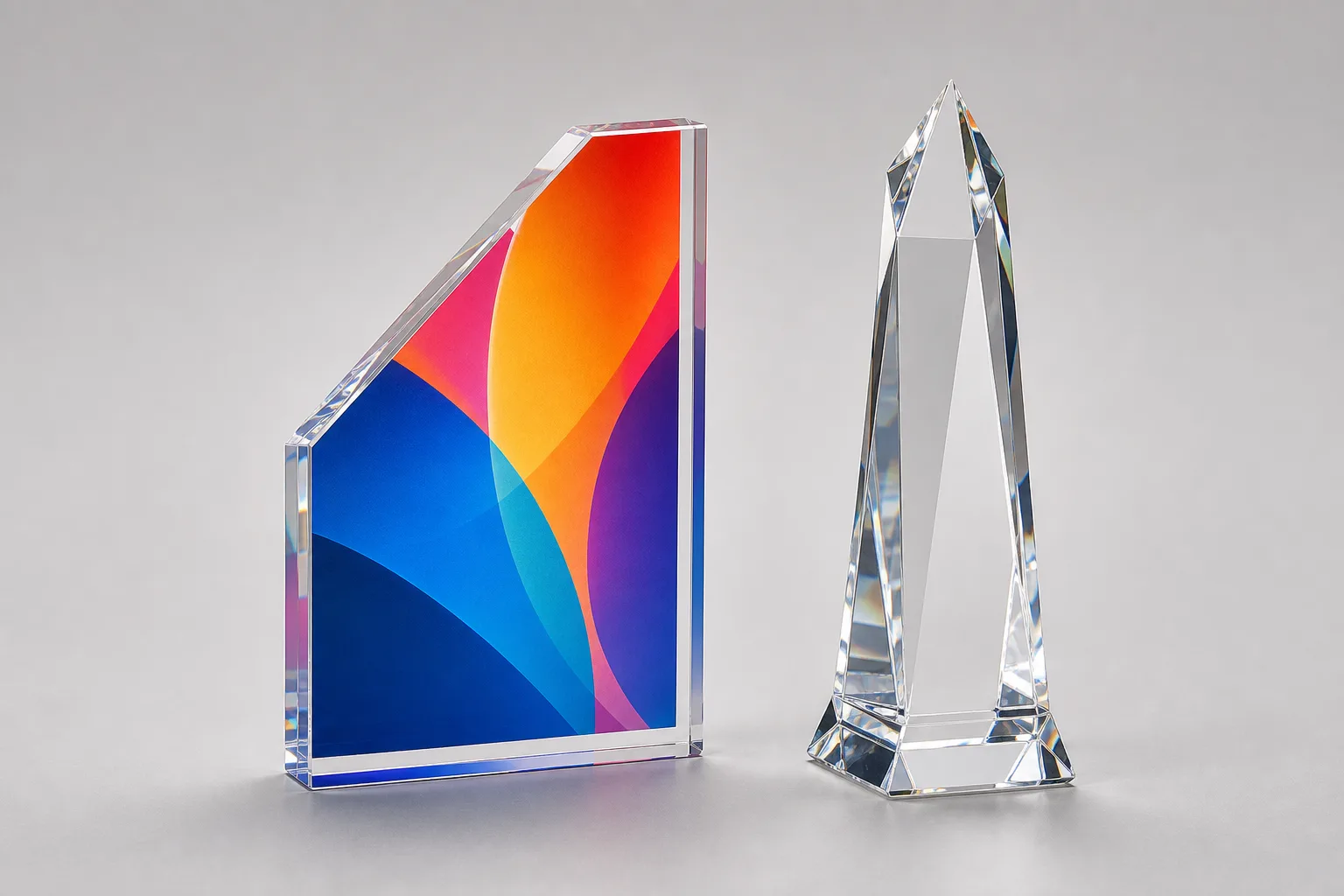
Optical crystal can suit a flagship piece where heft and refraction carry the moment, other glass awards require their own composition and forming specification, and acrylic can suit programs that need repeatable shapes, color and variable text. Compare all three on the same size, decoration, quantity and packing brief.
The assumption I push back on most often in award inquiries is that crystal equals prestige and acrylic equals compromise. Recipients do not weigh awards on a scale. They see the design: the shape, the finish of the edge, the crispness of the engraving, whether their own name is on it. A thick, diamond-polished acrylic piece with clean personalization reads as a premium object — and a thin, generic crystal wedge with a rushed etch reads as a catalog item. Material is one input; the buying mistake is treating it as the whole decision.
This guide compares the two materials on the axes that actually change your outcome — optics, weight, breakage, branding methods, unit price, and lead time — and ends with plain decision rules. We build custom acrylic awards and we do not build crystal, so where crystal genuinely wins, this guide says so. Sending a buyer toward the right material costs us one order and earns the next three.
What each material actually is
Acrylic awards are CNC- or laser-cut from cast PMMA sheet, then edge-polished, engraved, or UV-printed. Crystal awards are glass-family pieces — typically optical crystal — that are molded or cut, then ground, polished, and annealed. Cutting versus molding is the root of almost every cost and lead-time difference between them.
The fabrication difference matters more than the chemistry. Because an acrylic award starts as flat sheet and a cutting file, any outline — a bespoke silhouette, a company logo shape, an interlocking two-part trophy — costs the same tooling as a rectangle: nothing. We cut awards on the same CNC and laser lines as our display work, which is why most custom acrylic carries no tooling fee. Crystal works the other way around. Standard catalog forms (towers, wedges, globes) are economical because the molds already exist; a custom crystal form means a new mold, a setup charge, and a longer clock before the first article exists.
Crystal’s process also buys it real physical qualities: higher density, a harder surface, and stronger light refraction. Those are genuine advantages in the right context — the next two sections put numbers on where they help and where they quietly cost you.
Optics: sparkle versus clarity
Crystal refracts more light — its higher optical density produces the prismatic fire that makes a faceted tower glitter under stage lighting. Cast acrylic is water-clear rather than fiery: it transmits about 92% of visible light with very low haze, so it reads as pure transparency instead of sparkle.1
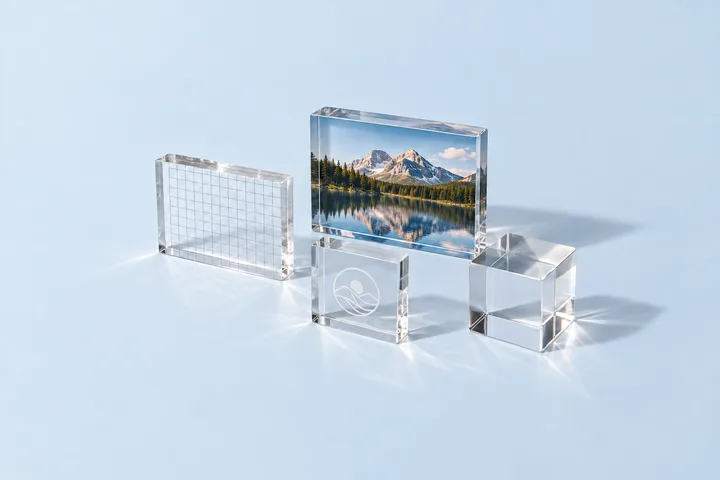
Which optical behavior you want depends on the award’s design language. Faceted, jewel-like geometry rewards crystal, because every cut face splits the light. Clean modern geometry — floating text, a UV-printed full-color logo panel, a minimalist slab on a lit base — rewards acrylic, because the material disappears and the design carries the piece. Acrylic also takes light through itself beautifully: edge-lit awards, where an LED base makes the engraving glow, are an acrylic-native effect that crystal’s density and cost make impractical at program quantities. For a solid award rather than a flat plaque, start from a clear acrylic display block.
Hand-feel is the other optical-adjacent factor buyers ask me about. Crystal is cold and heavy in the hand, and that heft communicates value at the moment of presentation — a real, honest advantage for a single ceremonial piece. A 15mm or 20mm acrylic award has satisfying weight of its own, but a same-size crystal piece will always be roughly twice as heavy. For one award handed to one executive, that favors crystal. For two hundred awards in freight cartons, the same physics flips the argument — which is the next section.
Weight, freight, and breakage
Acrylic runs about 1.2 g/cm³;2 soda-lime and optical glass sit near 2.5 g/cm³.3 A crystal award of the same dimensions therefore ships at roughly double the weight, and on a 200-piece program the difference compounds into real freight money — before counting the heavier protective packing crystal demands.
| Property | Cast acrylic award | Crystal award |
|---|---|---|
| Density | ~1.2 g/cm³ | ~2.5 g/cm³ (higher for lead crystal) |
| Relative shipped weight | Baseline | Roughly 2x, plus heavier packing |
| Impact behavior | Can crack or chip; depends on geometry and support | Can chip or break; depends on composition and forming route |
| Surface hardness | Softer — can scratch, polishes out | Harder — resists scratches |
| Transit response | Inspect against the approved finish and packing criteria | Inspect against the approved finish and packing criteria |
Breakage behavior depends on the exact acrylic or glass-family material, geometry, support and packing. A dropped carton should be quarantined and inspected against the approved surface, edge and dimensional criteria; do not assume either material can be field-repaired or returned to service without review.
Crystal’s counterpoint is surface hardness: it resists scratching better than acrylic. For awards — objects that sit on shelves rather than being handled daily — we offset acrylic’s softer surface with thicker stock, diamond-polished edges, and individual sleeve packing, and scratch complaints on award programs are rare in my order history.
Branding: engraving, print, and color
Acrylic accepts nearly every decoration method we run: laser engraving, full-color UV print, silk-screen, frosted and tinted sheet, mirror sheet, and custom Pantone-matched color at a $200-300 one-time fee per color. Crystal branding is mostly limited to etching — elegant, but monochrome and shape-constrained.
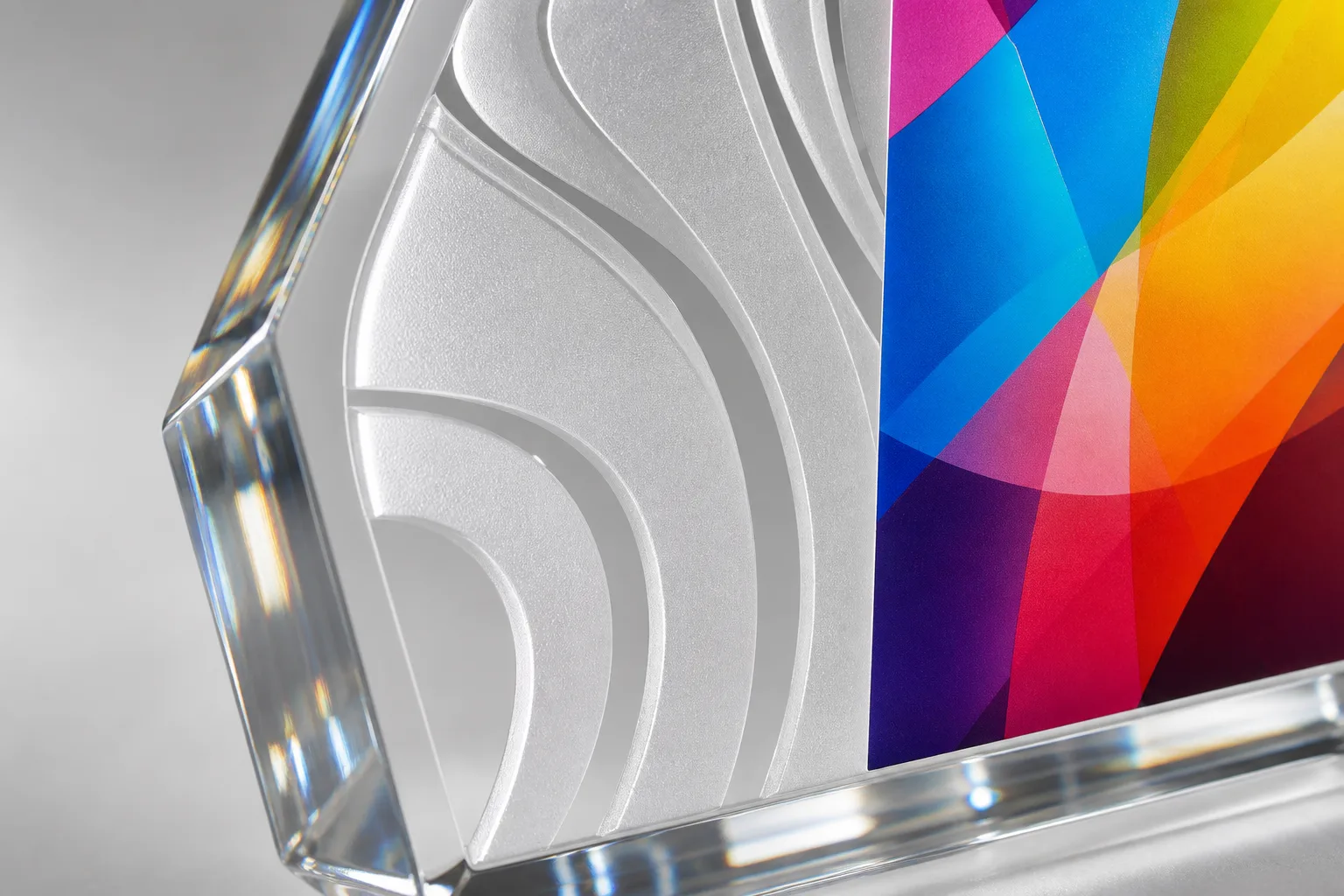
This is the axis where acrylic is not just cost-competitive but genuinely more capable. Laser engraving on acrylic produces a permanent frosted-white mark that reads much like sandblasted crystal. UV printing goes where crystal cannot: brand-exact color, gradients, photographic artwork, and edge-to-edge graphic panels. Colored and frosted sheet builds the brand into the material itself — a two-layer award in company colors, a smoked-gray slab with white engraving, a mirror-gold accent base.
Personalization at volume is the quiet decider for programs. Recipient names, titles, and per-region variants are file changes on a laser or UV line, not new tooling, so a 300-piece run with 300 different names moves through production as one order. Etching individual names into crystal is done all the time — but it is slower, single-color, and priced accordingly. If your award needs to carry a brand system rather than just a mark, acrylic gives your designer the full toolkit; see the decoration options across our custom acrylic awards line.
Price reference and lead times
The acrylic versus crystal price gap follows the approved construction, not a category slogan. The traceable acrylic point above is one specified plaque at one quantity; crystal and other glass awards need like-for-like quotes that name the material, forming route, decoration and packing.
| Factor | Custom acrylic awards | Custom crystal awards |
|---|---|---|
| Price comparison | $14.20 published price reference for the named plaque at 100 units | Current like-for-like quote required |
| Custom-shape tooling | $0 — CNC-cut from sheet | Mold or extended cutting setup |
| Sample | 3-5 days | Longer — molding and annealing cycles |
| Production | 15-20 days at 100-piece MOQ | Commonly longer for custom forms |
| Payment terms (ours) | 30% deposit, balance before shipment | Varies by supplier |
Exact pricing follows size, thickness, decoration count, packing and quantity. Use the $14.20 plaque reference above (and the custom acrylic awards hub) only for early planning, then compare current line-item acrylic and crystal quotes on the same approved specification.
Lead time deserves equal weight to price. Wetop’s acrylic sample-production window is 3–5 days and standard production is 15–20 days after approval; freight and door-to-door timing are quote-specific. Build the sample and name-list approval into the buyer’s event calendar.
Decision rules: which award wins when
Most acrylic vs crystal awards briefs resolve in two sentences. Buy crystal for the single high-stakes piece: a retirement gift, a keystone industry trophy, a one-off where heft and fire are the message and budget-per-unit barely matters. Buy acrylic when quantity, custom shape, color branding, personalization, schedule, or shipped durability enters the brief — which describes most corporate award programs.
The practical split I give buyers:
- Crystal is worth it when the order is one to a handful of pieces, the design is faceted or sculptural, presentation weight matters, and a catalog shape (tower, wedge, globe) fits the brief — the mold economics work in your favor there.
- Acrylic can fit when the run is 100+ units, the award carries approved logo color or recipient data, and the buyer needs a custom shape. For one volume program, see our branded acrylic giveaway project. Displaying completed trophies raises a separate set of material, access, and installation questions; the university athletics trophy display project shows a non-electrical example subject to buyer-approved drawings, materials, hardware, and samples.
- Split the program when both exist in one brief: a crystal piece for the single top honor, acrylic for the tiered volume beneath it. This is a common and sensible structure — the materials are answering different questions.
One more option worth knowing before you lock the spec: mixed-material builds. A wood base under a polished acrylic upright adds warmth and desk presence without crystal’s cost or fragility — you’ll find these hybrid builds in our acrylic awards range. And if the piece is a flat plaque rather than a freestanding trophy, the comparison tilts even further toward printed acrylic; see our acrylic plaques formats.
How each award ages
Crystal’s hard surface resists scratching and the material never yellows; its aging risks are chipped corners and dust settling into facets. Quality cast acrylic holds its clarity for years indoors — a shelf award sees a fraction of the UV that outdoor glazing endures — and its softer surface is managed with packing and simple care.
Care instructions differ enough to be worth printing on the program’s insert card. Acrylic wants a soft microfiber cloth with mild soap and water, and never ammonia- or alcohol-based glass cleaners, which attack the surface chemically over repeated use. Crystal tolerates glass cleaner fine but collects dust in faceted recesses that only a brush reaches. Neither regimen is demanding; the practical difference is that a recipient will treat both awards like the glass objects they resemble, and only the crystal actually is one — so the care card earns its place in an acrylic program’s packaging, and we include one on request.
For recurring programs, aging has a second meaning: does year three’s award match year one’s? This is where cut acrylic has a structural advantage we lean on heavily. We keep every program’s cutting files, engraving settings, and artwork on record, so an annual reorder reproduces the original — same sheet grade, same edge finish, same mark — without re-setup. Our repeat-order tooling library guide explains how that file archive works across years. Crystal programs can achieve the same consistency, but mold availability and supplier continuity carry more risk across a five-year award series than a saved cutting file does.
Mid-program replacements follow the same logic. When a recipient’s award arrives chipped or a name needs correcting, an acrylic replacement is a single-piece cut from archived files — we turn those around with sample-lead-time speed. A single replacement crystal piece from a molded run is a heavier ask, and programs that anticipate attrition typically over-order to cover it, which quietly raises the real unit price.
Ordering acrylic awards from Wetop
To quote an acrylic award program we need five things: quantity, size and thickness, shape (file, sketch, or reference photo), decoration (engraving, UV print, colors), and your in-hands date. Send those through our contact form and we respond within 24 hours with pricing and a production plan.
The path from there is the same one our 2,000+ projects have followed: a sample in 3-5 days, your approval (with one revision round if needed), then 15-20 day production at a 100-piece MOQ in our ISO 9001-certified Shenzhen factory, with every unit inspected against the approved sample before packing. Terms are a 30% deposit with the balance before shipment. Personalized name lists ride along as artwork files — send a spreadsheet and we handle the per-unit text.
If you are still weighing formats, start at the acrylic trophies page for freestanding pieces or the awards hub for the full range. And if your brief is genuinely a single crystal showpiece — buy the crystal. For everything your program hands out by the carton, cut acrylic is the material doing that job well.
Footnotes
-
OPTIX acrylic sheet datasheet — Plaskolite — manufacturer datasheet listing acrylic total light transmission at 92% per ASTM D1003, the optical-clarity figure cited for cast acrylic awards. ↩
-
Poly(methyl methacrylate) (PMMA, Acrylic) properties — AZoM — materials-database property table listing PMMA density at 1.15-1.2 Mg/m³ (g/cm³), the acrylic-side figure behind the half-the-weight comparison. ↩
-
Soda-lime float glass material properties — MakeItFrom — independent material database listing soda-lime glass density near 2.5 g/cm³, the glass-family baseline used for the crystal award weight comparison. ↩
Frequently Asked Questions
Crystal vs acrylic vs glass awards: which looks more premium?
3 material families need separate specs: optical crystal emphasizes density and refraction, other glass awards vary by composition and forming process, and acrylic supports sheet-cut shapes, color and variable text. Approve the actual material, thickness, edge finish and decoration on a paid sample instead of treating a category name as a prestige guarantee.
How much less do acrylic awards cost than crystal?
1 published acrylic price reference is $14.20 each FOB Shenzhen for a 5 × 7 inch, 8 mm flat plaque with logo, name and year engraving at 100 units. Crystal needs a like-for-like quote on the same size, decoration, packing and quantity before a percentage comparison is valid.
Do acrylic awards scratch or yellow over time?
2 controls matter for surface appearance: the named acrylic grade and the handling method. Acrylic is softer than glass-family materials, so approve individual protection and a non-abrasive care instruction; outdoor color stability must follow the quoted grade's datasheet rather than a blanket lifespan claim.
Can acrylic awards be engraved like crystal?
2 common acrylic decoration routes are laser engraving and UV printing. The artwork proof and paid sample should approve engraving appearance, print side, color reference and variable-text file before the production name list is released.
What is the minimum order and lead time for custom acrylic awards?
100 pieces per design is Wetop's production MOQ, with paid samples in 3–5 days and production in 15–20 days after approval. Sample fees are paid separately and are not credited to production; payment is 30% deposit with the balance before shipment.
Compare an acrylic award brief with the crystal alternative
Send the finished size, thickness, shape, quantity per design, engraving or print, name list, packing and destination for a line-item quote and paid-sample plan. Sample fees are paid separately and are not credited to production.