



China vs USA Acrylic Manufacturing: Cost, Lead Time and Tariffs
Most buyers comparing offshore vs domestic acrylic supply pick on price alone and skip five other tradeoffs that decide whether the project lands on time and on spec.
Need this made?Custom acrylic fabrication services →
Key Takeaways
- On Q1 2026 spot rates, a full 40HC container Shenzhen-LA lands around $1,800-2,200 plus drayage, while a USA cross-country LA-NY truckload runs $2,800-3,500 — meaning offshore freight is often cheaper than domestic freight per CBM, not just per piece.
- Total door-to-door lead time from China runs 35-42 days median (tooling 5-10d, production 14-21d, ocean transit + customs 14-18d), versus 18-25 days from a USA fabricator. The gap is real but smaller than buyers assume — and shrinks further when tooling-included pricing is factored in.
- Do not compare a '$0 tooling' China quote with a separate USA setup fee in isolation. Ask both suppliers to show tooling, engineering, samples, unit price, packing, freight, duty, and tariff at the same quantity, then compare total landed cost.
- Offshore production fits custom work from 100 pieces per design with six or more weeks to the need-by date: at Wetop, a paid sample in 3–5 days, production in 15–20 days, then freight. It does not fit rush work under 14 days, on-site installation, or contracts that require domestic origin.
- Tariff exposure on PMMA sheet under HTSUS 3920.51 has shifted twice since 2024 and is the single biggest variable that can flip the math. Always confirm your finished product's HTSUS classification with a customs broker before signing — the rate on a fabricated display is not always the same as the raw sheet rate.
On this page
- China vs USA Acrylic Manufacturing: The 30-Second Answer
- 1. Freight Cost — When Ocean Beats Truck
- 2. Lead-Time Math — Door to Door, Not Just Production
- 3. Tooling — China’s “$0 Setup” Has Its Own Catch
- 4. Custom-Finish Capability — What an Offshore Factory Fits
- 5. Communication Friction — What Changed Since 2020
- 6. Tariff Exposure — How Section 301 / 232 Hits Acrylic
- The 6-Tradeoff Scorecard
- When Does Manufacturing in China Beat a USA Fabricator?
- Related guides
China vs USA Acrylic Manufacturing: The 30-Second Answer
Most US-based B2B buyers comparing China vs USA acrylic manufacturing instinctively assume domestic is faster and simpler. Since founding Wetop in 2008, I have learned that the right choice still depends on the specific quantity, need-by date, destination, required processes, and compliance scope; a slogan about domestic or offshore sourcing cannot settle the comparison.
The honest answer is that China and USA acrylic fabricators each have a real edge, but on different tradeoffs than the price-and-tariff comparison most buyers default to. Freight cost, lead-time math, tooling structure, finish-niche capability, communication friction, and tariff exposure each move the decision differently — and a buyer optimizing on only one of them is going to leave money or schedule on the table somewhere else. This guide walks through the actual 2026 numbers on six tradeoffs my team and I see when we quote against domestic suppliers, with no spin in either direction. Where USA wins, I’ll say so. Where China wins, the numbers will show why.
For broader context on what custom acrylic work involves regardless of supply geography, our custom acrylic fabrication hub lays out the processes, capabilities, and project types that show up in both supply chains.
1. Freight Cost — When Ocean Beats Truck
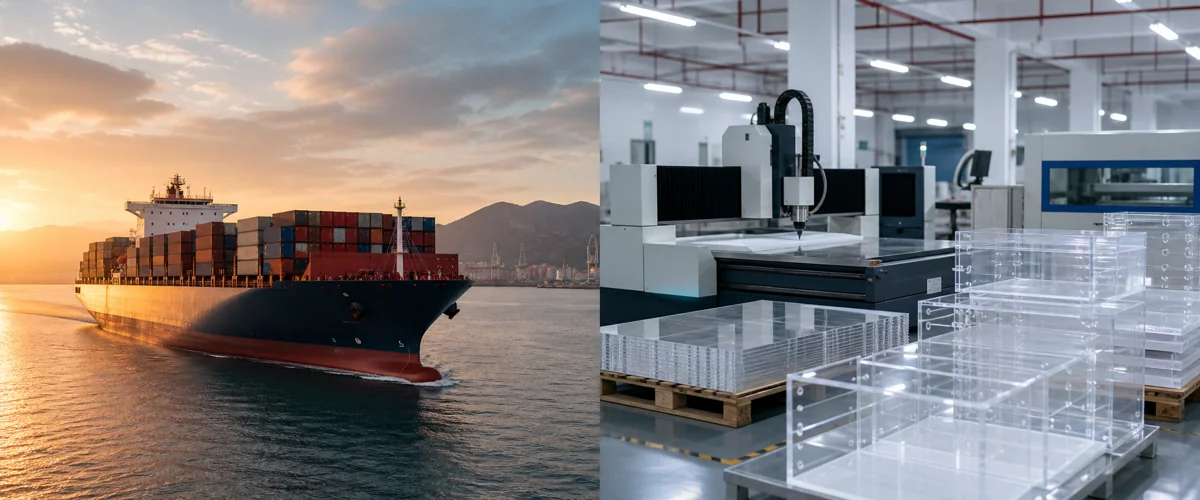
The first tradeoff most buyers get backwards: they assume domestic freight is automatically cheaper because the goods don’t cross an ocean. On a per-CBM (cubic-meter) basis, this is often false in 2026. Ocean freight from China, especially in a full 40-foot high-cube container, is one of the cheapest cargo modes per unit of volume that exists — cheaper than US cross-country trucking on most lanes I quote against.
Q1 2026 spot rates I’m seeing on actual bookings: Shenzhen-Los Angeles 40HC (high cube) runs roughly $1,800-2,200 for 67-68 CBM of usable space, which works out to $26-33 per CBM. Shenzhen-New York via Panama Canal runs $3,500-4,200, or about $52-62 per CBM, with 30-35 days transit. Drewry’s World Container Index and FreightWaves’ SONAR ocean freight data both confirm spot rates in this band through Q1 20261, with seasonal variability of 15-25% depending on Lunar New Year and Q4 retail peak. Compare that to US domestic trucking: a cross-country LA-NY full truckload runs $2,800-3,500 in Q1 2026, hauling roughly 80 CBM of usable space — about $35-44 per CBM. A USA fabricator in the Midwest shipping LTL (less-than-truckload) to coastal buyers often pays more per CBM than I pay shipping a 40HC across the Pacific.
The math flips on small orders. A 5-piece prototype run shipped LTL from Ohio to California costs roughly $200-400. The same five pieces in an ocean LCL (less-than-container-load) shipment from Shenzhen runs $300-500 plus 30-35 days transit — slower and not cheaper. Ocean freight only wins economically once you fill enough of a container to justify the per-CBM rate, which is why MOQ-respecting buyers (100+ pieces of typical custom acrylic display work) capture the offshore freight savings and small-batch buyers don’t.
Where the freight math actually leans: offshore wins on full-container or high-CBM consolidated shipments to West Coast ports; domestic wins on rush LTL, small-batch, and any East Coast destination where the Panama Canal transit penalty narrows or erases the per-CBM advantage. If your project lands in either of those two profiles, run the freight numbers explicitly before assuming offshore is cheaper.
2. Lead-Time Math — Door to Door, Not Just Production
The second tradeoff buyers compare unevenly: production lead time. A USA fabricator quoting “10 business days” sounds dramatically faster than a China fabricator quoting “21 days” — until you add up everything between PO and product on the buyer’s dock.
Here is a planning stack for a typical custom acrylic display project. Replace every range with dated supplier and freight quotes before committing the need-by date:
| Segment | China supply chain | USA supply chain |
|---|---|---|
| First sample | 3-5 days at Wetop; approval time additional | Quote project-specific sample and approval time |
| Production run after approval and deposit | 15-20 days at Wetop | Quote project-specific production time |
| Domestic ground freight to port / customer | 1-3 days (factory to port) | 2-7 days (factory to customer) |
| Ocean freight transit (Shenzhen-LA) | 12-18 days | n/a |
| Customs clearance + drayage | 2-4 days | n/a |
| Cross-country trucking to East Coast (if needed) | 4-7 days | 4-7 days (if applicable) |
| Median total door-to-door | 35-42 days | 18-25 days |
The 17-day gap is real, and I won’t try to talk a buyer out of it. What I will push back on is the framing that “China takes twice as long.” Door-to-door, China runs roughly 1.7-2x longer than domestic, but the absolute number — six weeks median — is well within the planning horizon for any buyer running a normal product launch, retail rollout, or trade show schedule. Buyers who plan production six weeks ahead of need-by-date capture the offshore cost savings without schedule pain. With less than four weeks to the need-by date, the rush surcharge a China fabricator quotes for compressed lead time usually erases the cost advantage.
One detail worth knowing: ocean freight transit from Shenzhen to West Coast US (LA, Long Beach, Oakland, Seattle) runs 12-18 days reliably. Shenzhen to East Coast (NY, NJ, Savannah) via Panama Canal runs 28-35 days, almost double. If your destination is East Coast and lead time is tight, ask your supplier whether transloading at LA — moving the freight off-vessel and onto US rail or truck for the cross-country leg — is worth the extra ~$800-1,200 in handling. We coordinate this for buyers when the schedule math justifies it.
For a deeper view of how we structure production timing on the factory side, see our acrylic RFQ guide — it covers how to phrase lead-time questions in your RFQ so both China and USA fabricators give you comparable numbers.
3. Tooling — China’s “$0 Setup” Has Its Own Catch
The third tradeoff is where buyers most often compare unlike line items. One supplier may include engineering or simple fixtures in the production quote, while another lists setup separately. Neither format proves a lower total cost.
Request a line-item explanation for engineering, CNC programming, fixtures, thermoforming molds, and print tooling. Ask who owns each asset, whether it can be reused, how long it will be retained, and whether a later reorder carries another setup charge. Wetop confirms tooling requirements project by project rather than promising that every custom order has no setup cost.
Here’s what the apparent gap actually masks: when a China fabricator says “$0 tooling,” what’s almost always happening underneath is that the engineering, jig-making, and first-article setup labor is being amortized into the unit price across the production run. Run the math at 500 pieces and a hidden $300 of setup amortizes to $0.60 per piece — invisible inside a $4-8 unit price. USA fabricators charge it as a separate line item because their labor cost is higher and the amortization would distort the unit-price comparison. Mathematically, on production volumes above 200-300 pieces, the two approaches converge; the China fabricator’s “free tooling” and the USA fabricator’s “explicit tooling fee” are functionally the same dollars moving through different line items.
The catch — and this is real — is that the $0-tooling framing pushes some buyers into ordering more pieces than they need just to hit MOQ and capture the unit-price math. At 100 pieces the unit price is substantially higher than at 500, because setup is spread over fewer units. Our production MOQ is 100 pieces per design. If you need fewer, a paid sample (USD 200–500, 3–5 days, never credited to production) lets you check the part before you commit to a 100-piece run.
The honest comparison is total landed cost per piece at your actual order quantity, not setup-fee line items. Ask both sides to quote at your real quantity, then compare. Don’t be impressed (or suspicious) of $0 tooling on its own — it’s a structural difference in how the two supply chains price work, not a fundamental cost advantage.
4. Custom-Finish Capability — What an Offshore Factory Fits
I’ll be direct here because it matters: some acrylic work does not fit an offshore factory, and pretending otherwise would be dishonest. The strength of the offshore supply chain is custom display, signage, retail fixturing, brand merchandise, and B2B production work made to order from 100 pieces per design — projects that fit our process, our equipment, and our scale. Four kinds of work sit outside that envelope:
Museum-grade aquariums and structural cast-block acrylic. Large-format aquarium walls, dive-tank viewing panels and structural cast-block work are outside what we build: projects that need 6”+ cast-block thickness, optical clarity through a meter of material, or aquarium-grade certification.
On-site retrofit, installation, and field measurement. Any project that requires a fabricator to physically be at the install site — measuring an irregular wall, retrofitting an existing fixture, installing dimensional letters on a building face — needs someone on site. We can’t show up, so we build to dimensions the buyer has measured and approved, and a paid sample confirms fit before production.
Regulated end-use specs requiring domestic origin. Medical-device housings, defense applications, certain aerospace specs, and any government contract work with Buy American provisions require domestic fabrication by definition.
One-off prototyping and pilot runs under 100 pieces. Below 100 pieces the offshore math collapses: per-piece price spikes and freight is mostly fixed cost. Our production starts at 100 pieces per design. Before that, a paid pre-production sample (USD 200–500 depending on complexity, 3–5 days, paid separately and never credited to production) is how a buyer checks the part in hand before committing the production order.
For high-volume custom display and signage projects, see our case study on automotive showroom countertop displays — a 600-piece program where the offshore fabrication math worked, and the project profile (production volume, replicable parts, no on-site work) was a clean fit for the supply chain. Your project’s fit with that profile, more than freight rates or tooling fees, is the leading indicator of whether offshore production works for it.
5. Communication Friction — What Changed Since 2020
The fifth tradeoff is the one I think buyers most overestimate — and where the gap between USA and China fabricators has narrowed dramatically since 2020. The cliché is that offshore communication is slow, time-zone-broken, and language-friction-heavy. In 2008 when I started this business, that was largely true. In 2026, the picture is different on most serious B2B work.
What changed: WhatsApp, WeChat, video calls, async project management tools, and English-fluency hiring at China-based factories serving international B2B markets. On our team, the account managers handling US-buyer projects work US business hours (which is China night shift) and reply within 4-6 hours during overlap windows, often within 1-2 hours during peak. USA fabricators advertise faster reply times in their marketing — and on first-touch RFQ they’re often genuinely faster — but mid-project, when a question needs a production-floor answer rather than a sales answer, the gap narrows or reverses. A USA fabricator’s salesperson in another office isn’t necessarily faster than my production manager who’s standing next to the laser cutter.
The real limit on communication is physical presence: in-person meetings, factory visits, and any conversation where seeing the work matters. Walking our floor in Shenzhen requires a flight. We bridge this with live video walkthroughs (covered in our supplier evaluation guide) — but a video tour is not the same as standing in the room, and I won’t pretend otherwise.
The honest read: communication friction is a smaller penalty than it was a decade ago, but not zero. If your project involves frequent in-person collaboration or stakeholder reviews, plan them around live video walkthroughs and a paid physical sample that your team can hold. If your project is a defined spec executed against a clear PO, the friction penalty offshore is usually 4-6 hours of reply latency on a long workflow — visible but not project-breaking.
6. Tariff Exposure — How Section 301 / 232 Hits Acrylic
The sixth tradeoff is the most volatile and the one where I’d most strongly encourage buyers to consult a licensed US customs broker rather than relying on what their supplier (offshore or domestic) tells them. Tariff law on Chinese-origin goods has shifted multiple times since 2024 and will likely shift again — any specific rate I quote here is a snapshot, not a permanent number.
The framework as of Q1 2026: Section 301 tariffs on Chinese-origin goods imposed under the 2018-2019 actions remain largely in effect, with rates varying by HTSUS code. Raw PMMA acrylic sheet falls primarily under HTSUS 3920.51, which has carried Section 301 List 3 tariff exposure since 20182. Finished fabricated acrylic products (custom displays, signage, enclosures) typically classify under different HTSUS codes — 3924, 3926, or category-specific codes depending on the finished product — sometimes with different duty rates than the raw sheet.
What this means in practice for a buyer comparing quotes: tariff is usually a single-digit-percentage adder on total landed cost for a finished custom acrylic project, not a make-or-break number. On a $4-per-piece custom display, a 7.5% Section 301 tariff adds $0.30 per piece — meaningful but not dispositive. Two cautions worth taking seriously: (1) the rate can change with limited notice, so quotes that lock in DDP (delivered duty paid) at current rates are worth requesting if you want certainty; and (2) HTSUS classification disputes do happen — a customs broker review of your finished product’s classification before signing can prevent a surprise reclassification at port.
USA fabricators have a real advantage here in being tariff-immune on their fabrication labor — but they’re not tariff-immune on the raw acrylic sheet itself if they source imported PMMA, which many do. The “buy domestic to avoid tariffs” framing is real for the labor portion of the cost stack and partially real for the material portion, depending on raw-sheet sourcing. Ask every fabricator you compare where its PMMA sheet comes from — Plaskolite, Evonik PLEXIGLAS, and Mitsubishi all have US manufacturing footprints, but plenty of USA fabricators run on imported sheet that carries its own tariff exposure.
Decision framework on tariff: for projects where landed cost is within 10-15% between offshore and domestic before tariff, tariff exposure can flip the math. For projects where the offshore landed-cost advantage is 25%+ pre-tariff, tariff math rarely flips the decision. Confirm classification with a broker on any project where the tariff math is borderline — we coordinate this with our buyers’ brokers on request.
The 6-Tradeoff Scorecard
Pulling the six tradeoffs into one view. The “wins for” column is the typical case for a B2B custom acrylic project of 200-1,000 pieces; project-specific factors can shift any row.
| Tradeoff | China typical | USA typical | Wins for… |
|---|---|---|---|
| Freight cost | $26-33/CBM (Shenzhen-LA 40HC) | $35-44/CBM (LA-NY truckload) | Offshore on full-container; domestic on rush LTL |
| Lead time door-to-door | 35-42 days median | 18-25 days median | Domestic is faster door to door; offshore fits plans with 6+ weeks |
| Tooling structure | $0 explicit, amortized into unit | $400-1,500 explicit setup | Functionally tied above 200 pieces; MOQ 100 per design, paid sample below that |
| Custom-finish niches | High-volume custom display, signage, retail | Museum aquariums, on-site work, regulated specs | Project-fit dependent — neither wins all niches |
| Communication | 4-6 hr async reply, live video | Same-day reply, in-person possible | Tied on async B2B work; in-person review replaced by live video and a paid sample |
| Tariff exposure | Section 301 single-digit % adder | Tariff-immune on labor, partial on material | Domestic on borderline math; offshore when pre-tariff gap > 25% |
When Does Manufacturing in China Beat a USA Fabricator?
Pulling the six tradeoffs together into a decision call. For a US-based buyer weighing China vs USA acrylic manufacturing, four conditions need to align for the offshore math to work:
Volume from 100 pieces per design. Ideally 200+ to capture full per-piece economics. Lead time of 6+ weeks from PO to need-by-date. Faster than that, the ocean transit penalty makes offshore math impossible without rush surcharges that erase savings. Defined spec without on-site work. Projects executed against finalized drawings and specs, not projects requiring field measurement, on-site retrofit, or stakeholder-meeting collaboration. Standard fabrication processes within offshore capability. Custom display, signage, retail fixturing, B2B production runs — the high-volume, replicable work where offshore supply chains are competitive. We don’t take on work outside this envelope: aquarium-grade cast blocks, on-site installation, sub-14-day rush, or contracts that require domestic origin.
When all four align, my buyers consistently report 25-45% landed-cost savings versus comparable USA quotes, with lead-time and quality outcomes that meet the same standards. When one or more don’t align, the math gets murky, and the landed-cost quote will show exactly which line moves it.
For buyers actively comparing offshore and domestic quotes side by side on a current project, send the spec — material, finish, dimensions, quantity, target ship date, destination port — and we’ll quote landed cost (FOB or DDP) with tooling, lead time, and current tariff rate broken out separately. If lead time or quantity is the tight constraint, the quote shows it line by line so you can plan around it. Reach out via our contact form and we’ll have a numbers-first reply within 24 hours.
Related guides
Footnotes
-
Drewry World Container Index — weekly composite ocean freight rate index covering eight major East-West container shipping routes, used as the industry reference for spot-rate movements; cited here for Q1 2026 Shenzhen-LA and Shenzhen-NY 40HC spot rates. ↩
-
USTR Section 301 Investigations — China — Office of the United States Trade Representative documentation of Section 301 tariff actions against Chinese-origin goods, including List 3 coverage of HTSUS 3920.51 (PMMA acrylic sheet) and subsequent rate adjustments through 2024-2026. ↩
Frequently Asked Questions
Is a China acrylic manufacturer a real option for a US buyer?
Yes, for B2B custom orders of 100 pieces or more per design with more than 30 days between PO and need-by date. On a typical 500-piece custom display program, landed cost can be lower than a comparable USA fabricator quote because of fabrication labor and production efficiency, though freight, duty, and tariff must be calculated project by project. The domestic edge is real on rush jobs under 14 days and on work that needs on-site installation.
How long does a typical China-to-USA acrylic order actually take door to door?
Median 35-42 days door-to-door for a standard custom acrylic project: tooling and sample 5-10 days, production 14-21 days, ocean freight (Shenzhen to LA/Long Beach) 12-18 days plus 2-4 days customs and drayage to destination. Add 4-7 days for cross-country trucking to East Coast destinations. USA fabricators typically run 18-25 days for the same project profile. The 17-day gap is the cost of offshore: buyers who plan production six weeks ahead capture the savings, and a paid sample in 3–5 days lets the approval step start before the PO is final.
Are tariffs on Chinese acrylic still in effect in 2026?
Yes — Section 301 tariffs on Chinese-origin PMMA acrylic sheet (HTSUS 3920.51) remain in effect, and the rate has been adjusted multiple times since 2024. Finished fabricated products (display cases, signage, custom enclosures) classify under different HTSUS codes than raw sheet, sometimes with different duty rates. We always recommend buyers confirm classification with a licensed US customs broker before finalizing landed-cost math. The good news: tariffs are usually a single-digit percentage of total landed cost on a finished custom acrylic project, not a deal-breaker, and they apply on both raw-sheet imports a USA fabricator might use as well.
Why do USA acrylic fabricators charge tooling fees when China fabricators say tooling is free?
Suppliers structure engineering and setup costs differently. One may show a separate fixture, mold, or programming fee; another may include part of that work in the unit price. Ask both sides to quote the same quantity and identify tooling ownership, reuse rights, engineering, sample, packing, and freight so you can compare total landed cost instead of one line item.
Which acrylic projects does a China factory fit, and which does it not?
Wetop fits custom display, signage, retail fixture, and B2B production work made to order from 100 pieces per design with six or more weeks between PO and need-by date: paid sample in 3–5 days (USD 200–500, never credited to production), production in 15–20 days, then ocean or air freight. It does not fit lead times under 14 days, work that needs on-site installation or field measurement, aquarium-grade structural cast blocks, or contracts with domestic-origin requirements. Below 100 pieces, the paid sample is how you check the part before a production order.
Comparing offshore and domestic quotes side by side?
Send us your spec — material, dimensions, quantity, target ship date, destination port — and we'll quote landed cost (FOB or DDP) with tooling, lead time, and current tariff rate broken out. No marketing spin, no padded freight, no surprise setup fees on the invoice.