




Supplier Audit Checklist for Acrylic Factories
Use this supplier audit checklist to define scope, evidence, site records, product checks, findings, and corrective-action closure before a China factory visit.
Need this made?Custom acrylic fabrication services →
Key Takeaways
- A buyer-direct review and a third-party audit may use different scopes. Confirm the named program, audited site, product coverage, evidence request, sampling plan, and deliverable for each appointment.
- The provider's name does not define the audit scope. Prepare against the appointment letter or program requirements rather than assuming a standard checklist for SGS, Bureau Veritas, Intertek, TÜV, or another provider.
- ISO 9001 is necessary but not sufficient for a project-level acrylic supplier audit. Buyers should also verify first-article approval, inspection records, material traceability, calibration, and non-conformance closure against the order.
- The 12-step preparation checklist starts by confirming the auditor, standard, scope, and evidence request; it ends with a documented corrective-action response. Adapt the timing to the audit program instead of assuming one universal calendar.
- Do not accept a claimed pass rate without evidence. Request the issuing body, audit date, scope, report or certificate identifier, open findings, and corrective-action status, then verify the document with the issuer where possible.
On this page
- Supplier audit checklist: the 12 steps at a glance
- The Two Audit Layers China Acrylic Suppliers Actually Face
- What Each Third-Party Auditor Actually Looks For
- ISO 9001 Is Necessary, Never Sufficient
- A 12-Step Pre-Audit Checklist
- Common Failure Patterns and How We Mitigate Them
- How to Verify a Supplier’s Audit Record
- Beyond ISO and quality — the compliance audits buyers also bring
- When buyers bring third-party inspection agencies — and how we accommodate
- Related guides
Supplier audit checklist: the 12 steps at a glance
A supplier audit checklist should name the audit scope, requested records, product-level checks, responsible people, open findings, and corrective-action evidence before the visit. Buyer-direct and third-party programs may use different standards, so verify each appointment separately. These are the 12 steps, in order:
- Confirm the auditor, standard, scope, and date from the appointment letter.
- Check the ISO 9001 certificate: scope, site, expiry, and last surveillance date, verified with the issuer.
- Pull current test reports (RoHS, food-contact, or other reports the product needs), sorted by SKU.
- Refresh the business license, export license, and any social audit reports.
- Walk the floor in the auditor’s route and list gaps: labels, calibration tags, blocked exits.
- Close every gap from step 5 and photograph the fix.
- Check five recent inspection records against the agreed AQL sampling table.
- Trace three finished pieces back to the sheet lot and inbound receiving record.
- Walk the floor again with records staged at each station.
- Brief the staff who will meet the auditor on the opening meeting and interviews.
- Confirm logistics: meeting room, badges, Wi-Fi.
- Run the audit, hold the closing meeting, and file the corrective-action plan with evidence inside the program’s window.
The 12-step table below adds timing and owners for each step. If you are still choosing between suppliers, start with how to choose an acrylic supplier, which covers quote comparison and the written questions to send before any visit.
The Two Audit Layers China Acrylic Suppliers Actually Face
A buyer may commission a product-specific capability review, a quality-system audit, a social or environmental program audit, a product-compliance review, or more than one of these. Keep the scopes separate: a result under one program does not establish compliance with another program or prove that a particular order meets its approved specification.
The buyer-direct audit is order-shaped. It cares about inspection discipline on the sourced SKUs, lead-time logic, traceability, and the people responsible for the account. A third-party audit follows the named program or standard and reports findings against that scope. Do not infer one audit’s coverage from another; verify the standard, site, product scope, issue date, and current status.
The reason this matters: any supplier qualification acrylic buyers run that starts with “are you audited?” and accepts a plain yes is incomplete. The honest follow-up is “by which layer, by whom, when, and what scope.” The acrylic supplier audit conversation gets sharper as soon as both layers are on the table.
What Each Third-Party Auditor Actually Looks For
SGS, Bureau Veritas, and Intertek are common providers of inspection, testing, certification, and audit services. The logo alone does not define the scope. Read the appointment letter or program requirements to identify the standard, evidence request, sampling plan, site, and deliverable before preparing documents.
Quality-management scope. If the commissioned audit uses ISO 19011 guidance or another management-system framework,1 the evidence request may cover calibration status, traceability, internal audits, responsibilities, and corrective-action records. Prepare only the instruments, records, sites, and processes named in the scope.
Social and environmental programs. When the commissioned scope includes labor, health and safety, or environmental requirements, evidence may include worker interviews, wage and time records, emergency exits, PPE, chemical storage, training records, and waste handling. Prepare the records named by the specific program rather than assuming an auditor’s brand fixes the checklist.
Product-safety and traceability programs. If the scope covers CPSIA, EN 71, RoHS, or food-contact requirements, the evidence chain may include applicable lab reports, raw-material identification, batch records, and links between inbound lots and finished products. The buyer must name the market and end use because no single report covers every product category.
Provider brands and certificates are not interchangeable. Match each report or certificate to its issuing body, standard, audited site, product or process scope, issue date, validity status, and open findings.
ISO 9001 Is Necessary, Never Sufficient
An ISO 9001 certificate is evidence about a defined quality-management-system scope. A buyer still needs order-level evidence for the named material, drawing, approved sample, inspection plan, and finished lot.
An ISO 9001 acrylic audit — the surveillance visit an IAF-accredited body runs annually against ISO 9001:20152 — is a process-management-standard audit. It requires documented quality policy, defined responsibility for every process step, internal audits, and a corrective-action register. What ISO 9001 does not certify is that any specific cast acrylic sheet, any specific laser-cut edge, or any specific AQL inspection lot in your PO meets your spec. That gap is by design. The standard certifies the system, not the output.
A buyer-direct audit should check product-level evidence that an ISO 9001 certificate alone does not verify. Four useful areas are below.
First-article inspection (FAI) records. Did the factory produce a first article on the new SKU, inspect it against the approved sample, document the result, and route it for buyer approval before running production? FAI is a discipline ISO 9001 implies but does not name.
AQL sampling evidence. When the factory pulled the pre-shipment QC sample, did they pull at the AQL tier committed in the RFQ (typically 2.5 major / 4.0 minor for standard custom acrylic, tightened to 1.5 / 2.5 for premium display work) under ISO 2859-1 sampling rules? Auditors ask for 3-5 recent inspection records and verify the sample size matches lot size and AQL tier. Factories that improvise sample sizes lose AQL credibility regardless of ISO status.
Material traceability to lot. Can the factory point at a finished piece in the warehouse and produce the cast acrylic sheet brand, lot number, MTR, and inbound receiving record for the material in that piece? This is the single hardest item to fake on short notice — it requires a real lot-tracking system running daily, not a binder assembled the morning of audit day.
Non-conformance closure rate. When the factory’s own QC team rejects a piece on the line, what happens in the next 24 hours? A documented non-conformance, root-cause analysis, corrective action — or a quiet rework with no record? Auditors sample the NC log, follow 3-5 entries through closure, and judge whether the system is real.
ISO 9001 is the foundation. The four checks above are the structure built on it. A factory that holds the certificate but fails on FAI, AQL, traceability, or NC closure is exactly the kind of supplier the acrylic supplier audit process is designed to expose. For what our own ISO 9001 certificate and inspection process cover, see our quality control and certifications page — this guide focuses on audit-day execution; that page shows the certificate-grade documentation we hold.
A 12-Step Pre-Audit Checklist
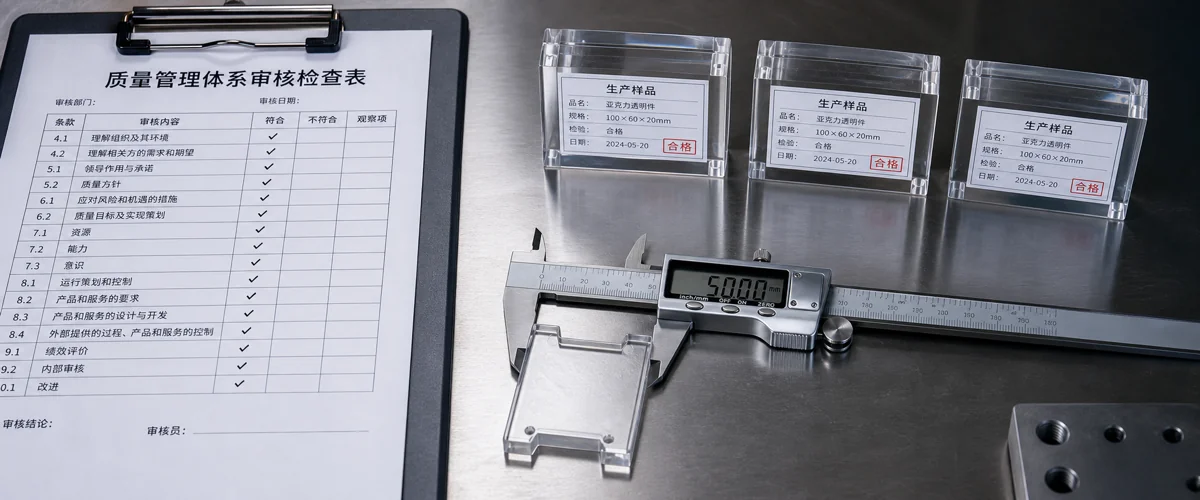
The table adds a planning window and owner to each step. Use it as a planning sequence, then replace the example windows with the appointment letter and program rules. Buyer-direct and third-party audits may require different owners, evidence, sampling, and corrective-action timing.
| # | Step | Window | Owner | Output |
|---|---|---|---|---|
| 1 | Confirm auditor body, scope, and on-site date | T-30 | QC Manager | Audit appointment email + scope confirmation |
| 2 | Refresh ISO 9001 certificate, scope, surveillance date | T-28 | QC Manager | Current cert PDF + IAF lookup screenshot |
| 3 | Pull most recent SGS / RoHS / FDA test reports (under 12 months) | T-25 | QC Manager | Test report binder, sorted by SKU category |
| 4 | Refresh business license, export license, social audit reports | T-21 | Operations | Compliance binder, all dates current |
| 5 | First floor-walk dry run, auditor route order | T-14 | QC Manager + Floor Lead | Findings list (gaps, missing labels, blocked walkways) |
| 6 | Close findings from Step 5 — labels, signage, PPE compliance, exits | T-10 | Floor Lead | All gaps remediated, photo evidence |
| 7 | Sample AQL inspection records — pull 5 recent orders, verify against ISO 2859-1 tables | T-7 | QC Manager | AQL evidence binder, sample-size math shown |
| 8 | Sample material traceability — pick 3 finished pieces, trace to lot | T-7 | QC Manager + Warehouse | Traceability chain, end-to-end |
| 9 | Second floor-walk dry run with full document staging at each station | T-3 | QC Manager + Floor Lead | Stations dressed, records visible at point of use |
| 10 | Brief auditor-facing staff on opening meeting, interview etiquette, NC posture | T-2 | QC Manager | Briefing notes, no-surprises list |
| 11 | Auditor logistics — meeting room, parking, badge, Wi-Fi, lunch | T-1 | Operations | Logistics confirmed |
| 12 | Audit day → closing meeting → corrective-action plan if needed → close within window | T-0 to T+7 | QC Manager | Audit report, CAP filed, evidence submitted |
Steps 5 and 9 — the two floor-walk dry runs — catch structural gaps such as missing labels, expired calibration status, blocked exits, and records that cannot be produced at the point of use. Record each gap, assign an owner, and verify closure before the audit rather than treating the walk as presentation rehearsal.
The checklist looks heavy on paper, but much of the evidence should already be controlled in normal operations. Audit preparation should verify current records and close real gaps, not manufacture a binder that exists only for the appointment.
Common Failure Patterns and How We Mitigate Them
Common failure patterns cluster around evidence integrity, traceability, worker-safety records, and corrective-action control. Use the commissioned audit standard as the authority for classification and closure timing.
Quality-system and buyer-direct findings often involve instrument and evidence integrity: expired calibration status, inspection sample sizes that do not match the agreed plan, missing first-article approval on a new SKU, or corrective actions with no evidence of closure. The mitigation is an operating control with a named owner and record, not a one-time document refresh.
Social and environmental findings can involve working hours, missing or outdated safety data sheets, blocked emergency exits, expired fire equipment, or coached worker interviews. Preparation must not script answers or hide conditions; it should correct the underlying issue and make current records available.
Product-safety findings often expose a broken traceability chain: a finished piece cannot be connected to the raw-material lot or applicable test evidence. For regulated end uses, define the required standard before production and verify that inbound, work-in-process, and outbound records preserve that link.
The pattern across all 10: most non-conformances are not caused by the factory being “bad at quality” — they are caused by the factory being unprepared for the specific lens a specific auditor applies on a specific day.
For an example of how documented process control supports a repeat program, see our automotive showroom countertop displays case study.
For broader quality management context, see our process and quality overview, the custom acrylic displays product hub, and our quality control and certifications page. And for a product-level application of the same vetting logic — checking print registration, cut quality, and sample discipline on one specific SKU type — see the acrylic standee supplier checklist.
How to Verify a Supplier’s Audit Record
A claimed pass rate is not useful without a denominator, scope, and source. Ask for the audit provider, program or standard, audited site, date, current certificate or report identifier, open findings, and corrective-action status. Verify certificates through the issuing body where a public check is available, and do not treat a social, quality-system, product-test, or pre-shipment report as interchangeable.
Wetop is an ISO 9001:2015-certified custom acrylic manufacturer in Shenzhen, established in 2008, with 100% piece inspection before packing. Those facts do not replace a buyer’s project-specific qualification. If you want to audit Wetop, send the required standard, scope, evidence list, and on-site or remote format through our contact page; the team will confirm availability document by document.
Beyond ISO and quality — the compliance audits buyers also bring
ISO 9001 covers quality-system requirements, but buyers selling into US or EU markets may need additional compliance evidence based on product category and end use. Three common domains are below.
Social compliance. SMETA and amfori BSCI are program-specific approaches covering labor, working hours, wages, health and safety, and related management practices. If a buyer requires one, name the program and acceptable report status in the RFQ. Do not infer that ISO 9001 includes social compliance.
Environmental compliance. ISO 14001 covers environmental management system maturity. Acrylic-specific verification includes adhesive and solvent disposal practices (bonding solvents are regulated), VOC emissions from UV printing operations, and acrylic scrap recycling protocols. Factories without documented environmental practices are increasingly disqualifying for brands with sustainability commitments — this lens has moved from “nice to have” to “qualification gate” inside the last 24 months.
Product-safety compliance. Specific to your market and product category. Children’s products require CPSIA (US) or EN 71 (EU) compliance with documented testing.3 Food-contact acrylic requires FDA 21 CFR 177 (US) or EC 10/2011 (EU) verification. California products require Prop 65 labeling compliance. Medical or regulated-industry acrylic work requires the specific compliance documentation for that category. Always request testing certificates from accredited labs (SGS, Intertek, Bureau Veritas) — certificates from non-accredited labs are not defensible at a customer audit.
When buyers bring third-party inspection agencies — and how we accommodate
Some buyers add an independent third-party inspection layer. Decide from order value, product risk, supplier history, and the cost of failure rather than applying one universal threshold.
First-order verification. For a high-value, regulated, or unfamiliar product, consider an on-site capability audit and pre-shipment inspection. Obtain the agency’s current quote and scope directly; fees, travel, report format, and sampling vary. Require independent verification against the PO, approved sample, and buyer checklist.
Ongoing pre-shipment inspection. Set the cadence from observed risk: defect history, specification changes, new materials, seasonal peaks, and failure cost. A repeat order is not automatically low risk. State the inspection level, acceptance criteria, report timing, and release authority in writing.
Related guides
- China vs USA Acrylic Manufacturing: Cost, Lead Time and Tariffs
- How to Choose an Acrylic Supplier: 7 Red Flags
Footnotes
-
ISO 19011:2018 — Guidelines for auditing management systems — the international guideline that SGS, Bureau Veritas, Intertek, and other IAF-recognized auditors follow when planning, conducting, and reporting management-system audits. ↩
-
ISO 9001:2015 — Quality management systems — Requirements — the international standard defining quality management system requirements; the certification basis for every IAF-accredited ISO 9001 audit referenced in this guide. ↩
-
Consumer Product Safety Improvement Act (CPSIA) — US Consumer Product Safety Commission — the US federal law setting product-safety testing and certification requirements for children’s products, frequently administered through Intertek and similar third-party labs for imported acrylic items. ↩
Frequently Asked Questions
Why do China-based acrylic suppliers get audited twice when US suppliers don't?
The audit count is set by the buyer, the applicable program, the product risk, and the evidence already available, not by country alone. A buyer-direct capability review and a third-party program audit can both be requested, but their scopes should be documented and assessed separately.
Is ISO 9001 enough to pass an acrylic supplier audit?
No. ISO 9001 addresses the quality-management system; it does not by itself confirm that the named sheet, approved sample, drawing, inspection plan, or finished lot meets a purchase order. Put those product-level checks in the buyer audit scope.
What's the difference between SGS, Bureau Veritas, and Intertek audits?
Do not infer the scope from the provider's name. For SGS, Bureau Veritas, Intertek, or another provider, read the appointment letter for the named standard, audited site, evidence request, sampling plan, interviews, product checks, and report deliverable.
How long does an acrylic supplier audit take, and how should we prepare?
Timing depends on the named program, site count, scope, sampling plan, interview requirements, and report format. Start when the appointment letter arrives: assign an owner to each requested record, verify current evidence, walk the relevant process, and close real gaps before the visit.
What happens if our supplier fails a third-party audit?
Classification, certificate status, notification, corrective-action timing, and any follow-up visit are defined by the commissioned program. Ask for the finding, cited requirement, responsible owner, due date, submitted evidence, reviewer decision, and current closure status.
Want to run your own audit on us?
Send us your audit checklist or third-party questionnaire. We will confirm which requested documents are available for the project and identify any items that require buyer-specific testing or an on-site review.