
Acrylic vs Cardboard POP Displays: Which and When
Campaign length decides this comparison before design ever does. An eight-week promotion belongs on corrugated; a fixture holding shelf position for years belongs in acrylic.
Need this made?Custom countertop display stands →

Key Takeaways
- Campaign length is the deciding variable: promotions measured in weeks favor corrugated cardboard, while fixtures meant to hold placement for a year or more favor acrylic.
- The cost math is amortization, not unit price — a corrugated display costing a fraction of acrylic per unit still costs more per month of service if the acrylic fixture serves multiple campaigns.
- Graphics favor corrugated: full-bleed printed board delivers big campaign artwork economically, while acrylic's strengths are clarity, UV-printed branding, and product visibility.
- Freight favors corrugated too — flat-packed board is light and dense to ship, while acrylic displays cost more to move and more to replace mid-campaign if damaged.
- Corrugated ends its life in the best-recycled packaging stream in the US (about 96% for boxes), while acrylic avoids the waste question by not becoming waste on campaign day 60.
On this page
The campaign-length rule
Campaign length decides the acrylic vs cardboard POP display question before any other factor gets a vote. A promotion measured in weeks — a launch burst, a seasonal endcap, a price event — belongs on corrugated. A placement meant to hold its counter or shelf position for a year or more belongs in acrylic.
Everything else in this comparison — unit cost, print, freight, sustainability — feeds into that one variable, because the two materials are engineered for different clocks. Corrugated board is a brilliant short-cycle material: light, inexpensive, printed edge to edge, gone when the campaign is gone. Acrylic is a duration material: it costs more to buy and to ship, and repays that only by staying presentable long after board would have softened and scuffed out.
The gray zone is real and worth naming: programs planned for four to twelve months. Board can survive that long in a dry, low-touch position, but it rarely looks new past month three, and premium retailers audit fixture condition. Placements in that middle band usually resolve toward acrylic — or toward the hybrid build covered later, where a durable acrylic fixture carries graphics that swap on the campaign clock.
Since 2008 I have watched buyers get this wrong in both directions, and the failures rhyme. Brands put a twelve-month program on corrugated to save budget, then pay for it twice — replacement units at month three and a tired-looking shelf in between. Brands put a six-week promo in acrylic and tie up fixture budget in units that outlive the campaign with nowhere to go. The material was never the mistake; the mismatch between material lifespan and campaign lifespan was. This guide prices that match properly.
What each material actually is
A cardboard POP display is die-cut corrugated board — a fluted paper medium glued between flat linerboards — printed, folded, and usually shipped flat for in-store assembly.1 An acrylic POP display is CNC- or laser-cut cast PMMA sheet, polished and bonded into a rigid fixture that arrives assembled and stays rigid for years.
The structures explain the behaviors. Corrugation gives paper its strength-to-weight magic: a material light enough to ship nearly free supports real product weight when the flutes run the right way. But paper strength is humidity-dependent — board in a humid store softens measurably — and the printed liner is the display’s only surface, so every scuff is permanent and visible. Acrylic’s strengths are equally structural: it is rigid at a few millimeters thick, transmits about 92% of visible light so the product stays the hero,2 and its polished surface is the material itself rather than a printed skin, so it wipes clean instead of wearing through.
One production difference matters commercially: corrugated economics reward big print runs (plates and dies amortize across thousands of units), while cut acrylic has no tooling at all — we cut a 100-piece run and a 5,000-piece run from the same files, which is why acrylic suits test markets and small chains that corrugated printers price awkwardly.
The cost math: unit price versus amortization
The acrylic vs cardboard POP display cost math is a division problem: compare monthly service cost, not invoice cost. A corrugated display at a fraction of acrylic’s unit price serves one campaign of one to three months; an acrylic display serves campaign after campaign from the same placement. Divide each landed cost by months of presentable service and the “expensive” option frequently inverts.
| Factor | Corrugated cardboard POP | Custom acrylic POP |
|---|---|---|
| Typical service life | One campaign, ~1-3 months | Years; multiple campaigns |
| Unit price | Low, rewards volume print runs | Higher; usually no tooling at any volume |
| Cost basis | Re-bought every campaign | Amortized across campaigns |
| Freight | Flat-packed, very light | Heavier, assembled or part-assembled |
| Mid-campaign damage | Minor cost to replace, often pre-stocked | Costlier to replace, rarely needed |
| Surface after 8 weeks | Scuffed edges, humidity softening | Unchanged with basic wiping |
Run the arithmetic on your own numbers rather than trusting either material’s marketing. The pattern I see across quotes: if a placement runs four campaigns a year and the fixture must look new for each, corrugated means four buys, four freight bills, four installs — and the acrylic fixture that costs several times one corrugated buy usually costs less than the year of board. Flip the placement to a single six-week program and the same arithmetic lands hard on corrugated’s side; the acrylic never gets the service months that justify it. Full cost drivers for the acrylic side — sizes, print, quantities — are in our custom POP displays design and cost guide.
The honest complication is uncertainty: many buyers do not know whether the placement will last one campaign or five. When retail-partner commitment is unproven, board first is rational — treat the corrugated run as a paid pilot, then move the placement to acrylic once it earns permanence.
Print and presentation
Corrugated wins the graphics contest: edge-to-edge campaign artwork on every face, printed economically at volume — a full-color billboard shaped like a display. Acrylic wins the presentation contest: water-clear material that shows the product itself, UV-printed logos, polished edges, and premium effects like frosted panels and lit accents.
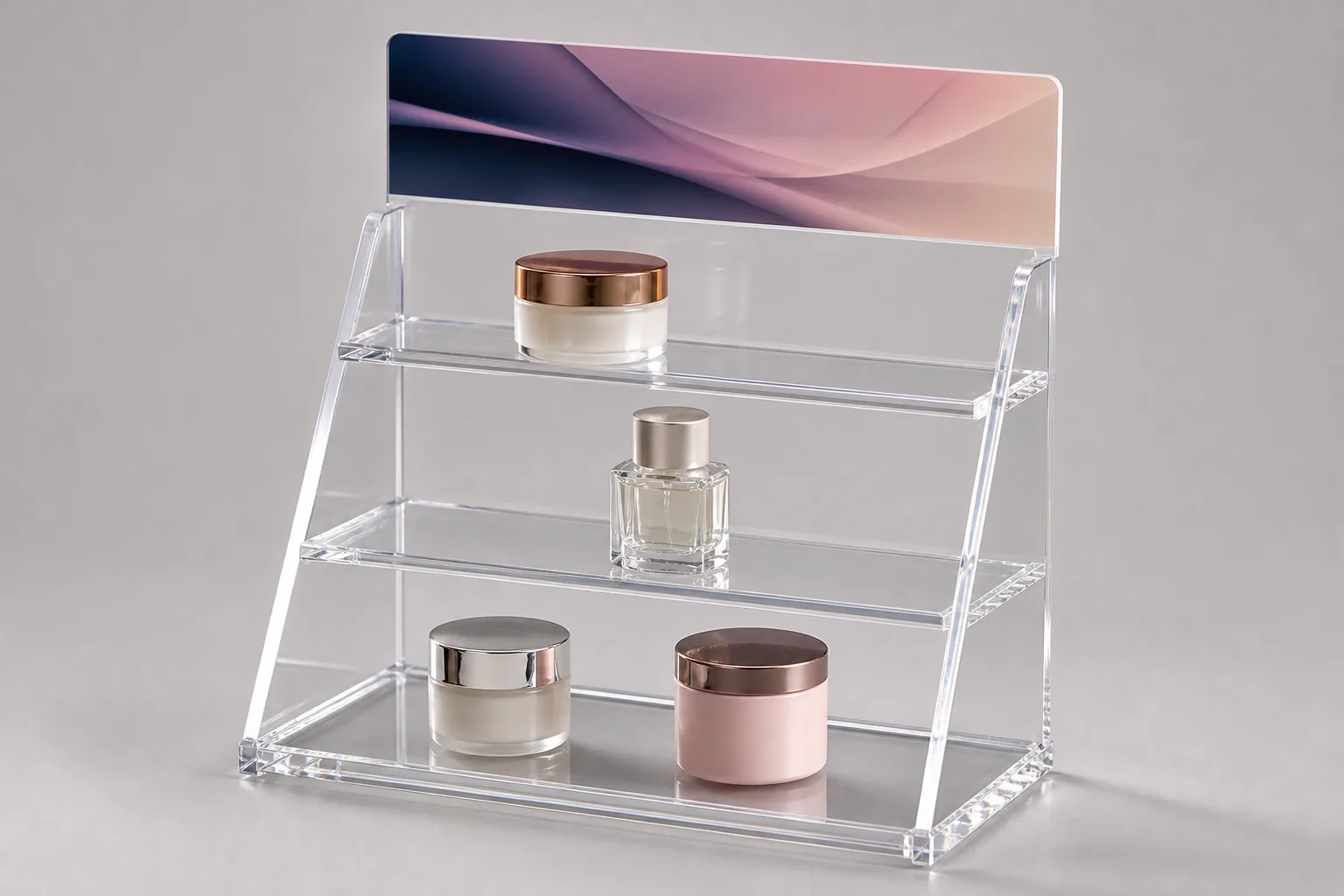
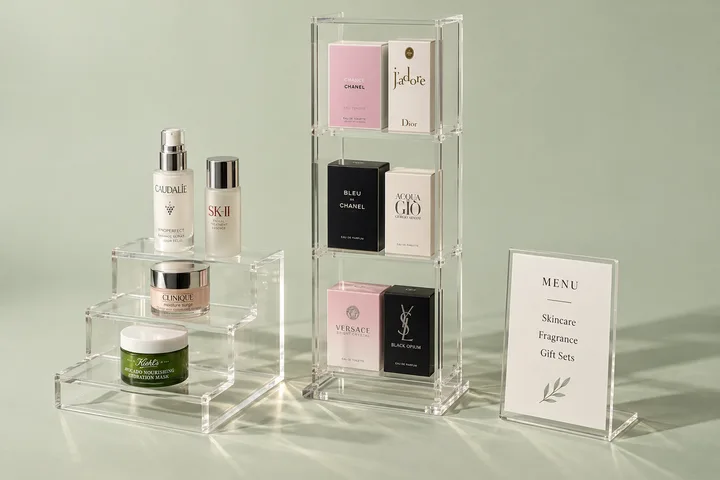
The two materials make opposite promises to a shopper. A corrugated display says look at this campaign — the graphic is the object, and product sits inside the artwork. An acrylic display says look at this product — the fixture recedes and the merchandise does the selling, with brand presence carried by a UV-printed header or an engraved logo. Neither promise is better in the abstract; they suit different merchandise. Impulse consumer goods with loud packaging thrive inside corrugated theater. Premium goods — cosmetics, spirits, electronics, eyewear — read down-market on board and justify acrylic’s quiet frame. That split is visible across our POP and POS display applications work: the categories that buy acrylic are the ones whose product is the artwork.
Color fidelity deserves a note for brand teams. Corrugated gives you full CMYK freedom on every surface. On acrylic, brand color arrives through UV print or through the sheet itself — colored, frosted, or custom Pantone-matched material at a $200-300 one-time fee per color — which yields a depth and permanence printed board cannot imitate, at the cost of graphic real estate.
Freight, setup, and the store’s labor
Corrugated ships flat and light — a national rollout moves in a fraction of the cube and weight that assembled acrylic needs, and store staff assemble units in minutes without tools. Acrylic arrives assembled and heavier: costlier to move, but zero assembly variance and no wrong-folded display standing crooked at aisle three.
Freight is corrugated’s structural advantage and it is real money at chain scale: hundreds of flat cartons versus hundreds of protected rigid fixtures is a different logistics tier. Weigh it honestly, though, against frequency — a corrugated program pays that smaller freight bill every campaign, while an acrylic program pays its larger one once. On split-shipment programs we also stage acrylic fixtures by wave, sending the first market’s units by air and the balance by sea, which softens the up-front freight difference for time-sensitive launches. If your program spans many doors for a short window, that weight difference alone can decide the material. The hidden cost on the board side is execution quality — every unit is assembled by whoever is on shift, and campaign photography from the field shows the spread, from crisp to collapsing. An acrylic fixture’s setup is placement: unbox, position, load product.
Damage risk splits the same way. Corrugated absorbs transit abuse economically — a crushed carton is a minor reprint, and programs routinely ship overage to cover it. Acrylic ships in engineered cartons precisely because each unit matters; our damage rates are low, but replacement is a production run, not a reprint. For long-duration placements this trade favors acrylic (you ship once and stop); for blitz campaigns it favors board (nothing precious is in the truck).
End of life: the sustainability question
Corrugated has the strongest end-of-life story in packaging: boxes are recycled at roughly 96% in the US, feeding an established paper stream.3 Acrylic’s answer is different in kind — a fixture serving years across campaigns generates no campaign-cycle waste at all, though at true end of life PMMA recycling streams remain far less developed than paper’s.
Both halves of that deserve honest weight, because sustainability briefs increasingly decide POP programs. If your fixture genuinely lives one campaign, corrugated is the defensible choice: the material is paper-based and the recovery infrastructure demonstrably works. If your placement is long-term, replacing board four times a year is the least sustainable option on the table regardless of recyclability — collection, reprinting, and refreighting have their own footprint, and durable-fixture-plus-swappable-graphic beats disposable-everything in most retailer scorecards I have seen from our brand clients.
That hybrid is worth designing toward deliberately: a permanent acrylic base, tray, or case that holds the product, with a printed graphic panel or corrugated header that swaps each campaign. The fixture budget buys durability once; the campaign budget buys only what actually changes — the message. We engineer slots, channels, and magnet mounts for swappable graphics into acrylic fixtures routinely; a program built this way was the backbone of our CPG brand POS kit case study, where one fixture family carried multiple markets’ campaign graphics.
How each material fails in the aisle
Corrugated fails environmentally: humidity softens the board, loaded shelves begin to sag, and edges scuff white wherever shoppers and restocking carts touch. Acrylic fails mechanically and rarely: scratches accumulate on high-touch surfaces, and a hard impact can crack a joint. Knowing the failure modes tells you what each campaign will actually look like in week six.
The corrugated failure curve is gradual and cosmetic long before it is structural. A board display photographed on install day and again a month later shows the difference field teams know well: shelf lips wave slightly under product weight, the base skirt shows scuffing at shoe height, and in humid climates the whole unit stands a little less square. None of that stops the display from working — but a premium brand’s field audit will flag it, and the fix is replacement, not repair. Smart corrugated programs plan for this: overage units in the regional warehouse, and a campaign clock short enough that the display retires before it embarrasses anyone.
Acrylic’s failure ledger is shorter but not empty, and pretending otherwise would oversell it. Open-counter fixtures collect fine scratches from years of restocking; abrasive cleaning accelerates the haze, which is why care instructions matter (soft cloth, mild soap, no ammonia-based cleaners). Bonded joints are the structural watch point: a well-engineered joint outlives the placement, but a drop onto concrete during a store refit can crack one — and repair means a replacement unit from the archived cutting files, a days-not-weeks fix but not a free one. Across our 2,000+ projects the practical takeaway holds steady: acrylic fixtures leave service because programs change, almost never because the fixture wore out.
Field maintenance splits accordingly. A corrugated program’s maintenance plan is inventory — spare units staged where campaigns run. An acrylic program’s maintenance plan is a cleaning instruction card and a reorder contact. Both are legitimate plans; they just belong to different campaign clocks, which is the theme this whole comparison keeps returning to.
Decision rules
Most acrylic vs cardboard POP display briefs sort themselves on campaign length and door count. Buy corrugated when the campaign is short, the doors are many, the graphics are the message, and the budget is per-promotion. Buy acrylic when the placement is durable, the product is premium, the fixture must survive cleaning and restocking, or the run is too small for corrugated print economics. Split the build when product needs permanence and messaging needs change.
The checklist version:
- Under ~12 weeks, many doors, loud campaign artwork → corrugated, no hesitation.
- A year or more in placement, product-led presentation, wet-wiped counters → acrylic.
- Unproven placement → corrugated pilot first; move to acrylic when the retailer commits.
- 50-500 unit runs → acrylic’s no-mold cutting often beats short-run corrugated print pricing; quote both.
- Premium brand on an open counter → acrylic; board undercuts the price point it sits under.
- Product permanence + campaign messaging → hybrid: acrylic fixture, swappable graphic.
Ordering acrylic POP displays from Wetop
To quote a POP program we need the product (dimensions, weight, facings), the placement (counter, shelf, floor), quantities, branding requirements, and your campaign or rollout date. Send those through our contact form — we respond within 24 hours, and drawings are welcome but not required to start; reference photos and product dimensions are enough for a first pass.
From there the path is the one 2,000+ projects have run: sample in 3-5 days, approval, then 15-20 day production at a 100-piece MOQ with 100% inspection in our ISO 9001-certified factory, on a 30% deposit with the balance before shipment. Custom shapes, tiers, headers, and swappable-graphic channels all cut on the same lines with no tooling fee on most designs. If you are still weighing the material, send the campaign calendar with the RFQ — matching fixture lifespan to campaign lifespan is the entire decision, and it is easier with both quotes on the table. The full fixture range starts at our custom acrylic display stands hub.
Footnotes
-
About corrugated — Fibre Box Association — the US corrugated industry association’s explanation of corrugated construction (fluted medium bonded between linerboards), the structure behind board’s strength-to-weight behavior. ↩
-
Polymethylmethacrylate (PMMA / Acrylic) material properties — MakeItFrom — independent material database documenting PMMA’s optical transparency (about 92% visible-light transmission), the clarity figure behind acrylic’s product-first presentation claim. ↩
-
Containers and packaging: product-specific data — US EPA — US EPA municipal solid waste data showing corrugated boxes recycled at about 96% (2018), the recovery-rate figure cited for corrugated’s end-of-life stream. ↩
Frequently Asked Questions
Should a POP display be acrylic or cardboard?
Match the material to the campaign clock. A promotion running 4-12 weeks belongs on corrugated cardboard — light, economical, printed edge to edge, recycled afterward. A placement meant to hold a counter or shelf position for a year or more belongs in acrylic, which stays presentable and amortizes across campaigns. Mixed programs legitimately use both at once.
How long does a cardboard POP display last in a store?
Corrugated POP displays are engineered as temporary fixtures — typically a single promotional cycle of roughly one to three months. Humidity softens board, shoppers and restocking wear the edges, and the printed surface scuffs. That lifespan is a design parameter, not a defect: the display is priced and printed to be replaced with the next campaign.
Is an acrylic POP display worth the higher price?
When the placement is long-term, usually yes. Divide each option's landed cost by its months of presentable service: a corrugated unit serving one 2-month campaign is priced per month at a level a multi-year acrylic fixture often beats. Acrylic also carries premium-brand presentation duties board cannot — clarity, polished edges, lit effects.
Can you combine acrylic and cardboard in one display program?
Yes, and strong programs often do. A common structure is a permanent acrylic base or tray that holds product, plus corrugated or printed-insert graphics that swap each campaign. The acrylic carries the product and the durability; the swappable graphic carries the promotion — so you re-print the message without re-buying the fixture.
What is the minimum order for custom acrylic POP displays?
Our MOQ is 100 pieces per design — samples in 3-5 days, production in 15-20 days from our ISO 9001-certified factory, with a 30% deposit and the balance before shipment. Because displays are CNC- and laser-cut rather than molded, custom shapes carry no tooling fee on most designs, which keeps small-chain and test-market runs economical.
Explore Custom Acrylic Products
Browse product categories to compare formats, materials, and customization options before choosing the closest fit for your project.