Acrylic vs Wood Menu Holders for Restaurants
The menu holder is the most-handled object on the table that isn't cutlery. Sauce, sanitizer, and nightly menu swaps decide this material choice — not the showroom photo.
Need this made?Custom acrylic sign holders →
Key Takeaways
- Cleanability splits the materials hardest: acrylic is one non-porous surface that takes a degreaser wipe-down every shift, while wood is a finish over open grain — and the finish, not the wood, is what daily sanitizer slowly destroys.
- Menu-change frequency is a design axis, not an afterthought. A CNC-routed acrylic slot at tight tolerance lets staff swap a paper insert in seconds; most wood holders fix the menu behind clips, corners, or screws.
- Wood genuinely wins the ambiance question in dark-toned, rustic, and heritage dining rooms — and a hybrid build (wood base, acrylic panel) keeps that warmth while the wipeable surface does the daily work.
- At chain quantities the economics favor acrylic: simple table-top menu holders commonly land in the low single digits per unit FOB, cut with no tooling fee on most designs, MOQ 100 pieces, production in 15-20 days.
- Lifespan follows the failure mode — scratched acrylic can be re-polished or replaced at low cost from archived cutting files, while worn wood finish needs refinishing labor that usually costs more than the holder.
On this page
Watch one table through a dinner rush
The fastest way to settle the acrylic vs wood menu holder question is to watch one table for a full service. The holder gets picked up, tilted toward the light, set down in a ring of condensation, splashed with sauce at table four, and wiped with quat sanitizer at turnover — eight, ten, twelve times a night.
Every one of those moments is a materials test. The pick-up tests weight and grip. The tilt tests how the menu reads — through clear material, or on a surface that competes with it. The condensation ring and the sauce splash test porosity. And the sanitizer wipe, repeated hundreds of times a month, tests whether the surface is the material itself or a finish that stands between the material and the rag.
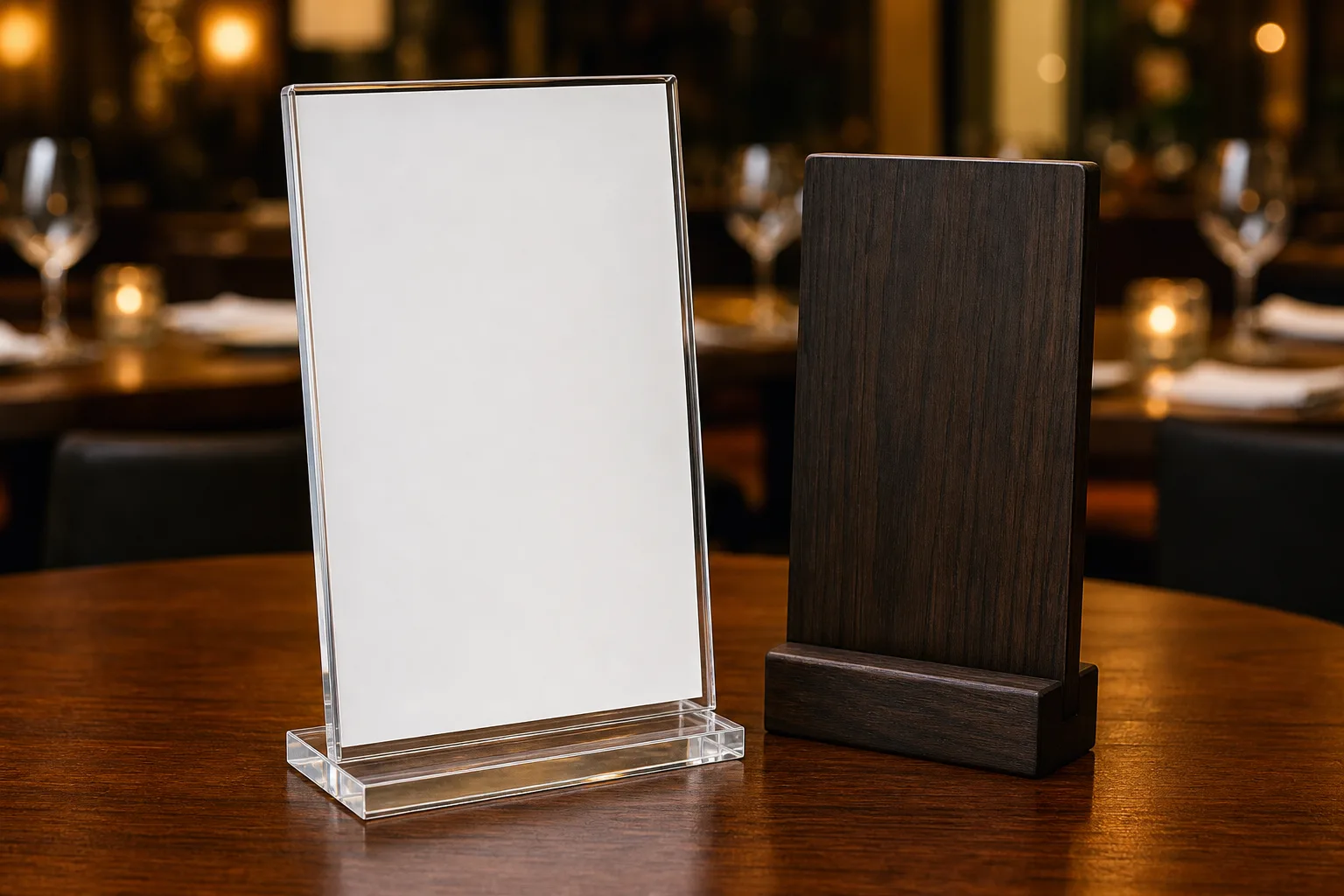
That last distinction is the whole comparison in one sentence: an acrylic menu holder is solid, non-porous material all the way through; a wood menu holder is a lacquer or oil finish protecting a porous substrate. The rest of this guide works through what that means for cleaning, menu changes, dining-room look, and cost across a multi-location order — and it gives wood its honest wins, because in the right room, wood is the correct answer.
What each holder actually is
An acrylic menu holder is CNC- or laser-cut from cast PMMA sheet — typically 3-5mm panels with a weighted base — then flame- or diamond-polished at the edges and routed with an insert slot. A wood menu holder is machined from hardwood or plywood, sanded, and sealed under lacquer, oil, or varnish.
The construction difference sets the maintenance contract. Acrylic’s surface is the material: transparent, hard, and chemically uniform, with a density around 1.2 g/cm³ that keeps even a weighted holder easy to handle.1 Cut it, polish it, and there is no coating to chip and nothing to reveal underneath. Wood’s surface is a protective film. Hardwood species used in restaurant fittings — oak is the classic — are genuinely tough, but the timber itself is porous, which is why every wood menu holder arrives sealed and stays serviceable only as long as that seal does.2
On the production side, the difference shows up as flexibility. Sheet-cut acrylic takes any outline, logo print, or slot geometry as a file change — we cut menu holders on the same lines as our display work, with no tooling fee on most designs. Wood shapes are shaped by cutter profiles and sanding labor, which is why wood holders cluster around a few standard forms.
Cleaning: sauce, grease, and the sanitizer test
Acrylic takes restaurant cleaning as designed: sauce, grease, and fingerprints lift off the non-porous surface with mild soap or a food-surface degreaser, shift after shift. Wood tolerates the same routine only through its finish — and repeated sanitizer contact is exactly what dulls, clouds, and eventually cracks that finish.
| Cleaning factor | Acrylic menu holder | Wood menu holder |
|---|---|---|
| Surface type | Solid non-porous PMMA | Lacquer/oil film over porous grain |
| Per-shift wipe-down | Yes — soap or degreaser | Yes, while the finish is intact |
| Repeated sanitizer exposure | No coating to wear through | Progressively degrades the finish |
| Failure mode | Fine scratches — polishable | Dulled, cracked, or lifted finish |
| After surface failure | Re-polish restores it | Refinishing labor, or grain absorbs spills |
| Cleaner to avoid | Ammonia/alcohol glass cleaners | Soaking, harsh solvents |
The regulatory backdrop points the same direction. US food-facility guidance calls for surfaces in food areas to be smooth, easily cleanable, and non-absorbent3 — a description polished acrylic meets by nature and sealed wood meets by maintenance. The honest caveat runs against acrylic too: ammonia- and alcohol-based glass cleaners are the wrong rag for it, since repeated use can craze the surface. Standard quat sanitizer and soap-and-water are the right routine, and they are what most floors already use.
The vulnerable point on a handled restaurant fixture is usually its surface finish at the spots hands and cleaning cloths touch most. Flame-polished cast-acrylic edges have no separate coating layer, but chemical compatibility still needs to be checked against the venue’s actual cleaner. Our custom acrylic menu-holder specifications cover edge finish, insert changes, and base stability for this application.
Menu changes: slot design beats clips
If your menu changes weekly, seasonally, or every service, the insert mechanism matters more than the material. A CNC-routed acrylic slot cut at tight tolerance grips a paper menu flat and swaps it in seconds; most wood holders fix the menu behind clips, screwed rails, or pressure corners.
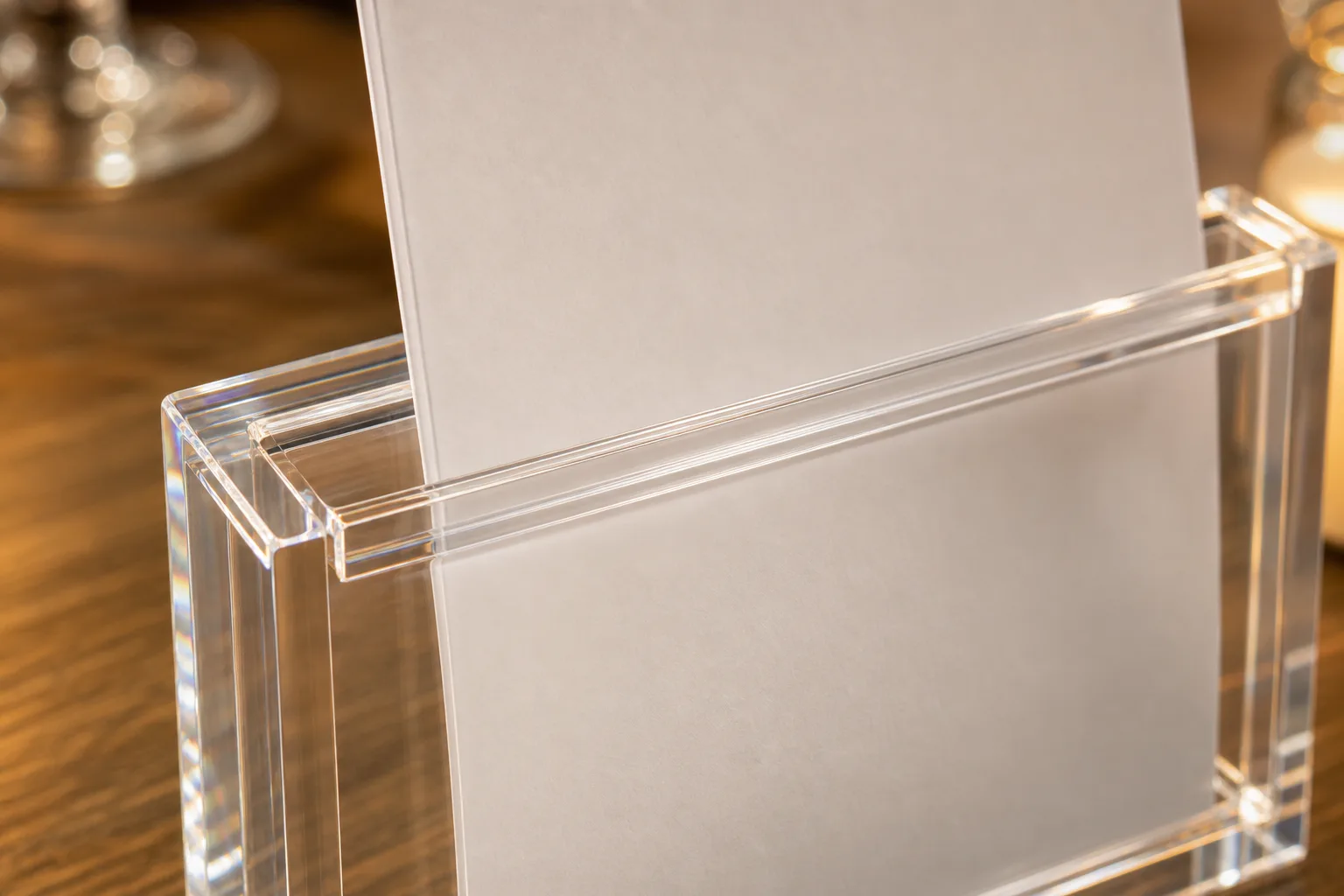
This is a genuine operational cost, not a convenience detail. A restaurant that reprints menus for a weekend special needs every holder on the floor updated between lunch and dinner. With top- or side-load slots, that’s one pass by one server. With clip-and-screw wood frames, it’s a task someone defers — and deferred menu swaps are how last month’s prices end up in front of a guest. On the 85-location program above, waitstaff swapped inserts in under 10 seconds per unit through slots routed at 0.3mm tolerance; that number was in the spec because the chain’s ops team asked for it, not because we volunteered it.
Slot geometry is also where custom earns its keep. Insert size (A4, A5, half-letter, custom die-cut), loading direction, single- or double-sided display, portrait or landscape — each is a routing-file decision, not a tooling charge. The same applies across the wider family of acrylic sign holders — table tents, slant-backs, hostess-stand uprights — and to wall-mounted sign holders where menus, hours, and compliance notices need the same quick-change slot at eye level.
Ambiance: where wood honestly wins
In a dark-toned steakhouse, a heritage tavern, or a rustic farm-to-table room, wood wins the ambiance question and it isn’t close. Warm timber matches the tables, the trim, and the story the room is telling. Clear acrylic’s strength is the opposite: it disappears, and the menu itself carries the look.
I’ll make the wood case properly, because a comparison that can’t is not worth reading. Wood has tactile warmth acrylic doesn’t imitate: grain under the fingertips, visual weight, the sense of an object that belongs to the furniture rather than the stationery. In rooms built around timber and leather, a clear plastic upright can read as a cost decision even when it wasn’t. If a dining room is that room and its menu rarely changes, a well-sealed hardwood holder is a legitimate choice — bought with a quality finish and a refinishing plan.
Print is the counterweight worth knowing before the aesthetic call is final. UV printing puts the restaurant’s mark on the acrylic itself — a logo on the base, a frosted band, a pattern echoing the interior — so the holder stops being generic clear plastic and starts being part of the room’s design language. Across work since 2014, I’ve printed menu-holder bases to match wallpaper, tile, and cocktail-list artwork; the print survives the same wipe-downs the panel does, because it cures into the surface rather than sitting on a label.
Two designs capture most of wood’s warmth without inheriting its maintenance. First, the hybrid build: a solid wood base carrying an acrylic display panel, so timber sits in the hand and on the table while the wipeable, slot-routed surface does the daily work — the same joinery logic as our wood and acrylic hybrid awards. Second, tinted material: bronze- or smoke-tinted and frosted acrylics carry a warmer, furniture-adjacent tone while keeping every functional advantage. Both are file-and-material changes on our lines, not new tooling.
Cost and lifespan across a chain
At program quantities the per-unit math favors acrylic: simple table-top menu holders commonly quote in the low single digits FOB Shenzhen, weighted-base and multi-panel formats in the high single digits to low teens — usually with no tooling fee at any custom size. Comparable wood holders carry sanding and finishing labor in every unit.
| Factor | Acrylic menu holder | Wood menu holder |
|---|---|---|
| Typical unit band (50-500 pcs) | Low single digits to low teens FOB | Higher — finishing labor per unit |
| Custom size/shape tooling | $0 — routing-file change | Cutter profiles, setup labor |
| Sample | 3-5 days, paid separately; not credited to production | Varies by workshop |
| Production | 15-20 days at 100-piece MOQ | Varies; finish cure time adds days |
| Mid-program replacements | Re-cut from archived files | Match wood tone and finish batch |
| End-of-life | Replace worn units at low cost | Refinish (labor) or replace |
Treat those bands as planning numbers — exact pricing follows size, thickness, base weight, print, and quantity. The structural point is what to notice: acrylic’s cost is machine time on cutting and polishing lines, which scales gently with volume, while wood’s cost is skilled finishing labor, which doesn’t.
The base is the spec detail that separates quotes
Base thickness is where low quotes hide their savings, and it’s the spec to check before anything else on a menu-holder quote. A table-top holder lives in a drafty dining room — door swings, HVAC vents, passing trays — and a light base turns every draft into a wobble the guest notices. On the 85-location program, the pilot units on 5mm bases drew staff complaints for exactly that; the shipped spec moved to a 12mm weighted base that held the panel steady under a 3-degree tilt threshold, and the complaints stopped. Two holders that photograph identically can differ by that one cross-section, and the difference is a few dollars of material against a chain-wide impression of flimsiness. When you compare quotes, ask each supplier for base thickness and weight — if the number isn’t in the quote, it’s usually because it wouldn’t help the quote.
Lifespan math should include the reorder, because chains grow and menus rebrand. We archive every program’s cutting files, slot dimensions, and print settings, so location fifty-one gets the same holder as location one — the 85-location chain’s second-phase order of 220 units turned around in 14 days on reused tooling. And when a rebrand changes the logo or the insert size, that’s a file revision, not a new product development cycle. If your tables are also carrying QR-code ordering, the same slot-and-base logic extends to acrylic QR code stands, which many of our restaurant buyers order in the same production run.
Decision rules: which holder wins where
The acrylic vs wood menu holder call resolves on operations, not looks. Buy acrylic when menus change often, cleaning is per-shift, the order spans many tables or locations, or budget is per-unit tight. Buy wood when the room is built around timber, menus are stable, and someone owns the refinishing. Buy the hybrid when you want the wood look with the acrylic maintenance contract.
The short version I give hospitality buyers weighing acrylic vs wood menu holder quotes:
- Acrylic wins when the operation is the priority: nightly sanitizer wipe-downs, weekly or daily insert swaps, multi-location consistency, branded prints, and low per-unit cost at 100+ pieces. Fast-casual floors, cafes, hotel F&B, and any chain rollout live here.
- Wood wins when the room is the priority: heritage and rustic interiors, stable menus, front-of-house objects chosen by the designer rather than the ops manager — and the budget includes maintaining the finish honestly.
- The hybrid or tinted build wins when both parties are right: the designer gets warmth on the table, the ops team gets a slot-routed wipeable panel, and the program still ships at sheet-cutting economics.
Ordering acrylic menu holders from Wetop
To quote a menu holder program we need five things: quantity, insert size, format (table tent, slant-back, upright, wall-mount), base and thickness preference, and any logo print or tint. Send them through our contact form and we respond within 24 hours with pricing and a production plan.
From there it’s the standard path across our 2,000+ projects: a sample in 3-5 days — the sample fee is paid separately and is not credited to production — your approval, then 15-20 day production at a 100-piece MOQ in our ISO 9001-certified Shenzhen factory, every unit inspected before packing. Terms are a 30% deposit with the balance before shipment.
If you’re comparing formats before quoting, the acrylic sign holders page covers table-level options, the wall sign holders page covers mounted ones, and the display stands hub covers the rest of the front-of-house range. And if your dining room truly calls for solid timber — order the wood, seal it well, and put the acrylic where the sauce is.
For the program-level version of this decision, review our multi-location menu-holder production plan.
Footnotes
-
Polymethyl Methacrylate (PMMA, Acrylic) properties — AZoM — materials-database property table listing PMMA density at 1.15-1.2 g/cm³ and its chemical characteristics, cited for the solid non-porous surface comparison. ↩
-
White Oak — The Wood Database — species profile documenting oak’s hardness and grain structure, the porous-substrate baseline behind the finish-over-grain comparison for wood menu holders. ↩
-
FDA Food Code 2022 — U.S. Food and Drug Administration — the model food code requiring surfaces in food areas to be smooth, non-absorbent, and easily cleanable, cited for the hygiene comparison between polished acrylic and finished wood. ↩
Frequently Asked Questions
Which is better for restaurant menus, acrylic or wood holders?
For most restaurants, acrylic — it survives per-shift sanitizer wipe-downs, swaps menu inserts in seconds through a routed slot, and costs less per unit at chain quantities. Wood earns its place in dark-toned or heritage dining rooms where warmth matters more than turnaround, and hybrid wood-base builds split the difference.
Do acrylic menu holders hold up to daily cleaning?
Yes — with the right cleaner. Acrylic is non-porous, so sauce, grease, and fingerprints wipe off with mild soap or a standard food-surface degreaser. What it does not want is ammonia- or alcohol-based glass cleaner, which can craze the surface over repeated use. A flame-polished cast acrylic edge has no coating to abrade, so there is nothing for daily cleaning to wear through.
How do restaurants change menus in acrylic holders?
Through the slot. A CNC-routed insert slot cut to tight tolerance grips a paper or card menu flat and lets staff pull and replace it in seconds — no tools, no disassembly. Specify insert size (A4, A5, half-letter, or custom), loading direction (top or side), and single- or double-sided display when you order, and the slot is machined to match.
Are wood menu holders more hygienic than acrylic?
No — the comparison runs the other way. Food-surface guidance favors smooth, non-absorbent, easily cleanable materials, which describes polished acrylic exactly. Wood is porous under its finish; once daily sanitizer dulls or cracks that finish, moisture and oils reach open grain that cannot be sanitized the same way. A sealed wood holder is acceptable; a worn one is a liability.
What is the minimum order for custom acrylic menu holders?
MOQ is 100 pieces per design — one mid-size restaurant, not just a chain. Samples ship in 3-5 days; the sample fee is paid separately and is not credited to production. Production runs 15-20 days with piece-by-piece inspection. Payment is a 30% deposit with the balance before shipment, FOB Shenzhen.
Explore Custom Acrylic Products
Browse product categories to compare formats, materials, and customization options before choosing the closest fit for your project.