Acrylic Reptile Enclosure Buyer Guide for Pet Retailers
Animal suitability, ventilation and escape prevention remain under the buyer's husbandry specialist; Wetop fabricates to the approved drawing and sample.
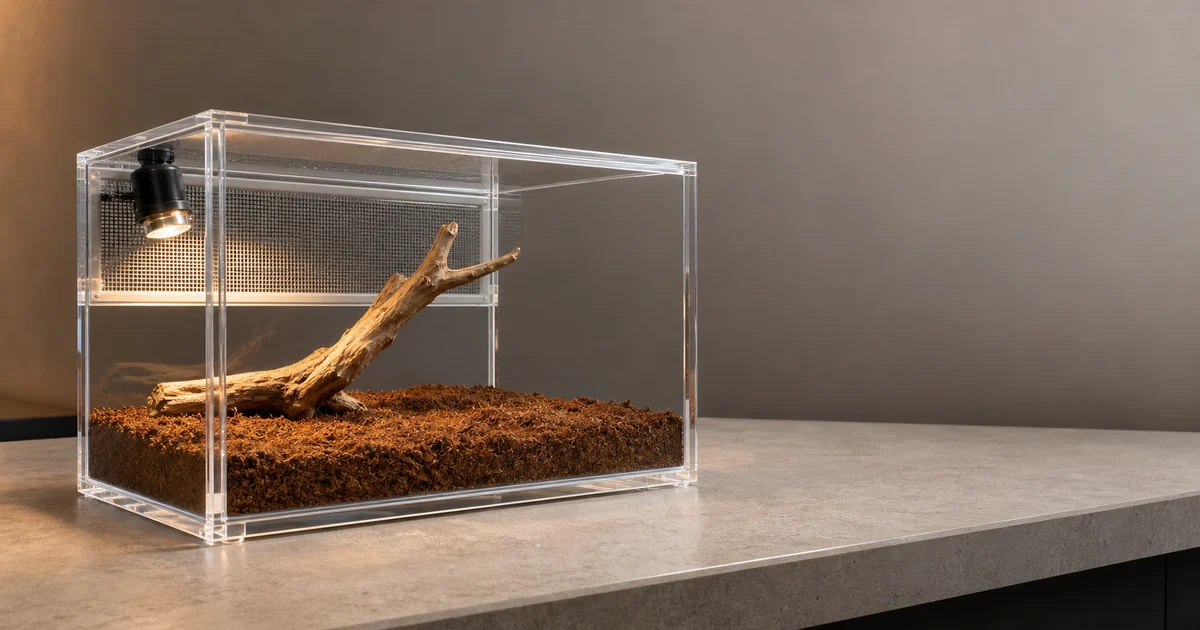
Key Takeaways
- Compare named acrylic and glass constructions at the same finished dimensions, access, ventilation, packing and quantity.
- Bonded and mechanically fastened constructions need their own drawing, material schedule and buyer-approved sample.
- The buyer's husbandry specialist defines ventilation, temperature, humidity and species requirements.
- Slider clearances, mesh openings and escape-risk checks are buyer-controlled acceptance criteria, not universal values.
- MOQ is 100 pieces per design; price and lifecycle comparisons require live like-for-like quotations and buyer data.
On this page
- Buyer-Controlled Acrylic Reptile Enclosure Specification
- Why acrylic over glass — weight, clarity, crack risk
- Bonded-corner construction — solvent-bond seam vs through-bolt
- Ventilation engineering — mesh inserts, gasket seams, cross-flow
- Escape-proofing — front-slider tolerances, hinge gaskets, locking hardware
- Sizing decisions — arboreal vs terrestrial, species-specific layouts
- Common spec mistakes I see on first inquiries
- Multi-species program planning — when SKU consolidation pays off
Buyer-Controlled Acrylic Reptile Enclosure Specification
An acrylic reptile enclosure requires a buyer-approved husbandry brief, named material, finished dimensions, construction, access, ventilation, maximum openings, cleaning method, packing and acceptance criteria. Wetop fabricates to the approved drawing and paid sample. MOQ is 100 pieces per design; sample fees are paid separately and never credited.
This guide organizes the fabrication questions. It does not determine animal suitability, ventilation, temperature, humidity or escape prevention. Those decisions remain with the buyer and its qualified husbandry specialist.
Why acrylic over glass — weight, clarity, crack risk
Compare acrylic and glass only on a common specification: finished dimensions, access, ventilation, joint design, hardware, named material, packing and quantity. The material densities and supplier data can inform handling and structural review, but a generic material comparison does not predict returns or lifecycle cost.1
Approve the appearance, operation and cleaning method on representative samples. Obtain live quotations for both constructions if the material choice remains open. The buyer retains responsibility for animal suitability and site use.
For the broader substrate comparison context across all display work (not just enclosures), see our acrylic vs glass displays guide. The enclosure-specific version of that comparison — weight, thermal behavior, and breakage economics side by side — is covered in the sections above.
Bonded-corner construction — solvent-bond seam vs through-bolt
Bonded and mechanically fastened corners differ in appearance, serviceability and fabrication. The drawing should identify the named sheet, joint process, hardware, gasket where applicable, access for cleaning and required test. Wetop confirms manufacturing feasibility after reviewing the complete geometry.
Do not assign a universal impact rating to either method. Panel thickness, edge preparation, joint geometry, cure, fastener spacing and loading all matter. The buyer approves the visible joint and operation on the paid sample.
Ventilation engineering — mesh inserts, gasket seams, cross-flow
The buyer’s husbandry specialist supplies the airflow, temperature, humidity, vent placement, mesh material, maximum opening and monitoring requirements. Wetop does not infer those values from a species label. Professional veterinary husbandry resources can support the buyer’s review, but the appointed specialist remains the approval authority.2
The drawing translates the approved brief into openings and inserts. The paid sample lets the buyer check access, mesh retention, cleaning and measurement points before production. Any active heating, lighting or ventilation equipment remains outside this non-electrical fabrication scope unless separately sourced and approved by the buyer.
Escape-proofing — front-slider tolerances, hinge gaskets, locking hardware
Escape prevention is a buyer-controlled safety requirement. The specialist specifies maximum openings, slider and door clearances, mesh, gasket, latch, lock and the acceptance test. Wetop can document measured dimensions against the approved drawing, but it cannot label a generic construction escape-proof.
The two related tarantula enclosure and snake enclosure pages are Manufacturing Case planning models. They do not document delivered quantities, escape rates or species suitability.
Sizing decisions — arboreal vs terrestrial, species-specific layouts
The fifth spec axis is sizing, and the framework is species-driven.
Arboreal vs terrestrial. Arboreal species (most tropical lizards, most arboreal tarantulas) need vertical-format enclosures — typically taller than wide, with usable vertical climbing surface. Terrestrial species (most snakes, most desert reptiles, most terrestrial tarantulas) need horizontal-format enclosures — wider than tall, with usable floor surface and substrate depth.
Species-specific dimensions. The buyer’s specialist supplies the minimum internal dimensions, substrate allowance, access and furnishing clearances. Wetop does not publish a universal enclosure size by species.
Custom-fit planning. Each distinct dimension or construction is a design under the 100-piece MOQ. Compare variants only after the buyer has approved the husbandry brief; lead time and price remain quote-specific.
Common spec mistakes I see on first inquiries
Three specification gaps should be closed before quotation:
Copying a glass thickness into an acrylic drawing. The buyer’s qualified reviewer should select thickness from the actual geometry, material data, loads, openings, joints and acceptance criteria.
Omitting the ventilation requirement. The specialist should supply measurable airflow, temperature and humidity requirements plus the inspection method before the opening pattern is released.
Using escape-proof as an unmeasured label. Replace it with maximum openings, operating clearances, hardware, test procedure and buyer acceptance.
Multi-species program planning — when SKU consolidation pays off
SKU consolidation is possible only when the buyer’s specialist confirms that the same internal dimensions, openings, access and environment are acceptable for each intended use. Each distinct design has a 100-piece MOQ. Shared tooling or packing assumptions must be stated in the live quotation rather than inferred from a fixed percentage.
Start the SKU record with a unique design code. For each code, list external and usable internal dimensions, named sheet grade and thickness, joint method, door or slider arrangement, maximum opening, vent and mesh drawing, substrate allowance, hardware, cleaning method and pack. A label such as small terrestrial or arboreal is not enough for fabrication and should not replace the specialist-approved requirements.
Keep husbandry approval separate from manufacturing approval. The husbandry reviewer signs off temperature, humidity, ventilation, access, maximum openings and intended animal use. The buyer’s product team approves appearance, branding, cleaning and retail handling. Wetop confirms manufacturability against the drawing and sample. A signature in one area does not transfer authority to another party.
For the paid sample, use the proposed production material and representative hardware. The buyer should check door or slider travel, all accessible gaps, mesh retention, edge condition, cleaning access, label placement and packing. If the specialist requires an environmental or escape-risk test, the buyer supplies the method, equipment, duration and acceptance criteria. Sample fees are paid separately and never credited.
Record every approved change by drawing revision. A different vent pattern, door track, sheet thickness, hardware set or internal dimension creates a new design unless the quotation says otherwise. Production should reference the approved revision rather than a photograph or a note such as same as sample. This matters when several enclosure formats share similar outward dimensions but have different openings or access.
Define inspection before production. The order can state which dimensions are measured, how openings are checked, how hardware operation is sampled, which faces are cosmetic surfaces and how packing is verified. Wetop can report measurements against the approved drawing; it does not convert those measurements into a husbandry or escape-proof certification.
Treat any powered equipment as a separate buyer-controlled system. Heating, lighting, fans, thermostats, sensors and cables require their own supplier data, clearances, electrical approval and site controls. The acrylic enclosure quotation does not claim compatibility with an unspecified lamp, heater or control device. The buyer confirms the installed system after reviewing all component documentation.
The packing brief should account for projections, tracks, doors, mesh and loose accessories. State whether hardware ships installed or separately, how moving parts are restrained, how finished faces are protected and how each carton maps to the design code. The buyer or logistics provider defines pallet, drop, stacking and destination requirements; the quotation covers only the approved pack.
For repeat orders, confirm that the named sheet, hardware and mesh remain available and that the buyer’s requirements have not changed. A previous sample supports comparison but does not automatically approve a substitution. Wetop should disclose proposed changes and obtain drawing or sample approval before production.
MOQ is 100 pieces per design. Quote quantity tiers only after the common specification is fixed, and do not combine different dimensions, opening patterns or hardware sets unless the quotation explicitly defines the shared basis. The buyer can then compare unit price without hiding a specification change inside the volume calculation.
The inquiry should also state destination market, intended sales channel and who will approve labeling and instructions. The buyer is responsible for market, animal-care, retail and consumer requirements. Wetop can manufacture the non-electrical acrylic assembly described in the approved files, but does not certify the finished enclosure for an unspecified species, jurisdiction or complete installed system.
Before placing the production order, confirm the approved drawing revision, sample record, material and hardware schedule, quantity per design, inspection plan, carton marks and shipping term. The order should say who may approve deviations and how nonconforming units are handled. This closes the manufacturing scope without turning a fabrication record into a claim about husbandry performance.
At receipt, the buyer checks carton identity, visible transit damage, quantities and the approved inspection points before putting units into service. Any animal-use evaluation follows the buyer specialist’s procedure. Keep that evaluation separate from a freight or cosmetic claim so each issue is reviewed against the correct evidence.
Retain the approved files, supplier documents, sample photographs and inspection record under the design code. That record supports repeat-order comparison while keeping husbandry decisions with the buyer’s appointed authority.
For retailers scoping a multi-species enclosure program, send the species list, buyer-approved husbandry requirements, object loads, dimensions, access plan, and quantity. Browse our acrylic cases catalog for adjacent forms. The regional museum traveling exhibit case Manufacturing Case is a non-electrical planning reference for buyer-controlled material, enclosure, handling, inspection, and packing decisions; it is not a delivered enclosure program or evidence for species suitability. Send the brief over to our team for drawing and sample questions. The buyer or appointed specialist remains responsible for ventilation, husbandry, escape prevention, and acceptance criteria.
Footnotes
-
PLEXIGLAS product information — manufacturer technical information used to identify a named PMMA grade before drawing and sample approval. ↩
-
Association of Reptile and Amphibian Veterinarians — professional veterinary resource; the buyer appoints its own specialist and requirements. ↩
Frequently Asked Questions
Why do retailers and breeders increasingly choose acrylic over glass for reptile enclosures?
A buyer may compare acrylic and glass for weight, appearance, handling, access, cleaning, packing and price. Use named materials and the same finished specification on both quotations. The buyer's specialist approves animal suitability; no fixed breakage or lifecycle result applies across programs.
What construction method is right for an acrylic reptile enclosure?
Bonded and mechanically fastened constructions can both be quoted. The choice depends on dimensions, named material, access, service, cleaning, disassembly and buyer-defined acceptance criteria. Approve the joint appearance and operation on the drawing and paid sample.
How much ventilation does an acrylic reptile enclosure need?
The buyer's husbandry specialist defines the required airflow, temperature, humidity, opening size and mesh. Wetop translates that approved brief into a drawing and paid sample; it does not prescribe a universal air-change rate or open-area percentage.
What front-slider tolerance prevents tarantula or small-snake escape?
There is no universal escape-proof tolerance by species. The buyer's specialist defines maximum openings, clearances, access hardware and the acceptance test. The drawing and paid sample must be approved before production.
Scoping a custom acrylic reptile or tarantula enclosure rollout?
Send the buyer-approved husbandry specification, enclosure dimensions, access and ventilation drawing, quantity and packing brief. We will reply with fabrication and paid-sample questions plus a project-specific quote; the buyer's specialist retains authority over animal suitability.