



Reptile Enclosure Ventilation: Engineering Guide
Since 2014, the conclusion is consistent: acrylic gets visibility right and fails on ventilation if the buyer treats it as an afterthought.
Need this made?Custom acrylic fabrication services →
The math here turns ventilation from an afterthought into a spec line.
Key Takeaways
- Acrylic has a smaller thermal margin than glass — heat builds faster inside an under-ventilated acrylic enclosure than the equivalent glass enclosure, which makes ventilation calculation more important on acrylic substrate.
- Cross-flow CFM math: minimum 1 air change per hour for terrestrial dry setups, 2-4 ACH for arboreal or tropical, 3-5 ACH for high-humidity setups. CFM target = (ACH × enclosure volume in cubic feet) / 60.
- Mesh-insert open area runs 8-15% of total enclosure surface area for typical species; below 8% creates condensation and humidity buildup, above 15% creates thermal control problems and (for tarantulas) escape-purchase risk.
- Hinge gasket spec is the variable most buyers skip — sealed-too-tight produces humidity problems in tropical setups; gasket compression at 70-80% under closed lid is the production-grade target.
On this page
- How Can Businesses Ensure Proper Ventilation in Reptile Habitats?
- Why acrylic + ventilation is harder than glass + ventilation
- Cross-flow CFM math at 4 reference volumes
- Mesh-insert engineering — open area, mesh size, escape-proofing
- Hinge gasket spec — when sealed-too-tight becomes a humidity problem
- Humidity-controlled vs arid setups — protocol switches
- Diagnostic — when ventilation is failing in the field
- Modifications and retrofits — adding ventilation to existing enclosures
How Can Businesses Ensure Proper Ventilation in Reptile Habitats?
Reptile enclosure ventilation starts with the buyer’s species, heat-source, humidity, and husbandry requirements. The commercial starting points are 100 pieces per design, a paid sample in 3–5 days, 15–20 production days, and drawing-controlled critical dimensions. Reptile enclosure ventilation geometry and sample readings require approval by the buyer’s husbandry specialist.
| Published price reference | Scope | Price basis |
|---|---|---|
| 90 × 45 × 45 cm retrofit | One additional routed mesh insert; stainless mesh kit and installation excluded | $15 published low-end reference per routed insert at a retrofit shop, not a Wetop enclosure quote |
Since we built our first enclosure line, I’ve watched the same ventilation failure modes show up across species and setups. The four sections below cover what acrylic specifically requires, the cross-flow CFM calculation, mesh-insert engineering, and hinge-gasket spec.
Why acrylic + ventilation is harder than glass + ventilation
Thermal conductivity is the variable that makes ventilation engineering different on acrylic vs glass. Cast PMMA conducts heat at roughly 0.18 W/m·K. Soda-lime glass conducts at roughly 1.0 W/m·K — about 5× higher.
In practice, a heat lamp or heat mat operating in an acrylic enclosure produces a slower wall-conduction heat dissipation. Heat that would conduct through a glass wall and dissipate to ambient instead remains inside the acrylic enclosure until it’s removed by ventilation airflow. The thermal margin — the gap between operating temperature and the species’ upper safe limit — is smaller, and reaches the limit faster under ventilation insufficiency.
The implication for ventilation spec: the same air-change-per-hour (ACH) target that works on a glass enclosure may not be sufficient on an acrylic enclosure with the same heat input. We typically recommend bumping ACH targets 25-30% above glass-baseline for any acrylic enclosure with active heat input (heat lamps, heat mats, or species with metabolic heat generation). The full substrate trade-off behind that adjustment — thermal conductivity, weight, and breakage economics — is laid out in our acrylic reptile enclosure buyer guide.
The good news: cross-flow ventilation is more predictable on acrylic than on glass because the wall surfaces don’t conduct away cross-flow heat as efficiently — the airflow is doing the thermal work directly. This means well-designed cross-flow geometry produces consistent thermal performance across batch.
Cross-flow CFM math at 4 reference volumes
The CFM calculation (adapted from ASHRAE 62.1 framework1 applied to husbandry-room volumes): CFM = (ACH × enclosure volume in cubic feet) / 60. ACH targets vary by setup type, with ranges informed by veterinary husbandry guidelines2.
Terrestrial dry setup (most snake species, desert reptiles). 1-2 ACH. The enclosure is generally cooler-running with no humidity control requirement. This is the profile we engineered for the 300-unit snake enclosure run for a specialty pet retailer.
Arboreal setup (most tropical lizards, arboreal tarantulas). 2-4 ACH. Higher airflow because the enclosure has vertical climbing structure that creates pockets where air can stagnate.
Tropical high-humidity setup. 3-5 ACH. Higher airflow to prevent moisture buildup that would otherwise produce respiratory problems for the species. For a production program that ran tropical and arid vent-insert profiles side by side across 4 SKUs, see our tarantula enclosure rollout for an invertebrate breeder — the condensation-channel detail on the tropical SKU came directly out of this ACH math.
Reference enclosure CFM targets:
| Enclosure dimensions | Volume (m³ / ft³) | Terrestrial 1 ACH | Arboreal 3 ACH | Tropical 5 ACH |
|---|---|---|---|---|
| 60 × 30 × 30 cm | 0.054 / 1.91 | 0.032 CFM | 0.096 CFM | 0.159 CFM |
| 90 × 45 × 45 cm | 0.182 / 6.43 | 0.107 CFM | 0.322 CFM | 0.536 CFM |
| 120 × 60 × 60 cm | 0.432 / 15.26 | 0.254 CFM | 0.763 CFM | 1.272 CFM |
| 180 × 60 × 60 cm | 0.648 / 22.89 | 0.382 CFM | 1.144 CFM | 1.907 CFM |
Cross-flow geometry — air entering at the lower end of one wall and exiting at the upper end of the opposite wall — produces convection-driven airflow that approximately matches these CFM targets without requiring forced ventilation. The mesh-insert area calculation in the next section determines whether the geometry actually delivers the calculated CFM.
Mesh-insert engineering — open area, mesh size, escape-proofing
Mesh open area is the percentage of the enclosure surface area that’s open to air exchange. The math links open area to delivered CFM through standard convection-airflow equations.
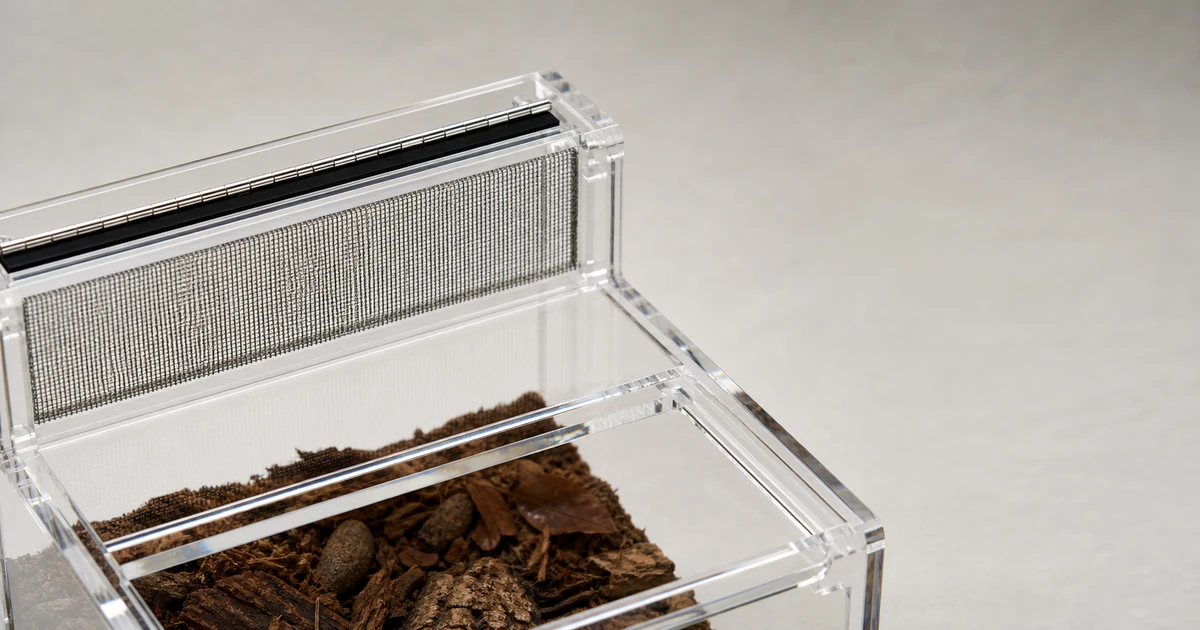
Open area target by setup. Terrestrial dry: 8-10% open area. Arboreal: 10-13%. Tropical high-humidity: 12-15%. Above 15%, two problems show up: thermal performance becomes harder to maintain because too much heat exchanges with ambient, and (for tarantula species) the mesh becomes a structural escape risk.
Mesh material. Stainless-steel woven mesh is the production-grade default. Aluminum mesh oxidizes in humidity-controlled setups within 12-24 months. Plastic mesh degrades under UV exposure and isn’t recommended for any enclosure with basking-lamp use. Stainless mesh holds 5+ years across all setup types.
Mesh aperture (hole size). For tarantula species: 1.5-2 mm aperture for adult terrestrial, 0.8-1.0 mm for slings (juvenile spiders), 1.0-1.5 mm for arboreal. For snake species: 2-3 mm aperture for adult, 1.0-1.5 mm for hatchling enclosures. For lizard species: 2-4 mm aperture depending on body size. The aperture must be smaller than the species’ minimum body diameter at all life stages to prevent escape.
Distribution geometry. Cross-flow requires intake low / exhaust high. A typical setup: 60% of total open area in lower-rear panel insert, 40% in upper-front or top panel insert. This produces convection-driven airflow without forced ventilation — warm air rises and exits the upper insert, drawing cooler air through the lower insert.
Forced vs convection. Convection-driven cross-flow handles 1-3 ACH cleanly without electrical infrastructure. Above 3 ACH, forced ventilation (small DC fan with controlled CFM) becomes necessary, particularly on larger enclosures (above 200 cm long edge). Forced ventilation adds installation complexity but is required for high-volume tropical or high-stocking setups.
Hinge gasket spec — when sealed-too-tight becomes a humidity problem
The hinge gasket is the seal between the enclosure body and the lid (or front-slider, depending on construction). On tropical and high-humidity setups, the gasket spec affects RH stability more than buyers usually realize.
EPDM gasket vs silicone gasket. EPDM is the production-grade default for tropical and humidity-controlled setups — it holds dimensional stability under 60-90% RH cycling for 5+ years without compression set. Silicone gasket is acceptable for dry setups but loses elasticity under humidity cycling within 18-24 months.
Compression target. 70-80% gasket compression under closed lid. Below 70%, the gasket leaks and the tropical setup loses RH stability — typically 5-10% RH drop overnight, which compounds husbandry stress on humidity-sensitive species. Above 90% compression, the gasket is sealed too tight and produces internal pressure variance with daily temperature cycles (warm day → expanding interior air → gasket creak and seal-line stress).
Gasket profile. D-section EPDM at 4 mm thickness is the typical production spec, sized to the lid-to-body gap geometry. The gasket compresses from 4 mm at rest to 3 mm under closed lid (75% compression target).
Cycle-life testing. Production-grade gasket spec passes 5,000-cycle opening test (= 5+ years of weekly opening for a typical retail or breeder display enclosure) without dimensional drift or seal failure. Consumer-grade enclosures typically ship with gasket material that fails the cycle test at 1,500-2,500 cycles.
Humidity-controlled vs arid setups — protocol switches
The two dominant setup types have different operational profiles, which affect the rest of the enclosure spec.
Humidity-controlled tropical setup. RH target 60-80%, depending on species. Requires: 3-5 ACH ventilation (higher because moisture must exit), 12-15% mesh open area, EPDM gasket at 75-80% compression, optional misting system or moss substrate for active humidity contribution. Typical species: most arboreal tarantulas, tropical lizards, some snake species (rosy boas, some pythons).
Arid setup. RH target 30-50%, depending on species. Requires: 1-2 ACH ventilation (lower because moisture management isn’t required), 8-10% mesh open area, EPDM or silicone gasket at 70-75% compression. Typical species: desert reptiles, most snake species (corn, milk, kingsnake, garter), some lizard species (leopard gecko, bearded dragon).
Mixed or transitional setups. Some species cycle between higher and lower humidity (seasonal, breeding cycle). The enclosure spec should be tuned to the higher-humidity end of the cycle — a tropical-spec enclosure runs fine at arid setup, but an arid-spec enclosure can’t be temporarily upgraded to tropical without humidity control problems.
Diagnostic — when ventilation is failing in the field
Ventilation problems are sometimes invisible in the spec sheet but show up as observable symptoms once the enclosure is set up. The four diagnostic signs I have my reseller customers and breeder partners watch for:
Persistent condensation on interior walls. Water droplets visible on the upper-half of interior walls indicate humidity is condensing because moist air is hitting cool surfaces faster than ventilation can cycle it out. On a tropical setup running at correct ACH, condensation should clear within 30-60 minutes after misting. Persistent condensation 4+ hours post-misting indicates ACH is below target.
Substrate molding within 30 days of enclosure setup. Mold growth on substrate (paper, sphagnum moss, coconut fiber) indicates moisture is accumulating faster than ventilation can remove it. On a properly-vented tropical setup, substrate may stay damp but should not develop visible mold. Mold within 30 days indicates ACH below target or mesh-insert open area below spec.
Temperature stratification with hot top and cool bottom. Warm air should rise and exit through the upper mesh insert, drawing cooler ambient air through the lower insert. If the top of the enclosure runs 6-8°C warmer than the bottom (above the spec’d basking gradient), the cross-flow geometry isn’t producing sufficient air exchange. Common cause: lower mesh insert blocked by substrate or decor.
Animal stress signs in otherwise-correct setup. Reptiles and tarantulas show ventilation distress through observable behaviors — gaping (snakes), increased substrate burrowing, retreat to corner-most position furthest from heat source. When the spec’d temperature and humidity targets are correct but the animal still shows stress signs, ventilation is the likely missing variable.
For all four symptoms, the diagnostic protocol is the same: measure actual ACH against spec target using a smoke-pencil test (release smoke at the lower mesh; time how long it takes for the smoke to clear through the upper mesh) and inspect mesh inserts for blockage. If actual ACH is below target, either retrofit a forced-ventilation fan or add additional mesh-insert area in the next production batch.
Modifications and retrofits — adding ventilation to existing enclosures
About 1 in 4 enclosure inquiries I see comes from a buyer trying to retrofit ventilation onto an existing enclosure that’s running humidity or thermal problems. Three retrofit approaches and their tradeoffs:
Cut additional mesh inserts. A CNC operator can route mesh-insert windows into existing acrylic walls at any retrofit shop, producing additional open area to lift ACH. Cost: $15-30 per insert at typical retrofit shop labor rates, plus $3-8 per stainless-steel mesh kit. Production-grade retrofit on a 90 × 45 × 45 cm enclosure adding 6% additional open area takes about 2-3 hours of shop time. Pros: low-cost, no additional equipment. Cons: changes the enclosure’s structural geometry; the buyer should verify the retrofit doesn’t compromise enclosure rigidity at the cut location.
Forced ventilation fan retrofit. A small DC fan (typically 12V, 80×80×25 mm computer-style fan at 30-60 CFM) installed on the upper mesh insert produces forced exhaust that lifts ACH dramatically. Cost: $25-40 for the fan + power supply, plus $40-80 of installation labor. Pros: lifts ACH from 1-2 to 5-8 with no enclosure modification beyond fan mounting. Cons: requires power infrastructure at the enclosure location, and continuous fan operation accelerates substrate drying for tropical setups (mitigated by misting cadence).
Replace the enclosure with a correctly-spec’d unit. When the existing enclosure is fundamentally mis-spec’d for the species (e.g., a desert-spec enclosure being used for a tropical species), replacement is often more cost-effective than retrofitting. Cost: $80-300 for the replacement enclosure (volume-dependent) plus animal-transfer labor. Pros: clean re-spec, and the new unit is inspected against its approved sample before shipment. Cons: cost and disruption to the animal during transfer.
The right retrofit depends on whether the existing enclosure’s underlying geometry is correct (then retrofit makes sense) or fundamentally mismatched to the species (then replacement is correct). I run a 5-minute diagnostic call with reseller customers on retrofit decisions to assess which path fits.
For broader context, see our acrylic reptile and tarantula enclosure buyer guide and acrylic cases catalog. Specialty pet buyers remain responsible for husbandry, ventilation, escape prevention, and acceptance criteria. The regional museum traveling exhibit case project covers buyer-controlled sheet, enclosure, handling, and packing decisions; it is not an airflow, seal, or species-suitability example. Send the brief over to our team to define the drawing and paid-sample review.
Footnotes
-
ASHRAE. ASHRAE 62.1 — Ventilation for Acceptable Indoor Air Quality. (Reference framework adjacent to animal-husbandry ventilation calc.) https://www.ashrae.org/ ↩
-
Association of Reptilian and Amphibian Veterinarians. Captive Husbandry Guidelines. https://www.arav.org/ ↩
Frequently Asked Questions
Why is ventilation harder on acrylic enclosures than glass?
0.18 W/m·K is acrylic's approximate thermal conductivity versus 1.0 W/m·K for glass, so heat from a basking lamp or heat mat dissipates more slowly through acrylic walls. The thermal margin between operating temperature and the species' upper safe limit is smaller, so ventilation geometry has to be validated for the actual heat input.
What's the CFM math for cross-flow ventilation?
0.107 CFM is the result for a 90 × 45 × 45 cm enclosure at 1 ACH: CFM = (ACH × enclosure volume in cubic feet) / 60. At 4 ACH the same enclosure needs 0.43 CFM; a 120 × 60 × 60 cm enclosure at 4 ACH needs 1.02 CFM. Mesh dimensions must then be validated under the actual convection path.
What mesh-insert open area is right for tarantula species?
8–12% open area is the planning band stated here for tarantula enclosures, with aperture selected for the actual species and life stage. The approved drawing must define mesh material, opening size, panel position, and escape-risk check; husbandry requirements remain the buyer's or specialist's authority.
What's the hinge gasket spec for a tropical-setup enclosure?
70–80% EPDM gasket compression is the working target stated here for the closed lid. The sample must still be checked with the specified mesh and climate setup, because gasket compression alone does not establish humidity or airflow performance.
How can businesses ensure proper ventilation in reptile habitats?
3 checks come first: calculate the target airflow from enclosure volume, define low intake and high exhaust geometry on the drawing, and validate temperature and humidity on the physical sample with the buyer's husbandry specialist.
Spec'ing ventilation for a custom acrylic enclosure?
Send the species, enclosure dimensions, heat source, and climate profile for a fabrication review. Paid sample fees are billed separately and are not credited to production; husbandry approval remains with the buyer's specialist.