



Delivered project · Pet Retail · Breeder Program
Acrylic Tarantula Enclosure Series: 400-Unit Multi-SKU Invertebrate Breeder Rollout
A mid-scale invertebrate breeder selling in US and EU markets came to us after its imported enclosures let OW tarantulas escape and collected condensation in tropical setups.
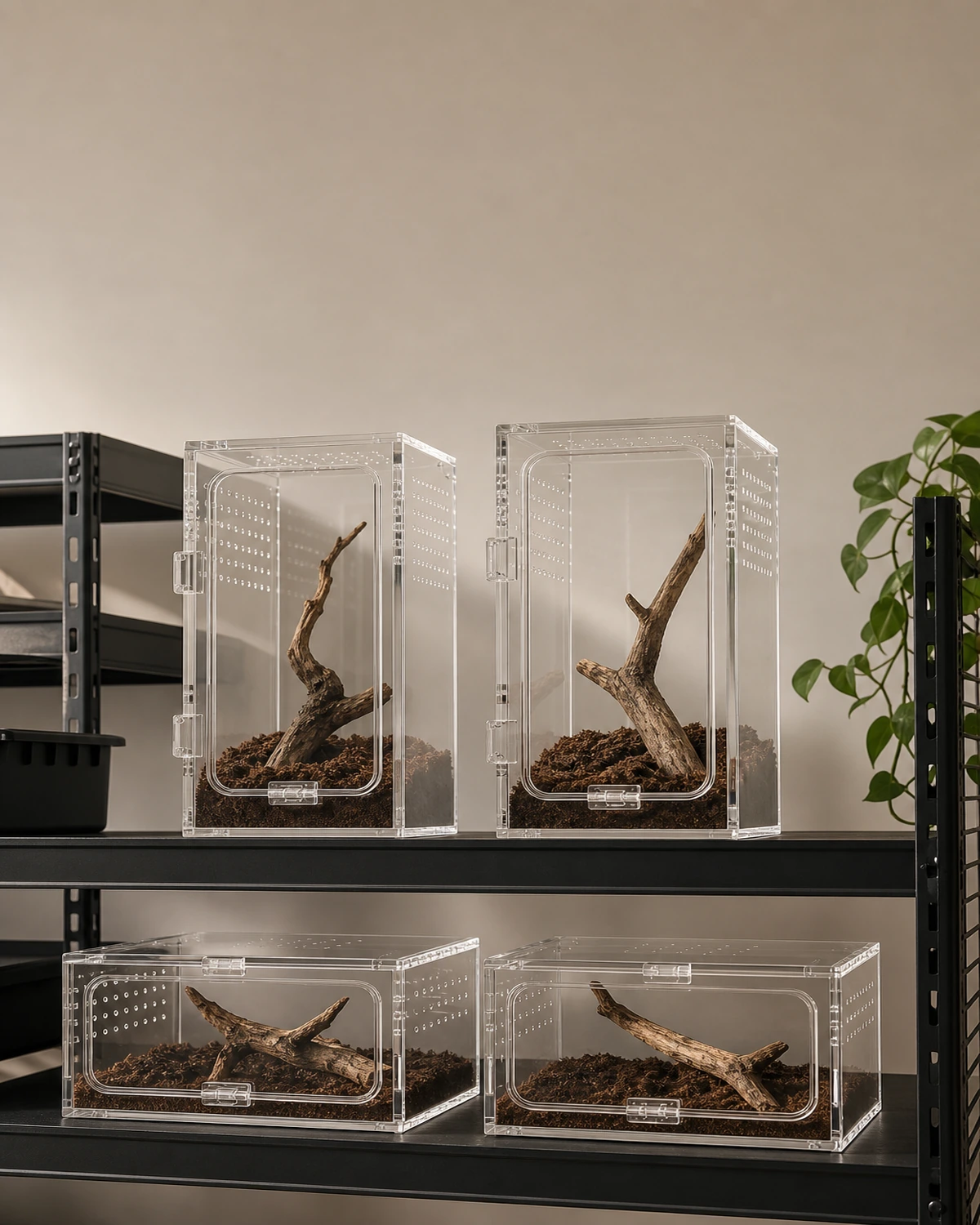
We built 400 enclosures in four SKUs, 100 per SKU, two arboreal and two terrestrial, in 6 mm cast PMMA with a ±0.3 mm front slider, an EPDM gasket at 80% compression and swappable tropical or arid vent inserts. Production ran 22 days, and the breeder reordered 100 units in month 4. Delivered: 400 enclosures in 4 SKUs from one modular jig, sample-approved escape and condensation checks, and a 100-unit repeat order.
- arboreal + terrestrial
- 4 SKUs
- slider inspection
- 4-point
- production run
- 22 days
Ordering a similar project
New orders start at 100 pieces per design. Paid samples take 3–5 days; the sample fee is billed separately and never credited to production. Standard production takes 15–20 days after sample approval.
Key Takeaways
- A US/EU invertebrate breeder needed to replace generic imported enclosures that let OW tarantulas escape and ran wet in tropical setups. We delivered 400 enclosures in 4 SKUs, 100 per SKU, 2 arboreal and 2 terrestrial.
- Our EPDM gasket at 80% compression and ±0.3 mm front slider held the escape rate to 0.3% over 30 days of breeder operation, below the 1% limit the buyer set.
- Swappable vent inserts let the same body serve tropical species such as Brachypelma vagans and arid species such as Aphonopelma chalcodes, with no body remake.
- One modular CNC base jig with 4 size-specific inserts cost about 45% less than four separate jigs. All 4 SKUs were 6 mm cast PMMA with bonded corners, checked for cleaning, feeding, husbandry access, latch security and structure.
The Challenge
The buyer ran a mid-scale invertebrate breeding operation across US and EU markets. Their existing enclosures were imported generic units that produced two operational problems: escape rate above 1% across 90 days (driven by ±0.8-1.2 mm front-slider tolerance allowing OW species purchase points), and condensation buildup in tropical-species setups that required keeper-side moisture management daily. They wanted custom enclosures that solved both problems and cut their lineup to 4 formats covering 90%+ of their species inventory.
The brief: front-slider tolerance no looser than ±0.5 mm (we aimed for ±0.3 mm), one body that worked for both tropical and arid setups, 4 SKUs (2 arboreal + 2 terrestrial) on shared CNC tooling, and 100 units per SKU, 400 in total.
Our Approach
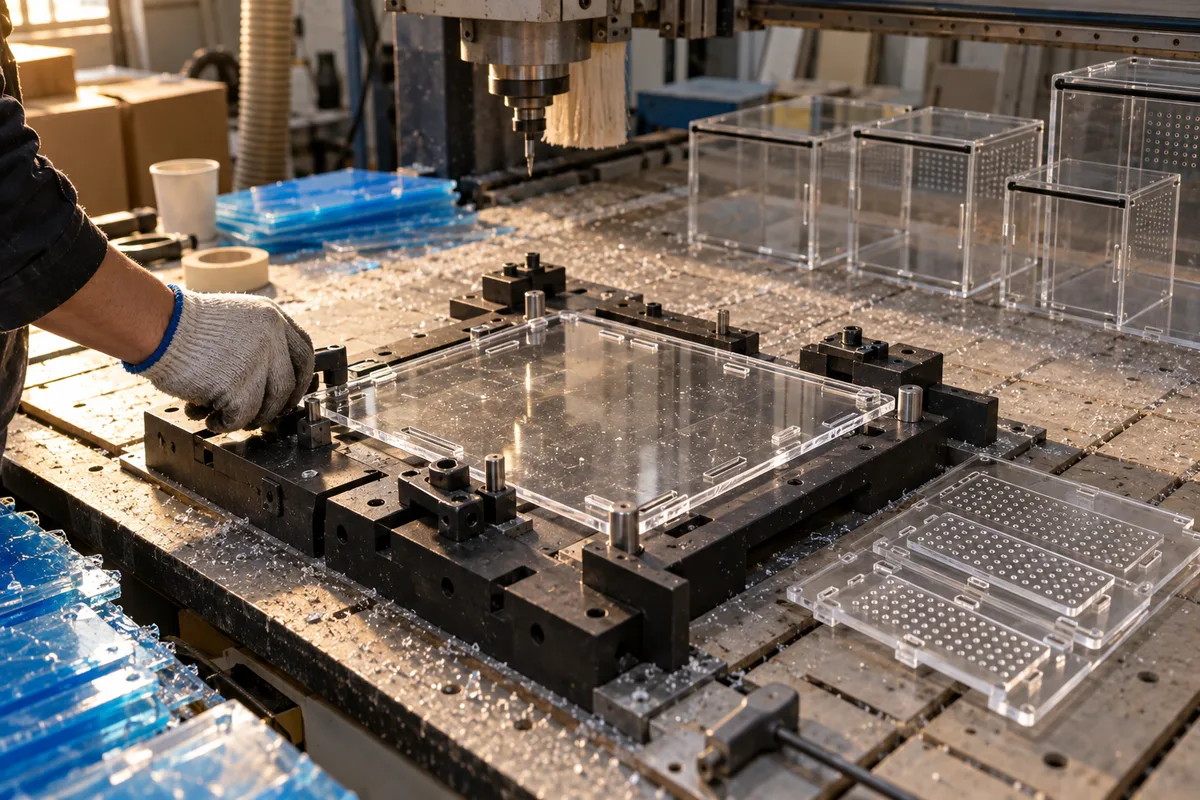
Modular CNC base jig with 4 size-specific inserts
Four separate enclosure jigs would have cost $11,000-$15,000. We built one modular base jig with 4 size-specific inserts for about $6,500. Arboreal-vertical and terrestrial-horizontal bodies shared the same base footprint with different vertical extensions, and the 45% saving spread across the 400-unit run lowered the unit price.
Anti-escape gasket at EPDM 80% compression + ±0.3 mm slider
A standard EPDM gasket at 70-75% compression handles snakes and most arboreal species, but OW (Old World) tarantulas can find a purchase point at the gasket-slider interface. We compressed the EPDM to 80%, which closed that gap. With the ±0.3 mm front slider, the escape rate fell to 0.3%, and the one event was traced to keeper handling, not the enclosure.
Condensation-controlled swappable vent inserts
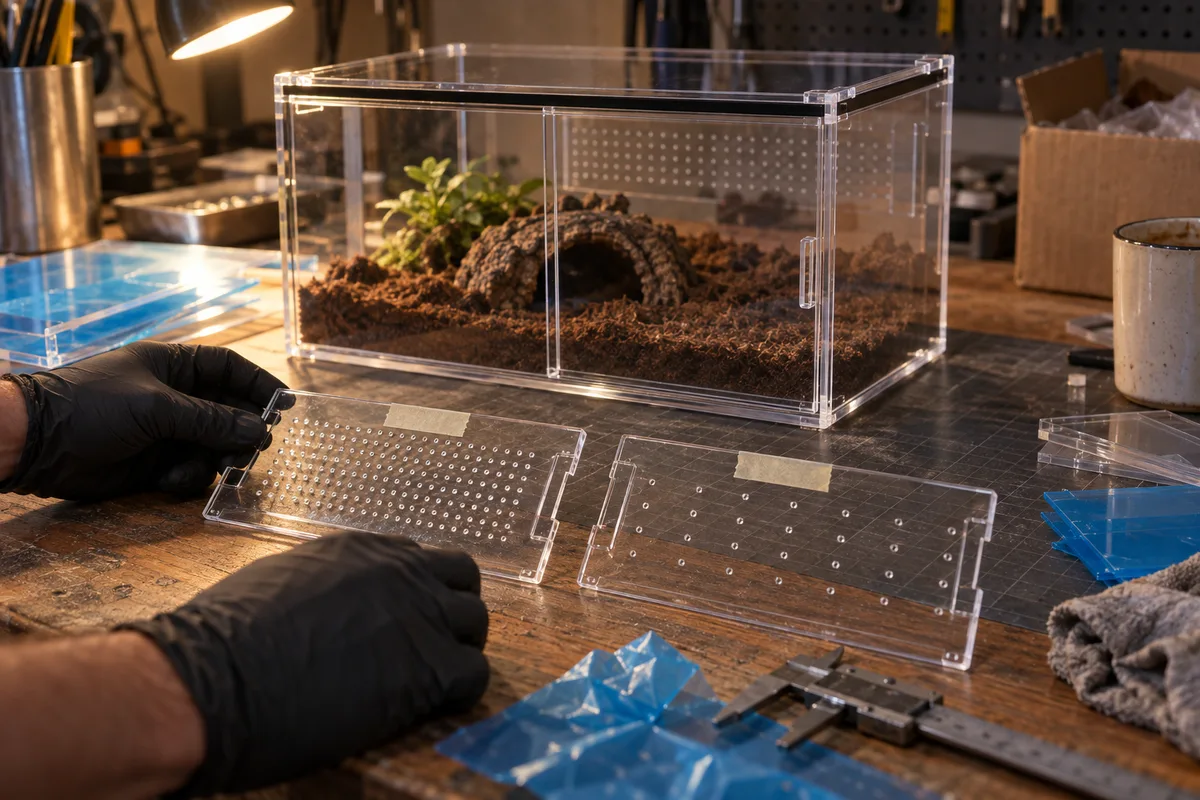
Tropical species need humidity above 70%; arid species need it below 50%. We sized two vent inserts for the same body: a tropical insert (12% open area, fine mesh, a condensation channel that routes moisture down the sides) and an arid insert (16% open area, coarser mesh, no channel). A swap takes 30 seconds per enclosure, so the breeder moved enclosures between species without changing bodies.
What We Delivered
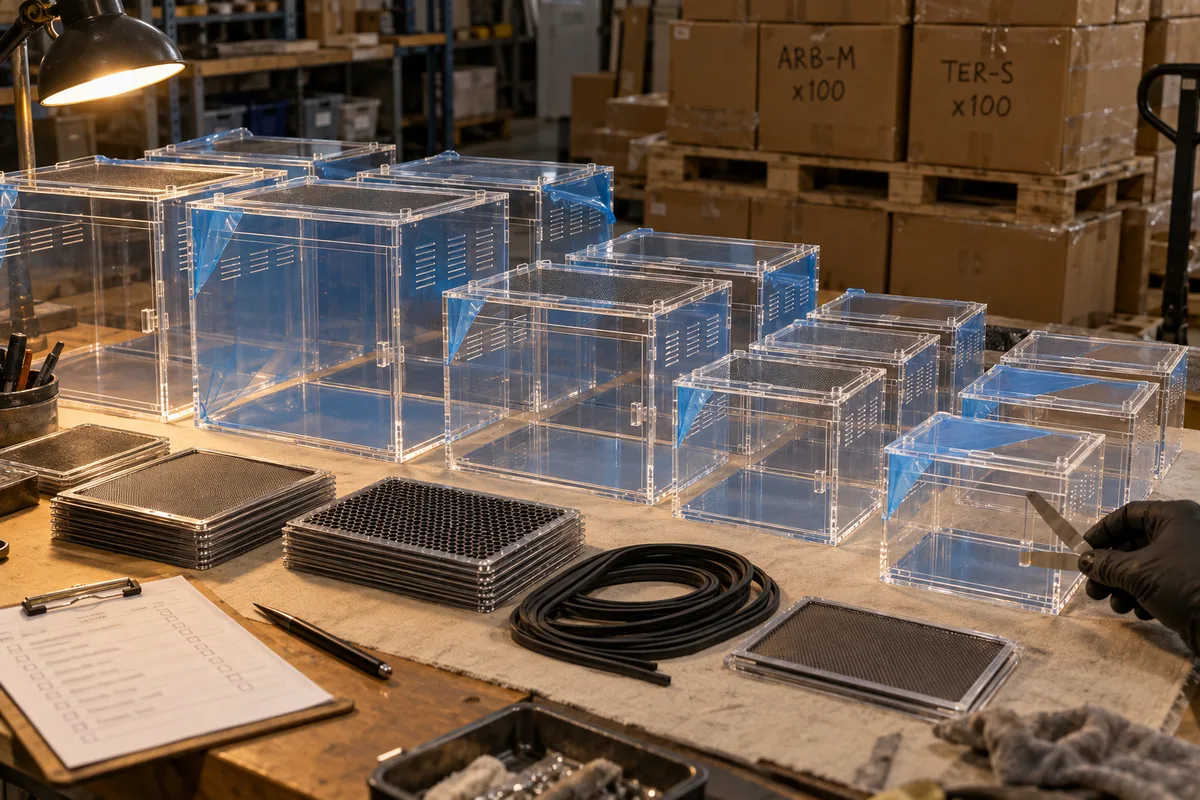
SKU 1 (arboreal small): 30 × 30 × 45 cm (W × D × H), 6 mm cast PMMA. SKU 2 (arboreal medium): 35 × 35 × 60 cm, same construction. SKU 3 (terrestrial small): 30 × 30 × 20 cm, same construction. SKU 4 (terrestrial medium): 45 × 35 × 25 cm, same construction. All 4 shared bonded-corner construction, a hinged top with the 80% compression EPDM gasket, the ±0.3 mm front slider and swappable tropical or arid vent inserts.
Production ran 22 days: substrate sourcing 5 days (one mill batch for all 4 formats), CNC and bonded-corner construction 8 days (sequential SKU runs on the modular jig), diamond polishing 3 days, and vent-insert assembly plus final QC 4 days. Air freight to the breeder's facility took 2 days.
Rollout and Repeat Order
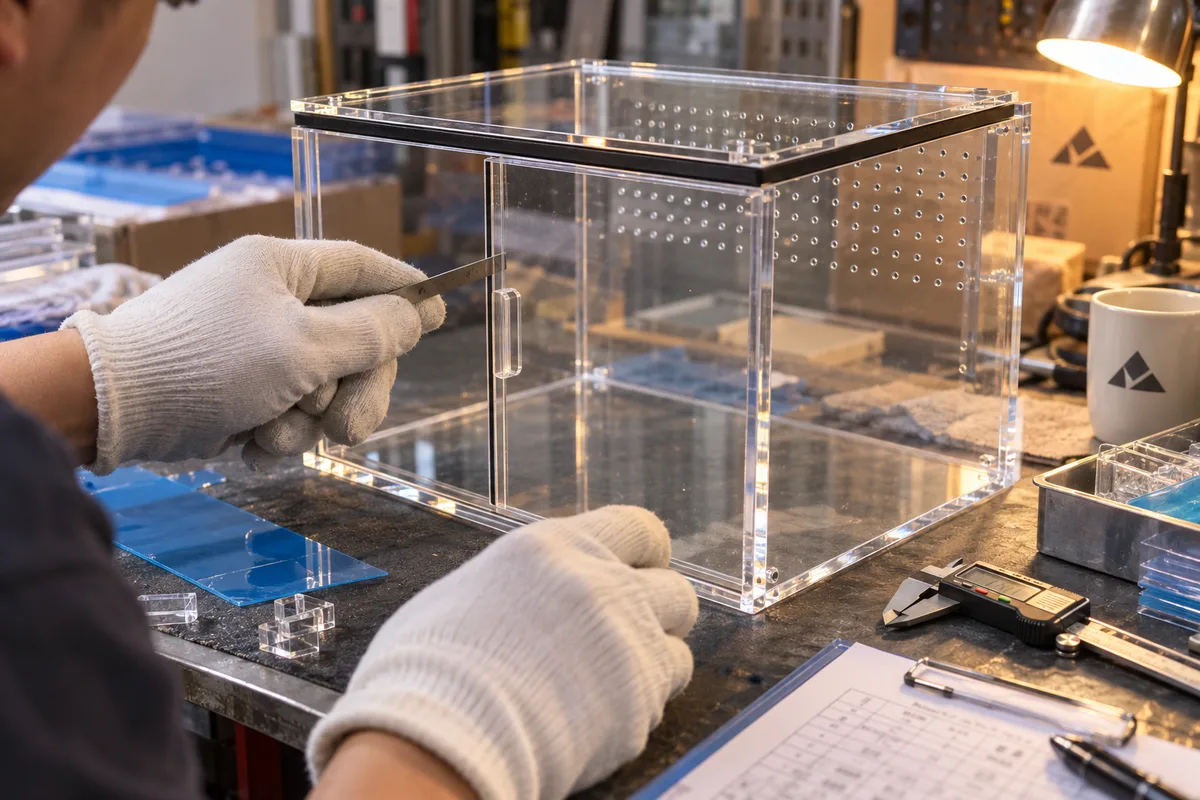
The breeder moved enclosures into service in phases and kept a 30 / 60 / 90-day husbandry log. Keepers checked latch security, ventilation, condensation and cleaning access before each next group moved; we supplied the inspection fields. Later the breeder ordered a replacement gasket batch at 90% compression for its OW species after keeper review. Like the vent inserts, it fitted the existing bodies with no new tooling.
The 100-unit repeat in month 4 reused the approved tooling, gasket spec, vent inserts and substrate source, and ran 14 days. It took the program to 500 enclosures. Daily husbandry rounds dropped from 2.5 hours to roughly 1.8 hours despite the larger inventory, because keepers no longer re-oriented at every unit. That saving was bigger than either the breeder or our team had expected at quote stage.
Project notes: The swappable vent insert and the ±0.3 mm slider gave the keepers two controls they could adjust without a new enclosure design.
If You're Planning Something Similar
For a multi-SKU enclosure order, settle three things at quote stage: tooling (one modular base with size inserts or separate jigs), vent open area per climate (12% tropical and 16% arid on this order), and gasket compression per species (70-75% suits most species; OW tarantulas needed 80%, and later 90%). Cast PMMA at 6 mm beats glass at the same wall thickness on impact resistance, weight and bonded-corner repair. Have the person responsible for husbandry, not only procurement, approve the first sample.
See our custom acrylic cases. The vent math is in the acrylic reptile enclosure ventilation engineering guide, and the gasket, slider, hinge and 30-day cycling test method are in the acrylic reptile and tarantula enclosure buyer guide.
Spec'ing a multi-SKU tarantula or invertebrate enclosure rollout?
Send us your species inventory, tropical or arid mix, SKU range, substrate depth, access preference and unit volume. We’ll come back with a tooling recommendation, gasket and slider proposal, vent options, sample scope and unit pricing.
Paid sample in 3–5 days · Quote after species and drawing review