Manufacturing Case · Specialty Pet Retail · Multi-SKU Program
Acrylic Snake Enclosure Multi-SKU Manufacturing Plan
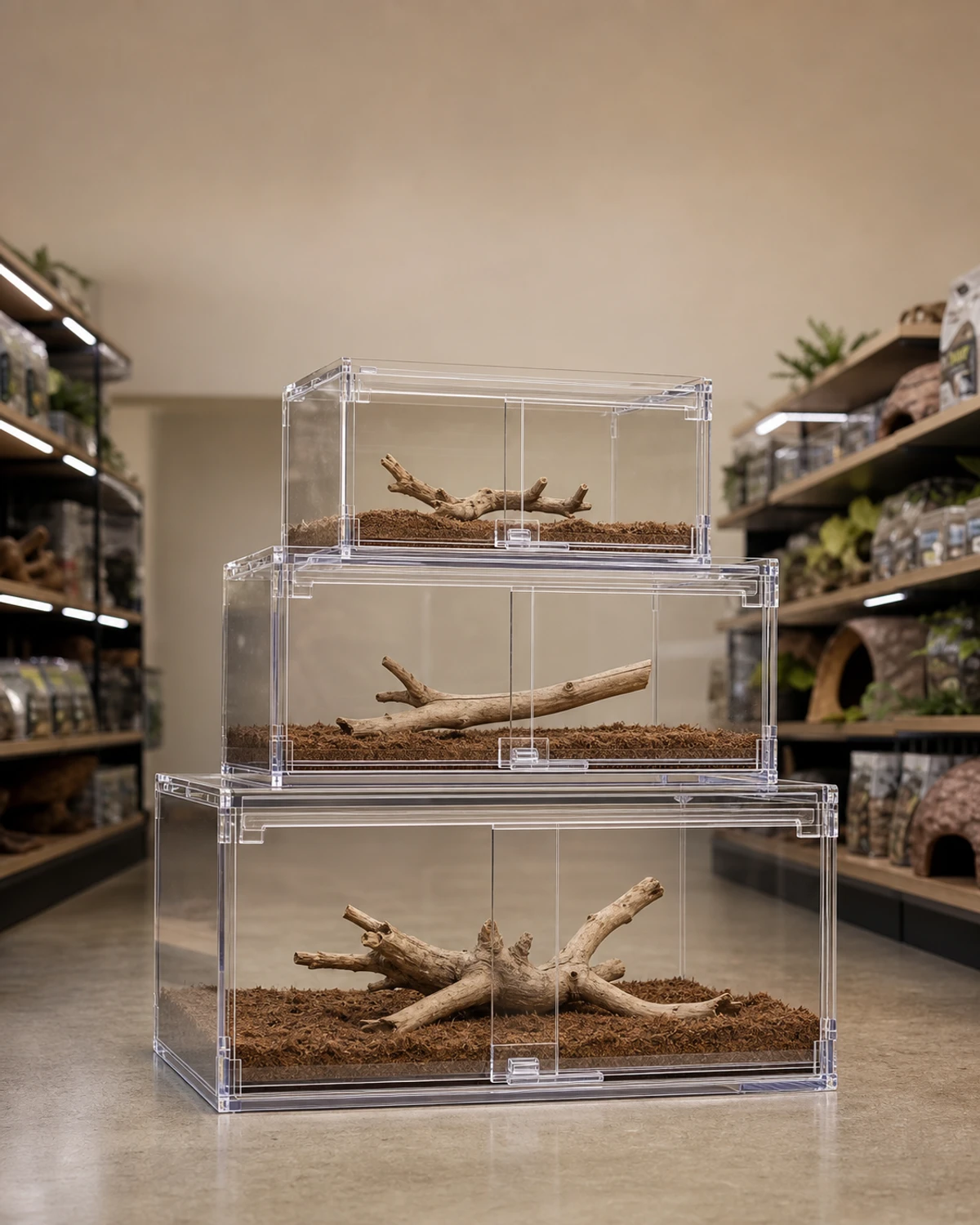
This manufacturing case models a three-SKU program, with each design ordered from 100 pieces, without claiming a completed buyer shipment. Species and habitat inputs, internal dimensions, ventilation, heating interface, slider, closure, cleaning, packing, and acceptance tests are released through buyer-approved drawings and physical samples.
- Program input · pieces per SKU design
- 100+
- Program input · prospective SKU sizes
- 3
- Program input · production target
- 15–20 days
- Program input · setup strategy
- Quoted
Current ordering baseline, not featured-project timing
MOQ is 100 pieces per design. Paid samples normally take 3–5 days, are paid separately, and are never credited to production. Standard production takes 15–20 days after habitat inputs, drawings, material, hardware, sample, inspection plan, and packing are approved; Wetop responds to a complete brief within 24 hours.
Different-specification price reference: the acrylic cases hub lists a 150 × 100 × 100 mm magnetic-lid case in 3 mm clear acrylic at 500 pieces from $6 per unit FOB Shenzhen. That compact display case is not a live-animal enclosure and is not a quote for this planning model. Habitat geometry, ventilation, access, closure, heating interface, thickness, hardware, packing, quantity, and destination determine the written quotation.
Key Takeaways
- A modular CNC jig can share one base with 3 size-specific inserts, but tooling cost and dimensional acceptance follow the quoted drawings and approved samples.
- Front-slider clearance is measured at four points and released against the approved species and habitat specification, not a generic enclosure tolerance.
- Bonded corners, sliders, ventilation, and any heat provision require buyer-approved habitat criteria and sample checks; this page does not assign universal loads or tolerances.
- Heat equipment is buyer-specified. Wetop quotes only the drawing-defined opening, clearance, material, and inspection gate after the actual device is named.
- A shared tooling strategy may reduce duplicated setup, but the written quotation determines the cost for each SKU and quantity split.
The Challenge
Consider a specialty pet retailer planning three enclosure formats. A product name or species list is not enough to release a drawing: the buyer must provide the intended species and life stage, habitat conditions, internal clearances, access method, ventilation target, heating equipment, substrate depth, cleaning routine, monitoring equipment, quantity split, and destination.
Escape control and animal welfare are buyer-defined, species-specific requirements. Wetop fabricates to the approved brief and sample; it does not publish one slider tolerance, ventilation rate, heat opening, or load value as suitable for every animal or setup.
Convert habitat inputs into drawing checkpoints
The RFQ should separate internal clear dimensions from the enclosure's external size. It should identify usable substrate depth, door opening, slider overlap, closure hardware, cable routes, ventilation locations, and the named heating interface. Wetop converts those buyer inputs into drawing callouts so the sample and inspection teams use one reference.
The buyer should define how to approve ventilation, access, and equipment fit. The released drawing can state a hole pattern, slot geometry, open-area target, or another measurable requirement supplied by the buyer. During sample review, the buyer installs the planned habitat equipment and records the acceptance criteria. Wetop then links the signed sample record to the material, drawing revision, hardware schedule, inspection plan, and packing instruction for that SKU.
Our Approach
The planning model separates shared production controls from habitat-specific inputs. A modular base can reduce duplicated setup, while each SKU still receives its own drawing, sample, inspection points, and release decision.
Modular jig design across 3 SKU sizes
One CNC base with size-specific inserts may be practical when the panel relationships and processes genuinely overlap. The quotation separates base tooling, SKU inserts, fixtures, samples, and unit pricing so the buyer can compare a shared system with independent tooling. This page does not assign a fixed tooling cost or saving.
Drawing-defined front-slider clearance
The buyer approves the clearance and measurement method for each SKU after reviewing the species and habitat requirements. The inspection plan can measure multiple points on every unit, but neither the value nor the frequency should be copied from an unrelated enclosure.
Solvent-bonded corners with optically continuous seam
Bonded and mechanically fastened corners create different appearance, service, repair, and inspection requirements. If bonded construction is selected, the drawing, material, joint preparation, cure process, and buyer-approved sample define acceptance. No universal impact multiple is claimed.
The Results
The result is a release package for three buyer-defined SKUs: internal dimensions, material and thickness, corner method, access, slider, closure, ventilation, heating interface, hardware, inspection, labels, and packing. The diagram below is illustrative and does not release habitat dimensions or performance values.
After approval, standard production is planned at 15–20 days. The actual schedule is written into the quotation after material, process, cure, hardware, inspection, packing, quantity split, and freight inputs are known.
QC measures front-slider clearance at four points on every unit, checks the bonded-corner load on the agreed sampling plan, and verifies the heat-mat opening against the approved drawing. Cosmetic edge issues are corrected before packing; the signed inspection plan defines the numerical limits for each SKU.
What This Means for Your Project
The deployment plan starts with a controlled store or habitat group, then logs slider security, breakage, corner condition, cleaning access, and keeper observations at 30 / 60 / 90 days. That evidence determines whether the remaining units release unchanged or need a documented revision.
A fourth SKU can be added as another insert on the modular base jig rather than a separate tooling program. The buyer still approves the new habitat geometry and first-off unit, but the existing material, corner, slider, and QC logic carries forward.
Change control matters when the three sizes share materials and fixtures. A revision to ventilation, access, substrate depth, heating clearance, or closure should identify the affected SKU instead of automatically propagating across the family. The released drawing, approved sample, inspection record, and packing specification remain linked by revision so production and receiving teams compare the same configuration.
Before a reorder, the buyer reconfirms the species and life stage, habitat equipment, quantity split, destination, labeling, and cleaning method. Wetop then reviews whether the prior drawing and sample still represent the requested build. Any new heater, monitor, substrate depth, access route, or packing condition returns to sample approval before production release.
Sample and release checklist
The production-intent sample should be reviewed as a complete enclosure rather than as separate acrylic panels. The buyer checks usable internal space after substrate and equipment are installed, access for routine care, door or slider movement, closure security, ventilation layout, cable and heater interfaces, cleaning reach, edge finish, hardware, and label position. The factory records the approved material, sheet thickness, joint method, hardware schedule, drawing revision, and any buyer-supplied components. Open items remain on the sample record until both sides agree on the correction and inspection method.
Bulk release also needs a SKU-specific packing standard. The packing review identifies removable parts, protective film, hardware bags, dividers, orientation marks, carton quantity, and destination labels. A mixed-size shipment should keep each enclosure, accessory set, and document tied to the correct SKU. The inspection plan then names which features are checked on every unit and which use an agreed sampling level. Receiving teams can use the same SKU code, drawing revision, carton label, and approved sample to confirm that the delivered configuration matches the released order.
Field feedback belongs in the same revision loop. Record the enclosure SKU, habitat setup, observed condition, cleaning method, and date before requesting a design change. That context separates a fabrication issue from a changed heater, substrate, animal life stage, or handling routine. A proposed correction is reviewed against the affected drawing and sample, then released as a new revision only after the buyer approves its impact on fit, access, ventilation, hardware, inspection, and packing.
Buyer decision point: A modular jig makes a three-SKU enclosure family easier to control and expand without paying for three unrelated tooling systems.
For specialty pet retailers scoping a multi-SKU enclosure program, settle the habitat criteria and SKU inputs before choosing tooling. A modular base may reduce duplicated setup, while front-slider clearance, access, closure, ventilation, heating interface, and corner method remain drawing- and sample-controlled decisions.
Panel thickness and the acrylic-versus-glass decision affect weight, scratch behavior, structure, access, packing, and price; neither is universal. Use the acrylic reptile and tarantula enclosure buyer guide to frame the tradeoffs and confirm the actual habitat. The buyer remains responsible for species suitability and husbandry requirements.
Scoping a multi-SKU acrylic enclosure rollout?
A useful RFQ separates each habitat by internal dimensions, animal life stage, access route, vent area, substrate depth, heating interface, latch risk, and cleaning method. That lets Wetop quote one controlled product family while showing exactly which requirements change by SKU.
Send us your species mix, store count, target SKU range, adult body dimensions, ventilation preference, heating method, and cleaning routine. We’ll return a modular-jig recommendation, species-specific slider and latch proposal, sample plan, inspection checklist, packing approach, and unit-cost projection scaled across the retail program.
Sample in 3–5 days · Production in 15–20 days after approval