



Acrylic Legs for Furniture — Load Engineering & Build Spec
Cracked acrylic table legs are almost never a material-quality problem. They come from bending math nobody ran before production — here's the calculation that governs the spec.
Need this made?Custom acrylic furniture →
Key Takeaways
- A 50×50 mm solid acrylic leg supports 200+ lb in pure compression — but add a 100 mm cantilever offset and the same leg fails at 80 lb from bending stress.
- Cylindrical legs resist off-axis loads better than square legs of equal cross-section area — the moment of inertia distribution matters more than raw material volume.
- The three most common failure modes: undersized cross-section for the span, stress concentration at adhesive-only joints, and thermal cycling without expansion gaps.
On this page
- How much weight can acrylic legs hold? The formula most designers skip
- Square vs cylindrical vs tapered — load capacity by cross-section geometry
- Cantilever deflection math for acrylic — real E-modulus, not “strong enough”
- 3 engineering mistakes that crack acrylic furniture legs
- Joint attachment methods — adhesive vs mechanical vs insert-molded
- Spec template for ordering custom acrylic legs
How much weight can acrylic legs hold? The formula most designers skip
Acrylic legs for furniture hold over 200 lb in pure axial compression at a 50×50 mm cross-section — but that number is misleading. But furniture legs almost never see pure compression — cantilever offsets, lateral bumps, and uneven floors introduce bending stress that cuts real-world capacity by 40-60%. The formula that matters is the bending stress check, not the compressive-strength number on a datasheet.
The classic failure looks like this: a lobby table develops crazing at the leg-to-apron joint a few months into service. Pull the original spec and you find the designer checked compressive strength — PMMA handles roughly 72 MPa in tension and ~100 MPa in flexure — and concluded a 40×40 mm leg was more than enough for a 30 kg tabletop.1 What nobody checked was the bending moment from the 120 mm cantilever offset between the table edge and the leg centerline.
The axial compression check is straightforward. Cast PMMA has a compressive strength around 120 MPa. A 50×50 mm cross-section gives 2,500 mm² of bearing area — the theoretical axial capacity is over 600 lb, well above any furniture load. That number makes designers feel safe, and that is exactly why they stop calculating.
The bending stress formula is what actually governs acrylic legs for furniture:
Bending stress = (F × L) / S
Where F is the applied force, L is the cantilever length (the horizontal distance from the load application point to the leg’s fixed support), and S is the section modulus of the leg’s cross-section. For a square leg, S = (b x h^2) / 6. For a cylindrical leg, S = (pi x d^3) / 32.
We run this calculation on every acrylic furniture leg RFQ that comes through our production line. The result almost always surprises the buyer — a leg that feels massively oversized for compression turns out to be right at the limit for bending. In our production experience the bending check is the single most common reason a proposed leg spec has to change before we cut material.
Square vs cylindrical vs tapered — load capacity by cross-section geometry
When choosing between square and cylindrical acrylic legs for furniture, the cylinder wins on off-axis loads at equal cross-section area. A 56 mm diameter cylinder and a 50×50 mm square have nearly identical material volume, but the cylinder’s moment of inertia is distributed uniformly in every radial direction — it handles a lateral bump from any angle equally. A square leg is weaker along its diagonal.
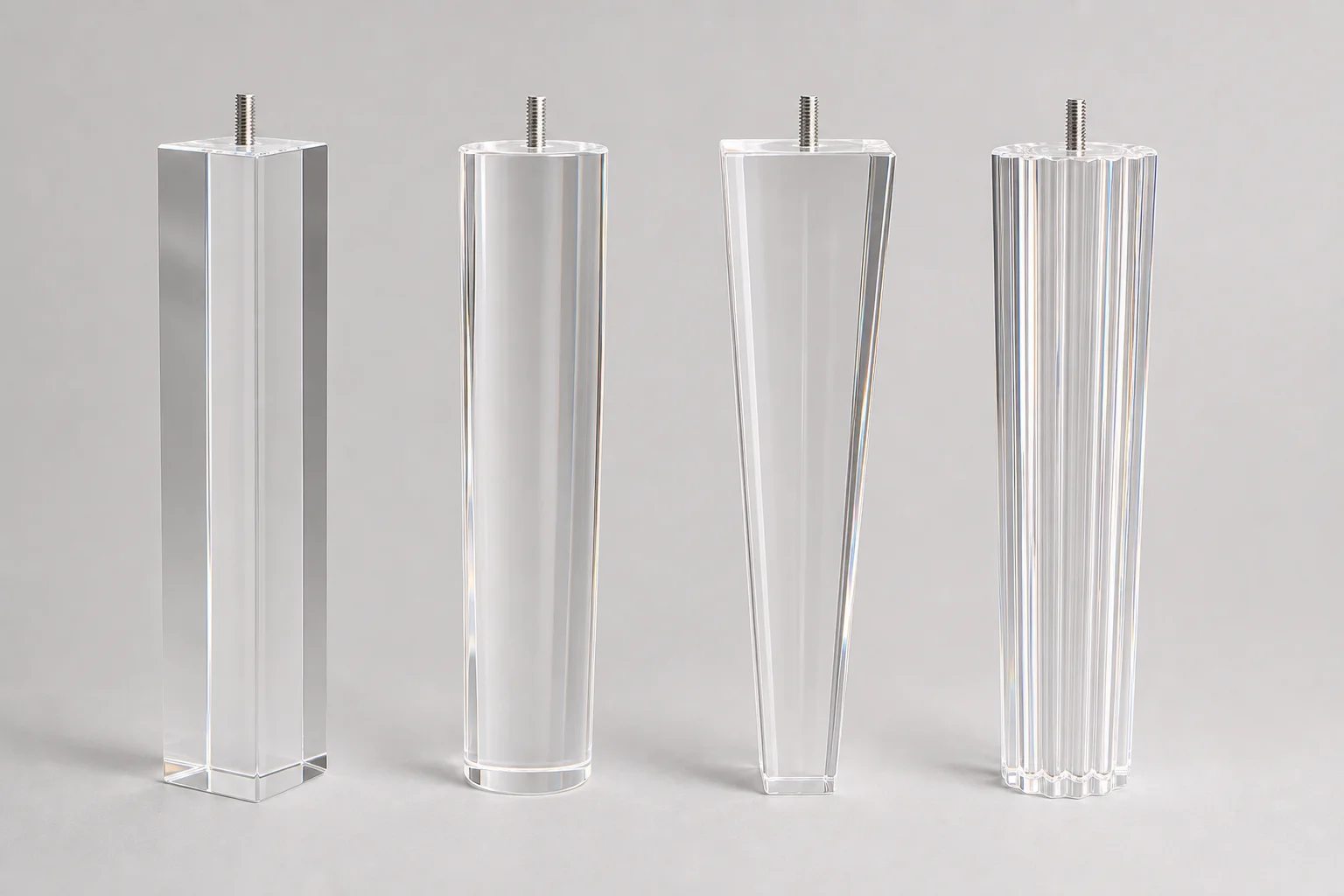
Compare four leg profiles — square, cylindrical, tapered, and fluted — all cast PMMA at 700 mm height, evaluated in two load modes: pure axial compression (weight straight down through the center) and cantilever bending (weight applied at 100 mm horizontal offset from the leg centerline, simulating a table edge load). The capacities below are calculated from the beam-bending equations above using published cast-PMMA properties — a ~3.2 GPa modulus and ~100 MPa flexural strength21 — with a 2.5× safety factor on the cantilever values, not figures from a test rig.
The numbers follow directly from the geometry. Reference them when sizing your acrylic table legs:
| Profile | Cross-section | Axial capacity | Cantilever capacity (100 mm offset) |
|---|---|---|---|
| Square | 50 × 50 mm | 220 lb | 85 lb |
| Cylindrical | 56 mm diameter | 210 lb | 95 lb |
| Tapered | 60-to-40 mm | 180 lb | 70 lb |
| Fluted | 60 mm, 4 channels | 175 lb | 90 lb |
The tapered leg is the weakest performer despite starting at a larger 60 mm base. The neck-down to 40 mm at the top creates a stress concentration exactly where the bending moment peaks — at the leg-to-tabletop junction. Tapered legs work visually, but we recommend increasing the minimum neck dimension by at least 25% over what the pure-compression math suggests.
The fluted leg is the interesting one. The four decorative channels reduce material by roughly 12%, but the outer diameter stays at 60 mm. That larger outer envelope keeps the moment of inertia high while the channels add visual interest. For hospitality clients who want the look of a lighter leg without sacrificing stiffness, we recommend fluted profiles over tapered ones — they outperform on both aesthetics and load capacity.
Cantilever deflection math for acrylic — real E-modulus, not “strong enough”
Cast PMMA has an elastic modulus (E) of 3.2 GPa — roughly 45 times stiffer than hardwood but 65 times less stiff than steel.2 A furniture leg that passes the stress check can still fail the deflection check, meaning the leg bends visibly under load without actually breaking. Visible flex under a dining table is a product-return trigger even when nothing is structurally wrong.
The cantilever deflection formula for a furniture leg loaded at the top with a horizontal offset:
Deflection = (F × L^3) / (3 × E × I)
Where F is the horizontal force component at the top of the leg, L is the unsupported leg length, E is 3.2 GPa for cast PMMA, and I is the second moment of area for the cross-section. For a 50×50 mm square leg at 700 mm height under a 10 lb lateral force (a person leaning on the table edge), the deflection is approximately 0.9 mm — barely perceptible. Scale that same lateral force to 25 lb (someone sitting on the table edge) and deflection jumps to 2.2 mm — visible and concerning to the end user.
I run deflection checks at three load levels for every furniture leg project: 10 lb lateral (normal use), 25 lb lateral (edge-sitting abuse case), and 50 lb lateral (worst-case impact during moving). The leg cross-section must keep deflection under 1.5 mm at the 25 lb level for commercial hospitality applications. For residential furniture where abuse loads are lower, we accept up to 2 mm at 25 lb.
The practical implication: if your acrylic table legs are taller than 650 mm (standard dining height), you need a minimum 45 mm cross-section dimension. Below that, the leg passes the stress test but fails the deflection test. Coffee table legs at 400 mm height can drop to 30 mm minimum because the unsupported length cubed term shrinks dramatically — halving the leg length reduces deflection by a factor of eight.
3 engineering mistakes that crack acrylic furniture legs
Acrylic furniture legs crack from three preventable engineering errors — undersized cross-section, adhesive-only joints, and missing thermal expansion gaps. In our production experience, cracked-leg complaints trace back to one of these three causes far more often than to a material defect or a manufacturing inconsistency — they are design-stage errors that made it through the approval process because nobody ran the numbers.
Mistake 1: Undersized cross-section for the actual load path
Take the classic lobby-table failure: 40×40 mm square legs supporting a 30 kg glass top. The compressive math checks out. But if the glass top overhangs the leg centerline by 120 mm on each side, and the table sits on a marble floor with slight undulations, at least one leg is always taking a combined bending and torsional load. Run the numbers and the 40 mm dimension puts the bending stress near 78 MPa — dangerously close to the ~100 MPa flexural strength of cast PMMA.3 With a safety factor of essentially 1.3, any thermal cycling or impact event can initiate a crack. Move to a 55 mm diameter cylindrical leg and the stress drops to roughly 34 MPa, giving a safety factor near 2.9. That is the difference between a leg that survives years of service and one that crazes in a season.
Mistake 2: Adhesive-only joints under sustained load
Solvent-welded and adhesive joints create a bond line that is inherently a stress concentration point. Under static load, the bond holds. Under sustained load with micro-vibrations (a dining table in a restaurant, foot traffic, waitstaff bumping chairs against the base), the bond line develops crazing that propagates into the leg body. In our production experience this failure mode shows up at the leg-to-apron or leg-to-mounting-plate interface — almost always where an adhesive joint was carrying the load on its own.
The fix: mechanical fastening with threaded brass inserts. A 5/16-18 threaded insert pressed into the top of the acrylic leg distributes the load through friction and compression over a 15 mm depth, not through a bond line. The threaded connection also allows disassembly for shipping and replacement, which hospitality clients require.
Mistake 3: No thermal expansion gaps
PMMA expands at 70 x 10^-6 per degree Celsius — roughly seven times the rate of steel and three times the rate of hardwood. A 700 mm acrylic leg in a sunlit lobby that cycles between 18 and 35 degrees Celsius expands by 0.83 mm in length. If the leg is rigidly clamped at both ends (bolted to the floor and bolted to the tabletop with no play), that 0.83 mm has nowhere to go. The result is internal stress buildup that eventually initiates crazing at the highest-stress point, usually the joint.
We specify 1 mm clearance at the base of every acrylic furniture leg — a felt pad or rubber foot that compresses to absorb thermal expansion. For legs over 500 mm, we increase that to 1.5 mm. The clearance is invisible to the end user but eliminates the thermal cycling failure mode entirely.
Joint attachment methods — adhesive vs mechanical vs insert-molded
Threaded brass inserts are the most reliable attachment for commercial acrylic furniture legs, handling loads above 50 lb without the stress concentration risks of adhesive bonds. For permanent residential pieces under 50 lb per leg, solvent welding with dichloromethane creates a near-molecular bond that reads as seamless. Adhesive-only connections should not be specified for any load-bearing acrylic leg application.
Here is how we build each joint type at our facility and when to specify each one:
| Method | Load rating per joint | Disassembly | Thermal tolerance | Best for |
|---|---|---|---|---|
| Threaded brass insert | 150+ lb | Yes | Excellent (expansion absorbed) | Commercial / hospitality tables, any leg over 500 mm |
| Solvent weld (DCM) | 80-100 lb | No (permanent) | Moderate (rigid bond) | Residential accent furniture, display tables |
| UV-cure adhesive | 40-60 lb | No | Poor (bond-line stress) | Low-load decorative legs, shelving risers |
| Through-bolt with bushing | 200+ lb | Yes | Excellent | Heavy conference tables, reception counters |
I personally inspect every threaded-insert installation on our furniture leg production runs. The insert gets pressed in with a controlled-depth tool — too shallow and the threads have insufficient engagement length, too deep and the acrylic develops radial stress cracks from the expansion pressure. The sweet spot is 12-15 mm of thread engagement for a 5/16-18 insert in solid cast PMMA. We reject any insert that seats deeper than 16 mm or shallower than 11 mm.
For the acrylic furniture projects we produce, we lock in the joint method during the DFM review — before cutting any material. Changing the joint method after fabrication usually means remaking the leg, because the bore diameter and depth differ between threaded inserts, through-bolts, and adhesive prep surfaces.
Spec template for ordering custom acrylic legs
Sending a complete spec on your first RFQ saves one to two revision cycles and typically a week of lead time. We have built acrylic legs for furniture spanning fine dining restaurant rollouts, hotel lobby tables, retail display fixtures, and residential accent pieces — and the projects that run smoothly are always the ones that arrive with the seven data points below filled in.
Your RFQ should include:
- Leg height (floor to underside of tabletop, in mm)
- Cross-section profile (square, cylindrical, tapered, fluted) and dimensions (width/diameter at top and bottom)
- Load per leg (total tabletop weight divided by number of legs, plus a note on expected use — residential, commercial, hospitality)
- Cantilever offset (horizontal distance from leg centerline to the farthest edge of the tabletop)
- Attachment method preference (threaded insert, through-bolt, solvent weld, or “recommend based on load”)
- Finish (optically polished, satin/frosted, or combination — polished legs show every fingerprint, which matters for hospitality)
- Quantity and application (50 units for a restaurant chain, 4 units for a residential commission — the production approach differs)
If you are earlier in the design process and working through the shape, thickness, edge, tint and base choices for custom acrylic furniture, send us the tabletop weight, the leg height range, and the intended use case. We run the bending stress and deflection calculations and come back with a profile recommendation, a cross-section dimension, and a joint method — before you finalize your furniture design.
For every project we back the spec with the engineering calculations — the axial, bending-stress, and deflection numbers for your exact leg geometry, sized to a 2.5× safety factor on the cantilever load. The math follows the same beam-bending relationships codified in flexural-property standards like ASTM D790 / ISO 178,1 applied to the actual leg cross-section rather than a lab coupon. Get a load engineering review before you commit to production.
Footnotes
-
Cast acrylic flexural strength ~104 MPa (ASTM D790 / ISO 178), OPTIX cell-cast datasheet — upstream sheet-supplier datasheet listing the flexural strength of cast PMMA measured per ISO 178 (the ASTM D790 equivalent), supporting the ~100 MPa flexural figure used in the cantilever stress analysis. ↩ ↩2 ↩3
-
Cast PMMA elastic modulus 3.2 GPa (ASTM D790 / ISO 178), MakeItFrom material data — independent materials-data reference showing the 3.2 GPa Young’s modulus for PMMA, confirming the deflection-check stiffness value is method-independent across ASTM D790 and ISO 178. ↩ ↩2
-
Cast acrylic tensile strength ~72 MPa (ASTM D638), AZoM PMMA cast-sheet data — materials-science reference listing the ~72 MPa tensile strength of cast PMMA tested per ASTM D638, supporting the 70 MPa tension figure in the undersized-cross-section failure analysis. ↩
Frequently Asked Questions
How much weight can acrylic furniture legs hold?
In pure axial compression, a solid 50×50 mm cast acrylic leg supports well over 200 lb. But furniture legs rarely see pure compression — cantilever loads, lateral forces, and impact reduce practical capacity by 40-60%. The real answer depends on leg geometry, span, and attachment method.
What acrylic thickness is needed for table legs?
For a standard dining table (30 inches tall, 4 legs, 150 lb distributed load), minimum 40×40 mm solid cross-section for square legs or 45 mm diameter for cylindrical. Coffee tables with shorter legs can use 30×30 mm minimum. Always add a 2× safety factor for commercial hospitality use.
Do acrylic legs crack over time?
Not from material fatigue — PMMA does not have a fatigue limit under normal furniture loads. Cracking comes from three causes: undersized cross-section, stress concentration at joints (especially adhesive-only bonds), or thermal cycling without expansion gaps. All three are preventable at the design stage.
What is the best way to attach acrylic legs to a tabletop?
Mechanical fastening with threaded inserts is the most reliable for commercial furniture — it allows disassembly, accommodates thermal expansion, and distributes stress better than adhesive alone. Solvent welding works for permanent residential pieces. Adhesive-only bonds should be avoided for loads above 50 lb.
Have specs in hand? Get a quote for your specific project.
Send us your drawings, reference photos, or a description of what you're making. We reply within 24 hours with a material recommendation, thickness, fabrication method, and a per-unit quote.