Custom Acrylic Furniture Design Principles for B2B Buyers
Most commercial furniture RFQs describe the look, not the spec. This framework bridges that gap — from mood board to production-ready brief.
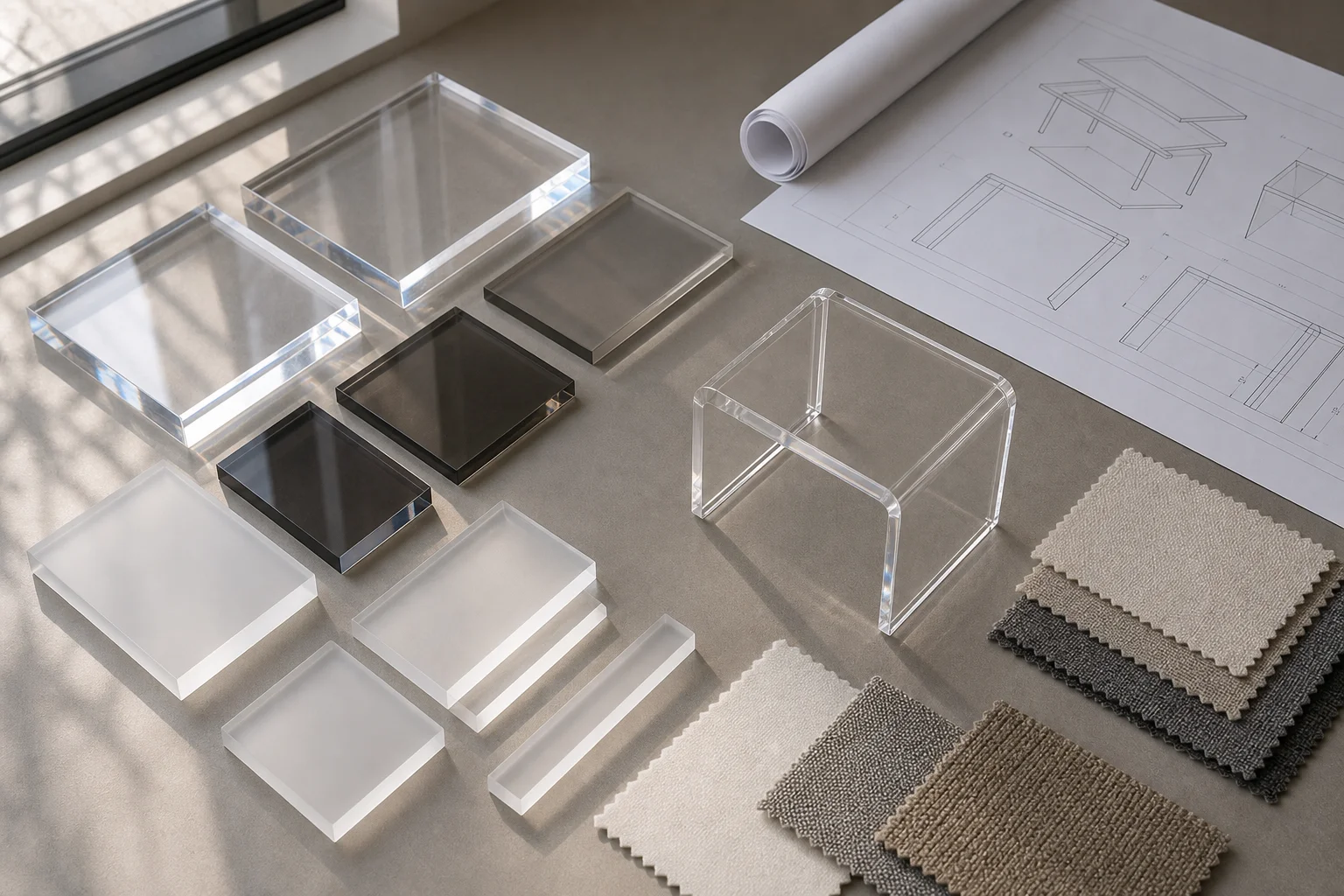
Key Takeaways
- Every commercial acrylic furniture project resolves to 5 decisions: shape, thickness, edge profile, tint/finish, and base architecture.
- Acrylic can be thermoformed into curves but has limits — minimum bend radius scales with thickness (roughly 2x the sheet thickness).
- A complete manufacturer brief includes shape, dimensions, thickness, edge finish, tint, base type, quantity, and timeline — skip any and you'll get a quote you can't compare.
On this page
- The 5 Design Decisions Every Commercial Acrylic Furniture Project Starts With
- Shape Constraints — What Acrylic Can and Can’t Do at Furniture Scale
- Thickness and Edge Treatment — Where Aesthetics Meet Structural Engineering
- Tint, Frost, and Color — Matching Material Finish to Brand Environment
- Base and Support Architecture — Cantilever vs Pedestal vs Waterfall
- From Concept to Production Spec — How to Brief a Manufacturer
- Acrylic Furniture Design Decision Tree
The 5 Design Decisions Every Commercial Acrylic Furniture Project Starts With
Acrylic furniture design for commercial projects — hotel consoles, retail nesting tables, office partitions — resolves to five decisions: shape geometry, sheet thickness, edge treatment, tint or finish, and base architecture. Get all five locked before requesting a quote, and the number you receive is one you can actually compare across suppliers.
Most commercial furniture RFQs we receive describe the look they want — “modern,” “minimalist,” “like the one in this photo” — but not the spec that determines cost. The photo tells us the aesthetic. It does not tell us the sheet thickness needed to span 900mm without deflection, or whether the edge should be flame-polished for warmth or diamond-polished for optical clarity. That gap between mood board and production-ready spec is where projects stall, quotes diverge, and timelines slip. The framework below closes it.
In our production experience across hotel, retail, and corporate furniture work, the projects that move fastest share one trait: they arrive with all five decisions either made or explicitly flagged as open questions. The ones that drag are the ones where the buyer assumed the manufacturer would fill in the blanks. We can — but every blank we fill is an assumption the buyer did not approve, and assumptions inflate the quote.
Shape Constraints — What Acrylic Can and Can’t Do at Furniture Scale
Cast PMMA can be thermoformed into curves, bent along straight axes, and CNC-routed into complex profiles — but each technique has scale limits that matter at furniture dimensions. Flat panels up to 2,400mm x 1,200mm are standard stock sheet sizes. Curves are possible but governed by minimum bend radius: roughly 2x the sheet thickness for a clean, stress-free curve.
Acrylic furniture design often starts with a shape inspired by glass or wood furniture. The material can achieve many of the same forms, but the physics differ. Bend a 12mm acrylic sheet to too tight a radius and it stress-whitens at the fold — the material does not crack, but it develops a visible haze line that destroys the optical clarity buyers expect. Producer forming guidance for cast PMMA puts the safe cold-bend minimum at several times the sheet thickness, which is why a clean fold in 12mm stock wants a radius on the order of 24mm rather than 20mm1. For furniture-scale pieces like waterfall console tables or curved display shelves, tight radii require precision strip-heating and add roughly 15-20% to production cost.
Three shape categories cover most commercial acrylic furniture projects:
- Flat-panel assemblies — tables, shelves, partitions. Joined at 90-degree angles using solvent bonding. Simplest to produce, lowest cost per piece. The structural challenge is span: a flat 6mm panel spanning more than 500mm without support will visibly deflect under load.
- Single-bend profiles — waterfall tables, L-shaped stands, J-shaped magazine racks. One continuous sheet bent along a single axis. The bend determines the piece’s character and its cost — tighter radius = more tooling.
- Multi-curve or compound shapes — S-curves, saddle forms, barrel vaults. Require oven thermoforming over custom molds. Mold cost is amortized across the run, so unit economics improve above 100 pieces but remain steep below 50.
When I walk a new buyer through shape options, the first question is always about curves — and the honest answer is that acrylic curves beautifully, but every curve has a cost multiplier. If your design has curves for structural reasons (strength through geometry), they are worth the premium. If curves are purely decorative and the project is under 100 units, consider whether a sharp-edge flat-panel version achieves the same visual impact at lower cost.
Thickness and Edge Treatment — Where Aesthetics Meet Structural Engineering
Acrylic furniture thickness determines two things simultaneously: structural capacity (how much weight the piece holds without deflection) and visual presence (how substantial the piece looks in the space). For commercial furniture, 12mm is the practical minimum for tabletops and shelving; 20-25mm is common for statement pieces like reception desks or hotel lobby consoles.
Thickness selection in acrylic furniture design is an engineering decision disguised as an aesthetic one. A procurement manager specifying a coffee table for a hotel lobby might request 8mm because it looks “lighter.” But an 8mm acrylic panel spanning 600mm will deflect visibly under a stack of magazines and a laptop. The mechanism is simple beam physics: mid-span deflection rises with the cube of the span and falls with the cube of thickness, so doubling the load area punishes a thin panel disproportionately. Cast PMMA has a relatively low flexural modulus for a rigid material — around 3.2 GPa2 — which is why span and thickness matter so much more than they do for glass or metal. Switching to 15mm eliminates the visible sag and gives the piece a visual weight that reads as “premium” rather than “flimsy.” Before quoting a furniture panel we sanity-check the specified thickness against the intended load and span using that published flexural modulus, so the number reflects the piece’s real duty rather than a guess.
Edge treatment is the second half of this decision. Four options cover virtually all commercial acrylic furniture:
| Edge Finish | Visual Character | Best For | Cost Relative to Raw |
|---|---|---|---|
| Flame-polished | Warm, slightly soft edge with minor undulation | Organic designs, hospitality furniture | 1x (baseline) |
| Diamond-polished | Optically flat, glass-like clarity | Statement pieces, galleries, luxury retail | 2-3x |
| Beveled (chamfered) | Angled cut that catches light, architectural feel | Modern commercial interiors, office furniture | 1.5x |
| Matte / sanded | Non-reflective, subtle, fingerprint-resistant | High-traffic environments, retail fixtures | 0.8x |
I recommend diamond-polished edges for any piece where the edge is a primary visual surface — a waterfall table edge, a console side panel, a freestanding shelf. For pieces where edges face walls or are hidden by adjacent components, flame polish saves cost without sacrificing quality. The choice sounds minor, but on a 200-piece hotel furniture rollout, the edge-finish spec alone can shift the total cost by 10-15%.
Tint, Frost, and Color — Matching Material Finish to Brand Environment
The three most common acrylic finishes for commercial furniture are clear, frosted, and tinted. Clear delivers maximum visual lightness and works in spaces where the furniture should disappear — hotel lobbies, art galleries, showrooms. This is where the material earns its reputation: water-clear cast PMMA transmits roughly 92% of visible light, higher than ordinary glass, with the transmittance and haze that drive that “disappearing” look measured under ASTM D10033. Frosted hides fingerprints and surface scratches, making it the practical choice for high-touch environments like retail and hospitality. Tinted acrylic (smoke, bronze, blue, or custom Pantone-matched) anchors furniture to a specific brand palette.
Finish selection for custom acrylic furniture depends on three factors: the space’s lighting conditions, the expected touch frequency, and the brand’s color system. Clear acrylic in a space with warm directional lighting reads as elegant. The same clear acrylic under flat fluorescent lighting reads as cheap plastic — it needs either a frost treatment or a tint to compensate for the unflattering light.
Here is how we guide the decision on commercial acrylic furniture projects:
- Clear — use when the surrounding environment does the visual work (textured walls, warm lighting, adjacent materials like wood or stone). Requires regular cleaning in public-facing settings.
- Frosted (matte / satin) — use in any environment where the furniture will be touched frequently. Frosting is applied via sandblasting or chemical etching and can be done on one side or both. Single-side frost on a tabletop gives a soft surface above with a glossy underside that reflects light upward.
- Tinted — use when the furniture must reference a brand color or complement an interior palette. Standard stock tints include smoke, bronze, and blue. Custom colors require a minimum run (typically 50+ sheets from the supplier) and add 2-4 weeks to lead time for material sourcing.
- Colored (opaque) — use for branded statement pieces. Opaque acrylic loses the translucency that distinguishes it from painted wood or laminate, so specify it only when the color itself — not the material’s optical properties — is the design intent.
We keep a swatch library of 40+ tinted and colored acrylic grades in our Shenzhen facility. For commercial acrylic furniture projects, we ship a physical swatch set alongside the first sample so your design team can validate the material finish under your actual lighting conditions — not ours.
Base and Support Architecture — Cantilever vs Pedestal vs Waterfall
The base or support system defines how the furniture sits in the space and how much load it handles. Three architectures account for most commercial acrylic furniture: cantilever (one fixed end, one floating), pedestal (central column or legs), and waterfall (continuous sheet bent to form both surface and legs). Each has distinct structural, aesthetic, and cost implications — and all must meet ANSI/BIFMA X5.5 stability and load-bearing requirements for commercial use4.
Base architecture is the decision most often left unspecified in commercial furniture RFQs — buyers describe the top surface in detail and leave the support structure to the manufacturer. That works if you trust your manufacturer’s judgment, but it also means you will receive a quote based on their default, which may not match your intent.
Cantilever — the surface extends beyond its support on one or more sides. Visually dramatic for shelves and console tables. Structurally demanding: the cantilevered span, thickness, and load determine whether the piece holds or sags. Cantilever deflection is especially unforgiving because a cantilevered beam sags far more than the same beam supported at both ends — roughly an order of magnitude more for the same span and load — and that sag scales with the cube of the overhang. A modest 300mm overhang in thick cast acrylic can look dead flat, while pushing the same panel to 500mm makes the outer edge drop visibly under identical load. For that reason we reinforce long cantilevers with a thicker base section or a hidden steel bracket rather than relying on the acrylic alone.
Pedestal — the surface rests on a central column, legs, or a base plate. The most structurally forgiving option because the support is directly below the load. Common in hotel side tables, retail product displays, and office organizers. Pedestal bases can be acrylic (solvent-bonded to the surface) or mixed-material (metal legs with acrylic top). Mixed-material builds add hardware sourcing to the timeline.
Waterfall — a single acrylic sheet bends from the horizontal surface down to the floor on one or both sides. The bend itself provides the structural support, eliminating visible joints. This is the signature look of high-end acrylic furniture for hotels and luxury retail. Production requires precision thermoforming and adds cost, but the visual result — a seamless, gravity-defying surface — justifies the premium for hospitality and brand environments.
When I review a furniture brief that says “modern acrylic coffee table” without specifying the base, I quote all three architectures with a line-item breakdown. That gives the buyer a real comparison: waterfall at one price point, pedestal at another, cantilever at a third. The aesthetic differences are obvious in renderings; the cost differences only become clear on paper.
From Concept to Production Spec — How to Brief a Manufacturer
A production-ready brief for custom acrylic furniture includes seven fields: shape type, overall dimensions, sheet thickness, edge finish, tint or color, base architecture, and quantity with timeline. Every field left blank forces the manufacturer to assume — and every assumption adds margin to the quote because the manufacturer prices in the risk of guessing wrong.
Below is the brief template we share with procurement teams at the start of every commercial acrylic furniture project. You can send it as-is or adapt it to your internal RFQ format. The goal is to ensure that every supplier who receives your brief is quoting against the same spec — not against their own assumptions.
Acrylic Furniture Production Brief
| Field | Your Specification | Notes |
|---|---|---|
| Shape type | Flat panel / Single bend / Multi-curve / Compound | Attach a reference image or sketch |
| Dimensions (L x W x H) | ___mm x ___mm x ___mm | Include tolerances if critical (standard: +/-0.5mm) |
| Sheet thickness | ___mm per component | List separately if top, sides, and base differ |
| Edge finish | Flame / Diamond / Beveled / Matte | Specify per edge if mixed finishes needed |
| Tint or color | Clear / Frosted / Tinted (specify) / Opaque (Pantone #) | Request a swatch if matching to a brand palette |
| Base architecture | Cantilever / Pedestal / Waterfall / Other | Describe mixed-material if applicable (e.g., metal legs) |
| Quantity + timeline | ___pcs / Delivery by _____ | Include sample quantity (we recommend 2-3 pcs) |
| Load requirement | ___kg distributed / ___kg point load | Critical for tables, shelves, and cantilever spans |
| Environment | Indoor / Outdoor / UV-exposed / High-traffic | Determines material grade and coating requirements |
Three common project types show how a vague brief evolves into a quotable spec:
Hotel lobby console table. A typical first brief reads “clear acrylic console, modern, 1200mm wide” — missing thickness, edge, base type, and load. A production-ready version resolves to something like 20mm clear cast PMMA, diamond-polished edges, a waterfall base with a ~450mm drop, and a stated distributed-load rating. Locking those four items lets the manufacturer drop the risk margin they would otherwise pad in to cover the guesses.
Retail nesting tables. A brief like “three sizes, frosted, stackable” leaves dimensions, thickness, and edge open. A complete version pins them down — e.g., 400/500/600mm square tops, 12mm frosted cast PMMA, flame-polished edges, pedestal base with rubber feet. Frosted is usually the right call for this use case: nesting tables in high-traffic cosmetics or apparel departments show fingerprints badly in clear acrylic, turning maintenance into a daily chore.
Corporate office partition panels. “Tinted acrylic room dividers, floor-standing” omits tint color, height, thickness, and the stability system. A finished spec might be 1800mm tall, 15mm smoke-tinted cast PMMA, matte edges, aluminum base channels for stability. Matte edges are the deliberate choice here — diamond-polished edges on a tall panel catch overhead light and create a visual distraction across an open-plan floor.
For guidance on how to structure the broader RFQ process around this brief, see our acrylic RFQ guide. For load engineering specifics on acrylic furniture legs and supports, our load engineering guidance covers span tables and deflection calculations. Our customization process page walks through the full workflow from brief through sample approval to production. For a real-world example of a corporate brief executed from concept to delivery, see our branded trade-show giveaway rollout.
Browse our acrylic furniture product range to see the shapes, finishes, and base architectures we produce at scale.
Acrylic Furniture Design Decision Tree
The decision tree above maps the path from concept to quotable spec. Use it as a self-check before sending your brief: if any of the five nodes is blank, you are asking the manufacturer to guess — and guesses cost money.
Commercial acrylic furniture sits at the intersection of material science and interior design. The five-decision framework — shape, thickness, edge, tint, base — is not a creative constraint. It is the structure that turns a mood board into a number your finance team can approve and your manufacturer can build against. Lock the spec, then let the material do what it does best: disappear into the space while holding everything on top of it.
We build custom acrylic furniture in our 5,000 m² ISO 9001-certified facility in Shenzhen — paid samples in 3-5 days, production in 15-20 days, MOQ 100 pieces per design. Sample fees are paid separately and never credited to production. If you have a brief ready, or need help turning a concept into one, send it to us. We respond within 24 hours.
Footnotes
-
Röhm PLEXIGLAS — fabrication and forming guidance for cast acrylic (PMMA) — producer processing documentation covering cold-bending and thermoforming, including minimum bend radius scaling with sheet thickness to avoid stress-whitening. ↩
-
Cast acrylic (PMMA) flexural properties, measured per ASTM D790 — flexural strength ~110 MPa, elastic modulus ~3.2 GPa — published flexural strength and stiffness figures for cast PMMA, the values we use as the reference input when sanity-checking a specified thickness against its span and load. ↩
-
Luminous transmittance and haze of transparent plastics, per ASTM D1003; cast PMMA typical total transmittance ~92% — the standard test method behind the transmittance and haze figures that describe optical-grade acrylic’s clarity. ↩
-
ANSI/BIFMA X5.5 — Desk/Table Products — the standard for structural performance testing of commercial furniture, including stability and load-bearing requirements. ↩
Frequently Asked Questions
What information does a manufacturer need to quote custom acrylic furniture?
A quotable brief needs seven items: shape type, dimensions (L x W x H), sheet thickness, edge finish (flame-polished, diamond-polished, beveled, or matte), tint or color, base/support type, and quantity with timeline. Missing any one of these forces the manufacturer to assume — and assumptions add cost margin.
Can acrylic furniture be curved or shaped?
Yes — cast PMMA can be thermoformed into curves using strip heaters or oven heating. The practical minimum bend radius is roughly 2x the sheet thickness. For furniture-scale pieces (tables, consoles), curves with radii under 25mm require precision tooling and add 15-20% to production cost.
How do I choose between clear, frosted, and tinted acrylic for commercial furniture?
Clear works for spaces where visual lightness is the goal — hotel lobbies, galleries. Frosted hides fingerprints and scratches, making it better for high-traffic environments like retail. Tinted acrylic (smoke, bronze, blue) matches specific brand palettes but limits the number of suppliers who stock the grade.
What is the MOQ for custom acrylic furniture?
Custom acrylic furniture follows our standard 100-piece MOQ per SKU. Start with a paid sample to verify dimensions, finish, stability, and material feel before production. Sample fees are paid separately and never credited to production.
Have specs in hand? Get a quote for your specific project.
Send us your drawings, reference photos, or a description of what you're making. We reply within 24 hours with a material recommendation, thickness, fabrication method, and a per-unit quote.