
Acrylic Shelf Talkers: Clip-On Sizes, Specs and Bulk Pricing
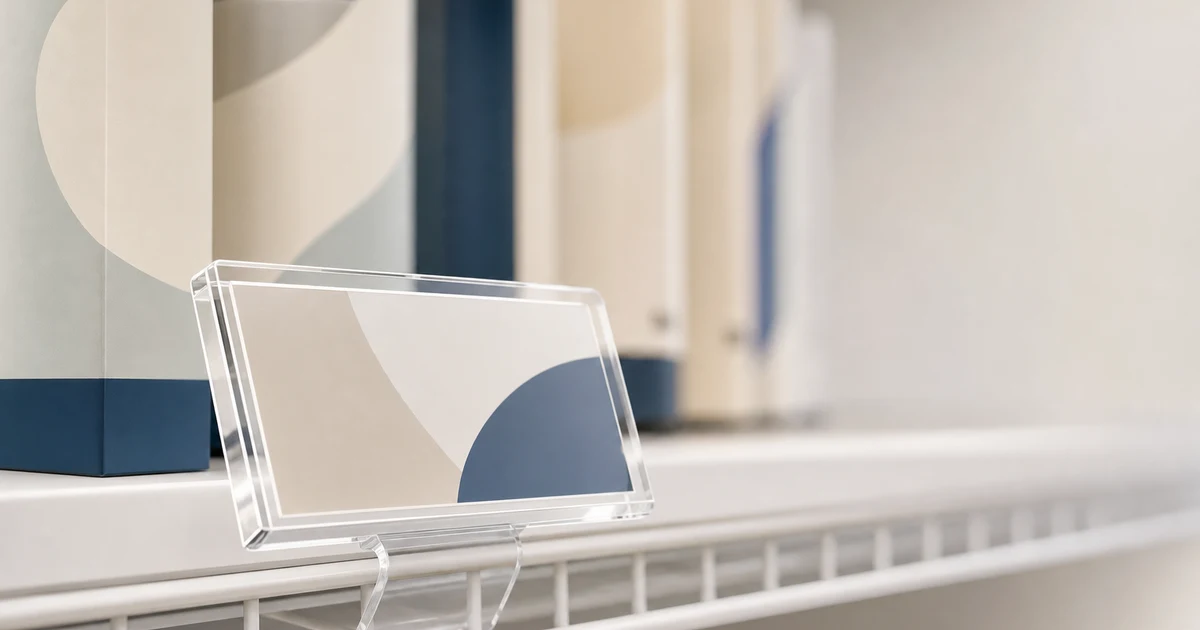
An acrylic shelf talker is a clear sign that clips to the shelf edge and holds a printed promo card right at the product.
Need this made?Custom acrylic sign holders →
Here are the clip types, common sizes, and bulk price breakpoints, made to order from 100 pieces per design.
Key Takeaways
- Imported shelf talkers fall off after 60 days because clip-tension is calibrated for one rail profile — usually wire — and degrades on metal or wood profiles. The right spec defines tension by rail substrate.
- Replaceable-graphic insert beats UV-printed permanent for any brand running seasonal promotions: the insert is swapped in 30 seconds while the talker stays clipped, the UV-print version goes to landfill at season-end.
- Diamond-polished edges beat die-cut on any retail-floor handling environment because die-cut edges show stress whitening within 30 days of stocker contact, which kills the premium brand read.
- Bulk pricing breakpoints land at 500 and 1,000 units. Below 500 the tooling per-unit dominates; between 500-1,000 line scheduling efficiency wins; above 1,000 material discount kicks in.
On this page
- What an acrylic shelf talker is: clip types, sizes, and order basics
- Clip-tension math — why imported shelf talkers fall off
- Replaceable-graphic insert vs UV-printed permanent
- Diamond-polished vs die-cut edge
- Bulk pricing math at 250 / 500 / 1,000 / 5,000 unit tiers
- Insert spec details — what to send your supplier
- Failure modes I see post-launch
What an acrylic shelf talker is: clip types, sizes, and order basics
Acrylic shelf talkers are small clear signs that clip onto the shelf edge and hold a printed card (a promo, price callout, or “new” flag) at eye level in front of the product. The acrylic body stays on the shelf for years; the printed insert swaps out each season. We make them to order from 100 pieces per design, with paid samples in 3–5 days and production in 15–20 days after approval.
| Spec | Common options |
|---|---|
| Clip type | Wire-rail clip (mass merch, grocery), metal-rail or channel-strip clip (pharmacy, specialty), wood-rail clip (boutique), adhesive mount with tether for glass-front fixtures |
| Insert window | 70 × 100 mm (small SKU callout), 100 × 150 mm (mid-size promo), 150 × 200 mm (large promo or category sign) |
| Graphic | Replaceable printed insert (top-loading by default) or UV print direct on the acrylic |
| Edge | Diamond-polished, which stays clear under stocker contact, or die-cut |
| Order basics | From 100 pcs per design; per-unit cost drops about 28% at 500 units and 42% at 1,000 against a 250-unit run |
As a price reference from the worked example further down, a clip-on acrylic body runs about $4 with a $0.40 replaceable insert, while a $5 UV-printed talker has to be replaced whenever the graphic changes. For shelf-edge holders that take standard paper sizes, see our acrylic sign holders. A delivered example at chain scale is our 1,000-piece, three-SKU shelf-edge sign holder program for a multi-store supermarket retailer.
Shelf talkers fail at retail floor for predictable reasons: wrong clip-tension for the rail profile (60-day fallout), die-cut edges that whiten under stocker contact (30-day brand read degradation), and UV-printed permanent design that forces landfill swaps every season. The four specs that decide 90-day survival: clip-tension tuned to rail substrate (wire / metal / wood / glass / curtain), replaceable-graphic insert vs UV-print (insert wins on any seasonal program), diamond-polished edge vs die-cut (diamond wins at retail-floor scale), and bulk pricing breakpoints at 500 and 1,000 units.
The shelf talker is the only display piece in retail that fails publicly. A pedestal that wobbles, a riser that flexes, a sneeze guard that scratches — those degrade quietly. A shelf talker that falls off the rail at month two leaves the brand spot empty in front of every shopper who walks the aisle, every day, until the next stocker rotation catches it. That’s why a 60-day fallout rate isn’t a quality issue; it’s a brand-visibility issue. The four sections below cover the specs that decide 90-day survival across mass merch, grocery, pharmacy, specialty, and cosmetics rails, and where the breakpoints fall on bulk pricing.
Clip-tension math — why imported shelf talkers fall off
Shelf talkers attach to rail fixtures by mechanical clip, and clip-tension is the variable most often miscalibrated on imported programs. Imported talkers typically ship with one clip-tension geometry — usually calibrated to wire shelving (~3 mm rail diameter, the most common profile in mass merch). On any other rail profile, the same clip either falls off or damages the fixture.
Wire rail (3-4 mm diameter, mass merch + grocery). Clip-tension target: 800-1,200 g pull force. Below 800 g the talker pops off under stocker contact; above 1,200 g the clip stresses the rail and creates “shelf-talker-scratched-our-fixture” complaints from store ops.
Metal rail (4-6 mm thickness, pharmacy + specialty). Clip-tension target: 1,200-1,800 g pull force. The thicker metal substrate distributes the clip force differently from wire — same nominal tension reads as too loose if not adjusted.
Wood rail (8-12 mm, boutique specialty). Clip-tension target: 1,500-2,200 g pull force. Wood is softer than metal and allows the clip to seat deeper, which means tighter nominal tension is needed to maintain the same hold force.
Glass-front fixture (cosmetics counters). Typically uses double-sided adhesive mount or counter-stand variant rather than rail clip. The clip-tension question doesn’t apply here — but the surface mount calibration does.
Production-grade shelf talkers are produced in tooling variants that ship in mixed allocation matched to the buyer’s rail-profile mix. A retailer running 60% wire shelving + 30% metal + 10% wood would ship an order with that allocation built in, not a single clip-tension geometry calibrated to averaging across all three (which produces poor performance on every profile).
Replaceable-graphic insert vs UV-printed permanent
The graphic-handling decision affects both per-cycle cost and operational workflow. Two viable options: a replaceable graphic insert (the talker has a slot or pocket that holds a printed paper or plastic insert) or a UV-printed permanent graphic (the design is printed directly onto the acrylic substrate).
Replaceable insert. The acrylic talker body stays clipped to the rail; the printed insert slides out the back or top of the channel and a new insert slides in. Insert swap takes ~30 seconds per door for a trained merchandising team. Lifetime: insert holds 90 days of retail wear before showing visible scuff (matte coated paper) or holds 180+ days (laminated insert or rigid card stock). The acrylic body lasts 5+ years across multiple seasonal swaps.
UV-printed permanent. The graphic prints directly onto the acrylic substrate at production time. No swap mechanism — the entire talker is replaced when the graphic refreshes. Lifetime: the printed graphic holds 12-18 months under retail-floor conditions before fading or scratching; in seasonal-program use the talker is typically replaced before the lifetime is fully utilized.
The math for a brand running 4 seasonal swaps per year across 200 doors: replaceable insert at $4 acrylic body + $0.40 insert × 4 swaps = $5.60 lifetime cost per door across 4 seasons. UV-printed permanent at $5 finished talker × 4 swap cycles = $20 lifetime cost per door across 4 seasons. The replaceable-insert approach pays itself off after the first swap and continues compounding savings across the program’s life.
UV-printed permanent makes sense in two scenarios: when the graphic is permanent brand identity that doesn’t refresh seasonally (logo placement, category signage), or when the talker is shipped for a single short-term campaign with no expected refresh.
Diamond-polished vs die-cut edge
Edge finish on a shelf talker is the third spec axis and the one most often skipped on importer programs to save margin. Two viable options: die-cut edge (the talker is laser-cut or punch-cut without secondary edge finishing) or diamond-polished edge (the cut edge is mechanically polished on a multi-spindle CNC operation).
Die-cut edges have visible cut marks at sub-millimeter spacing. Under retail-floor stocker contact (carts, hands, other fixtures during restocking), the cut surface develops stress whitening — visible micro-cracking at the edge — within 30 days of daily contact. The whitening reads as “damaged” to the eye even if the printed graphic is otherwise fine, and it degrades the brand read of the entire talker.
Diamond-polished edges are mechanically polished to optical-grade smoothness using progressively finer abrasive (typically 600 / 1200 / 2400 grit). The polished edge holds clarity through stocker contact for the full retail season because cast PMMA’s surface is hard enough to resist micro-scratching from incidental cart and hand contact at retail-floor frequency, with the relevant hardness behavior characterized by Rockwell M-scale per ASTM D7851. The cost premium is real but compresses at volume: ~$0.30-$0.60 per linear meter of finished edge at 1,000+ unit production runs. Retail shelf-talker programs are a subset of the broader point-of-purchase display category tracked by industry research from the Path to Purchase Institute2.
For shelf talkers specifically, the visible edge length per unit is typically 12-18 cm (the perimeter of the talker body minus the clip area). At $0.50 per linear meter, that’s $0.06-$0.09 per unit of polishing cost — negligible against the brand-read cost of die-cut whitening across a 200-door program. For the broader edge-polish context, our diamond vs flame polishing acrylic guide covers the wider application matrix.
Bulk pricing math at 250 / 500 / 1,000 / 5,000 unit tiers
Per-unit cost on shelf talkers follows the standard non-linear curve with breakpoints at 500 and 1,000 units. Indexed to 100 at the 250-unit baseline:
| Volume tier | Per-unit cost index | What’s driving it |
|---|---|---|
| 250 units | 100 (baseline) | Setup carries the most weight per unit |
| 500 units | 72 | First major breakpoint — tooling amortizes, line scheduling tightens |
| 1,000 units | 58 | Second major breakpoint — material bulk discount, two-shift production |
| 2,500 units | 49 | Continued material discount and freight efficiency |
| 5,000 units | 44 | Full-container freight, multi-shift production, optimized line throughput |
For brand merchandising programs running annual seasonal swaps across 100+ doors, the right batch size is typically 1,000 units — covering the door count with a 5x replenishment buffer for the year. Runs from 100 to 500 units carry more setup cost per piece; above 5,000 units the additional margin gain flattens.
Insert spec details — what to send your supplier
When the program uses replaceable inserts, the spec brief sent to the supplier needs to lock four insert dimensions before tooling. I see this miscommunicated about half the time on first inquiries.
Insert width × height (visible window). The dimensions of the printed graphic visible through the talker face. Lock to the brand team’s print template — typical formats are 70 × 100 mm (small SKU callout), 100 × 150 mm (mid-size promo), 150 × 200 mm (large promo or category). The visible window dimension determines the talker’s body proportions.
Insert pocket depth (channel slot dimension). The pocket holds the insert plus 2-3 mm of clearance for easy slide-in. For a 0.3 mm coated paper insert, pocket depth of 3-4 mm is right; for a 0.8 mm laminated card stock, pocket depth of 4-5 mm. Spec’d too tight and inserts bind; too loose and inserts can slip out under stocker contact.
Insert load-edge orientation (top / bottom / side). Top-loading is the production-grade default because gravity holds the insert seated even if the talker rotates slightly during install. Side-loading produces a cleaner aesthetic with no visible top channel but requires positive retention (a small detent or friction tab) to prevent the insert from sliding out. Bottom-loading is rare and not recommended.
Insert retention method. Friction fit (insert held by pocket dimensions alone) is the most common; magnetic detent (a small magnet at the insert top engaging a steel insert in the talker body) is the production-grade default for travel-tournament or high-handling environments. For typical retail seasonal programs, friction fit at the right pocket depth holds reliably.
The spec brief should include the print template (PDF or AI file) so the supplier can verify pocket dimensions against the actual insert format. I send the supplier a sample insert from the print run before bulk production starts — a 30-minute fit-check on the proof talker that catches dimensional misses before they’re locked into 1,000 units of tooling.
Failure modes I see post-launch
After the program ships, these are the operational issues that surface most often in the first 30-60 days:
Talkers falling off after 30-45 days on rails the supplier didn’t sample. The most common post-launch failure. The supplier sampled clip-tension on the buyer’s reference rail but the brand’s actual stores have rail variation the sample didn’t capture (older stores with thinner wire, retrofit stores with mixed metal-and-wood). Resolution: ship a small batch (50-100 units) of higher-tension clip variants for store ops to swap into the problem locations. The cost is small relative to a re-tooling decision.
Inserts slipping out under stocker contact. The pocket depth is right for the printed insert thickness but inserts shipping with promotional rigid card-stock are 1.5-2× thicker than the spec’d insert. Resolution: either re-print on the spec’d thickness or order a small replacement batch with deeper pockets for the rigid-stock SKUs.
Edge whitening on talkers from the lower-cost SKU tier. When the brand splits the program into tiers (premium SKUs get diamond-polished talkers, value SKUs get die-cut), the value-tier whitening becomes visible at retail within 4-6 weeks and erodes the value-tier brand read. Resolution: most brands accept this as a planned trade-off, but I encourage upgrading to diamond-polished across the full program when the cost differential at the program’s volume tier is below ~$0.10 per unit.
Confusion between SKU variants during install. When the program ships in mixed allocation (60% wire-tuned, 30% metal-tuned, 10% wood-tuned), store ops sometimes installs the wrong variant on the wrong rail. Resolution: ship variants in clearly labeled packaging with rail-type pictograms on each carton, and include an install guide at every store. The 5 minutes of additional packaging design saves hours of in-field swap labor downstream.
For the related sign-holder context — wall-mount and countertop brochure holders share clip-tension and substrate-mounting decisions with shelf talkers — see our acrylic sign holders product page and the wider acrylic display stands range. For brand merchandising leads scoping seasonal shelf-talker programs, send the brief over to our team — we’ll come back with a clip-tension allocation tuned to your retail door mix, replaceable-insert vs UV-print recommendation by SKU, and a sample with your insert window dimensions.
Footnotes
-
ASTM International. ASTM D785-08(2015) — Standard Test Method for Rockwell Hardness of Plastics and Electrical Insulating Materials. ↩
-
Path to Purchase Institute — Retail and Shopper Marketing Research — industry research organization covering in-store marketing effectiveness, shelf-edge merchandising ROI, and POP display performance data referenced in the context of shelf-talker program economics. ↩
Frequently Asked Questions
Why do imported shelf talkers fall off after 60 days?
Clip-tension calibration. Imported shelf talkers ship with a single clip-tension geometry calibrated to one rail profile — usually wire shelving (the most common in mass merch). On metal or wood rails, the same clip is either too loose (talker falls off under stocker contact) or too tight (talker scratches the rail, damages the fixture, and creates retailer complaints). Production-grade shelf talkers are tuned to the buyer's actual rail mix — one clip-tension for wire, another for metal, another for wood. Most importers don't disclose the rail-profile assumption because it's a commodity-pricing pressure point.
When does replaceable-graphic insert beat UV-printed permanent?
On any brand running seasonal promotions or quarterly graphic refreshes. Replaceable-graphic insert lets the merchandising team swap the printed graphic in 30 seconds (insert slides out the back of the talker channel) while the acrylic talker body stays clipped to the rail. UV-printed permanent talkers go to landfill at season-end and need fresh production runs each cycle. The math: a $4 acrylic body + $0.40 print insert × 4 seasonal swaps = $5.60 lifetime cost per door. A $5 UV-printed permanent × 4 seasonal swaps = $20 lifetime cost per door. The replaceable-insert approach pays itself off after the first season swap.
Diamond-polished vs die-cut edge — which matters at retail floor?
Diamond-polished, on any program where the talkers will see stocker contact (which is essentially all of them). Die-cut edges develop visible stress whitening within 30 days of contact with carts, hands, or other shelf fixtures during restocking — the whitening reads as 'used' or 'damaged' and degrades the brand read of the talker even if the printed graphic is fine. Diamond-polished edges hold optical clarity through stocker contact for the full season. The cost premium is real (~$0.30-$0.60 per linear meter of edge) but disappears in unit pricing above 500 units.
What rail profiles do acrylic shelf talkers need to support?
The five typical retail rail profiles: wire (mass merch and grocery), metal (pharmacy and specialty retail), wood (boutique specialty), glass-front fixture (cosmetics counters), and curtain wall or unfinished column (custom retail). A shelf talker production run targeting multi-vertical retail typically needs 3 clip-tension variants (wire-tuned, metal-tuned, wood-tuned) shipped in mixed allocation matching the retailer's door mix. Cosmetics and curtain-wall installations typically use a different mounting method (wall-mount or counter-stand) rather than shelf-rail clip.
Spec'ing seasonal shelf talkers across 100+ doors?
Send us your retail-vertical mix (mass merch / grocery / pharmacy / specialty / cosmetics), rail profile inventory, target unit volume, and seasonal swap cadence. We'll come back with a clip-tension recommendation tuned to your rail mix, replaceable-graphic vs UV-print recommendation by SKU, and a sample shelf talker with your insert window dimensions.