




Custom Serving Trays — Depth, Thickness & Weight Spec Guide
Half an inch of depth changes the weight, the freight, and the quote — these are the three numbers every custom tray RFQ lives on.
Need this made?Custom acrylic serving trays →

Key Takeaways
- Three specs drive every custom serving tray quote: depth, wall thickness, and finished weight — nearly everything else is a finish decision layered on top.
- Dropping tray depth from 2 inches to 1.5 inches removes a quarter of the wall material — on a handle-less tray, roughly a 9% weight cut that flows straight into freight.
- Always declare whether your dimensions are internal or external — on a 4mm-wall tray the difference is nearly a centimeter of usable space, enough to break an insert fit.
- Tray weight is computable before ordering: cast PMMA runs about 1.2 g/cm³, so sheet area × thickness gives per-tray and per-carton weight in advance.
- Plan the timeline on two clocks — 15–20 days of production plus freight transit on top — and put a 3–5 day sample in front of any bulk order.
On this page
- The three specs that drive every custom tray quote
- Depth — what 1.5 inches vs 2 inches actually changes
- Wall thickness — 3mm vs 4mm vs 5mm, and the weight complaint
- Weight math — density times sheet area, per tray and per carton
- Internal vs external dimensions — the ambiguity that wrecks quotes
- Handles — metal, integrated cutout, or none
- Food contact and hospitality finish — what a serving tray must additionally satisfy
- From spec to quote — production time, freight time, and the sample gate
The three specs that drive every custom tray quote
Custom serving trays are quoted on three numbers: depth, wall thickness, and finished weight. A custom serving tray is a made-to-order acrylic tray — typically 3–5 mm cast PMMA walls around a solid base, cut, polished, and decorated to the buyer’s spec — and once those three numbers are right, the rest of the custom acrylic tray conversation (handles, printing, packaging) is a finish decision.
The proof is a revision email I see two or three times a month, and it’s almost always the same half inch: “Can we do 1.5 inches deep instead of 2?” The buyer isn’t redesigning the product — she’s reacting to the first quote, where that half inch showed up in the weight, the freight estimate, and the unit price all at once.
The reason those three specs dominate is that they’re all the same variable wearing different clothes: material volume. Depth sets how much wall the tray carries, thickness sets how much acrylic sits in every square centimeter of it, and weight is what the first two multiply out to. Material volume drives the acrylic cost, the per-carton weight drives the freight, and both land in the quote.
This guide walks through each spec the way we walk buyers through them on real orders — including the math you can run before you ever request a quote, and the dimension-labeling trap that wrecks more tray quotes than any other single mistake.
Depth — what 1.5 inches vs 2 inches actually changes
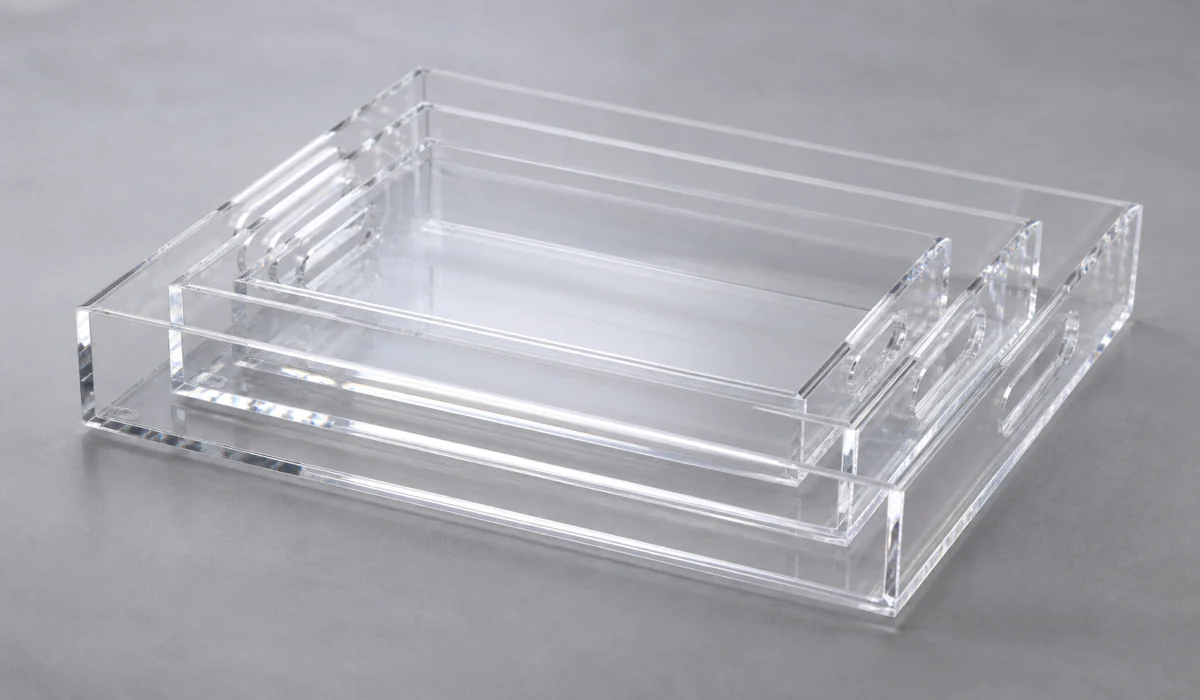
Depth is the tray spec buyers most often revise after the first quote, so here is what the half inch actually does. A 2-inch (51mm) wall corrals taller contents (bottles, amenity kits, glassware) and reads more substantial on a console or a room-service cart. A 1.5-inch (38mm) wall carries 25% less wall material, nests tighter when trays stack in a carton, and keeps low-profile contents visible instead of hiding them behind acrylic.
Depth also decides how trays travel. Shallower trays nest closer together, so more units fit per carton at less weight per carton, which is why a depth revision moves the freight line, not just the material line. If the trays need to stack in storage between services, say so in the RFQ: stacking wants a slight rim design consideration, and it’s a one-line note at quote stage versus a redesign after samples.
The honest guidance we give buyers: pick depth from the contents, not from the catalog photo. Measure the tallest item the tray must corral, add clearance, and stop there. Every extra millimeter of wall gets paid for three times: in acrylic, in freight, and in the hands of whoever carries the tray.
Wall thickness — 3mm vs 4mm vs 5mm, and the weight complaint
Wall thickness is where “premium” and “practical” pull in opposite directions. At 3mm, a small vanity or amenity tray is light and economical, but large formats flex. At 4mm (the standard for most serving tray sizes) the tray feels solid without punishing whoever carries it. At 5mm, a large-format tray reads unmistakably premium, and the weight climbs with it.
That climb is not hypothetical. One buyer pattern I’ve handled more than once: the sample arrives, the quality is approved, and then the pushback comes: the tray is simply too heavy for its job, at four and a half kilograms for a large-format piece. Nobody had run the weight math before specifying thick walls on a big tray. The fix wasn’t a quality fix; it was a spec fix — thinner walls, slightly shallower profile, same footprint.
“Good quality, thick” is a real instinct buyers bring to acrylic trays, and it’s half right: below a size-appropriate thickness, a tray flexes and feels cheap. But above it, the extra weight is something servers and freight forwarders both notice, and neither of them sends compliments. Our rule of thumb pairs thickness to the longest side: 3mm below roughly 300mm, 4mm for the broad middle of serving sizes, 5mm when the longest side pushes past 450mm or the brand positioning demands heft. For the deeper engineering behind span and flex, our acrylic thickness guide covers the load math; for what the material itself is (and why “lucite” and “acrylic” name the same PMMA), see the lucite vs acrylic tray comparison.
Weight math — density times sheet area, per tray and per carton
You can compute a tray’s weight before requesting a quote, and I recommend every program buyer does. Cast PMMA has a density of about 1.2 g/cm³,1 so tray weight is just the acrylic volume (base area plus wall area, times sheet thickness) multiplied by density.
Worked example, a 16 × 12 inch (406 × 305 mm) tray with 2-inch (51mm) walls in 4mm acrylic. The base: 406 × 305 mm = 1,238 cm² of sheet, times 0.4 cm thickness, times 1.2 = about 594 g. The walls: the perimeter is 2 × (406 + 305) = 1,422 mm, times 51mm of height, times 0.4 cm, times 1.2 = about 348 g. Total: roughly 0.94 kg per tray before handles and packaging. The same tray at 5mm walls lands near 1.18 kg; at 3mm, about 0.70 kg. And the revision email’s version, 1.5 inches deep instead of 2, saves about 87 g of wall — a 9% lighter tray.
Now scale it: a 100-piece order of the 4mm version is roughly 94 kg of acrylic before cartons and protective packaging. That number is why depth and thickness revisions come back from freight quotes, not from designers. Run the math at RFQ stage, and the quote holds no surprises; skip it, and the surprise arrives with the shipping estimate. When we quote, your drawing includes the computed unit weight for exactly this reason — you deserve to see the kilograms before you commit to them.
Internal vs external dimensions — the ambiguity that wrecks quotes
A tray dimension without the word “internal” or “external” next to it is ambiguous by exactly two wall thicknesses (8mm on a 4mm-wall tray), and both readings are reasonable. The buyer measuring a shelf or a cart thinks external. The buyer fitting inserts, glassware, or printed cards inside thinks internal. The factory can’t tell which from the number alone.
I’ve seen this ambiguity surface at every stage it possibly can: at quoting (two suppliers quote “12 × 12” trays that differ by a centimeter of usable space), at sampling (the sample is perfect, externally — but the buyer’s insert doesn’t fit), and worst, after bulk production. The fix costs one word per number: write “external 406 × 305 × 51 mm” or “internal to fit a 380 × 280 mm insert,” and if a fit matters — an insert, a bottle diameter, a cart rail — state the object instead of trusting the arithmetic.
Whichever convention the RFQ uses, confirm the factory’s pre-production drawing repeats it back. Our drawings dimension both internal and external explicitly, because a drawing that shows both numbers cannot be misread. If a supplier’s drawing shows one bare number, ask which it is before approving. That question has saved more than one bulk run.
Handles — metal, integrated cutout, or none
Handles are a spec, not an accessory, and they change the tray’s cost, packaging, and even its QC checklist. Three routes cover nearly every custom serving tray program we build:
Metal handles — brushed steel, gold-tone, or chrome, screwed through the tray wall. They carry the premium hospitality look, and they come with a spec most buyers forget until reorder time: screw spacing. A buyer replacing an existing program once specced it precisely (three and three-quarter inches between the screws) because the new trays had to accept the handle hardware already in stock. Buyers matching existing hardware should send the spacing and screw gauge with the RFQ. On our side, hardware kits pack inside each carton and get counted at final inspection: a missing bag of handles is the classic accessory defect that 100% piece-by-piece inspection exists to catch.
Integrated cutout handles — openings machined directly into the tray walls, then polished. No hardware to loosen, ship, or lose; a cleaner minimalist look; and a lower unit cost than metal. The trade-off is that cutouts must be positioned and sized at the drawing stage, and the cut edges need proper polishing, because a rough cutout edge is the first thing a hand notices.
No handles — clean rectangular geometry, “smooth sides,” the retail-display and vanity-tray default. Simplest to produce and to pack.
One MOQ note that matters here: our 100-piece production minimum applies per design. An acrylic serving tray with handles in two artwork versions is two designs, so the normal production plan is 100 pieces of each. If that inventory is too high, approve one paid sample of each artwork, select the stronger version for production, and hold the second artwork for a later run. The bespoke printed tray project shows how artwork, color proof, drawing, sample, inspection, and packing were placed under one buyer approval route. If what you actually need is engraved names, a monogram, or a printed logo repeated across the run rather than a spec answer, that ordering route lives on our personalized and branded tray programs section.
Food contact and hospitality finish — what a serving tray must additionally satisfy
A serving tray isn’t just a display product that carries things — in hospitality service it can meet food directly, and that adds a compliance layer plus a finish standard. On the compliance side, acrylic polymers used in food-contact articles are covered by FDA regulation 21 CFR 177.1010,2 which defines the conditions under which acrylic plastics may safely contact food. What that means practically for a buyer: declare food contact in the RFQ. The declaration drives sheet-grade selection and, just as important, the choice of adhesives and finishes on seams that food or moisture will reach. A tray specced for cosmetics display and a tray specced for pastry service can look identical and be built differently.
On the finish side, hospitality buyers hold trays to a standard other acrylic products rarely face: liquid. A serving tray takes spills, wipe-downs, and wash cycles, so seams need to be genuinely watertight (a term that comes verbatim from the premium end of our tray inquiries) and rims need clean polished edges with no sharp corners for hands that grab the tray a hundred times a shift. Bubbles or gaps in a wall seam aren’t just cosmetic on a serving tray; they’re where liquid gets in and cloudiness starts.
Finish quality is where fabrication depth shows. We cut trays on our own laser and CNC lines, polish rims and handle cutouts on our in-house diamond-polishing line, and print bottom artwork on the UV line we brought in-house in 2020. The whole chain runs under one roof, under ISO 9001, with 100% inspection before shipment. We say that not as a brochure line but because trays punish outsourced finishing: a subcontracted polishing pass shows up as inconsistent rims across a 50-piece carton, and a serving tray gets handled too often to hide it.
Two care facts buyers ask us to confirm in writing: acrylic (PMMA) is BPA-free, and we recommend hand-washing over commercial dishwasher cycles — repeated dishwasher heat stresses acrylic in a way hand-washing never will, and ammonia- or alcohol-based cleaners can craze the surface over time.
Both compliance and finish are sample-stage checks. When your sample arrives, run water into it, wipe it down hard, and inspect the seams. That two-minute test tells you more about the production standard than any certificate photo.
From spec to quote — production time, freight time, and the sample gate
The last thing every tray RFQ needs is a calendar built on two clocks, because buyers consistently plan around one. Production time is ours: samples in 3–5 days, bulk production in 15–20 days after approval. Freight time is the second clock, and it stacks on top: days by air, roughly 4–6 weeks door-to-door by sea (3–5 weeks port-to-port). When a buyer tells me the trays are “aiming for a Fall launch,” we count backwards from the launch through both clocks, and the answer to “when must the spec be final” is usually earlier than expected.
The sample gate is the step to protect even under deadline pressure. The pattern that works — one sample, then the larger order — exists because a tray’s three core specs are exactly the things a photo can’t confirm: depth in hand, wall feel, and weight. Ask for the sample at the correct final size, not a smaller stand-in; a scaled-down sample validates print quality but hides the weight and stiffness you’re actually deciding on. Budget it realistically too: a correct-size custom tray sample typically runs around $300 with air courier delivery, and it is the cheapest insurance in the program. Once the sample is approved, it becomes the acceptance standard the bulk run is inspected against — we inspect 100% of pieces before shipment, and the approved sample defines what “pass” means. Payment terms across the program are our standard 30% deposit, 70% balance before shipment.
If your quantities are still forming, the custom acrylic fabrication process explains how the 100-piece minimum works across designs and reorders. When the spec is ready (depth, thickness, dimensions labeled internal or external, handle route, food-contact declaration, target date), send it to us and you’ll have a quote with a computed unit weight on it, or start with what you have and we’ll build the spec sheet together. Most of the revision emails I mentioned at the top would never have been sent if the first RFQ had carried those three numbers.
Footnotes
-
MakeItFrom — PMMA (acrylic) material properties — materials database listing cast PMMA density of 1.2 g/cm³, the value behind every per-tray and per-carton weight calculation in this guide. ↩
-
FDA 21 CFR 177.1010 — acrylic and modified acrylic plastics in food-contact articles — the US federal regulation defining conditions for safe food-contact use of acrylic polymers, supporting the food-contact compliance discussion. ↩
Frequently Asked Questions
How deep should a custom serving tray be?
Most serving trays land between 1.5 and 2 inches (38–51 mm). Go 2 inches when the tray corrals taller items like bottles and amenity kits; 1.5 inches is lighter, nests tighter in a carton, and keeps low-profile items from disappearing behind the wall. Depth is the first spec to lock, because it drives weight and freight.
What acrylic thickness is best for a serving tray?
3mm suits small, light-duty trays; 4mm is the standard for most serving and vanity sizes; 5mm adds a premium feel on large formats. Thicker is not automatically better — buyers have pushed back on tray weight after specifying heavy walls, so match thickness to tray size and how far staff will carry it.
Are acrylic serving trays dishwasher safe and BPA free?
Acrylic (PMMA) is BPA-free — the polymer contains no bisphenol A — and cast acrylic is covered for food-contact use under FDA 21 CFR 177.1010. For cleaning, we recommend hand-washing with mild soap and water rather than a commercial dishwasher: repeated dishwasher heat can stress and craze acrylic over time, and hand-washed trays keep their clarity through years of daily service.
Should I give internal or external dimensions when requesting a tray quote?
Either works — as long as you say which. On a 4mm-wall tray, internal and external widths differ by 8mm, enough to break an insert fit or a shelf clearance. Write 'external' or 'internal' next to every number in the RFQ, and confirm the factory's drawing states the same convention before production.
What is the minimum order for custom serving trays?
Our MOQ is 100 pieces per design. Two artwork versions of the same tray count as two designs of 100 each. Most buyers order one sample first (3–5 days), confirm the size, weight, and finish in hand, then release the bulk run against the approved sample.
Get a Custom Serving Tray Quote
Send us your drawings, reference photos, or a description of what you're making. We reply within 24 hours with a material recommendation, thickness, fabrication method, and a per-unit quote.