



Pedestal columns
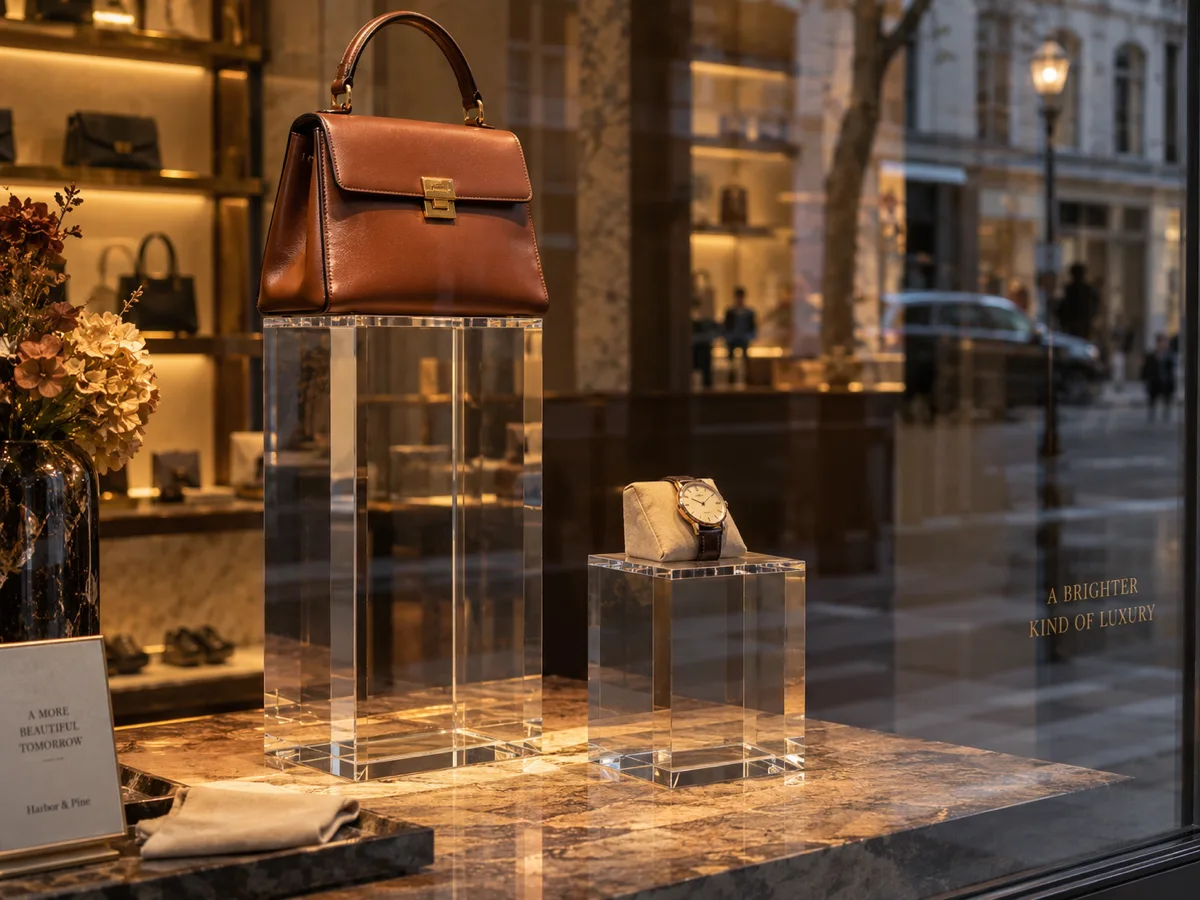
A slim column lifts one product in a retail window.
Columns and cubes that lift a single hero product, for jewelry and watch brands, museums, showrooms and retail launches from 100 pieces per design.
ISO 9001 Certified · 2,000+ Custom Projects
Get a Pedestal Quote
Acrylic display pedestals are clear, colored, frosted or mirrored columns and cubes for retail windows, galleries and jewelry displays. Choose a countertop 250–400 mm format or an 800–1200 mm floor column; confirm load and base stability on the sample.
Paid samples cost US$200–500 per design and are never credited to the order; production runs from 100 pcs per design.
Choose the configuration around the product, location, and approval drawing.
A slim column lifts one product in a retail window.

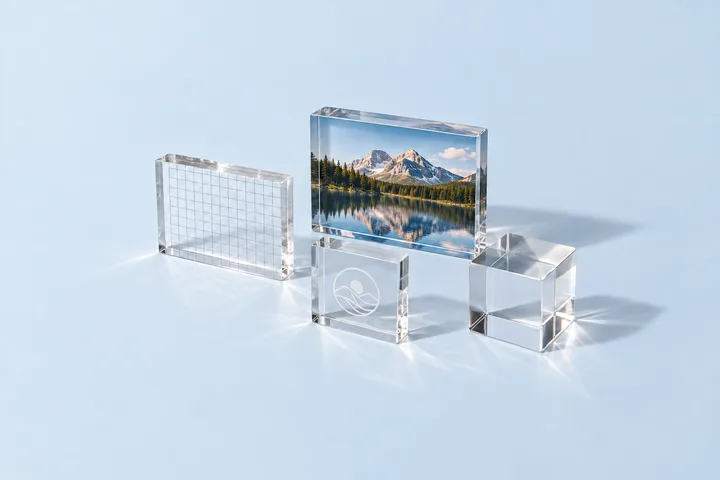
Pedestal display cubes lift one product with a minimal clear or colored form.

Two to five coordinated heights for grouped merchandise.
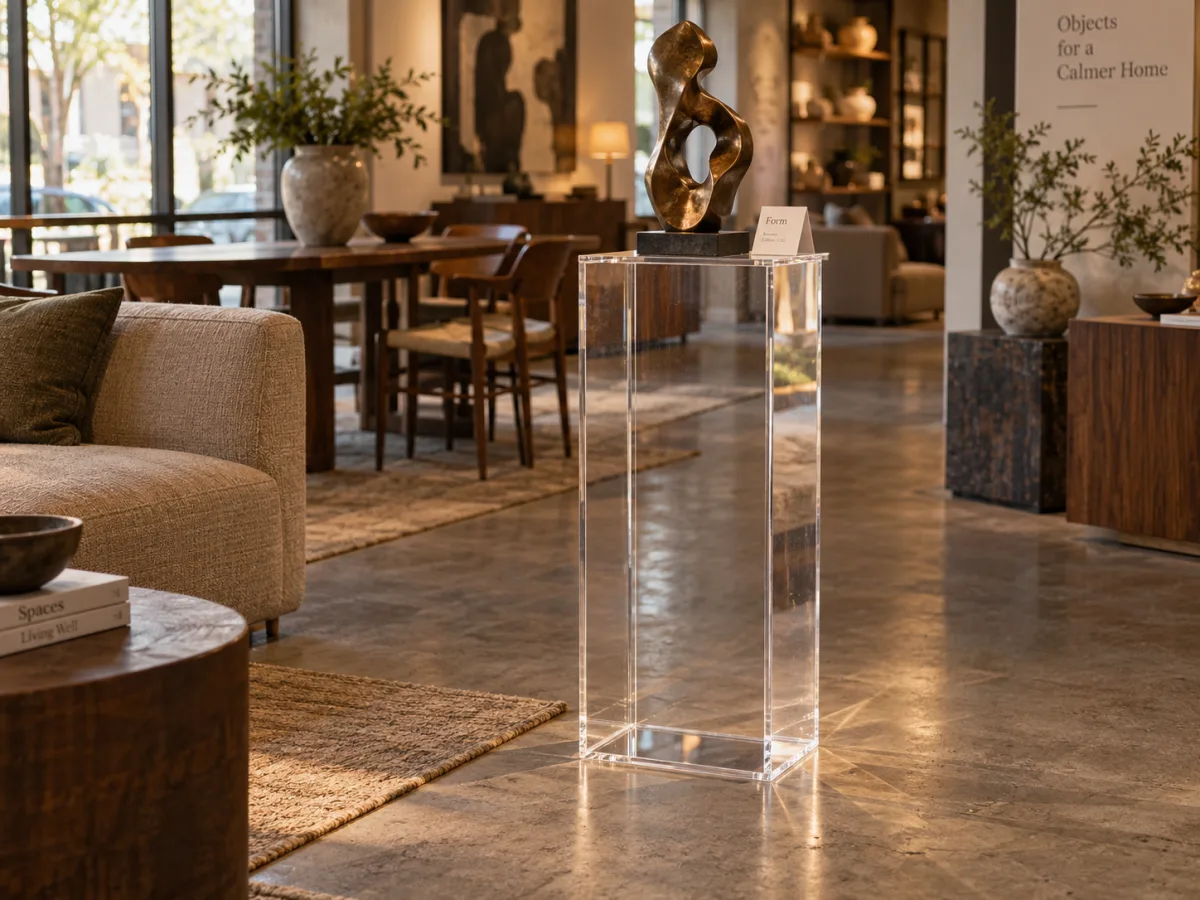
Taller columns with base and load checked for the site.

Surface finish changes the visual presentation without changing the format.
| Format | Typical width | Typical height | Construction |
|---|---|---|---|
| Countertop column | 150–300 mm | 250–400 mm | Hollow or bonded |
| Floor column | 300–500 mm | 800–1200 mm | Reinforced hollow |
| Display cube | Up to about 120 mm | Up to about 120 mm | Solid cast option |
| Larger cube | By drawing | Under 200 mm tall | Hollow bonded, 8–10 mm walls |
Final load, footprint and stability follow the approved drawing and physical sample.
Acrylic, plexiglass and lucite are buyer names for PMMA. Material thickness and joint construction follow the finished load.
Compare one approved size and construction; these relative changes are published references, not a dollar quote.
Final unit cost follows the approved size, load, finish and packout. Unit cost drops sharply above 200 pieces.
Request a quoteDelivered project
The closest delivered order to a pedestal: a European automotive brand ordered 600 countertop displays in 2 SKUs on a 22 mm CNC-machined base with the logo machined in and filled, delivered in 22 production days with every unit inspected, with 180 more ordered six months later. For a co-branded watch pedestal, see the showroom watch pedestal project.
“The bonded joints on the columns are seamless — no cloudy seam lines where earlier samples we'd pulled always showed them. On a clear pedestal that's the whole game, because there's nothing else on it to hide a flaw.”
It depends on load and height. A short display cube (under 200mm) holding a lightweight product works in 8mm or 10mm acrylic. A floor-standing pedestal column that holds a heavier single item — a sculpture, a handbag, a boxed product — needs 12mm to 20mm walls, or a solid cast block for small columns. We don't recommend anything under 8mm for a pedestal, because a pedestal carries a single concentrated load rather than spreading weight across tiers like a riser. We verify the wall thickness against your product weight for every custom order.
A pedestal (or display cube) raises one hero product on a single column or block — it's a spotlight for one item, common in jewelry windows, museums, and product launches. A riser elevates several small items across 2–5 stepped tiers so a whole product range stays visible on a counter. Pedestals are taller, heavier-walled, and minimal; risers are wider, tiered, and merchandising-focused. Many buyers order both — pedestals for the hero SKU, risers for the supporting range.
Yes. Clear is the default for a gallery look, but we also produce frosted white (soft, premium), matte black (high contrast for jewelry and watches), and mirrored (adds depth and reflects the product from below). We offer 50+ standard acrylic colors plus custom Pantone matching. Solid clear blocks show optical clarity and refract light at polished edges; hollow columns keep weight and cost down on taller pieces.
Four factors drive pedestal pricing: acrylic thickness or whether the block is solid vs hollow (solid cast blocks use far more material), overall height and footprint (a floor-standing column costs more than a countertop cube), material and finish (frosted, mirrored, and colored add 10–30% over clear), and order quantity (unit cost drops sharply above 200 pieces). As an indicative FOB Shenzhen guide, small hollow display cubes fall in the low single-digit US dollars per piece at volume, while tall solid or thick-walled floor pedestals run considerably higher. Every pedestal is custom, so treat these as reference ranges — send specs for a firm quote.
Yes, when engineered correctly. A hollow pedestal column with the right wall thickness and a bonded top and base plate is rigid and stable — the hollow build keeps a tall pedestal light enough to move and lower in material cost than a solid block. For very heavy hero products we add a thicker top plate, internal bracing, or a weighted base so the pedestal won't tip. We match the construction to the product weight you send us before production.
We're the factory. Wetop has operated its own ISO 9001 certified plant in Shenzhen since 2008 — today 5,000 m², 65+ workers, 2,000+ custom projects delivered. Pedestals are cut, bonded, polished, and inspected on our own floor, which is what lets us verify wall thickness against your product weight instead of forwarding the question to someone else and waiting.
Large pedestals are the most damage-prone thing we ship, so they're packed as individual units rather than stacked. Protective film stays on both faces through packing, polished tops and edges get foam protection, and every piece passes 100% inspection against your approved sample before it's wrapped. Terms are FOB Shenzhen by default, with CIF and DDP available if you'd rather we carry the freight. Tell us the destination and whether the pedestals go straight to store or through a distribution center — we'll spec the packing to that route and confirm it in writing before production.
Not from wall thickness alone. Thickness sets stiffness, but the load a pedestal can carry depends on the whole load path: top-plate span, walls, bonded joints, base, where the object sits and how far off center, side impact, and anchorage. A closed box-base spreads the load through four walls in compression, while a cantilever concentrates bending at its base seam. For a 50–200 lb object or a public floor, send the weight, footprint, load position, and venue; the rating then comes from a calculation or a load test on the finished design, and the venue's engineer approves anchorage. We can build a paid sample for that test.
Send us your product weight, target height, and quantity. We respond within 24 hours with a detailed quote — column-vs-cube recommendation, wall thickness for your load, material options, and timeline. No commitment required. Sample before you commit to production.