
Delivered Project · Automotive Showrooms
Luxury Watch Pedestal for Auto Showrooms
An automotive showroom buyer came to us for a luxury watch pedestal carrying two brands.
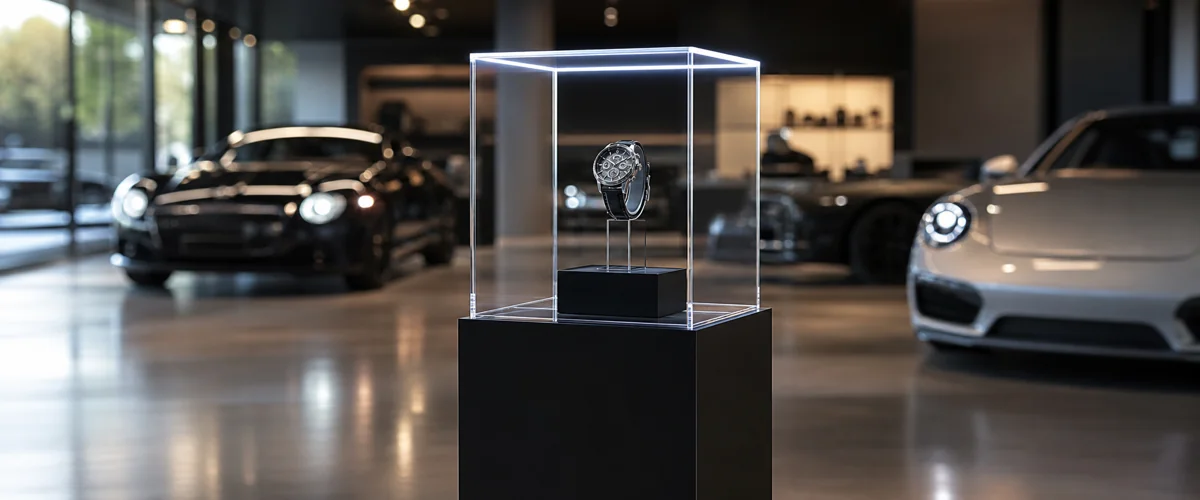
The buyer supplied the watch, mount, load and anchoring conditions and got both brands to sign off. We turned those inputs into a drawing and a paid sample, then produced the non-electrical acrylic pedestals to the approved specification.
Ordering a similar project
MOQ is 100 pieces per design. Paid samples normally take 3–5 days; sample fees are paid separately and never credited. Standard production takes 15–20 days after drawing, load input, sample, inspection, artwork, anchoring interface, and packing approval. Wetop responds to a complete brief within 24 hours.
Closest published price: this pedestal was quoted from its own drawing and load. The nearest public reference on the acrylic display manufacturer page is a two-tier countertop stand 250 × 180 × 220 mm, 5 mm clear, one-color UV logo: $28 each at 100 pcs, $16 at 500, $12 at 1,000 (FOB Shenzhen, published reference).
Key Takeaways
- An automotive showroom buyer needed a co-branded watch pedestal; it supplied the watch, mount and finished load, and we engineered the box-base to that load.
- We kept the pedestal non-electrical; lighting and powered parts stayed with the buyer's own electrical work.
- Both brand owners approved the artwork, logo spacing, orientation and permitted use before we released production files.
- The paid sample proved fit, stability, finish, anchoring interface, artwork and packing before we released production files.
The Brief
An automotive showroom buyer needed a luxury watch pedestal that carried two brands. It came to us with four controlled inputs: the watch and its mount, the finished load, the showroom surface, and artwork authority for both brands. The buyer also told us whether staff would move the pedestal, whether it would be anchored, and which side faced visitors.
With two brands on one display, both rights holders had to approve the artwork before we released production files. We worked from a drawing and a paid sample, not from a concept image.
- Load input: the buyer supplied the watch, turntable and security mount with the finished mass and center of gravity.
- Site input: the showroom team approved the counter or floor substrate, fastening method, cable-free non-electrical scope, cleaning method and installer responsibility.
- Artwork input: both rights holders approved logo files, spacing, orientation, finish and permitted use before we released production artwork.
We held the quote open until those inputs were fixed, then set wall thickness, anchor detail and adhesive from the finished geometry and site conditions.
What We Built
We built a non-electrical box-base with a removable brand panel. The drawing kept the load path apart from the decorative panel, so artwork could change without touching the structure. Wall thickness, joint method, top plate and base followed the buyer's load and footprint.
Box-base structure approved against the supplied load
The box-base spread the load across bonded walls and a top plate. Span, height, wall gauge, joint geometry and anchor detail came from the buyer's load and footprint. We recorded the approved material grade and dimensions on the drawing, then checked fit and stability on the paid sample.
The showroom's facilities team chose and approved the site anchor, since they knew the substrate and local installation rules. We machined an insert and hole pattern to the approved file and verified that interface on the sample.
Joint selection tied to the approved material
We chose the bonding process for this construction based on acrylic grade, edge preparation, adhesive, bonded area, cure controls and load direction, and documented how we inspected it. The paid sample gave the buyer a physical seam, polish, silhouette and load interface to approve, and production inspection compared the run with the released drawing and that sample.
| Part | Buyer input | Sample check | Production record |
|---|---|---|---|
| Bonded box-base | Load, span, material and finish | Seam appearance and agreed stability check | Drawing revision and inspection criteria |
| Top and product mount | Actual watch and mount | Fit, access, balance and viewing angle | Approved cavity and hole pattern |
| Site interface | Buyer-approved substrate and anchor | Hole and insert position | Released installation interface |
Non-electrical top rim and service access
The pedestal stayed non-electrical. A solid top rim hid the joint line and framed the watch with no drivers, wiring or powered parts. Venue lighting was the buyer's separate electrical work.
A removable rear access panel served the product mount. The buyer approved its opening direction and how much of it showed, and on the sample staff reached the mount hardware without disturbing the brand panel.
Spec Breakdown
The production specification recorded the fields below. The buyer and both brand owners signed off on the drawing and sample before we released the cutting, bonding, engraving and packing files.
- Material: named PMMA grade, nominal gauge, finish and supplier documentation, approved on the quote.
- Construction: top plate, walls, base, joints, service opening and the buyer-approved anchoring interface.
- Product interface: watch and mount geometry, load, center of gravity, access direction and visible clearances.
- Co-brand panel: controlled vector files, logo spacing, orientation, decoration method and written approvals.
- Sample checks: fit, balance, finish, seam appearance, service access, artwork and packing restraint.
- Electrical boundary: no lighting, wiring, driver or powered component in the pedestal we made.
Production + Co-Brand Approval
Production began after the buyer approved the drawing and paid sample. Artwork comments, venue approval, freight and installation ran outside that window. We got one written release naming both approvers and the accepted artwork revision.
- Drawing and artwork release. We issued one controlled drawing with product interface, material, structure, brand-panel position, access and packing. Both rights holders approved the same revision.
- Paid sample. The sample used the quoted material and finish. The buyer checked product fit, balance, seam appearance, surface finish, access, artwork and the site interface before written approval.
- Production and inspection. We cut, machined, bonded, decorated, inspected and packed to the released files. Venue labels and hardware kits followed the buyer's schedules and approved packing lines.
Our quote listed each design separately. Where venues needed different hardware kits for an identical pedestal, we handled the difference as a packing line, not a new design.
Delivery and Installation
We shipped the pedestals with the approved acrylic interface and packing records. The buyer's facilities team checked the substrate, fitted the site hardware, installed the pedestals and confirmed they met venue rules.
On receipt, the buyer compared the drawing revision, brand-panel orientation, surface finish, top interface, service access, protective film and carton label with the purchase order before removing film or fitting the watch mount.
What we signed off: the finished load, site interface, access, co-brand artwork and packing, all on one non-electrical physical sample before production.
If You're Planning Something Similar
Send the product or its controlled geometry, finished load, footprint, site interface, final vector artwork from every brand owner, quantity, destination and packing needs. Theacrylic sheet thickness guide explains which inputs go into the structural review. We keep the reference product, drawing revision, material, inspection checks, artwork proof and carton layout on file, so a repeat order is quoted to the same scope; a new logo or mounting condition gets a new revision. See custom acrylic cases and pedestals.
Need a co-branded display pedestal?
Send the product geometry, finished load, footprint, site interface, artwork, quantity, and destination. We will return a non-electrical manufacturing review and quote.
Paid sample in 3–5 days · Sample fees paid separately and never credited · Production in 15–20 days · MOQ 100 pieces per design · Quote response within 24 hours