Supplier Payment Terms: Deposit vs Full Payment on Acrylic
Payment terms aren't a take-it-or-leave-it line on a quote — they're a risk-allocation decision. Here's how we structure terms on B2B acrylic projects, and what every tier signals about the supplier on the other side.
Key Takeaways
- 30% deposit / 70% pre-shipment is the industry baseline for custom acrylic — it splits the cash-flow risk roughly in half between buyer and supplier and matches how setup costs are actually incurred.
- 100% upfront is a red flag on first orders, not a deal-breaker on repeat ones — context matters, and I explain when it's fair (small samples, regional currency restrictions) versus when it's a warning sign.
- For first-time international buyers above $50,000 USD, Alibaba Trade Assurance or a Letter of Credit shifts custody of the deposit to a neutral third party. Cost is roughly 0.5–1.5% of order value; peace of mind is worth more.
- Orders above $100,000 USD should be structured around milestone gates — material procurement, fabrication, QC, pre-shipment — not a single 30/70 split. Each milestone is a checkpoint where both sides can pause cleanly.
- The 30/70 structure works because it asks both sides to commit something at the same moment — the supplier funds setup before the balance lands, the buyer holds the balance until the goods are verified on spec.
On this page
- Why 30/70 Is the Industry Baseline
- When 100% Upfront Is Fair (and When It’s a Red Flag)
- Escrow and LC for First-Time Buyers — The $50k Threshold
- Stage Payments for >$100k Orders — Milestone Gates
- Currency and Bank Fees — Why USD vs CNY Changes the Math
- Payment Term Decision Tree by Order Size
- Related guides
Understanding supplier payment terms matters before you send a single dollar overseas. In the orders I’ve coordinated since joining Wetop in 2020, the buyers who push back hardest on a standard 30% deposit almost always fall into one of two camps: those who were burned by a previous supplier who took a big deposit and disappeared, and those working under a corporate policy that caps deposits at a low fixed number. In both cases the objection eases once you walk through where the deposit money actually goes — which is what this guide does.
Most deposit-vs-payment questions aren’t really about the percentage. They’re about trust. The answer isn’t a number, it’s a structure — when 30/70 makes sense, when it doesn’t, and what to use at each order tier. If you just want Wetop’s own accepted payment methods, the short answer is on our FAQ page — this guide is the long answer, the decision framework for supplier payment terms wherever you source. See our acrylic displays product range to understand the typical order profile these terms apply to, or contact us to get a quote with the recommended payment structure for your order tier.
Why 30/70 Is the Industry Baseline
The 30% deposit / 70% balance structure exists because it tracks the actual cost curve in custom acrylic production. When a PO is confirmed, we don’t sit on cash for a month and then start cutting. We immediately commit money on the buyer’s behalf — material is allocated from sheet stock or ordered from the mill, jigs are scheduled into the production calendar, the toolpath is programmed, and the QC team blocks inspection slots. Roughly 25–30% of the total order cost is incurred in those first 72 hours, before a single piece is cut.
That’s where the deposit number comes from. It isn’t arbitrary — it’s the supplier’s actual cash exposure during setup, rounded slightly. If a buyer wires us 0% deposit and asks us to start, we’re funding their order out of working capital, and a single cancellation or spec change forces us to absorb the loss on already-committed materials. No fabricator can run that risk across hundreds of concurrent orders.
The 70% balance is timed to pre-shipment, not on receipt. We send a QC photo set and packing list once production is complete and inspection is signed off. Payment of the 70% triggers freight booking — goods load once funds clear. From the buyer’s side, this is the leverage point: you don’t release the balance until you’ve seen evidence the order is on spec. From our side, we don’t load the container until funds have cleared. Neither side carries one-way risk.1
I describe 30/70 to first-time buyers as a meeting in the middle. The supplier risks the 30% (production setup) before the buyer commits the 70%; the buyer risks the 70% before the supplier ships. Both sides carry stake at every stage — which is why this structure has settled into being the default across custom fabrication.
When 100% Upfront Is Fair (and When It’s a Red Flag)
Full prepayment isn’t always a warning sign. There’s a narrow band where 100% upfront is genuinely fair, and a wider band where it’s a signal you should walk away. The difference is context.
Full prepayment is reasonable in three situations. First, on small sample orders below $500 — bank-wire fees alone run $30–$50, and splitting a $300 sample into two payments costs more in friction than it saves in risk. We charge 100% on samples for that reason. Second, on stock items shipping the same week — no setup cost staircase, no QC photo milestone, no real reason for a split. Third, in regional payment-system constraints — some buyers in Brazil, Argentina, and parts of Africa face currency-control rules that make outbound wires difficult, so they prefer one large transfer.
Full prepayment becomes a red flag when none of those conditions apply. If a supplier asks for 100% upfront on a $50,000 custom order from a first-time buyer and refuses to discuss escrow, that’s not a payment policy — it’s an asymmetric risk transfer. You’re being asked to fund their entire production cycle with no leverage to ensure spec. The classic failure pattern is well documented in trade-dispute forums: a buyer pays 100% upfront, the supplier ships a container that’s heavily defective, and then stops responding — with the full sum already gone, recovery through cross-border arbitration costs more than the order was worth. The leverage of an unpaid 70% balance is what keeps a supplier honest through QC.
The simplest filter: if a supplier won’t accept 30/70 and won’t accept escrow, they don’t have a payment problem — they have a trust problem they’re trying to push onto you. Walk away.
Escrow and LC for First-Time Buyers — The $50k Threshold
For first-time international buyers above $50,000 USD, I always recommend escrow rather than direct wire. Not because 30/70 is unsafe — it’s the settled default across custom fabrication for good reason. The point is narrower: a first-time buyer has no track record with us yet, and a 30% deposit on a $50k+ order is $15,000+ of exposure on an unproven relationship. Escrow eliminates that exposure for a small fee.
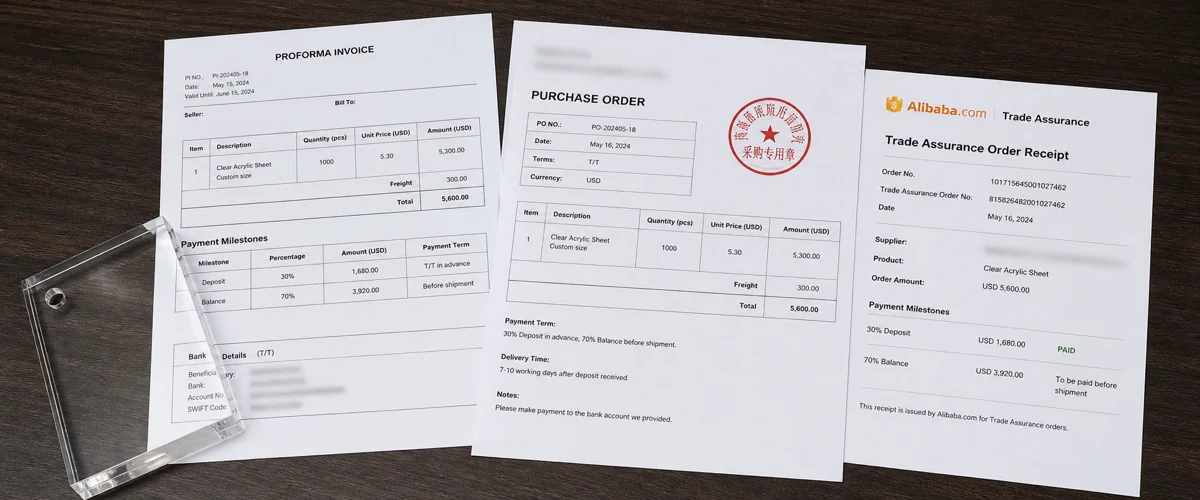
Alibaba Trade Assurance is the cheapest and fastest option. The buyer pays into a holding account managed by Alibaba; we don’t see funds until the order ships and the buyer confirms spec match.2 Setup takes one business day. Cost to the buyer is typically zero — Alibaba charges the supplier a 1–3% commission. The protection covers product quality and on-time shipment with a documented dispute process. It’s the option we most often point first-time buyers toward when an order clears the mid-five-figure range.
Commercial Letter of Credit (LC) suits buyers whose corporate policy requires bank-issued instruments, or orders above $200,000 where size justifies the formality. The buyer’s bank issues a credit instrument promising payment to our bank against documented shipment evidence (Bill of Lading, commercial invoice, packing list, inspection certificate). LC fees run 0.5%–1.5% of order value, split between the two banks; setup takes 5–10 business days. LCs work on any platform and satisfy the most rigid procurement policies.
The Trade Assurance flow in real timeline: Day 0, PO confirmed and 30% deposit paid into Trade Assurance. Day 1, Alibaba notifies us; production begins under our QC and process workflow. Day 19, we upload pre-shipment QC photos and request the 70% release. Day 20, buyer reviews and releases. Day 21, container loaded. The structure adds zero days to lead time and gives every milestone a verifiable money-trail.
For a sense of the order profile these terms apply to, see our automotive showroom countertop displays case study — the kind of first-time international project where routing the initial order through escrow, then moving to direct 30/70 once a track record exists, is the sensible progression.
Stage Payments for >$100k Orders — Milestone Gates
Above $100,000 USD, a single 30/70 split stops being the right structure. Production timelines stretch to 25–35 days, and both sides benefit from breaking the contract into defined checkpoints rather than two big transfers.
The structure I recommend at this tier:
- Milestone 1 — PO Confirmation (15%). Locks the calendar slot, confirms material allocation.
- Milestone 2 — Material Procurement Confirmed (15%). Triggered when we have signed mill certificates for the cast PMMA sheet and any specialty material (FDA-grade, anti-static, color-matched).
- Milestone 3 — Mid-Production QC Pass (20%). Halfway-mark dimensional QC reports and process photos. Buyer signs off; payment releases.
- Milestone 4 — Pre-Shipment Inspection (40%). Final QC pass plus (above $200k) a third-party inspection report from SGS or Bureau Veritas. Payment triggers freight booking.
- Milestone 5 — On B/L Copy (10%). Final 10% released against the Bill of Lading copy — leverage on documentation completeness (commercial invoice, packing list, inspection certificate, certificate of origin for duty drawback).
The total still adds to 100%, but buyer exposure is capped at 50% before mid-production sign-off — versus 30% on a standard structure where you’ve committed before production starts. Milestone gates also generate cleaner audit trails: every payment is tied to a documented production event, not a calendar date. On the larger custom orders where we’ve used this structure, each payment lands against a signed-off production event rather than a calendar date — which is exactly what a procurement team needs to reconcile the file after delivery.
Currency and Bank Fees — Why USD vs CNY Changes the Math
Headline supplier payment terms only say what percentage to pay when — not what currency or what bank fees you’ll absorb. For US and EU buyers sourcing from China, currency choice is one of the most overlooked friction points.
Most of our international orders settle in USD. Quotes, invoices, and the 30/70 deposit and balance are wired in USD to our HSBC Hong Kong account. We then convert USD to CNY for domestic operating costs and price that FX risk into the quote with a small buffer. A small number of buyers — typically European companies with strong CNY hedging programs — request CNY-denominated invoicing direct to our mainland China account. That shifts FX risk to the buyer but eliminates one conversion fee, saving 0.3–0.7% on large orders. Below $50k the savings rarely justify the operational complexity; above $200k it can.
Bank fees are often invisible until they hit the invoice. A standard SWIFT wire from a US bank to our Hong Kong account costs $25–$45 outbound, plus $10–$25 intermediary, plus a $5–$15 incoming fee we typically absorb. For 30% deposit + 70% balance on a $50k order, that’s roughly $60–$120 in banking friction — trivial on five-figure orders, but 2–3% of order value on anything below $5k. To reduce drag, consolidate orders so two wires cover $20k+ of business rather than $3k each, or route smaller orders through Trade Assurance’s payment rails since the platform absorbs most wire fees into the supplier’s commission.
Payment Term Decision Tree by Order Size
The fastest way to know which supplier payment terms apply: match your order value and buyer history to one of the four tiers below. Each tier maps to a structure we’ve validated across hundreds of orders.
| Order Value | First-Time Buyer | Repeat Buyer | Why |
|---|---|---|---|
| Under $10,000 | 50% deposit / 50% pre-shipment, direct wire | 30% / 70%, direct wire | Setup costs are proportionally high on small orders; 50% deposit covers actual exposure. |
| $10,000 – $50,000 | 30% / 70% via Alibaba Trade Assurance | 30% / 70%, direct wire | Standard split; escrow protects the first-time buyer at modest fee. |
| $50,000 – $100,000 | 30% / 70% via Trade Assurance or Letter of Credit | 30% / 70%, direct wire (or LC if buyer policy requires) | Above $50k, formal escrow is the rational hedge for a first order. |
| Over $100,000 | Milestone gates (15/15/20/40/10) via LC | Milestone gates via direct wire, or 30/70 if buyer prefers simplicity | Order size justifies five checkpoints and matches procurement-policy formality. |
My reading of the tree in practice: a first-time buyer placing a $30k order should run 30/70 via Trade Assurance — not direct wire, and not 50% upfront. A repeat buyer placing a $250k order should use milestone gates, even if the protection isn’t strictly needed — the audit trail is worth the slight overhead. Match the structure to the risk profile, not to the supplier’s preference or the buyer’s anxiety.
If you haven’t yet sent us a quote request, your starting point is the acrylic RFQ guide — a complete RFQ in your first email lets us price the order accurately and confirm which payment tier applies before any commitment.
Related guides
- Acrylic Awards Under $20: Bulk Trophy Math for HR Programs
- Repeat-Order Acrylic Lead Time — Why Wetop’s Tooling Library Cuts 30%
Footnotes
-
ICC Incoterms 2020 — International Chamber of Commerce — The standard set of international trade terms defining where each party’s payment, freight, and risk responsibilities begin and end. Payment-milestone language in custom acrylic POs typically references Incoterms (FOB Shenzhen, CIF destination, DDP) so that “pre-shipment” and “on B/L copy” milestones align with the agreed shipping term. ↩
-
Alibaba Trade Assurance — How It Works — Alibaba’s escrow program for B2B orders, holding buyer payments until confirmed shipment and quality match the agreed PO. Setup takes one business day for buyers already on the platform; cost is typically borne by the supplier as a small commission. The simplest neutral-third-party path for first-time international acrylic orders below $200,000. ↩
Frequently Asked Questions
What are standard supplier payment terms for B2B custom acrylic production?
The industry baseline is 30% deposit on PO confirmation and 70% balance against pre-shipment QC photos or inspection sign-off. This 30/70 split is what we run on the large majority of our custom orders. It matches the actual cost curve — material and setup costs are incurred early, finished-goods value accumulates later — and it splits the cash-flow risk between buyer and supplier rather than concentrating it on one side. Variants exist for very small orders (50% deposit), very large orders (milestone gates), and first-time international buyers (escrow or LC), all explained in the decision tree below.
Is it normal for a custom acrylic supplier to ask for 100% payment upfront?
It's normal for sample orders under $500, for stock-only items shipping immediately, and for some regional payment-system constraints. It's not normal for a custom production order above $1,000 USD on a first-time relationship. A supplier that demands 100% upfront on a six-figure custom order without offering escrow has shifted all cash-flow risk onto you and gives you no leverage if the production output isn't on spec. That's the red flag. Push back, ask for a 30% deposit / 70% pre-shipment structure, and if they refuse without explanation, find another supplier.
How does escrow work on a custom acrylic order from China?
The most common path for buyers we work with is Alibaba Trade Assurance — funds sit with Alibaba until you confirm shipment matches spec, then release. Cost is typically 0% to the buyer (Alibaba charges the supplier a small commission). Setup takes one business day. The other path is a commercial Letter of Credit through your bank, which is more expensive (0.5–1.5% of order value) but works for any supplier on any platform and gives you formal banking protection. Both options put a neutral party in custody of your deposit until production milestones are verified.
Can I negotiate payment terms with a Chinese acrylic manufacturer?
On a first order, you can usually negotiate the deposit percentage (down from 50% to 30%, sometimes to 20% on smaller orders), the payment milestone definition (pre-shipment vs. on B/L copy), and the escrow structure (Trade Assurance, LC, or direct wire). What you typically can't negotiate is the total — material and setup costs are real, and a supplier who agrees to 0% deposit on a custom order is either lying about the cost structure or planning to underdeliver. Reasonable negotiation lowers risk; unreasonable demands transfer risk to whichever side can least absorb it.
What happens if I pay a deposit and the supplier doesn't deliver?
Without escrow protection, recovery is hard — you're looking at international arbitration, which costs more than most acrylic orders are worth. With Alibaba Trade Assurance or a Letter of Credit, the funds are held by a neutral third party and released only on documented delivery. That's the entire point of those structures and why I recommend them for any first-time international order above $50,000 USD. Once you've built a track record with a supplier, direct 30/70 becomes routine — but on a first order, before any history exists, escrow is the rational hedge.
Want our payment terms in writing before you commit?
Send us your project brief, target order value, and whether this is a first or repeat order. We'll respond with a quote, the recommended payment structure for your tier, and — for first-time international buyers above $50k — the Trade Assurance or LC framework we use for that range.