



Delivered Project · Precious Metals Retail
Slide-Base Gold Bar Display
This delivered project covers a 100-piece order for a one-ounce bullion case with a sliding bottom and a 35 × 55 × 6.5 mm reference.
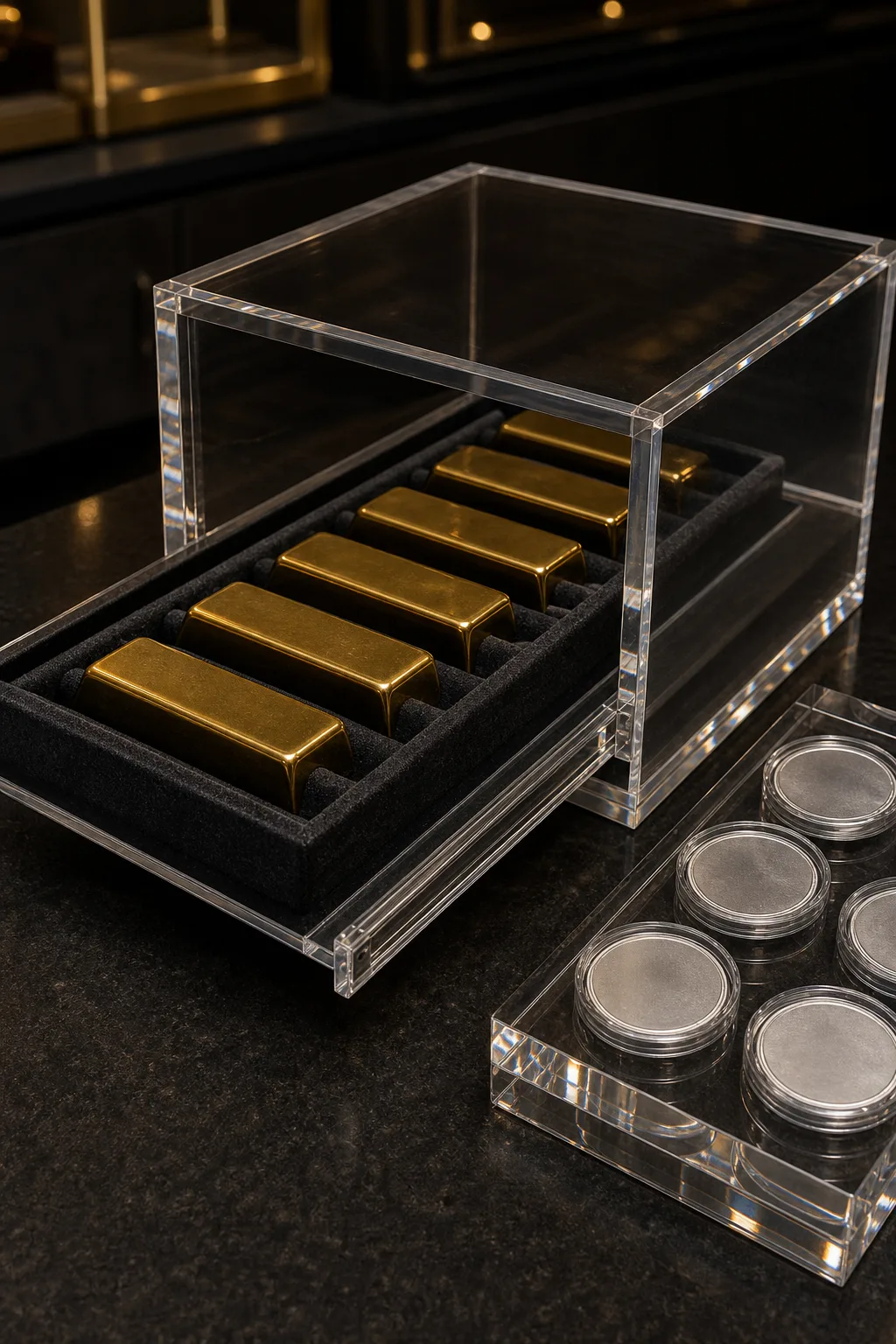
It shows the approvals used before production.
- bars delivered
- 100
- bar reference
- 35×55×6.5mm
Ordering a similar project
MOQ is 100 pieces per design. Paid samples normally take 3–5 days; sample fees are paid separately and never credited. Standard production takes 15–20 days after geometry, material, slide action, inspection, packing, and sample approval. Wetop responds to a complete brief within 24 hours.
Different-spec price reference: the coin display case page cites $4–8 per unit FOB Shenzhen for a comparable simple 3 mm clear acrylic case at 200 pieces. A bullion slide-base case is smaller but mechanically different; this reference is not its quote.
Key Takeaways
- A 35 × 55 × 6.5 mm buyer-supplied reference defined the one-ounce bullion case we built with a sliding bottom.
- The production drawing identified the actual bar geometry, slide direction, stop, material gauge, liner, branding, and packing.
- We approved track clearance on the physical sample; we did not copy a universal number from an unrelated case.
- Staff-side access was a layout decision, not a security or compliance guarantee.
- A separate capsule-holder inquiry belongs to another buyer and was not combined with this gold-bar display project.
The Challenge
The slide-bottom bullion display had to fit the buyer's actual bar, open from the intended side, and keep the base controlled during normal handling. Those requirements depended on the bar geometry, counter layout, material stack, and opening method.
The brief named 100 units, a one-ounce bullion use, a sliding bottom, and a 35 × 55 × 6.5 mm reference. A second capsule SKU was a separate design with its own drawing and sample.
The quote also had to fix the finished outside dimensions, whether the reference size described the metal or its assay packaging, the number of pieces held per display, the viewing angle, and the counter footprint. A few millimeters added around a bare bar can be wrong for a sealed card or capsule, so we did not substitute a catalog bullion dimension for the buyer's reference.
Our Approach
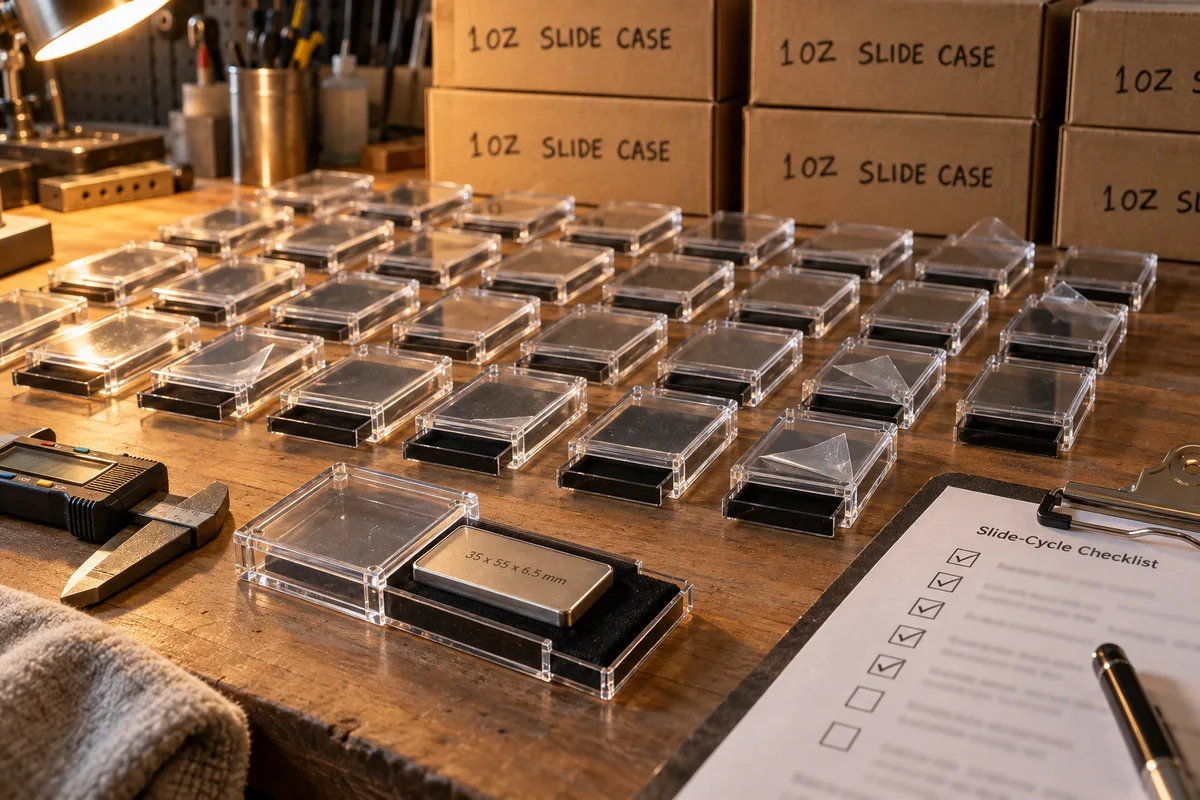
We converted the buyer's reference into a controlled drawing, then used a paid sample to approve fit, slide action, access direction, liner, engraving, and packing before production.
Tuning the slide: three tracks, one winner
The sample established the working clearance for the selected acrylic grade, gauge, track length, load, and finish. The buyer checked that the base moved as intended and remained seated under the agreed handling test. We recorded the approved clearance on the production drawing.
| Approval item | Buyer input | Sample check | Production record |
|---|---|---|---|
| Product fit | Actual bar or dimensioned reference | Insertion, removal, and visible clearance | Finished cavity dimensions |
| Slide action | Opening side and target handling feel | Movement, stop, and agreed tilt check | Track and stop geometry |
| Packing | Destination and retail presentation | Surface protection and carton restraint | Approved packing specification |
The brief required a stop, and we added one. Its position and release motion were approved on the sample; we do not claim that one stop design prevents every misuse or security event.
Environmental debris, protective film, polish quality, liner compression, and long track length can all change the handling feel. The sample therefore used the quoted material and finish and was checked with the intended load. Any change to the liner or gauge after approval would require a fresh slide-fit review.
Closed to the customer, open to the staff
The opening can face staff when the counter layout calls for controlled access, and the drawing states the orientation; the buyer remains responsible for store procedure, valuable-goods security, and any lock or supervision requirement.
Material thickness and liner selection followed the finished dimensions and bar weight. We confirmed them on the drawing and sample rather than applying an unsupported universal 5 mm wall or 8 mm base rule. See the coin and bullion display cases page for adjacent formats.
A separate inquiry: capsule blocks for silver rounds
A separate inquiry documents interest in a silver-capsule holder, but it belongs to another buyer and is not a delivered second SKU for this page. Where a program includes capsules, each diameter and layout receives its own drawing, sample, quote, and 100-piece production MOQ. The coin display ideas guide compares slabs, capsules, and bullion formats.
We kept each design, quantity, unit price, sample, and packing line separate even when mixed programs travelled on one purchase order and shipment.
The Results
The results record the release criteria. Production began only after the buyer approved the geometry, sample action, inspection method, packing, and written quote.
The quoted acceptance plan named the fit reference, slide-cycle check, cosmetic inspection, liner placement, engraving proof where used, and packing restraint — all measurable controls.
Pre-shipment records included the approved drawing revision, sample sign-off, inspection checklist, and packing photos. The buyer defined any additional valuable-goods handling or chain-of-custody requirement before quotation; standard acrylic inspection does not certify retail security.
Buyer decision point: approve the actual bar fit, opening direction, slide action, stop, and packing on one physical sample before production.
What This Means for Your Project
Send the actual bar or a dimensioned drawing, quantity, opening direction, liner choice, branding file, counter orientation, destination, and packing requirement. Wetop can then quote one defined construction instead of assuming a generic bullion size.
Geometry can support staff workflow, but it does not replace buyer-side security review. Any lock, supervised access, or local requirement belongs in the buyer-approved specification.
For receiving inspection, name the reference bar or gauge used for the fit check and the motion expected from the slide. Include the drawing revision, liner color, engraving proof, protective-film requirement, carton quantity, and any destination labels. A buyer comparing suppliers should hold all of those fields constant; otherwise a quoted unit price may cover a materially different case and packing scope.
Common Questions
How do you make an acrylic slide base glide smoothly without sliding open on its own?
Specify the target feel and access direction, then approve the working clearance on a physical sample made around the actual bar or a dimensioned reference. The production drawing records the approved track, stop, and handling test; no universal clearance is promised for every size or material stack.
What acrylic thickness does a gold bar display need?
Thickness depends on the finished span, bar weight, channel layout, opening mechanism, and handling. Wetop proposes the gauge on the drawing and verifies fit and deflection on the approved sample before production.
Will the capsule blocks fit Air-Tite and similar coin capsules?
A separate capsule-holder design can be machined to a buyer-supplied outside diameter or a physical capsule. It is a separate design with its own drawing and sample; a capsule inquiry is not evidence that this gold-bar display was delivered with a second SKU.
Putting gold and silver on an open counter?
Tell us the bar sizes, capsule diameters, and quantities, or mail us one bar or capsule and we'll cut the sample to the real thing, slide fit included.
Paid sample in 3–5 days · Sample fees paid separately and never credited · Production in 15–20 days · Quote response within 24 hours