



Delivered project · Numismatic Retail
Coin Slab Display for Retail Counters
A coin retailer with several stores asked us for one display family for its counters: single-slab stands, 6-slot blocks and lockable countertop cases.
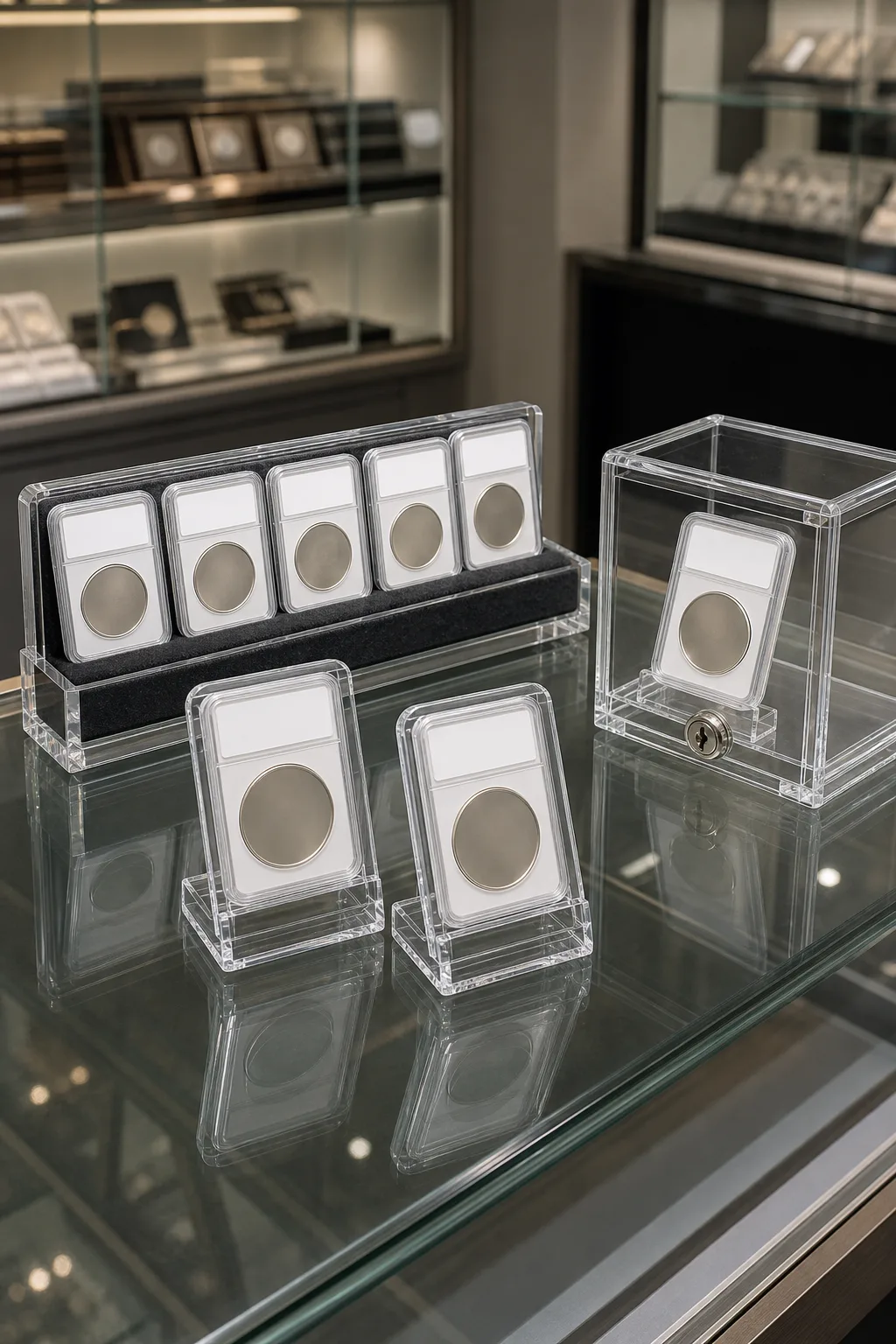
We fitted every recess to its real NGC and PCGS holders, produced each design to the approved sample, and packed the cartons by store. Delivered: three counter formats, each recess released against a physical holder and checked in production against the approved sample.
- display formats
- 3
- slots per block
- 6
Ordering a similar project
MOQ is 100 pieces per design. Paid samples normally take 3–5 days; sample fees are paid separately and never credited. Standard production takes 15–20 days after the profile, drawing, material, finish, inspection plan, and packing are approved. Wetop responds to a complete brief within 24 hours.
Closest published price: this order was quoted per design from the approved drawings. The nearest public reference on the acrylic cases hub is a 150 × 100 × 100 mm, 3 mm clear case with a magnetic lid at 500 pieces, from $6 per unit FOB Shenzhen. Slab recesses, liners, locks and store packing price above that plain case.
Key Takeaways
- A multi-location coin retailer needed single-slab stands, 6-slot blocks and lockable counter cases that looked like one family on every counter.
- We cut every recess to the retailer's own NGC and PCGS holders or approved gauges, not to catalog dimensions.
- The paid sample let the retailer approve insertion, grip, removal, display angle and felt contact before we released bulk.
- Each of the 3 formats ran as its own design, and we packed the cartons by store after sample and packing approval.
The Challenge
The coin retailer wanted single-slab stands, grouped blocks and lockable counter cases under one visual standard across its stores. Each format still needed its own controlled drawing, because the slab interface, viewing angle, access, closure and packing changed with each design.
Holder dimensions vary by grading service, generation and protective feature, so catalog numbers were not enough. The retailer sent a physical slab or approved gauge for every profile it stocked, plus the display angle, removal method, felt liner, case access, store allocation and destination.
Our Approach
We released fit first. The retailer approved insertion, grip, removal, angle, visible finish and contact material on a production-grade sample before bulk started.
Fit set by the retailer's own holders
We treated catalog dimensions as a starting point only. We measured the physical NGC and PCGS holders and gauges, sampled against them, and recorded on the drawing the recess geometry, clearance, contact points, liner and removal path.
Three formats, one family
The family was a single-slab stand, a 6-slot block and a lockable countertop case. They shared material and visual language, but each had its own drawing, profile, angle, contact surface, quantity, finish reference and packing route, and each counted as its own design. The retailer signed each format's row after checking its sample with the actual slab.
On the single stand, the critical point was the balance between angle, grip and removal. Too loose and a holder leans or rattles; too tight and staff have to force it out and mark it. We fixed the fit on the approved gauge, drawing and sample, and production inspection repeated that same check.
On the 6-slot block, the retailer confirmed the label sightline, finger access, spacing and the profile mix across the slots. We checked slot sequence and count against the drawing and protected the polished faces and recess edges so blocks arrived without rub marks.
On the lockable case, the sample covered door access, hinge construction, lock and key reference, internal clearance and staff-side opening space, and the retailer loaded and removed its own holders. Keys were packed labeled but out of sight of the retail face.
Packed by store
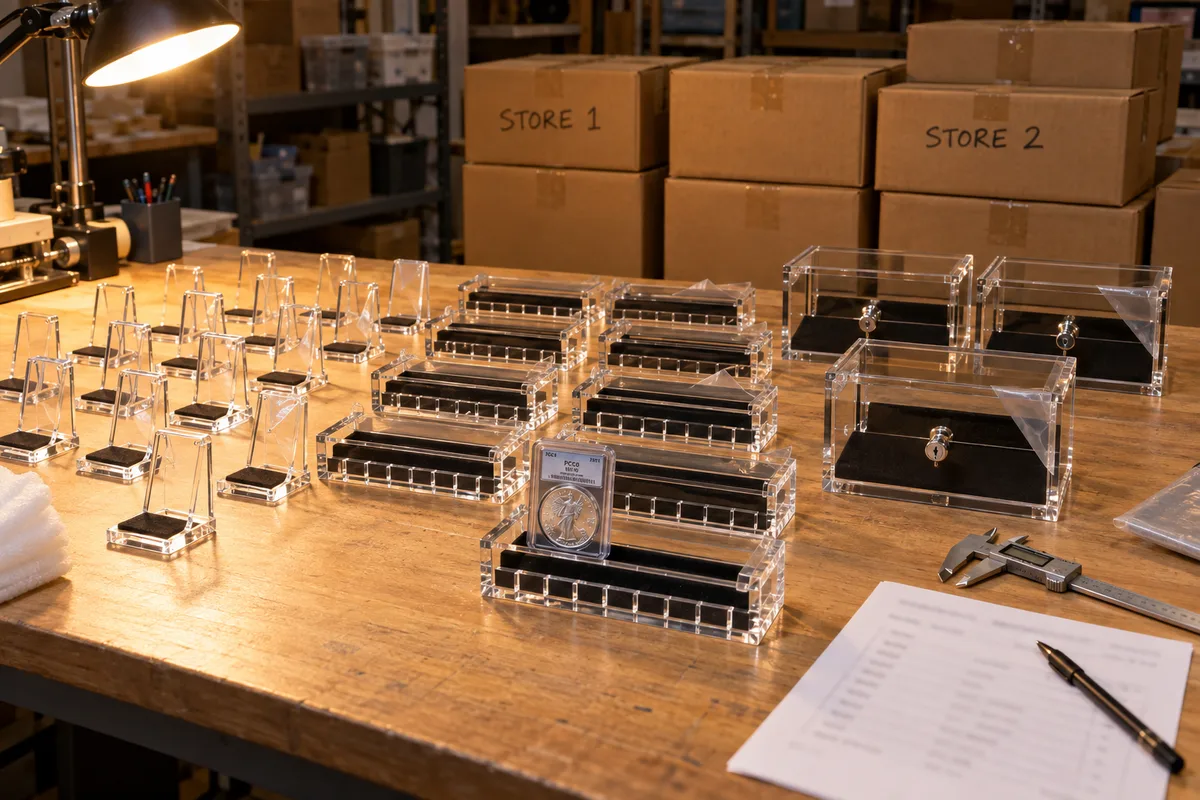
The retailer sent the allocation table before we designed the cartons. Every inner pack carried the format, holder profile, drawing revision, finish, quantity, destination code and any spares. We checked protective film, interleaving and support blocks on the packing sample, so each store could check its cartons against the allocation file before the displays went onto its counters.
The Results
Each design shipped with a full release file: drawing, approved fit sample, material and finish reference, inspection record and carton allocation.
The physical fit sample settled what catalog measurements leave open: edge profile, insertion force, removal path, liner compression and visible lean. Production inspection repeated those checks against the approved sample and drawing. For replenishment, the same file set is the reference; a new slab generation or a changed format goes back to fit sampling.
What made it work: we released every recess against the physical holder it had to fit, and production was inspected to that same holder.
If You're Planning Something Similar
Send one physical holder for each profile you stock, or an approved gauge, with the display angle, removal method, contact material, closure, store allocation and packing route. A grouped block and a lockable case are separate designs even when they hold the same slab, so each needs its own production run. See custom coin display cases, the coin display ideas guide and graded-card display cases, which use the same fit method.
Refreshing your coin counters?
Send the format list, quantities, slab profiles, display angle, liner, closure and store allocation. We will return a drawing review, paid-sample schedule and written quote.
Paid samples in 3–5 days, separately paid and never credited · Production 15–20 days · MOQ 100 pieces per design