
Wood and Acrylic Display: What We Build vs Source
Half of every mixed-material brief sits outside our own machines. Here is which half, how we handle it, and why we would rather tell you now than mid-production.
Need this made?Acrylic display manufacturer →
Key Takeaways
- A wood and acrylic display is two supply chains in one product: every acrylic part is fabricated in-house, and every wood part has to come from outside this building — either your own millwork source or a woodworking shop arranged for the project.
- There are three practical routes to wood character: acrylic engineered to seat into a wood base sourced outside our factory, real wood veneer laminated behind clear acrylic (prototype-gated), or UV-printed woodgrain straight from our own printers — only the last one is a standing in-house capability.
- The two materials move for different reasons — most woods shrink or swell roughly 3-10% across the grain between green and oven-dry, while acrylic expands about 76 µm per meter per °C — so joints need clearance and flexible bonds, never a rigid full-face glue line.
- When wood is most of the product, we build every acrylic part and match it to your millwork source on one shared interface drawing, so both halves fit at assembly.
- Mixed wood and acrylic orders run on the same standard 100-piece MOQ as acrylic-only work; what changes is the calendar — a 2-3 week prototype stage ahead of production, against 3-5 day samples and 15-20 day production on an acrylic-only order.
On this page
- What an acrylic factory can and cannot do with wood
- Wood base, veneer laminate, printed grain: the three routes we deliver
- Joinery between wood and acrylic: two materials that move for different reasons
- When wood leads: the split order
- Converting a wooden fixture to acrylic: what transfers, what re-engineers
- How a mixed wood and acrylic order actually runs
What an acrylic factory can and cannot do with wood
A wood and acrylic display is two supply chains in one product. We fabricate every acrylic part in-house — laser cutting, CNC, diamond polishing, bending, UV printing, solvent bonding, assembly — and the wood part is not one of them. There is no woodshop in this building, no lacquer room, no timber stock. Finished wood components come from a woodworking shop, arranged per project or supplied by you, and what we never do is pretend that shop operates inside our acrylic factory.
I want to open with the limits because most factories open with the opposite. Since 2008 I have watched suppliers answer every mixed-material inquiry with an unconditional yes, then discover mid-production that a walnut base warps, a groove binds, or a lacquer finish arrives in the wrong sheen with no one in the building qualified to judge it. The yes was never theirs to give. So here is our capability boundary, stated plainly:
| Fully in-house at Wetop | Requires an outside wood shop — yours or one we arrange | Wood work your millwork source leads |
|---|---|---|
| Laser and CNC cutting, polishing, bending, thermoforming | Solid-wood bases, plinths, and frames machined to our interface drawing | Wood-dominant fixtures and furniture-grade casework |
| UV-printed woodgrain on acrylic, silk-screen, engraving, hot stamping | Wood veneer stock for lamination | Carved or moulded millwork |
| The acrylic side of the joint: groove fit, clearance, flexible bonding, assembly, 100% inspection | Any wood finishing — stain, sheen, lacquer | Spray-lacquer finishing programs |
The commercial frame sits inside that boundary too. Acrylic-only work runs on our standard terms: 100-piece MOQ, samples in 3-5 days, production in 15-20 days. Once wood enters the build, the program changes shape — the same 100-piece minimum, but a 2-3 week prototype stage ahead of it — for reasons the rest of this guide walks through. Behind that boundary sit 2,000+ shipped custom projects and an ISO 9001 factory in Shenzhen — all of it acrylic work, which is exactly why the wood half of a mixed brief gets described here as an arrangement to set up rather than a line already running.
Wood base, veneer laminate, printed grain: the three routes we deliver
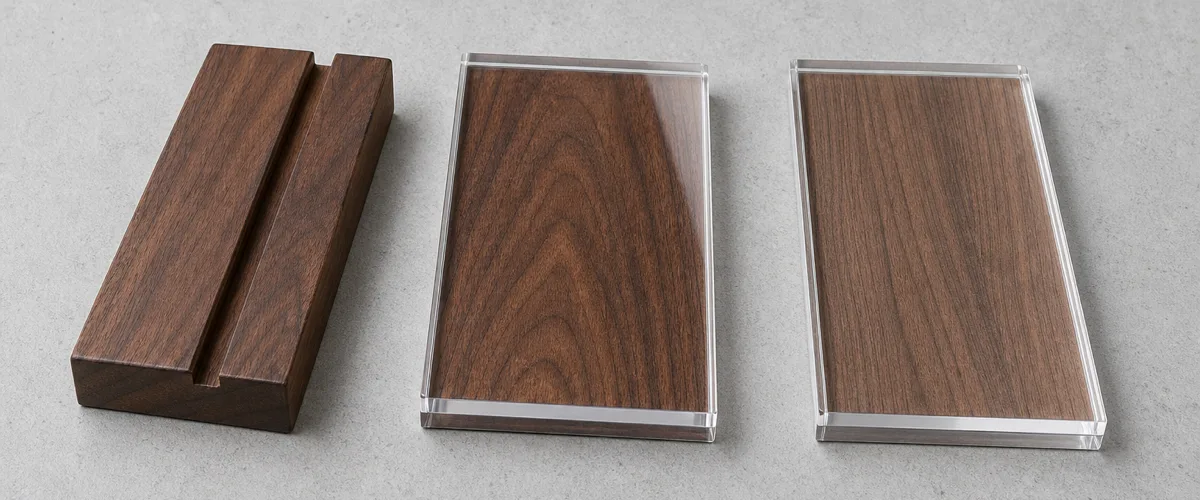
Every workable wood and acrylic display brief resolves to one of three routes: a solid-wood base or frame sourced outside our factory and joined to in-house acrylic, real wood veneer laminated behind a clear acrylic face, or UV-printed woodgrain applied directly to the acrylic. Each carries a different cost, a different depth of wood character, and a different amount of the work that actually sits inside our own walls.
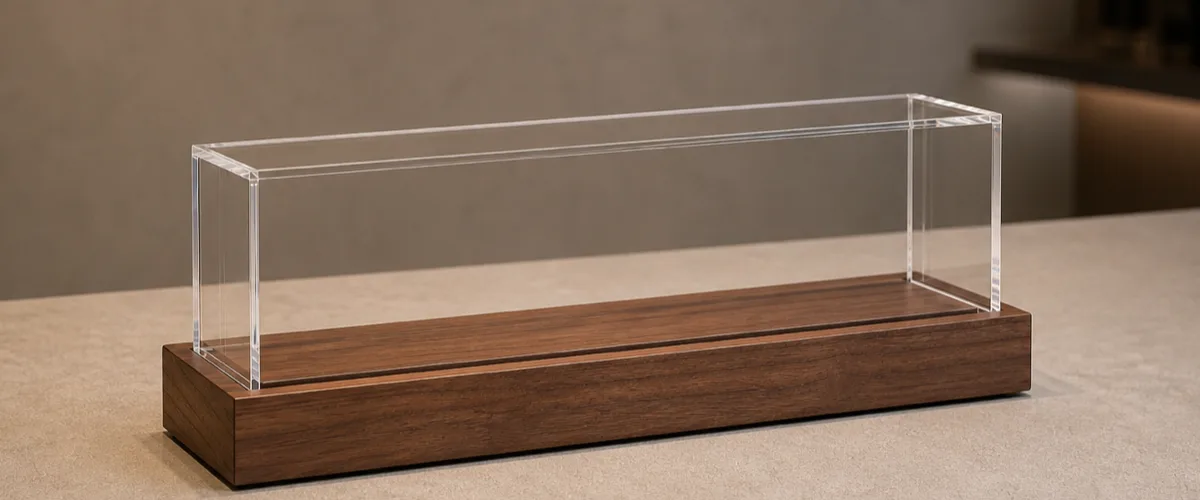
Route 1 — the wood base from outside. This is the classic wood acrylic display stand: a walnut- or oak-tone base machined to an interface drawing, with the acrylic body seated into it. The acrylic body, the groove fit, the clearance, and the bonding spec are ours; the base is not. It comes either from your own millwork supplier or from a woodworking shop we arrange for the project, and it arrives here as a finished component to be checked against the interface dimensions, assembled, inspected, and packed. You get real timber mass under crystal-clear acrylic, and quality control of the joint — the part of the product most likely to fail — stays with the party who engineered it. Counter displays on our acrylic display manufacturer page can be engineered to seat into a wood base when you ask for that build.
Route 2 — veneer laminated behind acrylic. A thin layer of real wood bonded to the back face of a clear panel reads with genuine depth: the grain sits under a glass-like surface, which suits brand plaques and premium backdrops. It is also the route I gate hardest, because the veneer stock has to be sourced and the lamination proven rather than assumed. Veneer is still wood — it wants to move with humidity while the acrylic holds still — so adhesion and flatness must hold on a physical swatch before a production quote is issued, and a swatch that fails ends the route. You hear that in the first reply, not after your deposit.
Route 3 — UV-printed woodgrain. Our own printers lay a woodgrain image directly onto the sheet. It is not timber and I never present it as timber: up close it reads flatter than veneer. What it offers is total consistency across a thousand units, no moisture movement at all, and the lowest cost of the three. For a wood-effect header panel on a bulk POS run, it is usually the honest recommendation.
Buyers sometimes ask which route is “best.” The truthful answer is that they price and age differently, and the decision belongs to you and your brand standard — our job is to price each one honestly and be explicit about which parts of it we make ourselves and which parts we would be buying on your behalf.
Joinery between wood and acrylic: two materials that move for different reasons
Wood moves with humidity; acrylic moves with temperature. Most wood species shrink or swell about 3-5% radially and 6-10% tangentially between green and oven-dry, and keep breathing seasonally in service1, while cast acrylic expands about 76 µm per meter per degree Celsius2. Joinery that ignores the mismatch fails; joinery that absorbs it lasts years.
The first consequence is chemical. Solvent cement — the bond that makes an acrylic-to-acrylic seam nearly invisible, covered in our acrylic box joinery guide — works by briefly dissolving two PMMA surfaces into each other. Wood cannot dissolve, so there is no such thing as a solvent-welded wood joint. If a supplier quotes you one, they are improvising.
What works instead is one of two families. Mechanical joints — screws through oversized holes into the wood, threaded inserts, cleats, or a routed groove the acrylic seats into — hold the parts in position while letting each material creep at its own rate. Flexible adhesives — neutral-cure silicone and similar elastic bonds — grip both surfaces while stretching a fraction of a millimeter as the materials disagree. What fails is the tempting third option: a rigid, full-face glue line. It works on the bench, then a season of humidity swings loads the bond in shear until the glue lets go or the acrylic crazes along the line. The arithmetic is small but relentless: a 600 mm acrylic panel over a 20 °C seasonal swing moves close to 1 mm on its own, before the wood has said anything at all.
That groove detail on the right is the spec we design to for a wood-base acrylic build, and it is the drawing that goes to whoever machines the wood: an 8 mm panel gets a 9 mm groove, 12 mm deep, with the panel resting on flexible adhesive rather than hard timber. It is also the part of a mixed-material product an acrylic factory is genuinely qualified to own — the interface, not the timber. When my engineers review an incoming design, this joint is the first thing I ask them to look at — not the artwork, not the finish, the joint. It is where mixed-material products live or die. If you keep one spec from this page, keep this one.
When wood leads: the split order
If wood is most of the product, I say so at the quoting stage and propose a split order: your millwork source builds the wood, and the acrylic parts are built here against one shared interface drawing.
The reasoning is not modesty; it is control. When you order acrylic from us, every process that decides quality runs under our roof and our ISO 9001 system. When you order a carved oak fixture “from us,” every process that decides quality runs in someone else’s building, and our role quietly degrades from manufacturer to middleman with a markup. I have seen how that arrangement performs since founding Wetop in 2008, and you would not accept it knowingly — so the honest move is to make sure you never accept it unknowingly.
A split order sounds harder to manage than one PO, but in practice it needs exactly one disciplined artifact: the interface drawing. It fixes the groove width, depth, and position, the tolerances each side must hold, and which party supplies the adhesive spec. Your millwork shop builds to their side of the line, we build to ours, and the parts meet in whichever facility does final assembly. Either direction works: wood parts can ship here to be assembled onto the acrylic and inspected, or precision-cut acrylic panels can ship to your own cabinet maker for assembly there — and the second version is the one where every process we are answerable for stays on our own machines.
What that boundary looks like in a real reply: a display-case retailer once asked whether we could supply matching wood stands alongside a run of cases. The honest answer had two halves — the cases were ours to build outright, a simple machined base could be arranged through a woodworking shop against our interface drawing, and for the furniture-grade stand family we quoted the acrylic parts plus an interface drawing, so the retailer’s existing wood supplier could build to it. Buyers respond to that split better than to an unconditional yes, because the no is specific enough to be believed. Buyers who have been burned before do not want a supplier with no limits; they want one who knows exactly where the limits sit.
Converting a wooden fixture to acrylic: what transfers, what re-engineers
When a buyer brings us an existing wooden fixture to remake in acrylic, the footprint, sightlines, and merchandising layout transfer almost one to one. Three things do not: the joinery, the panel thicknesses, and the finish language. Copying those from the wood drawing is the single most common conversion mistake I catch in review.
What transfers. Overall dimensions, shelf spacing, product capacity, brand geometry — everything the shopper experiences. If the wooden unit earned its slot in your store, that logic carries straight into the acrylic version, and we build from your existing drawing rather than starting over.
Joinery re-engineers. Screws, dowels, and dados belong to wood. The acrylic version wants solvent-bonded seams, slot-and-tab construction, or standoffs — connections with their own rules and their own look. A converted drawing keeps the geometry and replaces every joint callout.
Thickness re-engineers. A 18 mm plywood shelf spec says nothing about what the acrylic shelf needs, because the materials carry load differently. Spans get recalculated, not copied — under-specify and shelves sag, over-specify and you pay for material the display does not need.
Finish language translates, not copies. Stain and lacquer choices become decisions among clear, frosted, tinted, mirrored, or printed surfaces — a richer palette than wood offers, but a different one. This is also where the conversion pays: one hotel client ran our tinted-acrylic lobby tables beside hardwood furniture from another supplier, and the tint consistency across the rollout — plus zero yellowing under tropical sun — is what earned the follow-up order. Weight, feel, and maintenance all shift too; if you are still deciding whether the material swap itself is right for your product line, our acrylic vs wood jewelry display comparison covers that pre-purchase question properly, including when wood genuinely wins.
And sometimes the answer is not a full conversion at all. Plenty of fixtures come out best as hybrids — the warmth of a real wood base, the clarity and print capability of an acrylic body — which loops back to the three routes above, with pieces from our acrylic furniture line sitting comfortably next to timber when the program calls for both.
How a mixed wood and acrylic order actually runs
Plan your mixed-material program around three numbers: our standard 100-piece-per-design minimum, a 2-3 week prototype stage before production, and our standard 15-20 day acrylic production window once the prototype is approved. Acrylic-only orders keep the familiar terms — the same 100-piece MOQ, samples in 3-5 days.
The extra stage is arithmetic, not policy preference. A wood and acrylic display sets up two supply chains: our lines here, and an outside wood shop’s tooling, fixtures, and finish schedule there. Both setups amortize across the run, which is why the same 100-piece floor bites harder on a mixed build than on an acrylic-only one — one quantity is carrying two sets of fixed costs, and the quote reflects it. Where you need fewer units, consider a paid prototype or printed woodgrain first; the production floor remains 100 pieces per design.
The prototype stage is the part I will not compress. One physical unit, built exactly as production intends: the wood machined by the same shop that will machine the run, the acrylic cut and finished on our lines, the joint assembled with the production adhesive. It is where groove fits are proven, veneer swatches confirmed, and finish sheens approved against a sample rather than a screen. Production quantities of a mixed build start after that sign-off, never before — and every finished unit still passes our 100% piece-by-piece inspection, with the wood-to-acrylic interface checked as its own line item alongside the acrylic itself.
If you are earlier in the process — still choosing between routes, or unsure whether your fixture should be all acrylic, all wood, or a hybrid — the cheapest way to find out is to send us the design and let us mark up which parts fall on which side of the boundary. Our custom acrylic fabrication page covers what a complete brief looks like; a photo and rough dimensions are enough to start, and you will get a straight answer on what gets built here, what gets sourced, and what honestly belongs elsewhere.
Footnotes
-
Dimensional Shrinkage — The Wood Database — measured green-to-ovendry shrinkage ranges for solid wood: longitudinal about 0.1-0.2%, radial mostly 3-5%, tangential mostly 6-10%. ↩
-
Polymethylmethacrylate (PMMA, Acrylic) — MakeItFrom — lists the coefficient of thermal expansion for PMMA at 76 µm/m-K, the value behind the panel-movement arithmetic in this guide. ↩
Frequently Asked Questions
Can you combine wood and acrylic in one custom display?
Yes, with the split stated up front. The acrylic half is ours end to end — laser-cut, polished, printed, and assembled at our factory — and it is engineered to seat into a solid-wood base or frame that comes from outside: your own millwork supplier, or a woodworking shop arranged for the project. Mixed-material orders carry the same 100-piece-per-design minimum as our acrylic-only work, but add a 2-3 week prototype stage before production, because the wood-to-acrylic fit has to be proven on a physical unit first.
Do you make the wood parts yourselves?
No, and we are direct about that. Wetop is an acrylic factory — laser cutting, CNC, polishing, bending, UV printing, bonding, and assembly are in-house, and there is no woodshop, no wood finishing room, and no timber stock in the building. Solid-wood bases, frames, and veneer stock have to be sourced from a woodworking shop, whether that is your supplier or one we arrange for the project. What we own either way is the acrylic side: we specify the interface dimensions, check incoming wood parts against the drawing, and can do final assembly and 100% inspection here.
Can you make acrylic look like wood instead of using real wood?
Two ways, and one of them is entirely in-house. UV-printed woodgrain goes straight onto the acrylic from our own printers — consistent, cost-effective, and immune to humidity movement, though it reads flatter than real timber up close. Real wood veneer laminated behind clear acrylic gives genuine depth and grain, but the veneer stock is sourced and the build is prototype-gated: we prove adhesion and flatness on a physical swatch before a production quote goes out, and if it does not hold we say so instead of shipping it.
What happens if my design is outside your capability?
We tell you, and we tell you early. If wood is most of the product — carved millwork, furniture-grade casework, lacquer-room finishes — we build the acrylic parts and your own millwork source builds the wood, both working to one shared interface drawing. That keeps every process we are answerable for on our own machines.
What are the MOQ and timeline for a wood and acrylic display order?
Acrylic-only orders follow our standard terms: 100-piece MOQ, samples in 3-5 days, production in 15-20 days. Once wood enters the build the minimum is unchanged — still 100 pieces per design — but plan on a 2-3 week prototype stage before production starts, because two supply chains have to be set up and the material interface proven on a physical unit.
Have a mixed wood and acrylic design on your desk?
Send the drawing, or even a photo of the fixture you want to evolve. We will tell you which parts we build, which wood parts we source, and how the interface drawing ties them together — before you commit to anything.