
Acrylic Display Interchangeable Graphics Guide
Build the acrylic once and change only the graphic. The swap method decides who can change it, how often and what each campaign costs.
Need this made?Custom acrylic sign holders →
This guide compares the four common swap structures, how to size and print the graphics, and how to order spare graphics with the first run.
Key Takeaways
- Acrylic display interchangeable graphics use one of four structures: a slot insert, a magnetic panel, a two-panel sandwich or a clip-in back. Each suits a different change frequency.
- Slot inserts are the cheapest and fastest for store staff; the slot is cut 1–2 mm wider than the insert so it slides in without tools.
- Paper or film inserts can be printed locally at any quantity; printed acrylic panels are production parts with a 100-piece-per-design minimum.
- Size the graphic first. A standard paper size (A4 is 210 × 297 mm, US Letter 8.5 × 11 in) lets stores reprint inserts without a custom cutter.
- Published reference: an A5 slant-back sign holder in 3 mm clear acrylic is $6.80 at 100 pieces, $3.70 at 500 and $2.90 at 1,000, FOB Shenzhen.
On this page
What interchangeable graphics means on an acrylic display
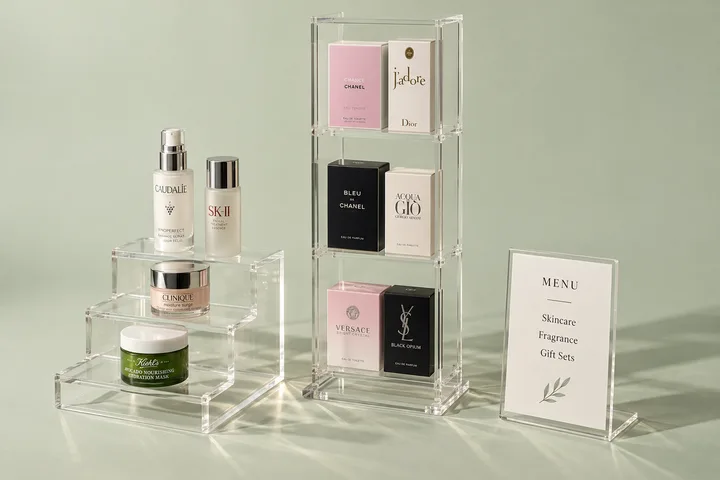
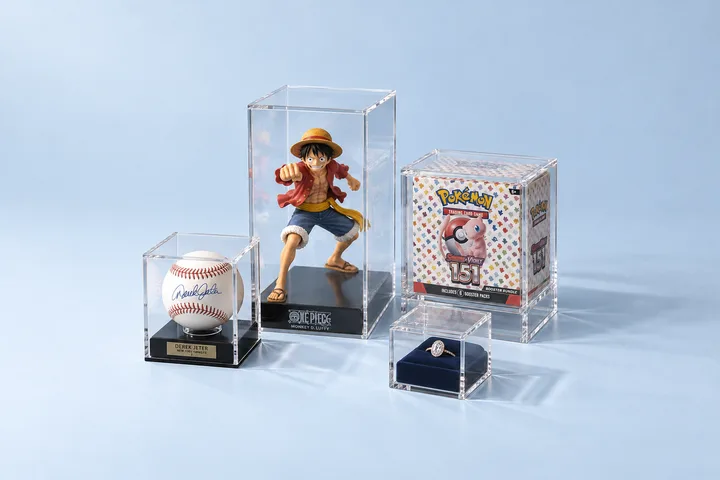
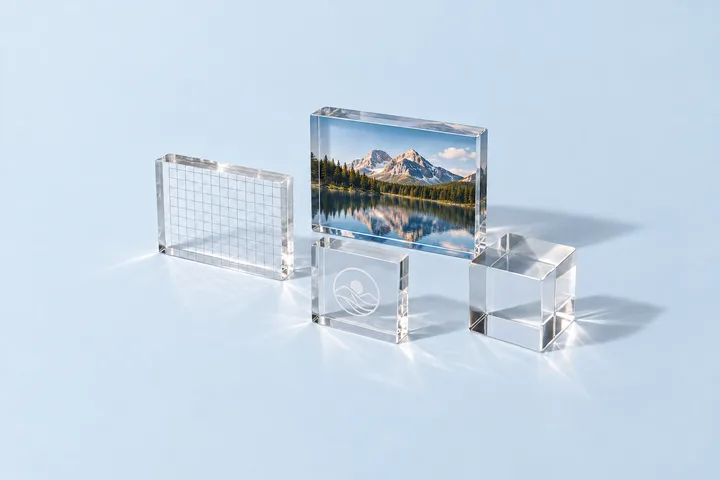
Acrylic display interchangeable graphics let a store change the printed message without replacing the stand. The acrylic body stays on the counter, shelf or wall for the life of the program, and only the insert or panel changes for each season, price or campaign. The swap structure is the main design decision, because it sets who can do the change and how long it takes.
A permanent print on the acrylic looks clean but locks the message in. Once the campaign ends, the whole stand is scrap. A swap structure costs a little more in the first drawing and saves the full stand cost on every later campaign. That trade usually pays from the second campaign onward if the stand is otherwise built to last.
The buyers who ask for this are usually running a program, not a one-off: recent requests for swap-graphic displays have ranged from 100 to 5,000 pieces, often for retail chains that refresh promotions several times a year.
Four ways to change the graphic
Four structures cover nearly every acrylic display with changeable graphics: a slot that takes a paper or film insert, a magnetic panel that lifts off, a two-panel sandwich held with standoffs or screws, and a back panel that clips or slides out. They differ in change speed, whether tools are needed, and how rigid the graphic has to be.
| Structure | How the graphic changes | Tools | Graphic material | Best for |
|---|---|---|---|---|
| Slot insert (top-load or side-load) | Slide the old insert out, drop the new one in | None | Paper, cardstock, PET film | Weekly or monthly price and promo changes by store staff |
| Magnetic panel | Lift the printed panel off, place the new one | None | Printed acrylic, PVC or metal-backed panel | Brand panels changed per season; header cards on a stand |
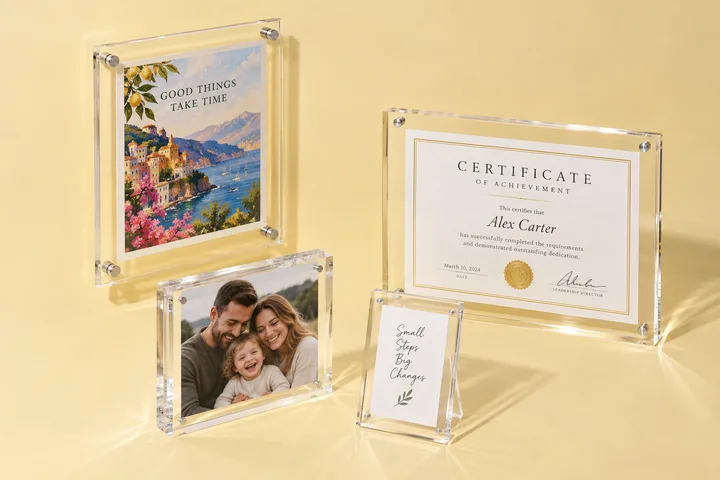
| Two-panel sandwich | Remove standoff caps or screws, swap the print between two clear sheets | Hand tool or caps | Paper, photo print, film | Wall and lobby graphics changed a few times a year |
| Clip-in or slide-out back | Release the back panel, change the print, refit | None or simple key | Paper, film, thin board | Frames and light-duty wall signs, posters |
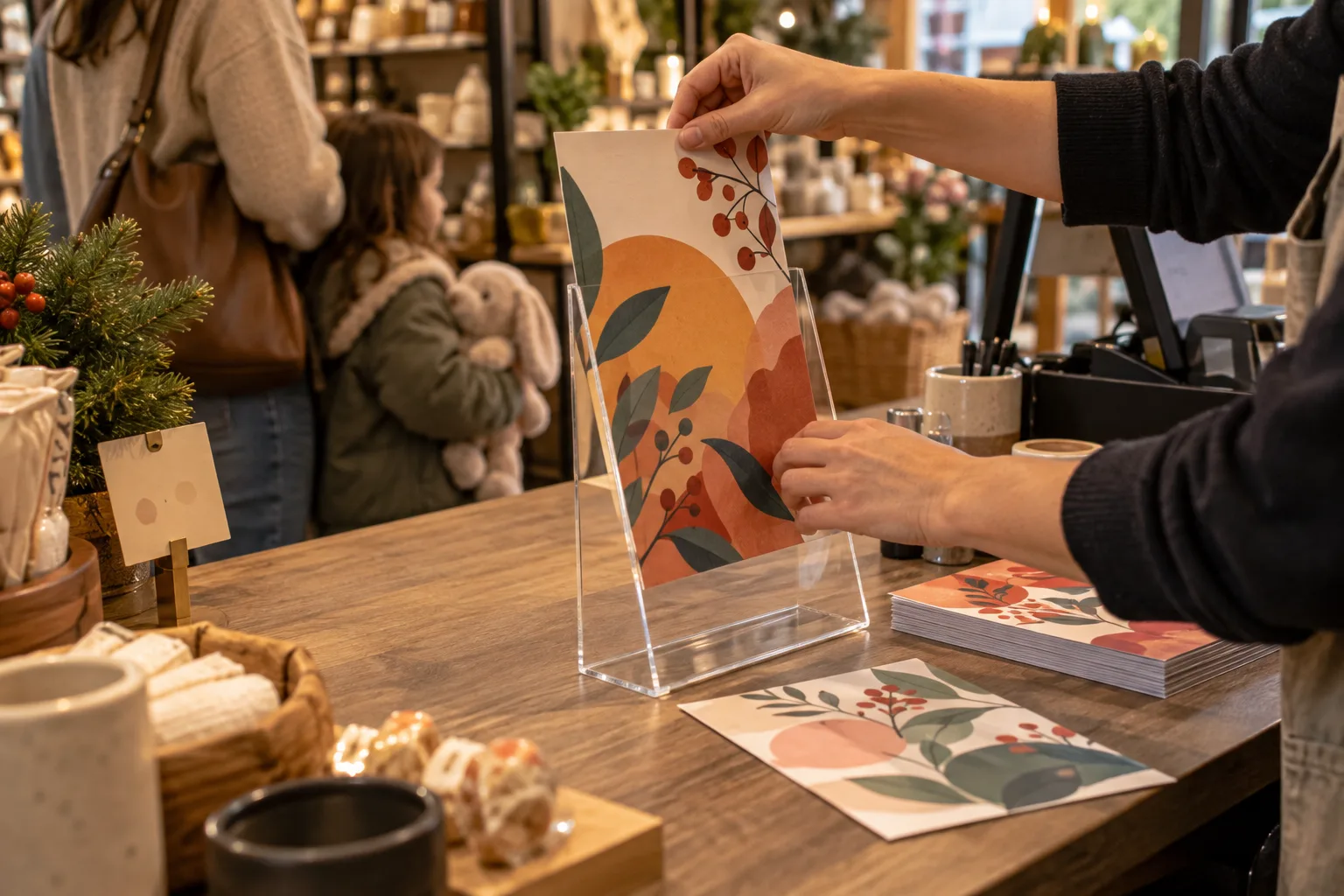
Slot inserts are the most common choice for store programs. On our custom acrylic sign holders, the slot is cut 1–2 mm wider than the insert so it slides without catching, and top-loading is the default when staff change prints often. Bottom-loading holds a semi-permanent insert more securely but is slower to change.
Magnetic panels suit a stand where the graphic is a rigid printed part rather than paper. The magnet has to carry the panel weight with margin. K&J Magnetics notes that a slightly larger N42 magnet can match the strength of an N52, so grade is only one of the choices that set hold.1 The magnet hold-strength chart covers embedding, substrate thickness and drop tolerance for magnet-mounted acrylic parts. The same principle runs our magnetic acrylic frames, where two clear panels hold a print between them.
Match the structure to how often the graphic changes
Choose the swap structure by change frequency and by who does the change. If store staff change the graphic every week or month, use a top-loading slot. If a brand team changes it once a season, a magnetic panel or header card works. If a contractor changes it a few times a year, a sandwich panel with standoffs is acceptable.
Three questions settle it in most briefs:
- Who changes the graphic: store staff, a merchandiser on a route, or a contractor?
- How often: weekly, monthly, seasonally or yearly?
- Is the graphic paper, film or a rigid panel?
A structure that needs a screwdriver will not be changed weekly by store staff. A paper insert behind a magnet will curl. When the answer to question 1 is “store staff” and question 2 is “monthly or more”, the slot insert wins nearly every time on cost and on whether the change actually happens. The shelf talker guide compares a replaceable insert with a permanent UV print for shelf-edge signs.
Size and print the graphic before the display
Fix the graphic size before the display drawing, because the slot, panel recess or frame is cut around it. A standard paper size is the easiest to keep: A4 is 210 × 297 mm and A5 is 148 × 210 mm under ISO 216,2 while US Letter is 8.5 × 11 in. Stores can reprint a standard size on an office printer or through any local print shop.
Graphic material choices and what each means for the display:
| Graphic | Thickness | Who prints it | Notes |
|---|---|---|---|
| Paper or cardstock | Thin | Your printer or the store | Cheapest per change; curls in humid spots if not held flat |
| PET or PVC film | Thin | Your printer | Stays flat, wipes clean, slides into a slot easily |
| Printed acrylic panel | 2–3 mm | Us, by UV printing | Rigid, durable; a production part with its own minimum |
| Photo or poster print | Thin | Your lab | Use a sandwich or frame back, not a slot |
Tell us the graphic thickness as well as its size. A slot cut for 80 gsm paper is too tight for a thick card stack, and a recess for a 3 mm panel will rattle with film. The sign holder size chart lists standard insert sizes and the clearance we cut for each.
If we print the graphic as an acrylic panel, it is made like any other production part: each panel design is a design with the 100-piece minimum, and artwork comes from you as print-ready files. The UV printing guide covers color, white ink and durability on printed panels.
Spare graphics: first order or later
Order spare printed acrylic panels with the first production run when the next campaigns are already designed. The panels then share the sample approval, the setup and the shipment. Paper and film inserts are better printed close to the stores, campaign by campaign, because they cost little and the content changes late.
Plan the first order in three lines: the display body, the launch graphic and, if known, the next one or two campaign panels. Keep the slot or recess dimensions on the approved drawing so any later panel or insert fits every store’s unit. A reorder of panels against the same approved drawing does not need a new display sample, although new artwork still needs its own proof.
What a display with changeable graphics costs
The display body is priced like any other acrylic stand, and the swap structure adds a line. Our published reference for a simple slot holder is an A5 slant-back sign holder in 3 mm clear acrylic with a polished top edge, no printing and bulk packing: about $6.80 each at 100 pieces, $3.70 at 500 and $2.90 at 1,000, FOB Shenzhen.
| Reference (FOB Shenzhen) | 100 pieces | 500 pieces | 1,000 pieces |
|---|---|---|---|
| A5 slant-back sign holder, 3 mm clear, no printing | $6.80 each | $3.70 each | $2.90 each |
| Two-tier countertop stand, 250 × 180 × 220 mm, 5 mm clear, one-color UV branding | $28 each | $16 each | $12 each |
What moves the price above those references: a larger graphic, a thicker sheet, embedded magnets, a header slot on a countertop stand, printed acrylic panels and store-ready packing. The display stand cost guide breaks the drivers down line by line, and the acrylic vs cardboard POP guide shows when a reusable acrylic body beats replacing a cardboard unit each campaign.
Production starts at 100 pieces per design. A paid pre-production sample costs USD 200–500 depending on complexity, takes 3–5 days, is paid separately and is never credited to production. Production takes 15–20 days after sample approval.
What to send for a quote
A complete brief gets a quote within 24 hours. Send the graphic first, then the display, so the swap structure can be chosen around it:
- Graphic size and thickness, and whether it is paper, film or a rigid panel.
- How often it changes and who changes it.
- The display drawing or a photo with key dimensions marked.
- Quantity per design and the number of stores.
- Whether you want us to print acrylic panels, and how many campaign designs.
- Logo files, packing route, destination and target date.
The paid sample is where the slot clearance, the magnet hold and the first graphic are approved together with your real inserts. As an acrylic display stand manufacturer, we build from your drawing or marked photo and inspect every piece against the approved sample before shipment.
Footnotes
-
Magnet Grades — K&J Magnetics — the magnet supplier explains that N52 is the strongest grade for a given size and that a slightly larger N42 magnet can reach the same strength, so magnet size and grade are traded against each other. ↩
-
ISO 216 paper sizes — Wikipedia — reference table for the ISO A series, listing A4 at 210 × 297 mm and A5 at 148 × 210 mm. ↩
Frequently Asked Questions
What is the easiest acrylic display for staff to change graphics on?
A top-loading slot. The insert drops in from the top and the slot is cut 1–2 mm wider than the paper or film, so staff swap it in seconds without tools. Magnetic panels are the next easiest when the graphic itself is rigid.
Can you print the replacement graphics as well as the display?
Yes, if the graphic is a printed acrylic panel: we UV-print it from your artwork, and each panel design follows the 100-piece-per-design minimum. Paper or PET film inserts are usually printed by your local printer to the slot size, at whatever quantity each campaign needs.
How much does a sign holder with a changeable insert cost?
Our published reference is an A5 slant-back holder in 3 mm clear acrylic with a polished top edge, no printing and bulk packing: about $6.80 each at 100 pieces, $3.70 at 500 and $2.90 at 1,000, FOB Shenzhen. Larger stands, magnets and printed panels are quoted from your drawing.
Do magnetic graphic panels fall off in transit?
They can if the magnet is undersized for the panel weight or the display ships assembled. Ship magnetic panels packed separately or with a retaining tab, and approve the hold on the paid sample with the real panel.
What should I send to quote a display with interchangeable graphics?
Send the graphic size, how often stores will change it, who changes it, the display drawing or a marked photo, quantity per design, store count, and whether you want us to supply printed panels. A complete brief gets a quote within 24 hours.
Send Your Display and Graphic Size
Attach the drawing or a marked photo, the graphic size, how often it changes and the quantity per design. We reply within 24 hours with the display, any printed panels and the sample as separate lines.