Acrylic Sign Holder 8.5 x 11 Size Chart: 10 Sizes
Sign holders are named by the paper they hold, not the acrylic around it.
Need this made?Custom acrylic sign holders →
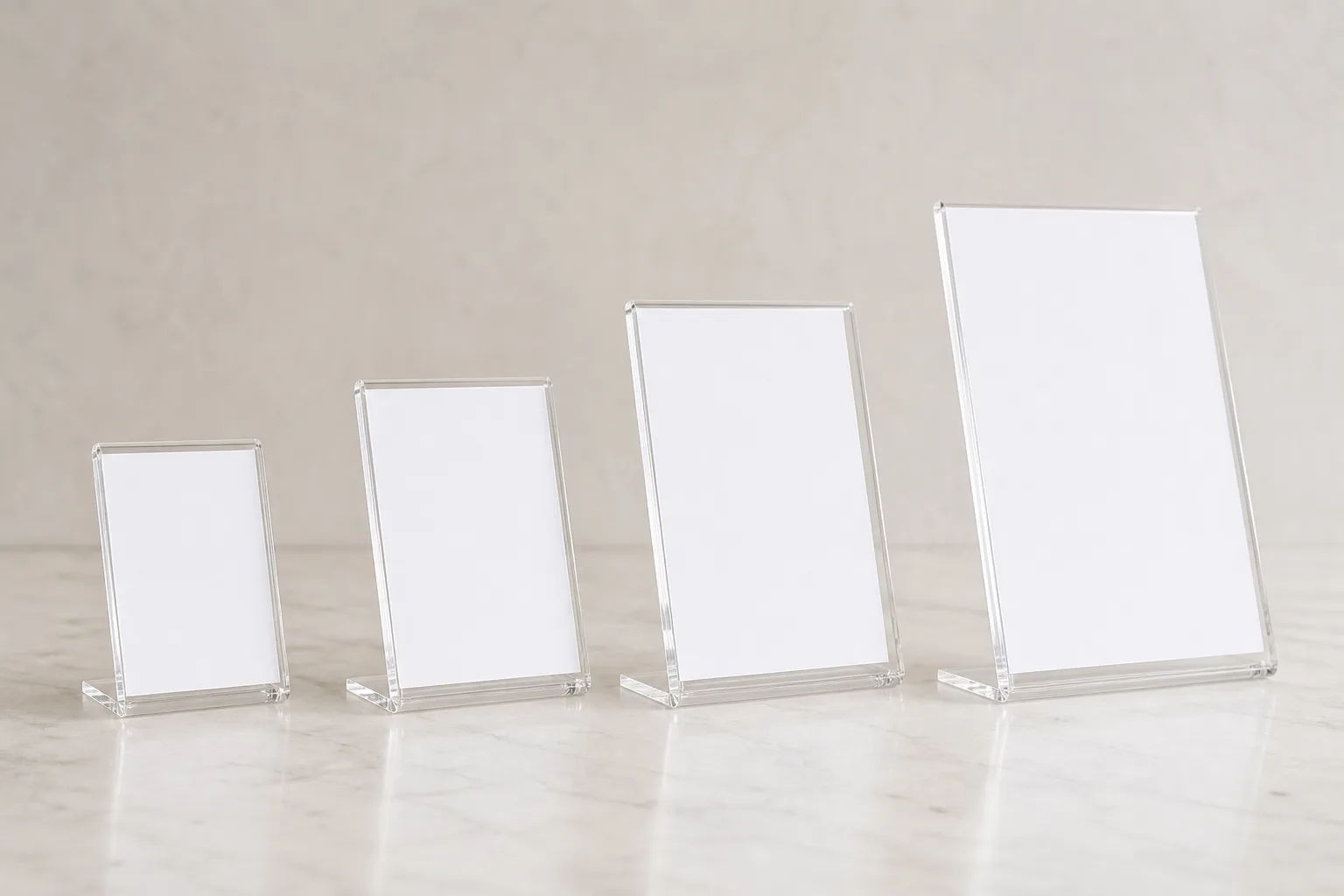
Here's every standard size on one chart — and the base-type rules that decide what fits your counter.
Key Takeaways
- Acrylic sign holders are named by insert size, not holder size: an acrylic sign holder 8.5 x 11 holds letter paper (216 x 279mm), and the holder itself runs a few millimeters wider plus a base that extends behind it.
- The approved drawing adds working clearance around the measured insert so paper loads without curling; paper stock, lamination, slot direction, and sample fit set the final clearance.
- Thickness follows insert size, orientation, base geometry, named PMMA grade, and support. The size chart gives planning starts; the approved drawing and sample set the production thickness.
- Portrait vs landscape is a fabrication decision, not a flip: the bend line and base move, so the orientation must be locked before production, not after.
- Mixed-size programs are easier to compare as one PO with per-size line items; the quote must state material allocation, packing, shipment grouping, and the quantity assigned to each design.
On this page
- The acrylic sign holder size chart
- Insert size vs holder size: how to read the chart
- The 8.5 x 11 and A4 workhorses
- Small formats: 5x7, 4x6, A6, half-letter
- Large formats: 11x17, A3 — where thickness steps up (and why legal doesn’t)
- Base types: what slant-back, T-style, and wall-mount each allow
- Ordering mixed sizes: one program, one PO
- From chart to order
The acrylic sign holder size chart
An acrylic sign holder 8.5 x 11 holds a standard US letter sheet — 216 x 279mm — in a clear holder whose working clearance follows the measured insert, paper stock, lamination, loading edge, and approved sample. Sign holders are named by the insert they hold, and the acrylic is sized around it.
An acrylic sign holder is a clear PMMA display — usually a heat-bent slant-back, a T-style upright, or a wall-mounted pocket — that keeps a printed insert visible, flat, and swappable. Because the insert is what you print, the insert is what you order by. Here is every standard size we cut, with the numbers you need to spec one:
| Insert size | Dimensions (mm) | Usual orientation | Planning thickness start | Where it works |
|---|---|---|---|---|
| 4 x 6 in | 102 x 152 | Both | 2mm | Shelf-edge cards, price tickets |
| 5 x 7 in | 127 x 178 | Portrait | 2mm | Counter promos, table tents |
| A6 | 105 x 148 | Portrait | 2mm | Shelf and till-point cards (metric markets) |
| A5 | 148 x 210 | Portrait | 2-3mm | Menus, small counter signs |
| Half-letter (5.5 x 8.5 in) | 140 x 216 | Portrait | 2-3mm | Counter signs, service menus |
| Letter (8.5 x 11 in) | 216 x 279 | Both | 3mm | The US workhorse — counters, reception, POS |
| A4 | 210 x 297 | Both | 3mm | The metric workhorse — same jobs, ISO markets |
| Legal (8.5 x 14 in) | 216 x 356 | Portrait | 3mm | Compliance notices, long-form menus |
| 11 x 17 in (tabloid) | 279 x 432 | Both | 5mm | Wall posters, lobby signage |
| A3 | 297 x 420 | Both | 5mm | Wall posters, metric large-format |
The 8.5 x 11, 5x7, and A4 formats are useful starting points for many counter briefs, but the insert file and channel decide the final mix. The rest of this guide explains how to read the chart, when thickness or support may change, and how base type constrains which sizes work where.
Insert size vs holder size: how to read the chart
The size in a sign holder’s name is the paper, not the acrylic. A holder for 8.5 x 11 inserts uses working clearance around the measured sheet, while a freestanding style adds a base behind the panel. Paper stock, lamination, loading edge, orientation, and the approved sample set that clearance.
That base is the dimension buyers forget. A slant-back holder for letter paper doesn’t occupy an 8.5-inch-deep sliver of counter; the bent foot runs back several centimeters to keep the panel from tipping, and the lean itself adds depth. When a client tells me their shelf is exactly 100mm deep and they want an 8.5 x 11 portrait holder on it, that’s a conversation we have before production, not after delivery. If your placement is tight, send the shelf or counter depth with the inquiry and we’ll confirm the true footprint of the style you picked.
Orientation is the other spec that has to be locked early. Portrait and landscape versions of the same insert size are different fabrications — the bend line, the slot opening, and the base all move. A landscape 8.5 x 11 can’t be turned sideways into a portrait one after the fact; it just falls over. Print your insert file first, look at which way it reads, then write the orientation into the order line: “8.5 x 11, landscape, slant-back” is a complete size spec in seven words.
For menu cards, shelf tags, or die-cut promos, send the measured insert and paper construction. CNC cutting and heat bending avoid an injection mold, but the quote still identifies material yield, jigs, bends, print setup, packing, and sample cost. The sample confirms loading clearance before production.
The 8.5 x 11 and A4 workhorses
The acrylic sign holder 8.5 x 11 is the default unit of American retail signage: letter paper is what every store printer holds, so the letter-size holder is what every counter, reception desk, and point-of-sale program standardizes on. Its metric twin is the A4 holder — same jobs, different paper, and critically not the same holder.
A4 runs 210 x 297mm against letter’s 216 x 279mm — six millimeters narrower and eighteen taller.1 The consequence for buyers is blunt: letter paper curls into the sides of an A4 slot, and an A4 sheet stands 18mm proud of a letter frame. I see this most with brands running both US and European locations from one artwork file. The clean fixes are either two holder variants on one PO (letter for US stores, A4 for EU stores) or standardizing the print spec to one paper size globally before the holder order is placed. Both work; choosing neither is how a rollout ends up with paper that doesn’t fit in a third of its stores.
For letter and A4 holders, 3 mm clear cast acrylic is a common planning start. The drawing and paid sample still confirm the base depth, bend geometry, flatness, stability, edge finish, and packing for the named SKU. You can see the full style range on our acrylic sign holders page.
Small formats: 5x7, 4x6, A6, half-letter
Small sign holders — the acrylic sign holder 5x7 above all — are counter merchandising formats: close to the customer’s hands, near the register, carrying one message each. At these sizes 2mm acrylic is fully rigid, and the design question shifts from stiffness to stability and slot feel.
The 5x7 (127 x 178mm) is the counter-promo standard: big enough for a headline and a price, small enough to sit beside a register without crowding it. The 4x6 (102 x 152mm) works the shelf edge and price-ticket duty; A6 (105 x 148mm) is its metric sibling; half-letter (140 x 216mm) covers service menus and counter signs that need a paragraph rather than a headline. Because a 5x7 uses roughly a third of the material of a letter-size holder, small formats are also where per-unit pricing gets friendliest — which is why counter card programs are usually the highest-quantity line on a mixed PO.
Two practical notes from the orders I coordinate. First, small T-style holders beat small slant-backs on tight counters — the inverted-T base is symmetrical and doesn’t reach backward, and it reads from both sides, which matters at a register queue. Second, if the counter cards are laminated or printed on heavy stock, say so in the inquiry: laminate adds thickness, and we’ll widen the slot allowance so cards drop in instead of wedging. If what the holder actually carries is a folded leaflet rather than a flat card, that’s a different product family — pocket depth rules and all — covered on our acrylic brochure holders page.
Large formats: 11x17, A3 — where thickness steps up (and why legal doesn’t)
From 11 x 17 upward, the chart uses 5 mm as a planning start. PMMA’s stiffness depends on the named grade, thickness, span, orientation, base, and support.2 The approved drawing and sample must define the flatness and stability criteria for the finished holder; this chart does not guarantee service life from thickness alone.
Large formats also migrate off the counter. An 11 x 17 or A3 holder is usually a wall unit — a pocket or standoff-mounted frame at eye height — because a freestanding holder that tall claims more counter than any retailer will give it. Wall-mount fabrication swaps the bent base for hanging hardware: pre-drilled holes with brushed-steel standoffs for lobby signage, or a top-loading wall pocket where inserts change weekly. If the program is wall-first, our wall sign holders page covers the mounting styles and hardware options we build in detail.
Legal size (8.5 x 14) is the in-between case: the same 216 mm width as letter and 77 mm more height. Use 3 mm as a planning start, then confirm orientation, base depth, bend geometry, stability, and viewing angle on the drawing and sample. Compliance notices and long-form menus often use this format.
Base types: what slant-back, T-style, and wall-mount each allow
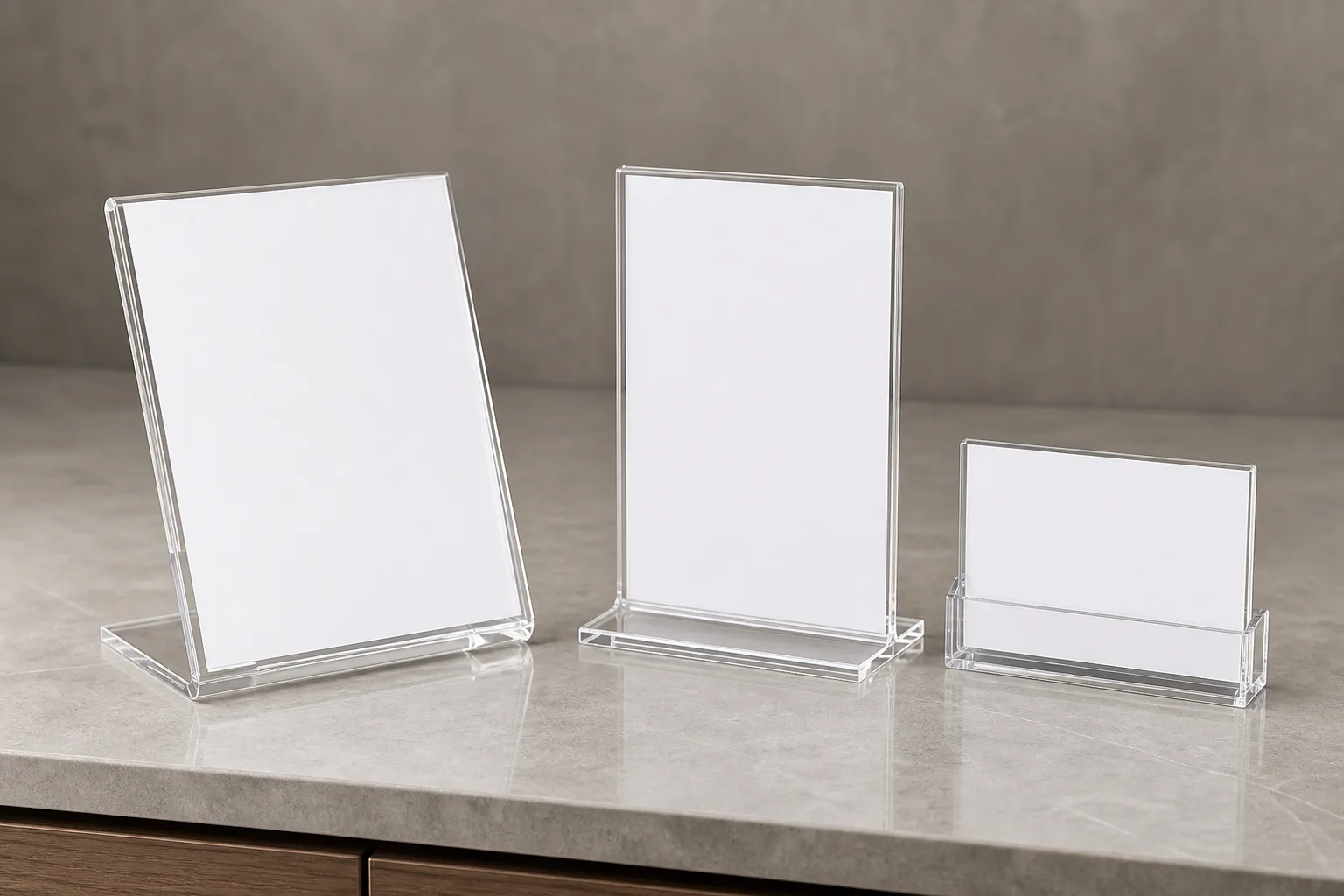
Size and base type are one decision, not two. A slant-back suits 4x6 through A4 on counters with depth to spare; a T-style suits small double-sided formats on tight or shared counters; wall-mount covers everything but owns the large formats. Pick the placement first, and the viable sizes narrow themselves.
| Base type | Size sweet spot | Reads from | Counter depth used | Best placement |
|---|---|---|---|---|
| Slant-back (L-shaped) | 4x6 to A4 | One side | Most — lean + rear foot | Counters, reception desks, POS |
| T-style (double-sided) | 4x6 to A5 | Both sides | Least — symmetrical base | Register queues, cafe tables, shared counters |
| Wall-mount pocket / standoff | Half-letter to A3 | One side | None | Lobbies, corridors, behind counters |
The pattern behind the table: the taller the insert, the more a freestanding base must reach backward to stay stable, so past A4 the freestanding formats give way to the wall. And double-sided T-styles stop making sense once the insert is big enough that nobody stands behind it. When a client sends me a fixture photo with their inquiry, the base type usually picks itself — which is why a photo of the intended counter or wall is the single most useful attachment on a sign holder RFQ.
Ordering mixed sizes: one program, one PO
Multi-size signage programs can use one purchase order with per-size line items. A buyer may pair a large-format wall unit, a letter or A4 counter format, and a small counter card, then define material identity, packing, and store allocation for each SKU.
Consolidating lets the quote show shared and per-SKU costs without promising one automatic price break. Color and clarity acceptance follow the approved material and sample, while packing and freight depend on the store allocation and destination. The supermarket shelf-edge sign holder case study shows how a documented signage program controlled geometry and rollout packing; the same one-PO logic can be reviewed for A5 table units after insert and base dimensions are approved.
Review near-duplicate sizes before scaling quantities. A multi-location RFQ may contain several counter-card dimensions inherited from regional teams; compare whether one small format, one letter or A4 format, and one large format can serve the approved inserts. Fewer designs can simplify line items and retained specifications, but each consolidation decision must preserve fit and each design keeps its own MOQ and quoted price. Every size is made to order from 100 pieces per design; our custom acrylic sign holders page shows the formats and price reference.
From chart to order
A complete acrylic sign holder 8.5 x 11 spec is shorter than most buyers expect: insert size, orientation, base type, quantity per size — “8.5 x 11, portrait, slant-back, 300 pieces” covers line one. Add 5mm thickness only if you’re in the large formats; everything else defaults sensibly. Logo printing on the base or panel, colored or frosted acrylic, and custom slot sizes are all available through our custom acrylic fabrication options, and every configuration in this chart is built to order from the styles on our custom acrylic sign holders page, part of the wider custom acrylic display stands line.
Production starts at 100 pieces per design. Paid samples take 3–5 days and are never credited to production; production takes 15–20 days after approval. Standard payment is 30% before production and 70% before shipment, FOB Shenzhen. Send the measured inserts and a photo of where the holders will stand, and the quote will confirm each footprint, clearance, base, and packing line.
Footnotes
-
ISO 216:2007 — Writing paper and certain classes of printed matter: trimmed sizes, A and B series — the international standard defining A-series paper sizes, including A4 at 210 x 297mm, the metric counterpart to US letter that sign holder slots must be cut separately for. ↩
-
Polymethylmethacrylate (PMMA, Acrylic) — MakeItFrom — independent PMMA property data including elastic modulus around 3 GPa, the stiffness figure behind stepping panel thickness up from 3mm to 5mm as insert sizes grow past letter/A4. ↩
Published price point
Quote a mixed-size sign holder program
$2 per unit published low-end reference at 500 pcs, FOB Shenzhen
Published low end for a related named format: a 5×7 inch single-panel tabletop frame in 3 mm clear acrylic with a slot-in angled stand. It is not a sign-holder quote; insert clearance, orientation, bends, base, print, packing, and quantity set the final number.
Paid samples are quoted separately and are never credited to production.
Thank you!
We've received your inquiry. Our team will reply within 24 hours — usually faster.
Frequently Asked Questions
What size acrylic sign holder do I need for 8.5 x 11 paper?
One sized for letter paper: 8.5 x 11 inches (216 x 279mm). Order by the measured insert, paper stock, lamination, orientation, and loading edge. The approved drawing adds working clearance, and the sample confirms that staff can load the insert without curl or excess movement.
Is an A4 sign holder the same as an 8.5 x 11 sign holder?
No. A4 paper is 210 x 297mm — narrower and taller than US letter at 216 x 279mm. Letter paper curls in an A4 slot and A4 paper sits proud in a letter slot. A holder is cut for one insert size, so international programs either run two size variants or standardize their print files to one paper size first.
What thickness should an acrylic sign holder be?
Use 2 mm, 3 mm, and 5 mm as planning starts across the chart, then review orientation, base depth, bend geometry, named PMMA grade, support, and handling. The approved drawing and physical sample set the production thickness for each SKU.
Can I order several sign holder sizes in one bulk order?
Yes. We can quote mixed sizes on one purchase order with per-size line items — for example 5x7 counter cards, 8.5 x 11 counter holders, and 11 x 17 wall units. MOQ remains 100 pieces per design; material allocation, quantity, packing, and shipment grouping are confirmed in the project quote.
Can I get a sign holder for a non-standard insert size?
Yes. Send the measured insert, paper stock, lamination, orientation, loading edge, base type, and quantity. CNC cutting and heat bending use a cut-to-order route, but material yield, jigs, bends, printing, packing, and quantity can still change the unit price.
Send the insert-size schedule
List the paper size, orientation, base type, quantity per SKU, branding, packing, and destination. We will return the holder footprints, production spec, and paid-sample plan.