Acrylic Riser Sizes: Height, Depth & Spacing
Most riser displays fail on size, not material.
Need this made?Custom acrylic risers →
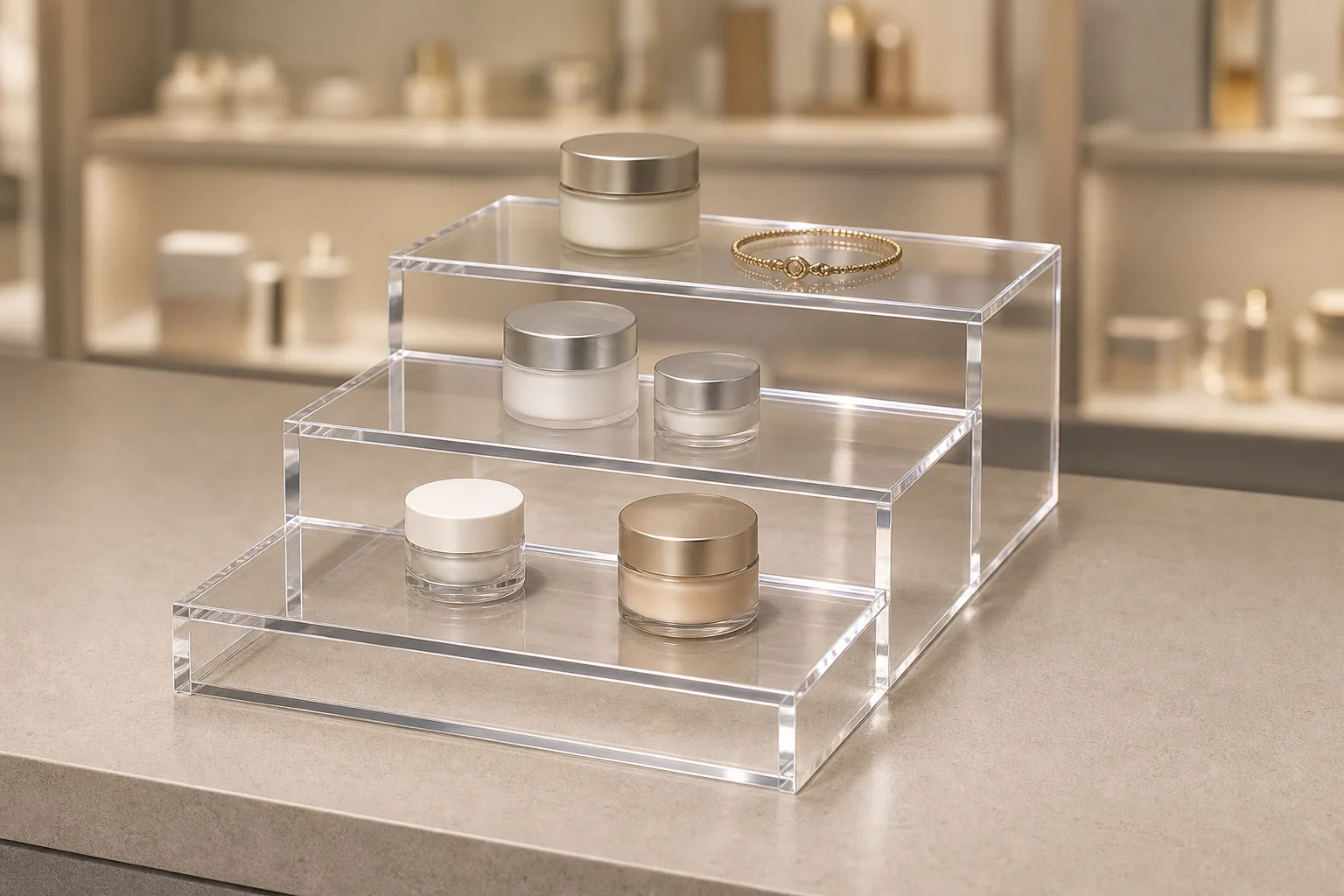
Here is how to pick height, depth, and step spacing for what the counter actually sells — before a single sheet gets cut.
Key Takeaways
- Size a riser to the product, not the shelf: the riser lifts the product so its midpoint sits near eye line, and the top plate gives the product's footprint 10-25mm of margin on every side.
- A three-piece riser set works because of consistent step spacing — 50mm (2 inch) height steps for jewelry and small goods, 75-100mm (3-4 inch) steps for cosmetics, footwear, and boxed products.
- Thickness follows load and span: 3mm cast acrylic handles small light goods on plates up to about 200mm, 5mm covers most cosmetics and footwear risers to about 350mm, and 8mm carries heavy or wide loads.
- The most common sizing mistake is one riser height for a mixed product line — a flat display; the second is a top plate cut tight to the product, which reads unstable and tips easily.
- Custom acrylic riser sizes carry no tooling fee because risers are CNC-cut and bent from sheet, not molded — a 100-piece first production run pays for programming and setup, not steel tooling.
On this page
The three numbers that decide it
Last month a buyer sent us a reorder note that explained itself: her first run of fifty risers had all been cut to one height, and on the counter the back row vanished behind the front one. Nothing was wrong with the acrylic — the spec just had no ladder in it. Three numbers decide acrylic riser sizes and would have caught it on paper: top-plate footprint (product footprint plus 10-25mm margin per side), lift height (enough to bring the product’s midpoint toward eye line, usually 50-250mm), and step spacing (50-100mm height difference between tiers in a set). Get those three right and almost any product line displays cleanly.
An acrylic riser is a clear or colored platform — usually a bent U-shape or a five-sided box cut from cast acrylic sheet — that lifts a product above counter level so it can be seen over the items in front of it. That is the whole job: elevation and sightline. Every sizing decision traces back to one question — what does the shopper’s eye need to clear?
We ask for three inputs before quoting any riser order: what sits on the riser, where the display lives (countertop, shelf, window, glass showcase), and how many tiers the set needs. I read a surprising number of briefs that arrive with only a riser dimension copied from a stock listing — 4 x 4 x 4 inches — and no product dimensions at all. The stock cube is not wrong, but it is a size chosen by a warehouse, not by the product it will hold. The sections below give the category ranges, the ladder logic, and the thickness rules, so the riser sizes on the spec sheet come from what the counter actually sells.
Riser sizes by product category
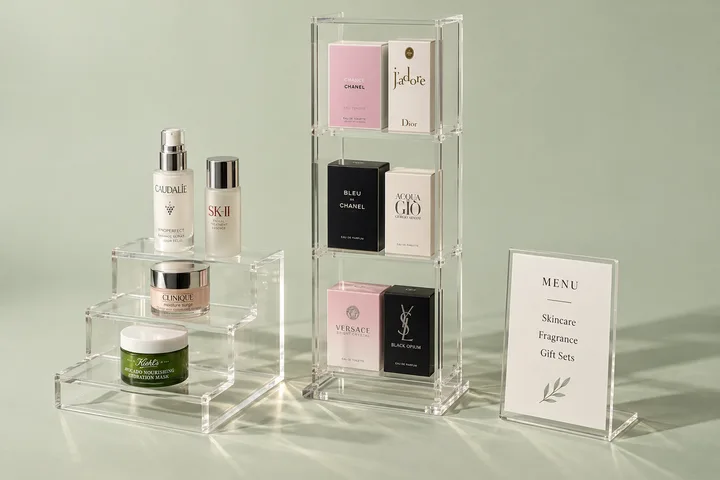
Riser sizing splits cleanly by product category because each category has a typical footprint, weight, and viewing distance. Jewelry wants small plates and short lifts; footwear wants a full shoe-length plate and taller steps; collectibles range widest because piece height varies most. The table below covers the ranges we quote most often.
These are working ranges, not rules — a category is a starting point, and your specific product’s footprint always wins. Read the table by the category you sell, then check the top-plate column against your real product dimensions plus margin. If your product straddles two rows — a boxed watch that is also a collectible, say — size to the heavier, taller reading of it.
| Product category | Top plate (W x D) | Riser heights | Typical thickness | Notes |
|---|---|---|---|---|
| Rings, earrings, small jewelry | 50-100 x 50-75mm | 50 / 75 / 100mm | 3mm | Small plates, short steps; often paired with inserts |
| Necklaces, watches, boxed jewelry | 100-200 x 75-100mm | 75 / 125 / 175mm | 3-5mm | Taller back tier so pendants hang visibly |
| Cosmetics, skincare, fragrance | 150-300 x 100-150mm | 75 / 150 / 225mm | 5mm | Bottles are tall — 75mm steps keep labels readable |
| Footwear (single shoe display) | 250-330 x 100-130mm | 100 / 175 / 250mm | 5mm | Plate covers the outsole; sneakers need the 330mm end |
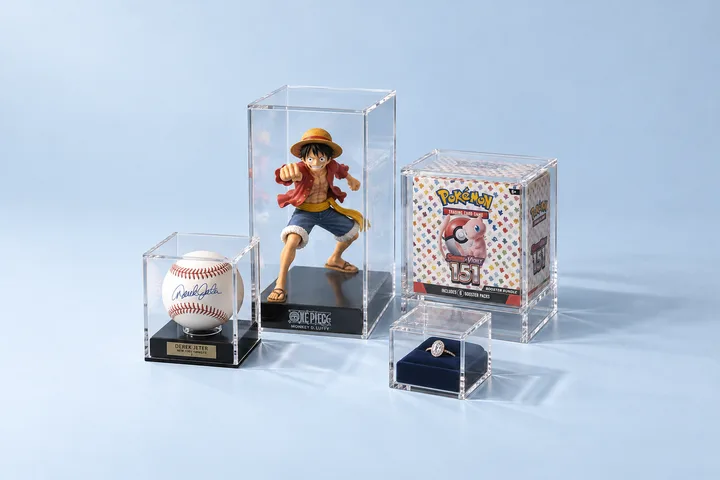
| Collectibles, figures, graded pieces | 100-300 x 100-200mm | 75-300mm | 5-8mm | Size to the tallest piece; heavy items go to 8mm |
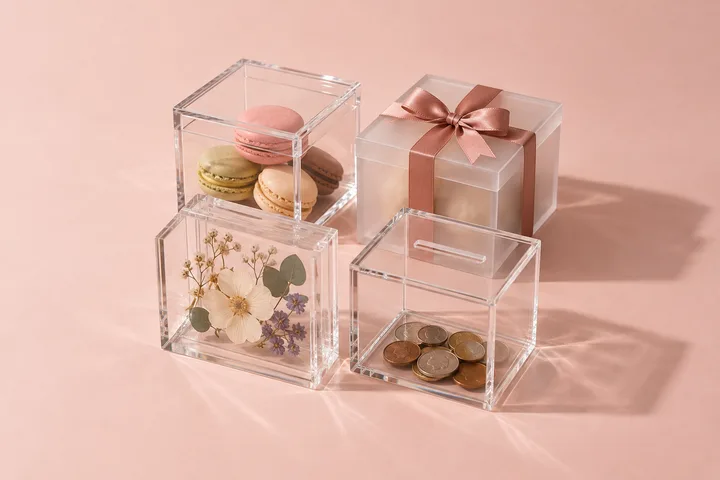
| Bakery, packaged food, retail goods | 200-400 x 150-250mm | 50 / 100 / 150mm | 5-8mm | Wider plates, lower lifts; weight adds up fast |
Two patterns run through that table. First, height steps scale with product height: a 15mm ring needs only a 50mm step to clear the tier in front of it, while a 200mm fragrance bottle needs 75mm or more before the tier behind it becomes visible. Second, thickness scales with plate width more than with product weight — a wide thin plate sags under its own span long before a small plate fails under load. Cast acrylic’s density is only about 1.18 g/cm³, roughly half that of glass, which is why even a large riser set ships light and handles safely on a busy sales floor.1
Category also drives finish, and finish quietly interacts with size. Jewelry programs lean toward mirrored and frosted acrylic, and mirror finish makes a riser read larger than its footprint — a 75mm mirrored cube carries the visual weight of a 100mm clear one. The mirror-finish sneaker pillar project shows how reflective faces, buyer-controlled heights, shoe fit, branding, inspection, and packing were defined. Cosmetics counters usually stay with clear or brand-colored acrylic so the packaging does the talking.
The three-piece ladder: step logic and spacing
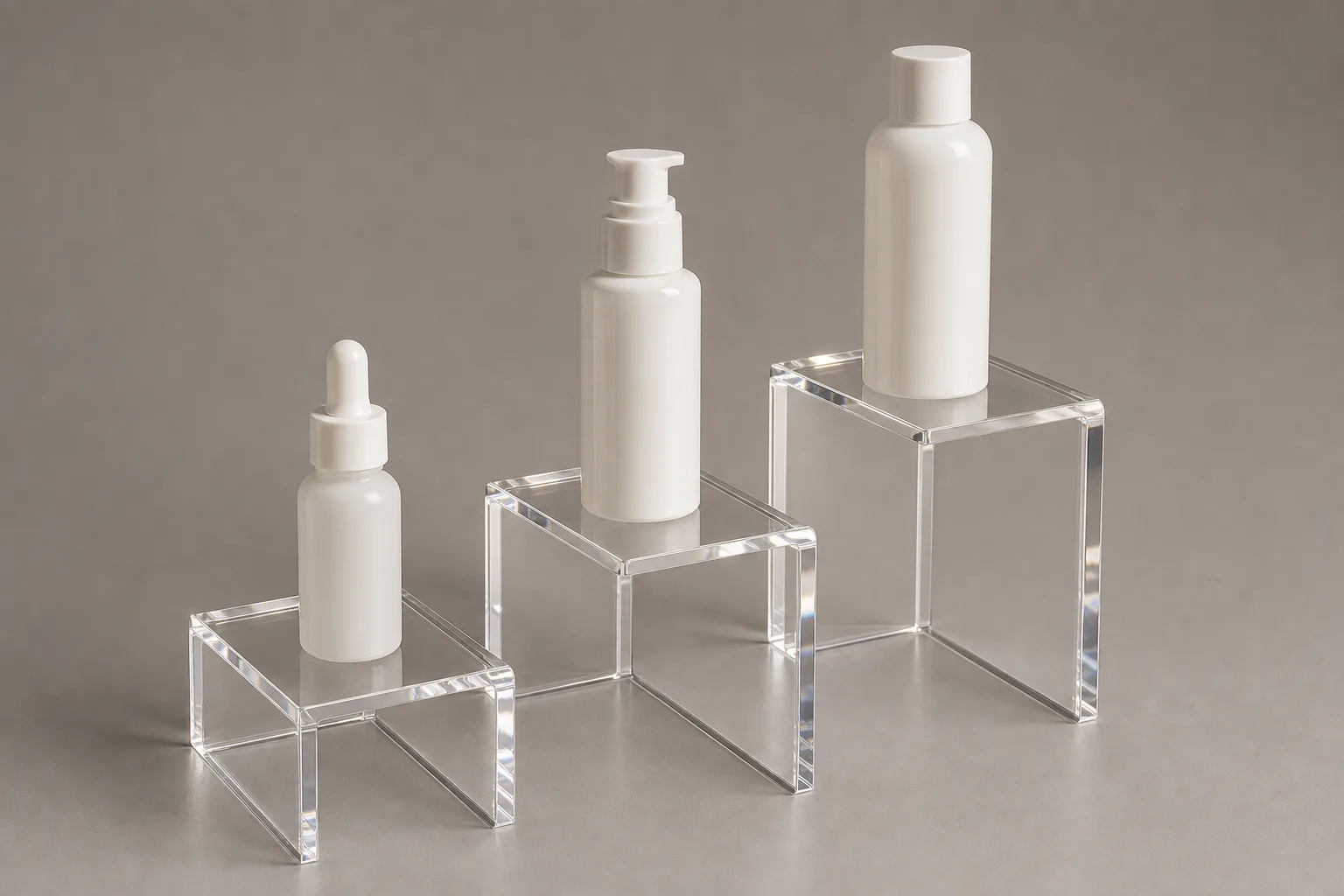
A three-piece riser set works because of one design decision: consistent height steps. The classic set steps each tier by the same increment — 50, 100, 150mm, or 75, 150, 225mm — so products form a diagonal line that pulls the eye from front to back. Uneven steps break the diagonal and the display reads as random boxes.
The increment comes from product height. My rule of thumb from quoting these sets weekly: the step should be 40-60% of the average product height. Shorter than that and the back rows hide; taller and the ladder looks like a staircase built for a product that is not there. For a 150mm skincare bottle, a 75mm step lands right in the band. For 25mm jewelry boxes, 50mm steps are already generous.
Depth spacing matters as much as height. Leave 20-40mm of clear air between the product on one tier and the face of the riser behind it. On a typical 450-600mm deep retail counter, that budget usually resolves to three tiers with 100-150mm deep plates — which is exactly why so many stock sets converge on those dimensions. If your counter is shallower, drop to two tiers rather than shrinking the air gap; crowded tiers cost you the whole ladder effect.
Nesting is the quiet logistics win of a well-sized set. If each smaller riser’s outer dimensions fit inside the next size up with a few millimeters of clearance, the set ships as one compact block instead of three boxes of mostly air. When we cut a custom set, we check nesting clearances at the drawing stage — it routinely cuts the shipped carton volume in half or better, and volume is what drives freight cost on lightweight acrylic. For the deeper set-design question — three tiers or five, and when a fifth tier stops earning its footprint — our tiered countertop display stands page covers that choice.
Odd-numbered sets are worth a note while planning the ladder. Two-piece sets exist and work on narrow counters, but three and five dominate for a reason: an odd count gives the arrangement a natural center, so the feature product has an obvious home on the middle or top tier and the composition reads as intentional. When a buyer asks us to add a fourth size to a three-piece set, we usually suggest jumping to five instead — the even set tends to get arranged as two pairs, which splits the display in half. If the tiers should stay fixed in one bonded piece rather than be rearranged, the brief is a 3 tier acrylic display stand, not a riser set.
One more spacing decision that briefs often skip: where the set sits relative to eye line. A countertop riser is viewed from roughly 300-500mm above its base, so modest lifts work; a floor-level window display is viewed from a full standing eye height of about 1.5-1.6m, which is why window risers and pedestals run 300mm and taller while counter risers rarely need to. Inside a glass showcase, the showcase shelf already sets the base height — we size showcase risers shorter, typically 50-100mm, so the top product clears the shelf above with room to lift it out.
Thickness, wall style, and load
Riser thickness follows two numbers: the top-plate span and the load sitting on it. 3mm cast acrylic covers small, light goods on plates up to about 200mm across; 5mm is the default for cosmetics, footwear, and boxed goods up to about 350mm; 8mm carries wide plates, heavy collectibles, and anything a customer might lean on.
The failure mode to design against is not breakage — cast PMMA’s flexural strength runs around 110 MPa, far beyond what a countertop product exerts.2 The real-world failures are visible sag on a wide thin plate and wobble on a tall thin U-shape. Both are stiffness problems, and stiffness rises with the cube of thickness, so one step up in gauge solves what looks like a structural defect. A 400mm-wide plate that flexes at 3mm is rock solid at 5mm.
Wall style interacts with height. A bent U-riser (three faces) is efficient up to roughly 200mm tall; beyond that, tall open U-shapes get tippy, and a five-sided box riser — or a U with a back panel — is the more stable build. For heights past 300mm, we recommend the box form regardless of load, purely for stability on a busy sales floor. If the riser plan involves long spans or unusually heavy pieces — stone, metal, dense glassware — start from our acrylic sheet thickness guide and give us the span and load so we can check deflection properly.
| Thickness | Max top-plate span (guideline) | Suits | Watch for |
|---|---|---|---|
| 3mm | ~200mm | Jewelry, small light goods | Sag on wider plates; fine for short U-risers |
| 5mm | ~350mm | Cosmetics, footwear, boxed goods | The default gauge for most riser sizes |
| 8mm | 350-500mm | Heavy collectibles, food, wide plates | Cost and weight step up; edge polish matters more |
Thickness also changes how the edges read, which matters more on a riser than on most acrylic products because every edge faces the shopper. At 3mm an edge is a thin bright line; at 8mm it is a visible face that needs diamond polishing to read as glass rather than as a saw cut. We polish riser edges as standard, but on 8mm programs we flag the edge finish on the quote line because it is a real share of the labor.
Five riser sizing mistakes that flatten a display
The five sizing mistakes we see most: one height for a mixed line, top plates cut tight to the product, steps too short to clear the front row, tall U-risers with no back panel, and stock cubes standing in for a planned ladder. Each one costs nothing to avoid at the drawing stage and plenty to fix after fifty pieces ship.
One height, mixed products. A single riser height flattens a product line into one row — the display loses the front-to-back diagonal that makes shoppers scan the whole set. If everything you sell is the same height, one riser height is fine; otherwise your spec needs a stepped set.
Zero-margin top plates. A plate the exact size of the product looks precarious and is: any bump slides the product’s edge past the plate. Hold 10-25mm of margin per side. The margin also gives your cleaning staff somewhere to grip that is not the product. I flag this on quotes more than any other dimension — buyers measure the product and forget the fingers.
Steps shorter than the front row. If the tier behind rises less than roughly half the front product’s height, the back row peeks rather than shows. This is the single most common regret I hear on reorders — buyers step up from 50mm to 75mm increments and the same products suddenly read clearly.
Tall and open. A 300mm U-riser with no back face wobbles when the counter gets bumped. Past 200-250mm of height, close the back or go box-form.
Stock size as default. The 4-inch cube exists because it is a safe average, and safe averages sell no specific product well. Since custom acrylic riser sizes carry no tooling fee — risers are CNC-cut and bent from sheet, not molded — the cost gap between stock and exact dimensions is a one-time setup, not a mold. At 50 pieces and up, sizing to the product is almost always worth it.
From riser size spec to a real order
Turning riser sizes into an order takes four specs per design: top-plate width and depth, height per tier, thickness, and form (U-bend or box). Add finish — clear, frosted, colored, or mirrored — and quantity per size, and that is a quotable brief. If you would rather work backward from the product, send us your product dimensions and where the display will live; we respond within 24 hours and come back with recommended riser dimensions rather than a menu. Not once in six years of coordinating these orders has a photo of the counter made a brief worse — send one if you have it.
For comparing forms and finishes before committing to dimensions, our custom acrylic risers page shows the standard builds — stepped sets, U-risers, box risers, and multi-tier units — and is the right place to start a quote for a sized set. For the wider counter context around risers, the acrylic display stands hub covers the pedestals, shelves, and sign holders that share floor space with them.
The ordering numbers, for planning: our MOQ is 100 pieces per design, samples ship in 3-5 days, and production runs 15-20 days, FOB Shenzhen. A three-size set counts as three designs, but we quote sets together and cut them from shared sheet programs, which is kinder to the price than three separate orders. Every run passes 100% inspection in our ISO 9001-certified factory, and the cutting programs stay on file — so the reorder six months later matches the first run to the millimeter.
Footnotes
-
Polymethylmethacrylate (PMMA, Acrylic) properties and applications — AZoM — material overview listing PMMA’s density of about 1.18 g/cm³, roughly half that of glass, supporting the claim that even large acrylic riser sets stay light to ship and safe to handle on a sales floor. ↩
-
Polymethylmethacrylate (PMMA / Acrylic) material properties — MakeItFrom — documents cast PMMA’s flexural strength of about 110 MPa, the property behind the guidance that riser failures in practice are sag and wobble (stiffness) rather than breakage (strength). ↩
Frequently Asked Questions
What size acrylic riser do I need for my product?
Work from the product outward. The top plate should exceed the product footprint by 10-25mm per side, and the riser height should lift the product's visual midpoint toward the viewer's eye line — typically 50-100mm of lift for countertop goods. Jewelry runs 50-150mm tall, cosmetics 75-200mm, footwear 100-250mm, collectibles 75-300mm depending on piece height.
What are standard acrylic riser sizes?
The most common stock sizes are square-plate risers in 2, 3, and 4 inch (50, 75, 100mm) heights, and rectangular risers around 150-300mm wide. Three-piece nested sets typically step in 50mm or 75mm height increments. Custom sizes are routine — risers are cut and bent from flat sheet, so a non-stock dimension changes programming, not tooling.
How thick should an acrylic riser be?
Match thickness to load and top-plate span. 3mm suits jewelry and lightweight goods on plates up to about 200mm across; 5mm is the workhorse for cosmetics, shoes, and boxed products up to about 350mm; 8mm suits wide plates, heavy items, and anything customers may lean on. Cast acrylic's flexural strength is around 110 MPa, so the practical failure is sagging and wobble, not breakage.
How far apart should display risers be spaced?
Leave 20-40mm of clear air between the product on one step and the riser behind it, so each item reads as its own tier instead of a crowd. On a standard 450-600mm deep counter, that usually means a three-piece set with 100-150mm deep plates. If products touch across tiers, the ladder effect disappears and the display reads as clutter.
Can I order custom riser sizes in small quantities?
Yes. Our MOQ is 100 pieces per design, with paid samples in 3-5 days and production in 15-20 days. Because risers are CNC-cut and line-bent from sheet rather than molded, a custom size carries zero mold-tooling fee; the cutting program and bending setup amortize across the 100-piece production run.
Explore Custom Acrylic Products
Browse product categories to compare formats, materials, and customization options before choosing the closest fit for your project.