
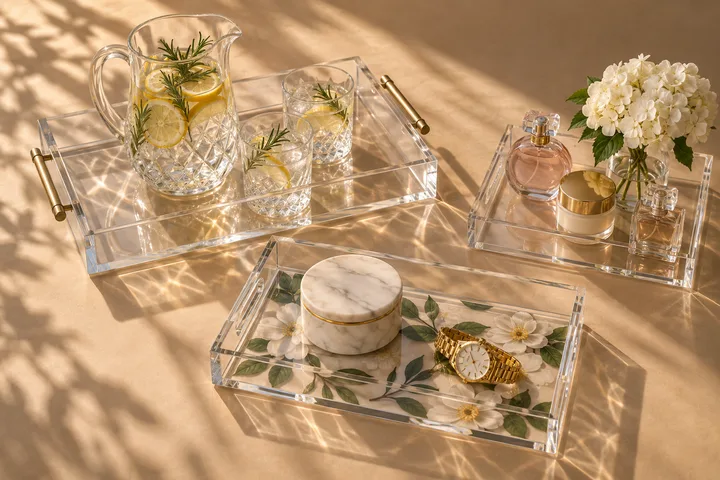
Custom Acrylic Tray Cost at 100 to 1,000
Quantity lowers the setup cost per tray, but size, sheet yield, walls, handles, print, and export packing still control the final quote.
Need this made?Custom acrylic trays →
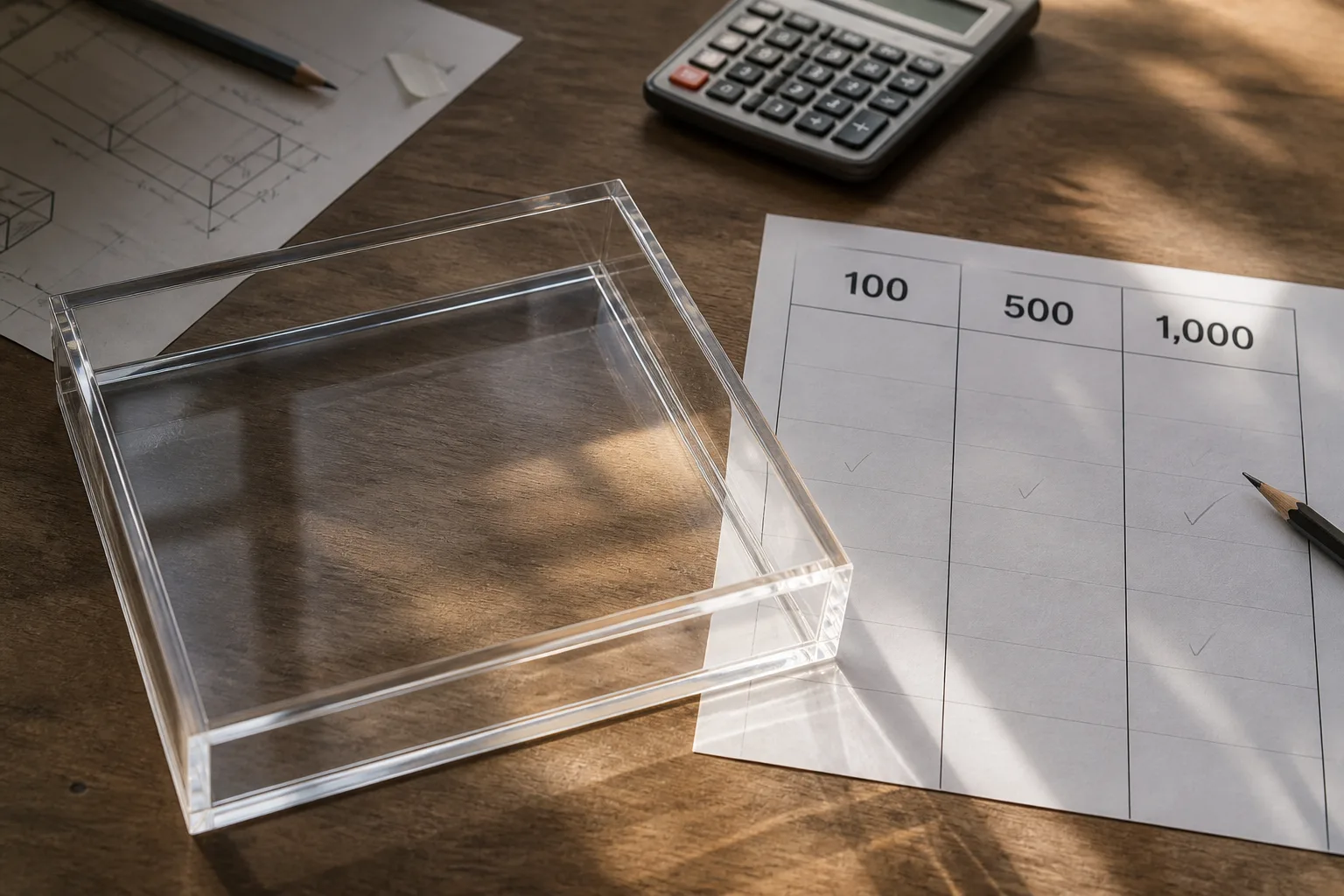
Key Takeaways
- A named 16 × 12 in serving tray in 5 mm clear acrylic with cut-out handles and an etched logo is $19 at 100 pieces, $11 at 500, and $8 at 1,000 FOB Shenzhen.
- Quantity spreads drawing, setup, proof, and packing-development work across more units; it does not remove material or assembly cost.
- Size and sheet yield often move the quote more than a small thickness change.
- Handles, bonded walls, dividers, printing, individual cartons, and store-ready kits add separate operations.
- Compare landed cost with the same drawing, packout, Incoterm, and destination.
On this page
- Start with one reference specification
- Quantity spreads fixed work
- Size and yield set the material line
- Handles and inserts add operations
- Artwork cost follows the method and versions
- Packing changes both damage risk and freight
- Compare FOB, DDP, and landed cost correctly
- Read the 100, 500, and 1,000 tiers as decisions
- Use a three-tier RFQ
Start with one reference specification
Custom acrylic tray cost becomes useful when the price names a product. Our current published reference is a 16 × 12 in serving tray in 5 mm clear acrylic with cut-out handles and an etched logo: $19 each at 100 pieces, $11 at 500, and $8 at 1,000, FOB Shenzhen. Those figures are published references for that named specification, not a catalog.
The same outside size can carry a bent rim, four bonded walls, metal handles, feet, dividers, a velvet liner, bottom printing, or a fitted insert. Each version uses a different sequence. A buyer who asks only for “tray price at 500” will receive assumptions rather than a comparable quote.
Use the published point as a baseline. Write your differences beside it: larger base, 4 mm material, 40 mm walls, two metal handles, one-color logo, individual carton. The factory can then explain which changes affect sheet yield, labor, print setup, hardware, inspection, and packout.
The custom acrylic trays hub carries the reference specification and other tray formats. Keep that page open while you build the RFQ so the price discussion stays attached to a physical product.
Quantity spreads fixed work
Quantity changes the setup cost per unit. Drawing review, production files, cutting setup, bending or bonding fixtures, print proofing, first-off inspection, carton development, and purchasing administration occur before or around the first unit. At 100 pieces, each tray carries a larger share of that work than at 500 or 1,000.
Variable work remains. Every unit still consumes sheet, machine time, edge finishing, bonding or bending labor, hardware, print time, inspection, protective film, and packing. A fivefold quantity increase does not create a fivefold unit-price reduction because most of those inputs scale with the order.
I ask buyers for three quantity tiers when their forecast is uncertain. The quote can show 100, 500, and 1,000 pieces on the same drawing. Your team sees the savings available from one larger release without pretending that a forecast is a purchase order.
Keep quantities by design. Two sizes at 250 each do not equal one 500-piece setup. Two artworks on the same tray can still require separate proofs, print setup, inspection labels, and carton marks. The quote should show which costs are shared and which repeat by SKU.
Size and yield set the material line
The base and wall panels must fit a production sheet with cutting gaps and edge allowances. A small dimensional change can improve or reduce yield. That is why a 5% increase in tray width does not guarantee a 5% material increase; the revised layout may cross a sheet boundary.
Send finished dimensions rather than a category name. Label inside and outside dimensions. If an insert needs a usable 300 × 200 mm pocket, state that requirement so the factory does not subtract wall thickness from the space you intended for the product.
Thickness changes sheet volume and edge finishing. Wall height adds material around the perimeter. A full bonded-wall tray also adds cutting, joint preparation, assembly, curing, and joint inspection compared with a shallow heat-bent rim. Ask the quote to name the construction method.
Our tray size and thickness chart shows how those dimensions connect. Use it to prepare the drawing before you compare custom acrylic tray cost across factories.
Handles and inserts add operations
Metal handles add purchased hardware, hole machining, assembly, protection, and function checks. Cutout handles avoid separate hardware but require their own geometry and edge finishing. Both can alter carton spacing because the highest or widest point may no longer be the tray wall.
Inserts create a second fit chain. Foam, velvet-covered board, card, molded pulp, and acrylic inserts have different suppliers, tolerances, cutting methods, and packout needs. The tray factory may buy the insert, receive it from your nominated supplier, or quote only the shell. Put that responsibility on the RFQ.
Dividers can be bonded, slotted, or removable. A bonded grid adds assembly time. A removable set needs labels and scratch protection. A single flat liner may cost less, yet it can fail the buyer’s product-retention requirement. The lowest insert line is useful only if it performs the same job.
Ask for alternates when cost matters. The factory might price metal handles versus cutouts, velvet-covered foam versus bare foam, or a removable insert versus a bonded grid. One drawing with alternate callouts creates a cleaner decision than separate vague quotes.
Artwork cost follows the method and versions
UV printing, screen printing, engraving, foil, and replaceable inserts use different files and setups. UV handles full color and variable images. Screen printing suits repeat spot-color work after setup. Engraving changes the surface and does not add printed color. Foil needs its own approval and tooling path.
Artwork versions matter as much as total quantity. A 1,000-piece tray order split across ten logos can carry ten proof and setup paths. A single logo across 1,000 units has one controlled print file. Show quantity by artwork on the RFQ.
Color approval should identify the file, color reference, substrate, print method, viewing condition, and acceptable sample. A monitor approval cannot by itself control a printed surface. Use a production-representative sample when brand color or fine artwork affects acceptance.
The tray branding methods guide helps route the artwork before quoting. Choosing the method early removes a large assumption from the custom acrylic tray cost comparison.
The printed-logo acrylic tray project connects the cost sheet to a released tray drawing, physical print sample, artwork-version allocation, first-off inspection, and protected nesting plan.
Packing changes both damage risk and freight
Protective film, bags, interleaves, corner protection, individual cartons, master cartons, labels, and store-ready kits all add material and labor. Clear trays with polished faces need a packout that prevents abrasion between units. Handles and projecting feet need extra clearance or local protection.
Ask for carton dimensions, units per carton, gross weight, and carton marks. Carriers may use dimensional weight when carton volume exceeds actual weight under their service rules.1 A shallow nesting tray can ship differently from a deep rigid tray even when both use the same amount of acrylic.
Store-ready packing can save warehouse labor by grouping each location’s assortment. It can also create more carton types and labeling work at the factory. SKU-packed cartons reduce factory sorting but shift allocation to your warehouse. Quote both methods if the decision has not been made.
The POD photo tray case is a useful example of product, print, and fulfillment controls. Apply the workflow to your own drawing and volume rather than copying its program assumptions.
Compare FOB, DDP, and landed cost correctly
FOB Shenzhen separates the product and origin scope from main freight, insurance, destination charges, duties, and final delivery. DDP places more of the delivery scope on the seller. ICC Incoterms define delivery obligations and risk transfer, but they do not guarantee the same insurance, destination service, or customs treatment in every quote.2
State the named place. FOB without a port and DDP without a delivery postal code leave room for different assumptions. Ask whether the quote includes export cartons, origin charges, insurance, customs clearance, duty, appointment fees, liftgate service, or inside delivery.
Build a landed-cost sheet with product, sample, packing, freight, duty/tax, brokerage, and local delivery on separate lines. Use the same exchange rate and shipment date when comparing suppliers. A low unit price can lose once carton volume and delivery charges enter the calculation.
If your team controls freight, ask for carton data before selecting a supplier. If the supplier controls freight, ask for the carrier/service level and claim path. Price transparency needs the logistics assumptions beside the fabrication assumptions.
Read the 100, 500, and 1,000 tiers as decisions
The 100-piece tier buys production evidence with the smallest standard release. It suits a first program, one market, or one design while your team learns how the tray fits, packs, and reaches the user. The unit cost is higher because setup and first-off work sit on fewer pieces.
The 500-piece tier often suits a repeatable program with a stable drawing and one or two destinations. Sheet purchasing, machine planning, print setup, and packing work spread across more units. The factory still needs enough time to inspect and pack each tray.
The 1,000-piece tier works when the forecast, storage, and artwork are stable. It can improve sheet and carton planning, but only if the order avoids a long tail of low-volume variants. Ten designs at 100 pieces each remain ten design releases.
Ask for the cash and inventory effect beside the unit saving. A larger release may lower the factory price while increasing warehouse space, carrying time, and artwork-obsolescence risk. Procurement should choose the tier that fits the sales or deployment plan, not the lowest unit price in isolation.
Use a three-tier RFQ
Send one drawing and request 100, 500, and 1,000 pieces per design. Include the material grade, finished dimensions, thickness, construction, handles, insert, artwork, finish, packing, destination, and required date. Ask the supplier to return assumptions and alternates.
Wetop’s production MOQ is 100 pieces per design. Paid samples take 3–5 days, are paid separately, and are never credited to production. Production takes 15–20 days after drawing, artwork, sample, and payment approval. We reply to a complete brief within 24 hours.
Use the tray quote form to send the drawing and tier quantities. We will show the unit price, setup assumptions, packout, and freight basis so your procurement sheet compares the same tray.
Keep the quote tied to the custom acrylic tray hub and the named serving-tray construction.
Footnotes
-
FedEx dimensional weight guidance — FedEx explains how package dimensions can affect billable shipping weight. ↩
-
ICC Incoterms rules — ICC defines the delivery tasks, costs, and risk allocation attached to each Incoterm. ↩
Frequently Asked Questions
How much does a custom acrylic tray cost at 100 pieces?
A published price reference for a simple 10 × 7 in clear 3 mm tray with no handles is about $7–13 each at 100 pieces FOB Shenzhen. Size, walls, print, hardware, packing, and freight change the final quote.
Why is an acrylic tray cheaper at 500 pieces?
The supplier spreads drawing review, setup, first-off checks, print setup, and packing development across more units. Material, cutting, bonding, polishing, inspection, and packing remain in every tray.
Does a second logo version share the 100-piece MOQ?
Production MOQ is 100 pieces per design. A second artwork version can require its own 100-piece quantity because proofing, print setup, inspection, and labels change.
How are sample fees handled?
No. Wetop's paid samples take 3–5 days, are paid separately, and are never credited to production. The sample fee covers one-off setup and evidence before the 100+ piece run.
What should a tray quote include?
Require material grade, finished dimensions, thickness, walls, handles, insert, artwork, quantity by design, sample fee, unit price, packing, carton data, Incoterm, destination, production time, and freight.
Get a Tray Quote with Comparable Price Lines
Send the drawing, size, thickness, handles, artwork, insert, quantity per design, packout, and destination. We reply within 24 hours.