Acrylic Serving Trays
Serving trays with the look of glass and the durability to survive a busy floor.
An acrylic serving tray is a clear, colored, or frosted tray — also called a plexiglass serving tray or lucite serving tray — built for carrying food, drinks, and amenities in hospitality, catering, retail, and home settings. Unlike glass, acrylic won't shatter when dropped; unlike wood, it's fully waterproof and can carry printed or etched branding on the bottom that reads through the serving surface. Wetop Acrylic manufactures custom acrylic serving trays with metal handles, cut-out handles, or handleless edges, in rectangular, round, and custom shapes, with solid, printed, or etched bottoms. MOQ 50 pieces, samples in 3–5 days.
ISO 9001 Certified · 2,000+ Custom Projects · Exported to 25+ Countries · Samples in 3–5 Days
Find Your Serving Tray Format
Metal-Handle Serving Trays
Stainless steel or brass handles attached with hardware — the strongest grip, built for busy hospitality service floors
Details below ›
Cut-Out-Handle Serving Trays
Handles routed directly into the acrylic for a seamless one-piece look — no hardware to loosen, easy to wash
Details below ›
Handleless Serving Trays
Clean diamond-polished edges with no handles — a minimal presentation surface for buffets, retail, and amenity use
Details below ›
Nested Serving-Tray Sets
Graduated trays that stack for storage and transport — practical for catering fleets and multi-property programs
Details below ›
Need a vanity or décor tray instead?
For countertop, cosmetics, and bottom-art trays, see the full acrylic trays hub
All Acrylic Trays ›Serving Tray Variants at a Glance
Acrylic serving trays split into four variants that differ mainly in handle type, bottom treatment, and the service environment they're built for. Metal-handle trays give the strongest grip for high-volume hospitality; cut-out-handle trays are seamless and wash-friendly; handleless trays present as a minimal surface; nested sets stack for storage and transport. The reference below shows the typical setup for each — every tray is custom-built, so your dimensions, handle, and bottom finish are engineered to your spec at an MOQ of 50 pieces with a sample in 3–5 days.
| Variant | Typical size range | Handle | Bottom treatment | Best for | MOQ | Lead time |
|---|---|---|---|---|---|---|
| Metal-handle | 14"×10" to 20"×14" | Stainless or brass, hardware-mounted | Solid, UV-printed, silk-screened, etched | Hotel bars, restaurant floors, room service | 50 pcs | 15–20 days |
| Cut-out-handle | 12"×8" to 18"×13" | Routed into the acrylic (one piece) | Solid, printed, etched, hot-stamped | Amenity trays, catering, wash-heavy use | 50 pcs | 15–20 days |
| Handleless | 8"×6" to 16"×12" | None — diamond-polished edges | Solid, frosted, mirrored, printed | Buffets, retail counters, spa & amenity | 50 pcs | 15–20 days |
| Nested set | 3–4 graduated trays, 14"–20" | Cut-out (stack-friendly) | Solid or etched — matched across the set | Catering fleets, multi-property programs | 50 pcs | 15–20 days |
Setups are indicative and depend on tray size, contents, and finish. For the three numbers every serving-tray quote lives on — depth, thickness, and weight — see our custom serving tray spec guide.
Featured Serving Tray Formats
Metal-Handle Serving Trays
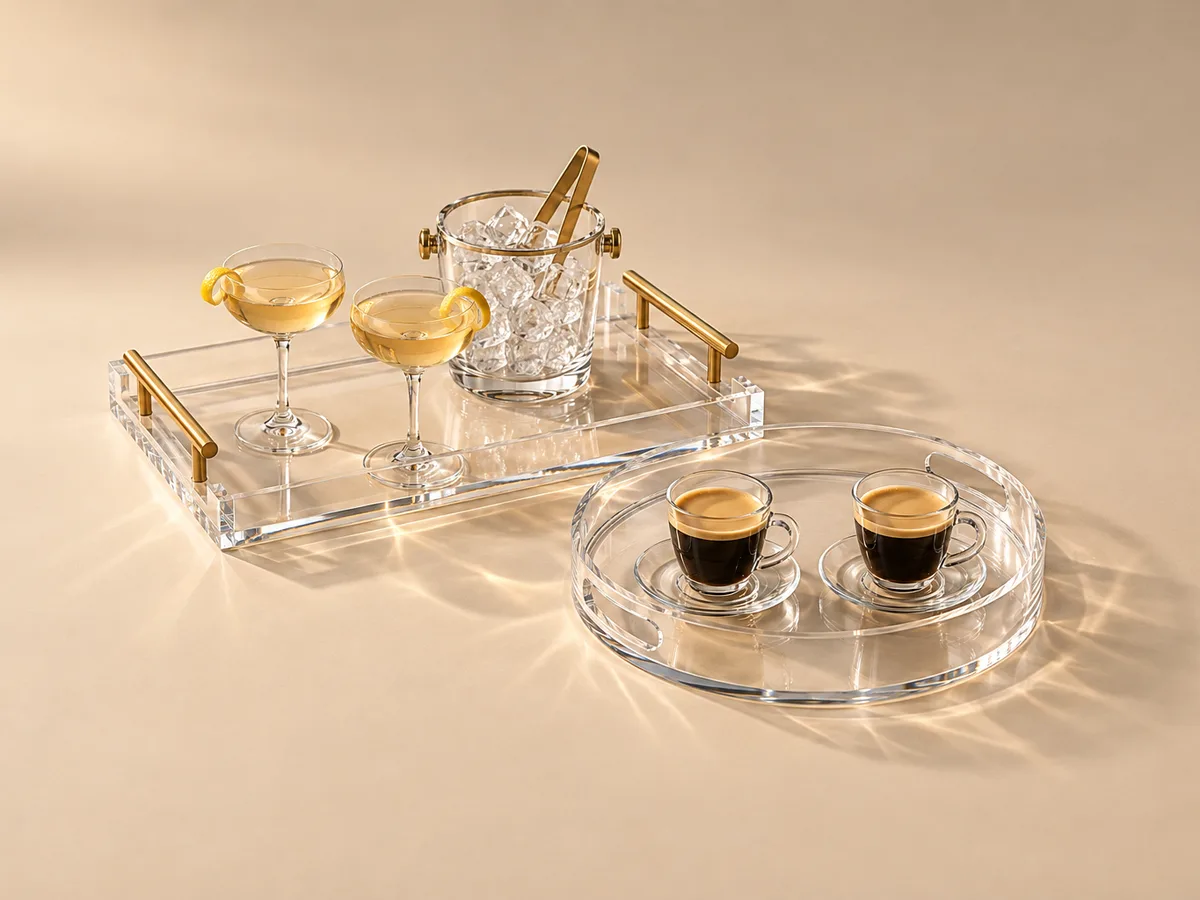
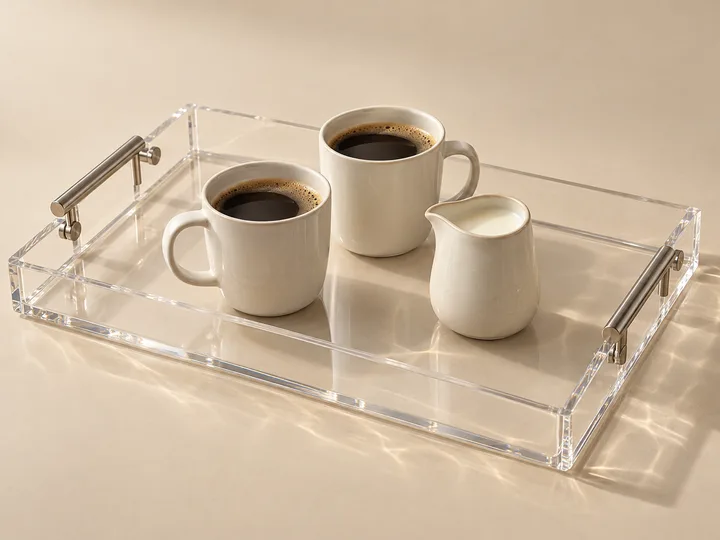
A metal-handle acrylic serving tray has stainless steel or brass handles mounted to the acrylic body with hardware — the strongest, most secure grip of the four variants. It's the format built for high-volume hospitality: hotel bars, restaurant floors, banquet service, and room service, where staff carry loaded trays through a busy room dozens of times a shift. The handles are bolted through, not glued, so they don't loosen under weight or repeat washing.
Metal handles carry more load and feel more secure in a moving hand than a cut-out grip — the reason premium hospitality programs default to them. Brushed stainless reads as modern and neutral; polished brass reads as warm and traditional. We match handle finish to your fixtures and can supply the same tray in both handle metals across one order.
Cast PMMA body — We build service trays in 5–8mm cast PMMA, not extruded, because cast holds its optical clarity past 100 wash cycles and its heat-deflection temperature (~100°C) survives commercial dishwasher heat. The body diamond-polishes to a clean edge that stays clear under repeat washing.
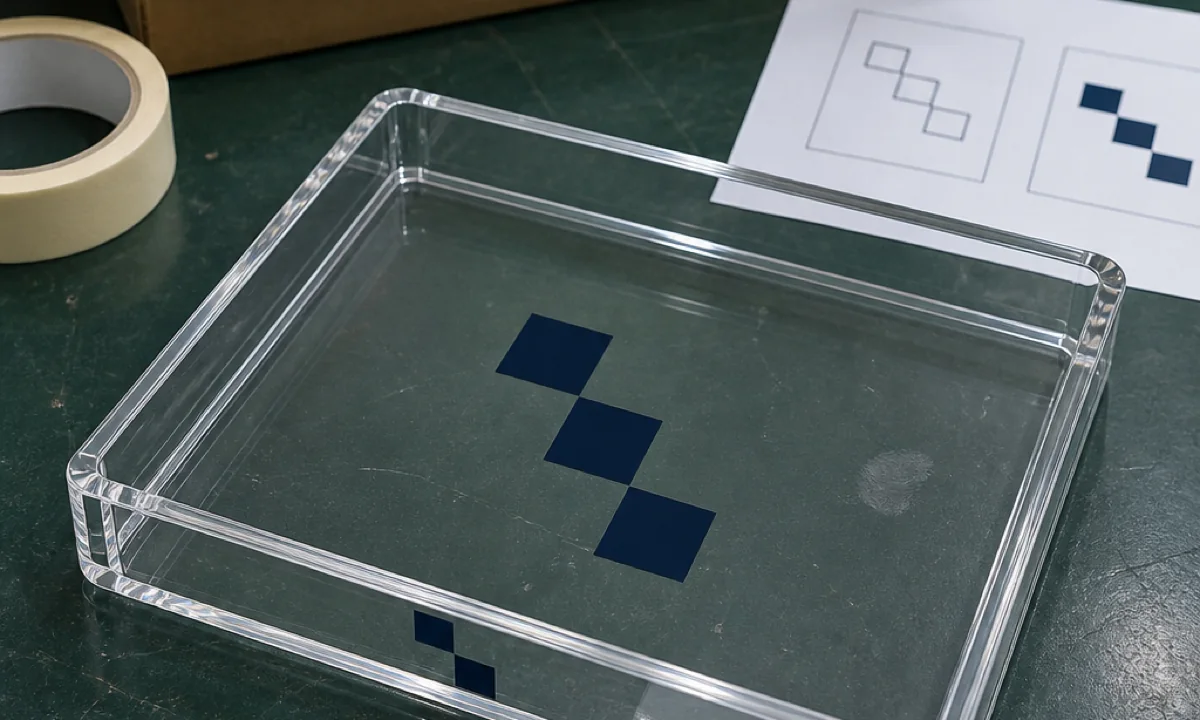
Bottom branding — Because the acrylic is clear, a UV-printed, silk-screened, or laser-etched logo on the bottom reads through the serving surface without sitting where food or drinks rest. We print second-surface so the ink is protected from wear.
| Spec | Options |
|---|---|
| Typical sizes | 14"×10" (bar), 16"×12" (room service), 18"×13" (restaurant), 20"×14" (banquet), custom |
| Acrylic thickness | 5mm (standard service), 8mm (heavy-duty / large trays) |
| Handle metal | Brushed stainless steel, polished brass, custom finish |
| Body material | Clear, colored, or frosted cast PMMA |
| Bottom treatment | Solid, UV-printed, silk-screened, laser-etched, hot-stamped |
| Edge finish | Diamond polished (standard), beveled |
Popular with: Hotels & resorts · Restaurants & bars · Banquet & catering · Airlines & lounges
MOQ: 50 pieces · Sample: 3–5 days
Send Us Your IdeaCut-Out-Handle Serving Trays
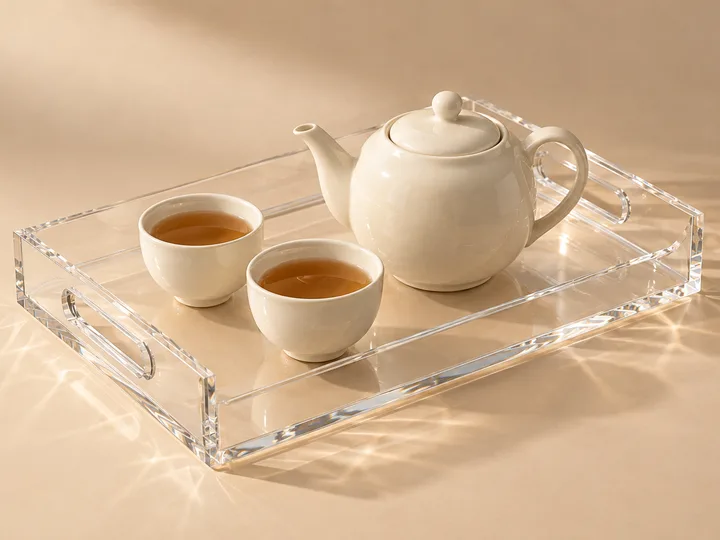
A cut-out-handle serving tray has its handles routed directly into the acrylic body — no separate hardware, no assembly seam. It's a single CNC-cut piece, which makes it the easiest variant to clean and the least likely to develop a loose part, so it's popular for amenity trays, catering, and any wash-heavy service. The handle openings double as a clean design line rather than an add-on.
With nothing bolted on, a cut-out-handle tray has no crevices where residue collects and no hardware to corrode — which is why housekeeping and catering teams favor it for daily-wash duty. The grip is a routed opening near each end, radiused smooth so it's comfortable to lift and safe on the hand.
One-piece durability — Because the handle is part of the tray, there's no joint to fail. For stacking and transport, cut-out handles nest better than metal handles, which is why our nested sets use cut-out grips.
| Spec | Options |
|---|---|
| Typical sizes | 12"×8" to 18"×13" (custom available) |
| Acrylic thickness | 5mm (standard), 8mm (heavy-duty) |
| Handle style | Routed openings, radiused edges, custom placement |
| Body material | Clear, colored, or frosted cast PMMA |
| Bottom treatment | Solid, UV-printed, silk-screened, etched, hot-stamped |
| Edge finish | Diamond polished (standard) |
Popular with: Hotel amenity programs · Catering companies · Spas · Airline & lounge service
MOQ: 50 pieces · Sample: 3–5 days
Send Us Your Idea
Handleless & Nested Serving-Tray Sets
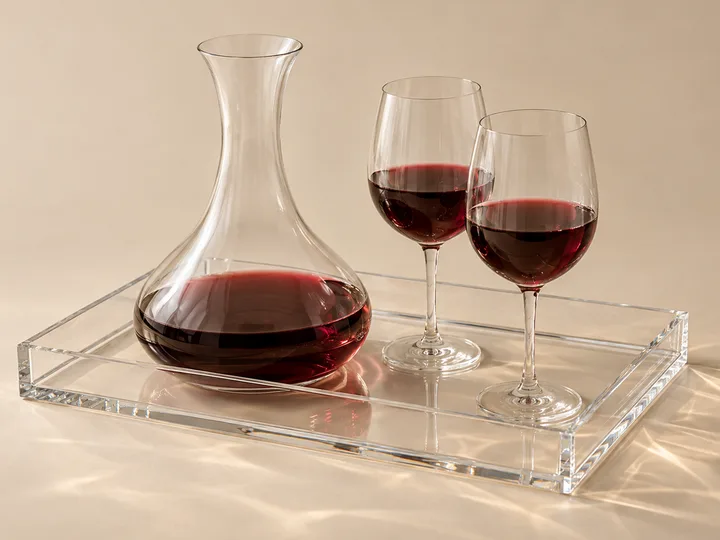
Handleless serving trays have clean diamond-polished edges and no handles — a minimal presentation surface for buffets, retail counters, spa rooms, and amenity displays where the tray reads as a fixture rather than a carry device. Nested serving-tray sets are graduated trays sized to stack inside one another, so a catering fleet or multi-property program stores and transports a full set in the footprint of the largest tray.
Handleless Trays — With no handle interrupting the edge, a handleless tray presents as an unbroken surface — ideal when the tray sits on a counter or buffet and is rarely carried far. Frosted or mirrored bottoms add a premium finish for spa and retail use; a clear bottom shows printed branding through the surface.
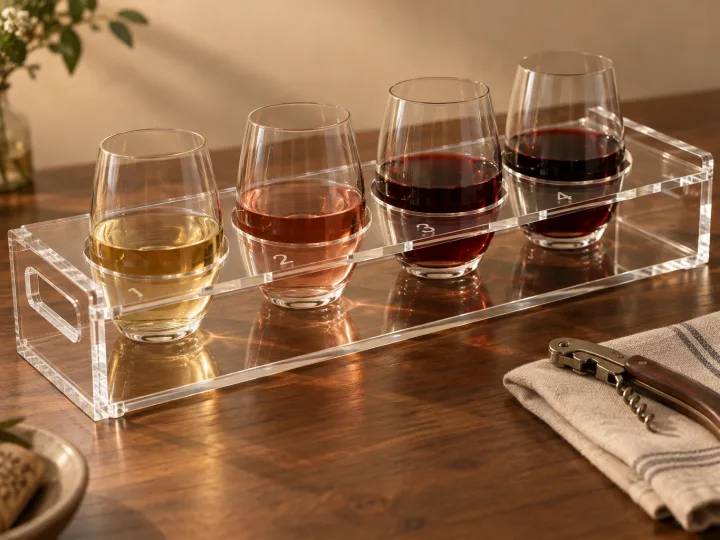
Nested Sets — A nested set is three or four trays cut in graduated sizes so each stacks inside the next. Cut-out handles keep the stack low. Common for catering companies that move service between venues, and for hotel groups that standardize one tray family across properties. We match material, edge finish, and branding across the whole set.
| Spec | Handleless | Nested Set |
|---|---|---|
| Typical sizes | 8"×6" to 16"×12" | 3–4 trays, 14"–20" |
| Handle | None (polished edges) | Cut-out (stack-friendly) |
| Best for | Buffets, retail, spa, amenity | Catering fleets, multi-property programs |
| Bottom treatment | Solid, frosted, mirrored, printed | Solid or etched, matched across set |
| Body material | Clear, colored, frosted cast PMMA | Clear or colored cast PMMA |
Popular with: Spas & wellness · Retail merchandising · Catering fleets · Hotel groups
MOQ: 50 pieces · Sample: 3–5 days
Send Us Your IdeaWhy Acrylic Serving Trays Over Wood, Stainless, or Melamine?
Acrylic serving trays cost more than melamine but deliver glass-like clarity at half the weight of stainless steel, won't shatter like glass, and — unlike any opaque material — carry printed or etched branding on the bottom that reads through the serving surface. Each competing material fails a different way in daily service: wood absorbs liquid and warps, stainless dents and shows fingerprints, melamine scratches and dulls. Cast acrylic stays waterproof, unbreakable, and optically clear past 100 wash cycles.
| Factor | Acrylic (PMMA) | Wood | Stainless Steel | Melamine |
|---|---|---|---|---|
| Clarity / branding surface | Transparent — bottom art reads through the surface | Opaque — surface engrave only | Opaque — etch or print | Opaque — surface print |
| Weight | ~50% lighter than glass, lighter than steel | Medium | Heavy | Light |
| How it fails in service | Diamond edge holds clarity; avoid ammonia/alcohol cleaners | Absorbs liquid, stains, warps once seal wears | Dents, shows fingerprints, no visual depth | Surface scratches and dulls over time |
| Shatter resistance | Won't shatter on drop | Durable | Durable | Durable |
| Water resistance | Fully waterproof | Requires sealing | Rust-resistant | Waterproof |
| Dishwasher | Cast PMMA safe to 60–65°C commercial cycles | Not recommended | Yes | Yes (varies by grade) |
| Best for | Hospitality, catering, branded retail, amenity | Rustic / artisan settings | Industrial / back-of-house | Budget high-volume food service |
Related guides: Lucite Tray vs Acrylic Tray (they're the same material — here's what actually differs) and Acrylic Tray Bottom-Insert Spec (how the swappable-art slot is built).
Personalization, Shapes & Nested Sets
Beyond size and handle type, three choices define how a serving tray looks and how it's branded: how you personalize it, what shape and finish it takes, and whether it ships as a single tray or a nested set. Every option below is buyable on the same MOQ-50, sample-in-3–5-days basis — pick the combination that fits your program and we engineer it to your spec.
Personalization & Monogram Options
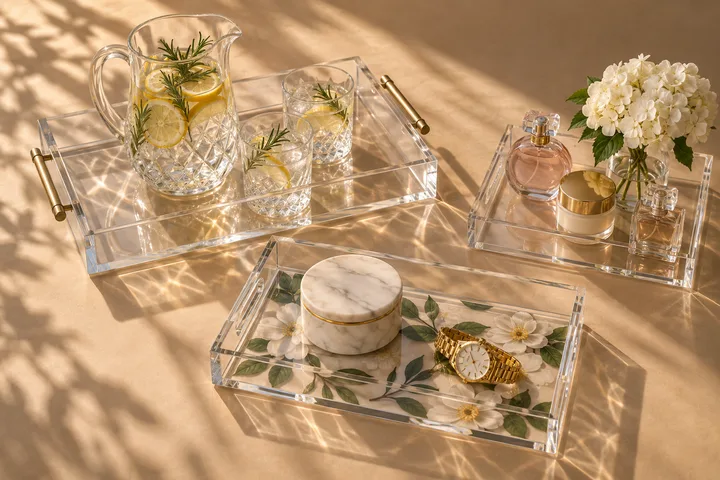
Buyers who want a tray to carry a name, initials, or brand mark have three routes, and the right one depends on run size and whether the artwork stays fixed across the order. A laser-etched monogram is a permanent frosted mark cut into the acrylic — the choice for a fixed logo or a repeated set of initials. A second-surface UV bottom print puts full-color artwork underneath the tray, protected from wear and washing, and reads through the clear serving surface. An interchangeable printed insert drops a swappable art card into a bottom slot, so one tray body can carry different names or seasonal designs without re-tooling.
| Personalization | Best for |
|---|---|
| Laser-etched monogram | Permanent initials or a single fixed logo; premium frosted look |
| Second-surface UV bottom print | Full-color artwork or photo, protected under the tray; food-safe surface stays clear |
| Interchangeable printed insert | One tray body, many names or seasonal designs — swap the card, keep the tray |
For the numbers behind each: our laser-etched acrylic tray logo spec (etch depth, register, art prep) and our bottom-print quality spec (second-surface anatomy and how a print earns a watertight, bubble-free pass).
Shape & Finish Menu
Serving trays are cut to shape, so the outline and surface finish are both open choices — not fixed catalog options. Pick a shape and a finish, or send a reference and we match it.
| Choose a shape | Choose a finish |
|---|---|
| Rectangular | Clear |
| Square | Frosted |
| Round | White |
| Scalloped-edge | Black |
| Custom outline (to your drawing or reference) | Mirrored |
Nested & Stacking Sets
A nested serving-tray set is three or four trays cut in graduated sizes so each seats inside the next, collapsing a full family into the footprint of the largest tray. For catering fleets that move service between venues, and for multi-property programs that standardize one tray family across sites, that space saving is the point — it cuts storage shelf space and lowers per-set shipping volume, since the set travels as one compact stack instead of loose trays.
The engineering that makes a set nest cleanly is the step sizing between trays. Each tray is stepped down enough in length and width — and the wall drafted — so an upper tray drops in and lifts out freely without wedging, but not so loose that the stack rattles in transit. We tune that clearance to your material thickness and set count at the sample stage, and use cut-out handles across the set because they keep the stack low and let a gloved hand separate two trays quickly. Material, edge finish, and branding are matched across the whole set so it reads as one family.
Serving Trays We've Built
Representative custom serving-tray projects from our Shenzhen factory. Client details are anonymized.
Hotel Lobby & Room-Service Trays
400 units · 16×12in · Clear cast acrylic, 5mm · Cut-out handles · Diamond polished · Laser-etched property logo
Branded Restaurant Serving Trays
200 units · 18×13in · Clear acrylic, 5mm · Brushed-stainless metal handles · UV-printed bottom logo
Catering Nested Tray Sets
150 sets · 14/16/18in graduated · Clear acrylic, 5mm · Cut-out handles · Stackable for transport
Spa Amenity & Bar Trays
150 units · 12×10in · Frosted acrylic bottom, 5mm · No handles · Diamond-polished edges
Have a similar project? See how we built bespoke trays with integrated artwork for a hospitality brand, or explore our customization options.
Send Us Your IdeaWe moved our room-service program from wooden trays that warped to clear acrylic with our logo etched underneath. They survive the dish line, they're light enough for staff to carry loaded, and guests notice the branding. Reorders have been dead-simple — the sample spec carries straight into every run.
What Affects Acrylic Serving Tray Pricing?
Custom acrylic serving tray pricing depends on five factors: tray size, acrylic thickness, handle type, bottom treatment, and order quantity. A small 3mm handleless tray costs a fraction of a large 8mm metal-handle service tray with a UV-printed bottom. The steepest per-unit drop is between 50 and 500 pieces, where setup, edge-polishing, and handle-mounting time amortize across more trays.
Tray Size
Larger trays use more acrylic and more edge-polishing time. A 12×8in bar tray costs well under a 20×14in banquet tray. Size is the biggest cost driver after quantity.
Acrylic Thickness
An 8mm heavy-duty tray uses far more material than a 3mm decorative tray the same size. Daily commercial service usually calls for 5–8mm; light or single-event trays can run 3mm.
Handle Type
Handleless is simplest and cheapest. Cut-out handles add CNC routing time. Metal handles add stainless or brass hardware plus mounting — the most cost per tray.
Bottom Treatment
A solid bottom is baseline. Laser etching and silk-screen add per-unit time; full-color UV printing adds per-unit cost. Multi-color and photographic bottoms cost the most.
Order Quantity
The steepest price drop is between 50 and 500 pieces. At 1,000+ units, setup, tooling, and material waste per unit all drop significantly.
Indicative Pricing Ranges (FOB Shenzhen)
| Serving tray | Typical size | Spec | MOQ | Indicative FOB Range |
|---|---|---|---|---|
| Small handleless amenity tray | 10"×7" | 3mm clear, diamond-polished, solid bottom | 200 pcs | from $5–10 / unit |
| Cut-out-handle service tray | 16"×12" | 5mm clear, routed handles, etched logo | 200 pcs | from $10–18 / unit |
| Metal-handle restaurant tray | 18"×13" | 5mm clear, brushed-stainless handles, UV-printed bottom | 200 pcs | from $18–32 / unit |
| Heavy-duty banquet tray | 20"×14" | 8mm clear, brass handles, silk-screened bottom | 100 pcs | from $30–55 / unit |
| Nested set (3 trays) | 14"/16"/18" | 5mm clear, cut-out handles, matched etching | 50 sets | from $28–48 / set |
Ranges are indicative and non-binding. Custom serving trays have no fixed price — final cost depends on your exact dimensions, material grade, handle, bottom treatment, and quantity. UV printing adds per-unit cost only (no setup fee); custom Pantone acrylic may require a minimum sheet order; DDP door-to-door shipping is quoted separately. Send your spec for an exact quote.
Wholesale & Bulk Pricing Tiers
Serving-tray buyers usually order in quantity bands — roughly 100, 500, 1,000, and 10,000 pieces — and per-unit cost drops at each step. The reason is fixed cost: cutting setup, edge-polishing jigs, print screens or etch files, and any handle-mounting fixtures are one-time costs amortized across the run, so the more trays share them, the less each tray carries. The steepest drop is the jump off the MOQ; from there the curve flattens as material and labor, not setup, dominate the unit cost. Every band below is quoted per project and priced FOB Shenzhen — send your target quantity and spec and we return tier pricing so you can size the order to your budget.
| Order band | What drives the per-unit price | Per-unit trend |
|---|---|---|
| MOQ 50–100 pcs | Setup, tooling, and edge-polishing spread over few trays | Highest per unit — pilot / test run |
| 500 pcs | Setup amortized across a full first production run | Sharp drop off the MOQ |
| 1,000 pcs | Material and labor dominate; setup near-negligible per unit | Lower, curve flattening |
| 10,000 pcs | Full sheet-yield and line efficiency; least waste per tray | Lowest per unit — program pricing |
Bands are indicative; exact tier pricing depends on your dimensions, thickness, handle, and bottom treatment. Ask for quantity-tier pricing in your quote and we return the full curve.
Who Orders Acrylic Serving Trays?
Acrylic serving trays are ordered by hotels, restaurants, catering companies, spas, corporate gifting programs, and airline and lounge operators. The common thread: a tray that survives daily service and washing, stays light enough to carry loaded, and carries brand identity on the bottom. The scenarios below are representative use-verticals, not named customers.
Hotels & Amenity Programs
Housekeeping and mini-bar teams sourcing amenity and room-service trays durable enough for daily cleaning. Representative scenario: 400 clear 16×12in cut-out-handle trays with a laser-etched property logo, ~18-day delivery.
Restaurants & Catering
Restaurant groups, cafes, and caterers needing service trays that survive a busy floor and match brand identity. Representative scenario: 200 clear 18×13in trays with brushed-stainless metal handles and UV-printed bottom artwork, ~20-day delivery.
See food & bakery displays ›Home & Gift Retail
Home-goods, lifestyle, and DTC brands ordering serving trays as retail SKUs or gift items — clear or frosted, often with a printed bottom or a lid to convert the tray into a presentation set. Representative scenario: 300 clear trays with cut-out handles and a printed monogram, ~16-day delivery.
Spa & Wellness
Spas, salons, and wellness chains sourcing treatment-room and retail-counter trays with a calm, premium finish that reads as a fixture, not packaging. Representative scenario: 150 mirrored- or frosted-bottom rectangular trays with diamond-polished edges and no handles, ~14-day delivery.
Corporate Gifting & Events
Brands and event teams ordering branded serving trays as gifts, launch props, or favor trays with custom color and logo. Representative scenario: 500 custom-Pantone colored trays with a silk-screened company logo and no handles, ~18-day delivery.
Airlines & Lounges
First-class cabins, airport lounges, and premium travel service needing lightweight, unbreakable trays that pass a shatter-safety brief and carry lounge branding. Representative scenario: 600 lightweight clear trays with cut-out handles and an etched lounge mark, ~18-day delivery.
How to Order Custom Acrylic Serving Trays
From your first message to delivered serving trays — 3 steps.
Share Your Spec
Send us your tray dimensions (or a reference photo), handle preference, quantity, and any bottom-branding artwork. No CAD file needed — a rough size and a logo file work. We respond within 24 hours with a detailed quote and material recommendation.
We respond within 24 hoursApprove a Sample
We build a production sample with your exact dimensions, handle, bottom treatment, and branding, and confirm the color match. What you approve is what we produce. Sample cost is credited to your first bulk order.
Sample ready in 3–5 daysReceive Your Order
Every serving tray passes 100% inspection — edge polish, handle fit, print quality, and dimensional tolerance checked on every unit. FOB Shenzhen standard; CIF and DDP available for door-to-door delivery.
Production in 15–20 daysFrequently Asked Questions
How much do custom acrylic serving trays cost?
Five factors drive acrylic serving tray pricing: tray size, acrylic thickness (3mm for light decorative trays vs 5–8mm for daily-service hospitality trays), handle type (handleless is simplest; cut-out handles are CNC-routed; metal handles add stainless or brass hardware), bottom treatment (solid vs UV-printed, silk-screened, or laser-etched branding), and order quantity. Unit cost drops sharply above 200 pieces because setup and edge-polishing time is amortized across more trays. As a rough guide, indicative FOB Shenzhen pricing runs from about $5–10 per unit for a small handleless tray up to $30–55 for a large metal-handle service tray with printed bottom art — non-binding ranges that we confirm against your exact spec. Send us your dimensions, handle preference, and quantity and we respond within 24 hours with an exact quote.
Are acrylic serving trays food-safe and dishwasher-safe?
Cast acrylic (PMMA) is FDA-compliant for food contact, and for serving trays we use cast PMMA rather than extruded because its heat-deflection temperature (~100°C) survives commercial dishwasher cycles (60–65°C) without softening. For food-contact trays we verify the material against the regulation your market needs — FDA 21 CFR 175.105 in the US, EU 10/2011 in Europe — and supply the technical data sheet tied to your production lot. Avoid alcohol-based, ammonia, or abrasive cleaners; they stress-craze PMMA over months of repeat washing. Mild detergent and a soft cloth keep the surface optically clear.
What handle options are available for acrylic serving trays?
Three options. Metal handles — stainless steel or brass, attached with hardware — give the strongest grip and a premium hospitality feel, best for busy service floors. Cut-out handles are routed directly into the acrylic for a seamless one-piece look with no hardware to loosen. Handleless serving trays have clean polished edges and read as a minimal presentation surface. We also build nested serving-tray sets that stack for storage. Handle style is chosen to match your service environment and brand look.
What is the minimum order quantity for acrylic serving trays?
Our MOQ for custom acrylic serving trays is 50 pieces per design. That lets a boutique hotel test amenity-and-service trays before a full rollout, or a restaurant group commit to a single branded run. Per-unit pricing drops as quantity rises — ask for quantity-tier pricing in your quote. Sample production takes 3–5 days; bulk production runs 15–20 days.
Can you print or etch our logo on the bottom of a serving tray?
Yes. Because clear acrylic is fully transparent, branding on the tray bottom reads through the serving surface without sitting where food or drinks rest. Options: UV printing for full-color logos and artwork, silk-screen printing for one or two solid colors, laser etching for a permanent frosted mark, and hot stamping for gold or silver foil accents. For food-service trays we print second-surface (underneath) so the ink is protected from wear and washing. Send vector artwork (AI/EPS preferred) and we confirm placement and color match at the sample stage.
Acrylic vs wood or stainless steel serving trays — which lasts longer in service?
Each material fails a different way. Wood absorbs liquid, stains, and warps once its seal wears through, and it can't show bottom branding. Stainless steel is durable but heavy, dents, shows fingerprints, and offers no visual depth. Melamine looks fine until the surface scratches and dulls. Cast acrylic is fully waterproof, roughly half the weight of a comparable steel tray, won't shatter when dropped, takes a diamond-polished edge that holds clarity past 100 wash cycles, and can carry printed or etched branding on the bottom. For daily commercial service where the tray is also a brand touchpoint, acrylic is the default.
Can the same serving tray ship in two split batches — air-freight rush, sea-freight balance?
Yes. For launches we routinely split shipments: a 50–200 pc air-freight first batch to hit your opening or event date, with the balance by sea freight 25–35 days later at a lower per-unit landed cost. We quote both legs together so total landed cost is clear upfront. FOB Shenzhen is standard; CIF and DDP door-to-door delivery is available for the US, EU, UK, and Australia.
Can you make a lighter tray? How does thickness affect weight?
Yes — wall thickness is the main lever on weight, and we tune it to your use. A large tray in 5mm cast PMMA carries a lot of material; dropping to 3mm can cut a tray's weight by roughly a third for the same footprint, which matters if staff carry it loaded through a shift or a buyer has told us the current tray is too heavy. The tradeoff is rigidity: thinner walls flex more, so a light 2–3mm tray suits decorative, amenity, or single-event use, while daily commercial service that sees heavy plates and repeat washing usually wants 5mm to stay flat and rigid. We size thickness to the tray's real load rather than defaulting to the heaviest option — tell us how the tray gets used and we recommend the lightest wall that still holds its shape, then confirm the exact sample weight before you approve production.
What's my landed / DDP cost per tray including freight?
Landed cost depends on Incoterm and shipping mode, so there's no single flat number. Our standard quote is FOB Shenzhen — the tray cost at our door — and from there you add freight to your destination. We can also quote DDP (delivered duty paid), where we handle freight, customs, and delivery to your door and roll it into one per-tray figure. Air freight lands in about 5–10 days but costs more per unit; sea freight is cheaper per unit but runs 25–35 days transit. For launches we often split the order — a small air-freight first batch to hit a date, the balance by sea to lower the average landed cost. Send your destination, quantity, and target date and we quote FOB and DDP side by side so the delivered per-tray cost is clear before you commit.
Can you add a matching lid or dividers/compartments?
Yes. A serving tray can be built with a matching acrylic lid that turns it into a covered presentation or storage set, and the interior can be divided into compartments — useful for amenity kits, multi-count packaging, or keeping items from sliding. Lid fit and divider layout are engineered to your contents and confirmed at the sample stage, including how easily the lid opens and closes. For the full spec — lid clearance, divider tolerances, and how the compartments are cut — see our acrylic serving tray with lid and compartments spec guide at /guide/acrylic-serving-tray-with-lid-compartments-spec.
Can you monogram or personalize each tray?
Yes. Three routes: a laser-etched monogram cuts permanent initials or a fixed logo into the acrylic as a frosted mark; a second-surface UV bottom print puts full-color artwork underneath the tray, protected from wear and reading through the clear surface; and an interchangeable printed insert drops a swappable art card into a bottom slot so one tray body can carry different names or seasonal designs. Etching and second-surface print are fixed for the run; the insert route lets each tray differ without re-tooling. Send vector artwork (AI/EPS preferred) and we confirm placement and color match at the sample stage.
Will the tray scratch or cloud over time, and how do I clean it?
Acrylic resists clouding far better than it resists scratching, and both come down to care. Cast PMMA won't yellow or go milky from normal use, but the surface is softer than glass, so abrasive pads or grit will scratch it. Clean with a microfiber cloth and mild dish soap in warm water, then rinse — that handles daily service without marking the surface. The one thing to avoid is ammonia- or alcohol-based glass cleaners: repeated exposure can stress-craze cast PMMA, producing fine surface cracks that read as cloudiness over months of use. Skip the window spray, use mild soap and a soft cloth, and a diamond-polished tray holds its clarity through heavy commercial washing.
Have a Serving Tray Design? Let's Quote It.
Send us your dimensions, handle preference, and quantity — plus any bottom-branding artwork. We respond within 24 hours with a detailed quote covering material grade, handle type, bottom treatment, and timeline. No commitment required. Sample before you commit to production.