




Delivered Project · Catering & Events
Wearable Catering Tray Program
This delivered project covers a 150-piece wearable catering-tray program.
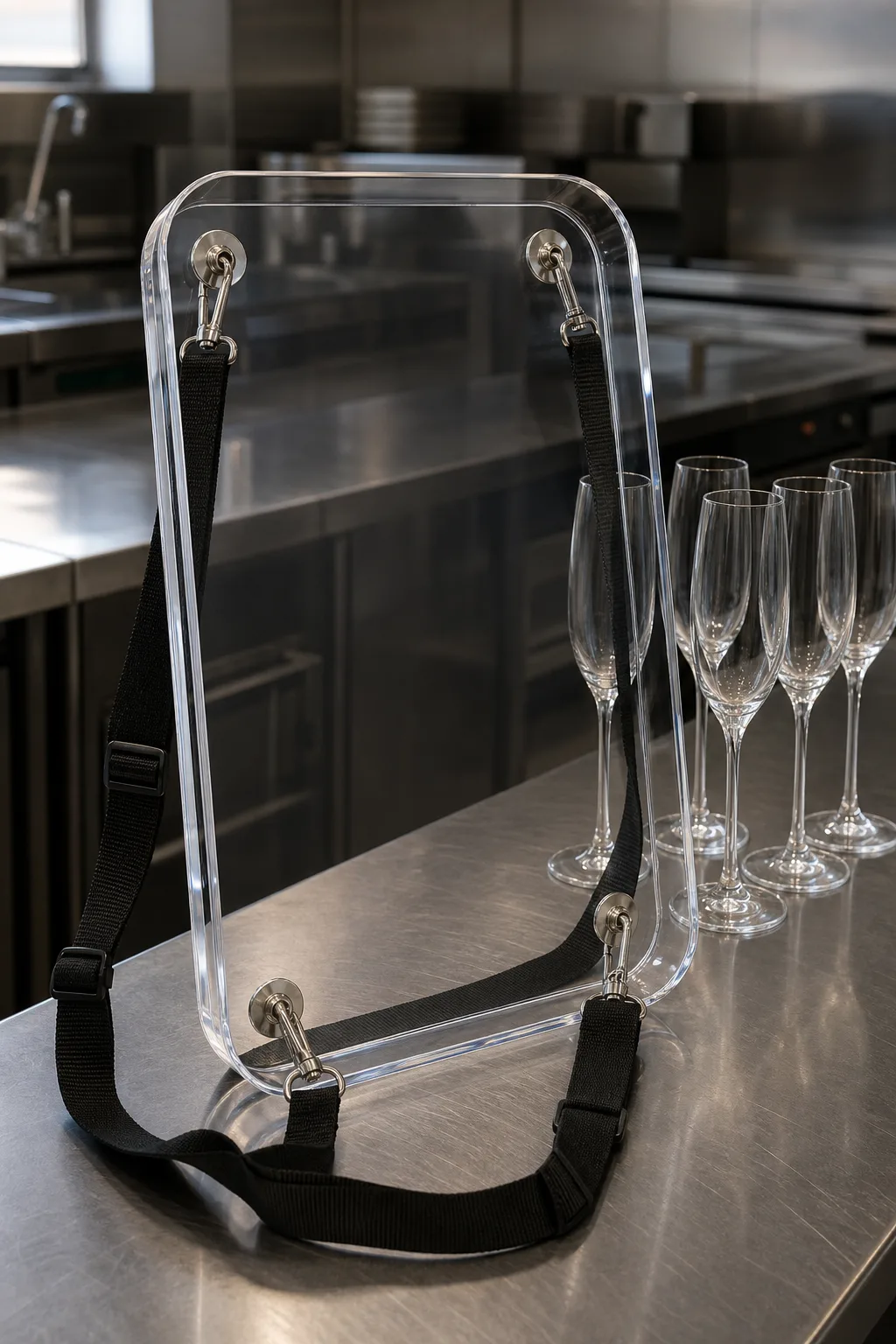
The buyer-defined load, strap layout, cleaning routine, hardware, packing, and dynamic test were approved on a production-intent sample before bulk release. Project profile: One tray family controlled by a released anchor drawing, hardware schedule, sample test, and inspection plan.
- program trays
- 150
- anchor points
- 4
- working load
- 8 kg
- cast acrylic
- 6 mm
Ordering a similar project
The minimum order is 100 pieces per design. Paid samples normally take 3–5 days, are paid separately, and are never credited to production. Standard production takes 15–20 days after the drawing, material, hardware, sample, inspection plan, and packing are approved; Wetop responds to a complete brief within 24 hours.
Different-specification price reference: the acrylic serving trays page lists an 18 × 13 in, 5 mm clear tray with brushed-stainless handles and a UV-printed bottom at 200 pieces from $12–22 per unit FOB Shenzhen. That conventional handled tray is not wearable and is not a quote for this project. Anchor hardware, load case, dimensions, thickness, cleaning requirements, packing, quantity, and destination determine the written quotation.
Key Takeaways
- We quoted the wearable tray from the loaded weight, load position, strap layout, walking motion, cleaning method, and the buyer’s acceptance test.
- The anchor is a system: the hole position and finish, eyelet or bushing, backing plate, webbing, and hardware all went through sample approval.
- Four anchor points carried the buyer’s load case but were not a capacity guarantee; the approved sample had to stay level under the defined load.
- This program delivered 150 trays with four anchor points and an 8 kg working load, each verified on the approved sample.
- Reorders can reuse released files and approved hardware, but quantity, material lot, cleaning requirement, packing, and destination are reconfirmed.
The Challenge
A wearable tray places repeated, moving load into a small number of attachment points. The brief therefore started with the loaded weight, its position on the deck, the walking motion, the strap path, the cleaning routine, and the consequence of a loose or damaged anchor.
A tabletop tray carries a different load case. A wearable tray hangs from a person, which changes the approval work:
- The load is dynamic. A tray on a table carries static weight. A worn tray swings, bounces with each step, and jerks when a guest lifts a glass — the anchors see repeated load cycles, which is exactly what grows a crack from a machining mark.
- The failure consequence is higher. The buyer defined the maximum load, inspection interval, retirement criteria, and a dynamic sample test before production.
- It still has to be a food surface. Whatever reinforcement went in, the tray needed a crevice-free top that washes fast between shifts and looks clean doing it — the trays are carried at guests' chest height, closer scrutiny than any tabletop tray gets.
Our Approach
We built the trays on a 550 × 350 mm deck in 6 mm cast acrylic, with a raised rim and four anchors. The final drawing followed the buyer's load case, reach, balance, hardware, and cleaning requirements.
Why drilled holes crack: stress concentration at the anchor
Two things gang up on a bare strap hole. First, geometry: a small hole in a loaded panel concentrates load at the hole wall and edge. Second, surface: a drilled hole wall carries machining marks that can act as crack starters. The drawing therefore controlled hole position, finish, eyelet or bushing, backing plate, and webbing contact instead of leaving a bare hole as an undefined attachment.
The production sample used polished holes, stainless eyelets, and backing plates so webbing bore on hardware rather than directly on acrylic. Exact diameters, edge distance, plate size, and hardware grade came from the buyer's load case and were confirmed by the approved dynamic sample test.
Load and human factors: where 8 kg actually goes
The buyer supplied the maximum loaded weight and representative load positions. The four-anchor harness carried that load case but was not a capacity promise: the sample had to stay level as items were removed from different zones and had to pass the agreed walking, stop, turn, and hardware-retention checks.
A surface that survives nightly washing
Reinforcement solves nothing if the cleaning plan is unsuitable. The trays used a plain polished panel and removable mat, and the buyer identified the food-contact market, service temperature, cleaner, sanitation method, and required documentation. We confirmed the named sheet and finished sample against that written requirement and did not apply a blanket dishwasher-safe or food-contact claim. See thefood-safe acrylic tray guide.
| Specification input | Value approved for this program |
|---|---|
| Tray size | 550 × 350 mm |
| Material | 6 mm cast acrylic |
| Rim | 25 mm raised, interior corners radiused 10 mm |
| Anchor holes | 10 mm, at 30 mm edge distance, flame-polished walls |
| Washer plates | 40 mm stainless, underside of each anchor |
| Strap | 38 mm webbing, over-the-shoulder harness, four anchors |
| Working load | Roughly 8 kg fully dressed |
The Results
The result was a buyer-approved release package. Bulk started only after the tray drawing, hardware schedule, loaded-balance test, cleaning requirement, inspection plan, packing, and sample were approved.
Field performance must be recorded by the buyer under the intended service. The useful log identifies each tray, load, event count, anchor condition, hardware condition, cleaning cycle, and retirement decision. That evidence, not an anonymous testimonial or a calendar-life promise, informs any reorder.
Buyer decision point: We released the wearable tray only after the production-intent sample passed the agreed loaded-balance, motion, hardware-retention, cleaning, and inspection checks.
What This Means for Your Project
If your acrylic piece hangs, straps, or mounts from discrete points — worn trays, suspended displays, wall-hung panels — the detail to interrogate is the hole, not the panel. Acrylic carries distributed loads differently from point loads; edge distance, hole finish, and hardware all affect the attachment. The buyer-defined sample test establishes whether the selected detail is suitable. None of that shows up in a product photo, which is why it is worth asking a supplier to describe their anchor detail before comparing prices.
The same thinking scales down. Even a tabletop tray with cut-out handles has two stress concentrations — the handle radii, so those inside edges and the loaded sample still need an explicit inspection gate.
Common Questions
The answers below identify the load, hardware, and sample checks required before production release.
How much weight can a wearable acrylic tray carry?
Capacity is not universal. The buyer must state the loaded tray weight, load position, strap layout, walking motion, and acceptance test. Wetop confirms the panel, hole position, eyelet, washer, webbing, and safety margin on a production-intent sample before bulk release.
Why not just drill holes in the tray for the straps?
A bare drilled hole concentrates load at the hole wall and edge. The anchor specification therefore covered edge distance, hole finish, eyelet or bushing, backing plate, webbing, and a buyer-approved dynamic load test instead of a bare hole.
Are wearable acrylic trays dishwasher safe?
Use the cleaning method approved for the named sheet and finished sample. Wetop does not make a blanket dishwasher-safe or food-contact claim for an unspecified build; the buyer identifies the market, cleaner, temperature, contact conditions, and required documentation before quotation.
Before requesting a quote, prepare the loaded tray weight, product layout, strap path, user-height range, walking conditions, cleaning method, market, quantity, delivery destination, and required acceptance test. Include photographs or drawings of the intended service setup and identify any removable mat, cup recess, branding, or food-contact documentation requirement. These inputs let the supplier review balance, anchor placement, edge clearance, hardware, packing, and sample testing as one system instead of pricing an incomplete tray outline.
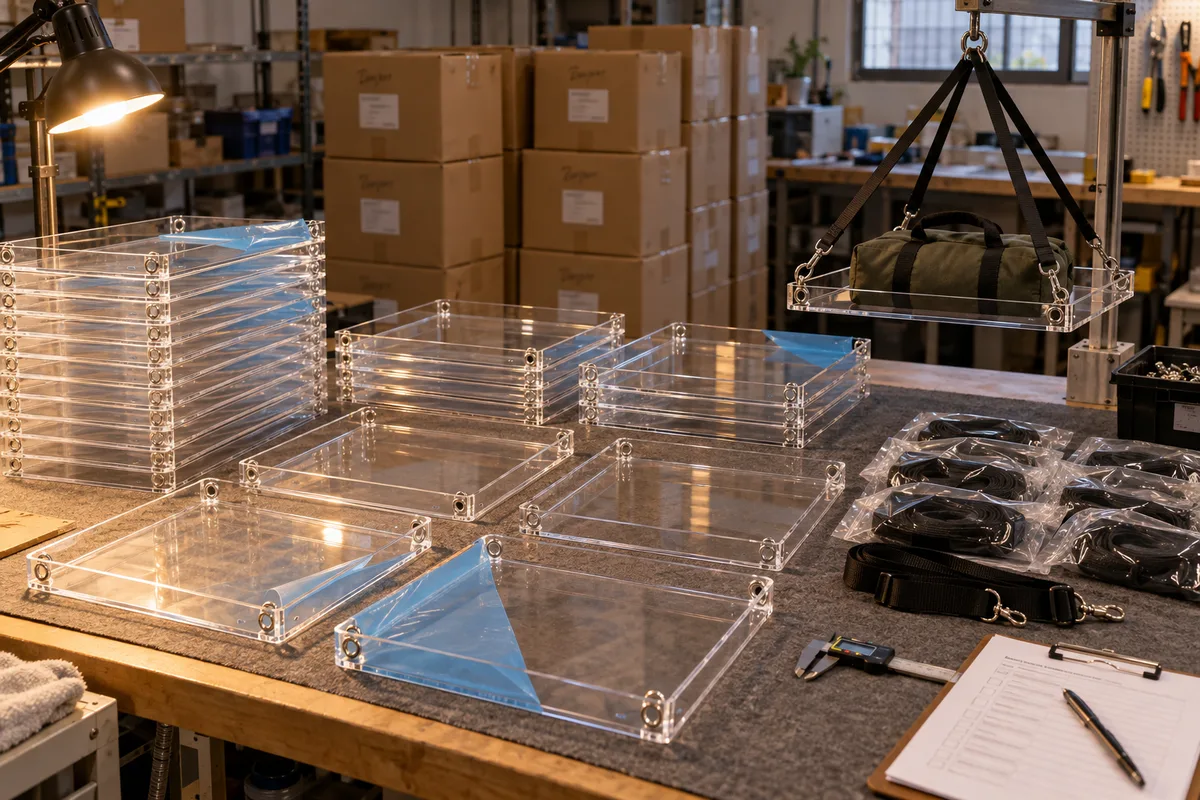
Building a tray that has to survive real service?
Tell us how the tray is carried, what it holds, and how it gets washed — we'll come back with an anchor and material recommendation, a DFM review, and a quote.
Paid sample in 3–5 days, separately paid and never credited