
Buyer Guide

Food Safe Acrylic Tray: Is It Dishwasher-Safe?

Yes to food-safe with the right grade. No to the dishwasher. Here is the regulation, the heat limit, and the care spec that keeps trays clear.

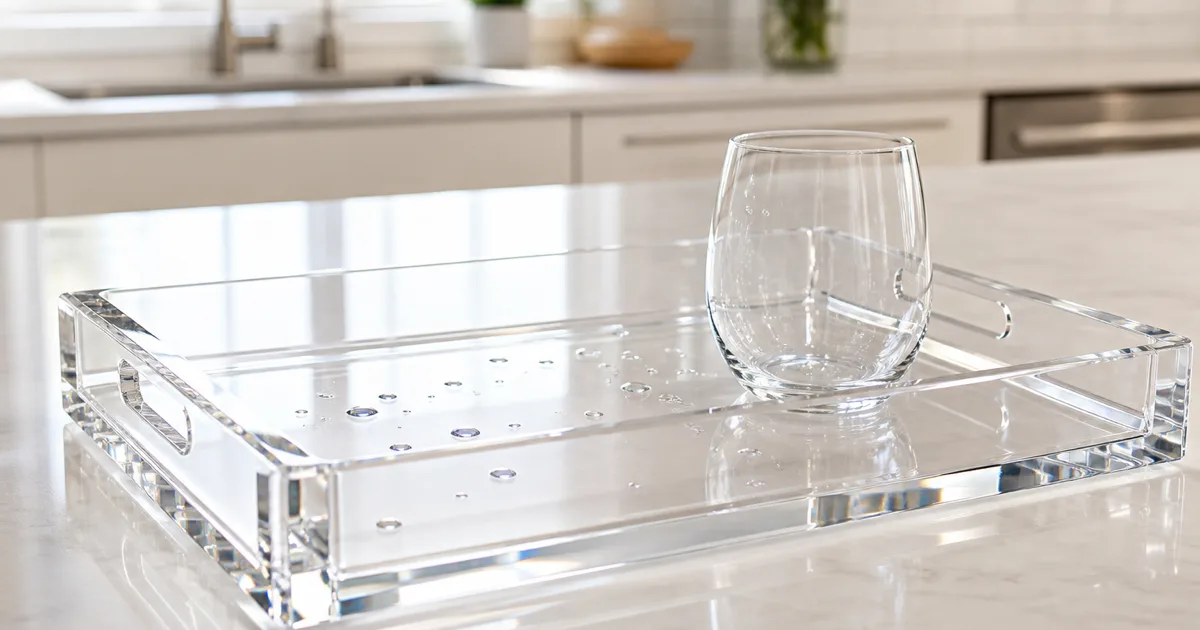
Clear food-grade acrylic serving tray holding pastries on a hotel amenity counter, light refracting through the polished cast PMMA edges

Key Takeaways

  1. Acrylic (PMMA) is permitted for food contact under FDA 21 CFR 177.1010 and, in the EU, under Regulation (EU) 10/2011 — but only material made to a food-grade formulation qualifies, so ask your supplier for the compliance documentation.
  2. Acrylic is BPA-free by chemistry: it is made from methyl methacrylate, not bisphenol A, unlike polycarbonate — so 'BPA-free' is a real, verifiable advantage for acrylic food trays.
  3. Acrylic serving trays are not dishwasher-safe: PMMA's heat-deflection temperature is roughly 96 °C, and commercial wash-and-dry cycles combine heat with harsh detergents that craze the surface into hairline cracks.
  4. Hand-wash only — warm water, mild dish soap, and a soft cloth keep a tray clear for years; skip abrasive pads, alcohol, ammonia glass cleaners, and any solvent, all of which attack the surface.
  5. For cold and room-temperature food service — pastries, canapés, amenities, bar snacks — food-grade acrylic performs well; it is not intended for hot food, microwaving, or oven use.
On this page
  1. The 30-second answer — food-safe yes, dishwasher no
  2. Is acrylic food-safe? What the regulations actually say
  3. Are acrylic trays dishwasher-safe?
  4. Acrylic vs polycarbonate: the BPA question
  5. How to clean an acrylic serving tray
  6. Can acrylic trays hold hot food?
  7. Cast vs extruded, and why grade quality matters
  8. What compliance documentation to request
  9. Acrylic vs melamine, glass, and stainless — on food-safety and care
  10. Do acrylic trays scratch or cloud over time?
  11. Which food-service settings suit acrylic trays?
  12. How we sourced this guide

The 30-second answer — food-safe yes, dishwasher no

A food safe acrylic tray is real: acrylic (PMMA) is permitted for food contact under FDA 21 CFR 177.1010 and, in Europe, under Regulation (EU) 10/2011.1 It is also not dishwasher-safe. PMMA softens near 96 °C, and a hot wash-dry cycle with strong detergent crazes the surface into hairline cracks.2 Hand-wash keeps a tray clear.

Those two facts settle the question most buyers actually ask, but they hide a spec that decides whether the tray you order is safe or not: “acrylic” alone is not a guarantee. Only material made to a food-grade formulation clears the FDA and EU rules, and only careful hand-washing keeps that material looking new. This guide walks the regulation, the exact heat limit, the reason dishwashers ruin acrylic, the do’s-and-don’ts of cleaning, and the compliance paperwork to request — so you can brief a food-service tray program without a second round of questions.


Is acrylic food-safe? What the regulations actually say

Acrylic is food-safe when it is made to a food-grade formulation. In the US, the FDA regulates acrylic under 21 CFR 177.1010, titled “Acrylic and modified acrylic plastics, semirigid and rigid,” which permits these plastics as articles intended to contact food, subject to defined composition and extraction limits.1 In the EU, plastic foodware falls under Regulation (EU) 10/2011, which only allows substances positive-listed in its Annex I and sets migration limits.3

The phrase that carries all the weight is food-grade. Acrylic sheet and resin come in many formulations — optical, signage, weather-resistant, cast, extruded — and not every grade is compounded for food contact. A food-grade acrylic is made from monomers, additives, and colorants that stay within the migration limits those regulations set. When a tray is fabricated from a compliant grade, it is food-safe for the cold and room-temperature service acrylic is built for. When it is cut from a generic display sheet with no food-contact declaration, the honest answer is: nobody has verified it. That is why the useful buyer question is never “is acrylic food-safe?” but “is this tray made from a documented food-grade acrylic?” — and why we cover the paperwork you should request further down.

What “food contact” testing checks

Food-contact compliance is a migration question, not a marketing label. Under both the FDA and EU frameworks, a material is tested against food simulants — water, dilute acid, ethanol, and fatty solutions that stand in for real foods — to confirm that substances migrating out of the plastic stay below defined limits.1 The relevant properties are chemical, not mechanical: it does not matter how clear or how thick the tray is, only what leaches into contact with food. This is why a supplier’s food-grade claim should trace back to a material declaration or test report for the specific grade used, not to a general statement that “acrylic is safe.” The material and the article are different things; a food-grade sheet fabricated cleanly gives you a food-safe tray, and that chain is what the documentation confirms.


Are acrylic trays dishwasher-safe?

No — acrylic serving trays are not dishwasher-safe, and running them through a cycle is the fastest way to ruin one. Cast PMMA has a heat-deflection temperature of about 96 °C (204 °F) and a glass-transition temperature near 110 °C.2 A household dishwasher wash cycle runs roughly 60–71 °C and the heated dry stage climbs higher, right into the range where acrylic starts to soften and distort.4

Heat is only half the problem. The other half is chemistry. Dishwasher detergents and rinse aids are aggressive by design, and the combination of heat plus harsh cleaning agents causes acrylic to craze — a network of fine hairline cracks that spreads across the surface. Crazing clouds a once-clear tray, weakens it, and creates crevices that trap food and defeat the point of a service tray. It is progressive and permanent: once the surface crazes, no cleaning brings the clarity back.5 Most acrylic and plexiglass makers therefore recommend hand-washing to preserve clarity and avoid this exact failure.6 The manufacturers who print “hand wash only” on acrylic drinkware are not being cautious for its own sake — they have watched dishwashers cloud the product.

Why the crazing shows up on the tray floor first

In 10+ years of opening finished orders for final QC, the first place I look for crazing is the flat tray floor, not the edges. That surprises buyers, so it is worth explaining. The tray floor is the largest continuous surface and usually the thinnest section, so it heats and cools fastest and carries the most residual stress from forming. When a hot detergent cycle hits it, that stored stress plus the chemical attack finds the weakest plane and spreads. On a bottom-printed tray the risk compounds, because the print sits on the second surface exactly where the stress and the wash chemistry meet. This is one more reason a food-service acrylic tray program should specify hand-washing in the care card that ships with the order — the failure is designed out at the care step, not at the material step.


Acrylic vs polycarbonate: the BPA question

Acrylic is BPA-free by chemistry, and that is a genuine advantage over polycarbonate for food service. Acrylic (PMMA) is polymerized from methyl methacrylate; polycarbonate is made using bisphenol A (BPA) as a building block.7 So acrylic never carried the BPA concern that pushed many buyers away from certain polycarbonate foodware — the concern simply does not apply to the material.

That does not make polycarbonate unsafe. BPA-free polycarbonate grades exist and are widely used, and polycarbonate brings far higher heat resistance (usable to around 135 °C) and much better impact strength, which is why commercial foodservice reaches for it on hot-line and heavy-duty items.7 The trade-off runs the other way on clarity and cost: acrylic is glass-clear, takes a premium polish, and holds its optical quality, which is what makes it the material of choice for display-forward service — bakery cases, amenity trays, beverage service, and branded presentation. For a buyer, the practical read is simple. If the job is cold or room-temperature food presented in front of a guest, food-grade acrylic gives you clarity, a real BPA-free story, and a premium look. If the job involves sustained heat or rough handling, that is a polycarbonate or stainless conversation, not an acrylic one.

Heat-deflection comparison: acrylic vs a typical commercial dishwasher cycleBar comparison in degrees Celsius. Commercial dishwasher wash cycle around 65 C and heated dry higher; acrylic PMMA heat-deflection temperature about 96 C and glass transition about 110 C. The wash-and-dry range overlaps the zone where acrylic begins to soften, which is why acrylic trays are not dishwasher-safe.Dishwasher wash~65 CDishwasher dry stagehigherAcrylic HDT~96 CAcrylic Tg~110 CThe wash-and-dry heat plus harsh detergent overlaps the softening zone, so acrylic crazes in a dishwasher.

How to clean an acrylic serving tray

Hand-wash acrylic trays in warm water with a few drops of mild dish soap, wiped with a soft cloth or sponge, then air-dry or blot with a microfiber towel. That single habit is the difference between a tray that stays clear for years and one that clouds in a season. Warm — not hot — water avoids the heat-softening range, mild soap avoids chemical attack, and a soft cloth avoids the micro-scratching that dulls the surface over time.8

The mistakes are as important as the method, because acrylic fails from the wrong cleaner, not from normal use. Never reach for alcohol, ammonia-based glass sprays (most blue window cleaners), acetone, or any solvent — these are the exact agents that trigger crazing, and one wipe with the wrong product can permanently haze a tray.6 Skip abrasive pads, scouring powders, and even paper towels, which are wood fiber and scratch clear acrylic. For dried-on food, soak the tray first and let the residue lift, rather than scrubbing. Light surface scratches can be buffed out with a purpose-made plastic polish, which is a repair option glass and melamine do not offer. For a fuller walkthrough of keeping acrylic clear across products, see our guide to cleaning acrylic displays without hazing or scratching.

Care do’s and don’ts

The table below is the care spec worth printing on the card that ships with a food-service tray order — it prevents the two failures (crazing and scratching) that account for most “the tray clouded” complaints.

DoDon’t
Hand-wash in warm water with mild dish soapPut the tray in a dishwasher (heat plus detergent crazes it)
Wipe with a soft cloth, sponge, or microfiberUse abrasive pads, scouring powder, or paper towels
Soak dried food loose, then wipe gentlyScrub hard at stuck residue
Use a dedicated plastic/acrylic polish for light scratchesClean with alcohol, ammonia glass cleaner, acetone, or solvents
Serve cold and room-temperature foodHold hot food, microwave, or place near an oven or heat source
Air-dry or blot dryAir-dry near a heat vent or in direct sun for long periods

Can acrylic trays hold hot food?

Acrylic serving trays are built for cold and room-temperature service, not hot food. Because PMMA softens near 96 °C, a tray is not designed for food straight from the oven, for microwaving, or for oven use.2 Its home is the presentation side of service — pastries, canapés, sushi, cheese and charcuterie, packaged amenities, bar snacks, and beverage service — where clarity and a clean edge matter more than heat tolerance.

This is a scope point, not a defect, and it is worth pinning down at the briefing stage. Warm ambient food and warm-to-the-touch plated items sit comfortably on acrylic; a hot casserole dish pulled from an oven does not. If your program has any hot-service leg — a heated buffet line, room-service covered plates carrying hot mains, a bakery moving trays near ovens — flag it to your supplier before you spec the material. A good fabricator will either design around it (insulated placement, a liner, a lid that isolates the hot component) or tell you honestly that a different material fits that leg better. The trays we build for hospitality and catering programs are almost always cold-and-ambient by design, and the food-service teams that use them treat “cold and room-temp” as the operating envelope — as in our hotel amenity tray case study, where the brief was cold amenity presentation with integrated artwork. For the format and thickness side of that spec, our serving-tray spec guide covers handles, depth, and weight.


Cast vs extruded, and why grade quality matters

For a food-service tray, cast acrylic is the grade to request, and not only for the finish. Cast PMMA is polymerized in sheet form, giving it a higher, more uniform molecular weight than extruded sheet, which is melted and rolled. That translates into cleaner polished edges, better performance at cemented corners, and — relevant here — more consistent resistance to the residual stress that crazing exploits.2 Extruded sheet is cheaper and fine for cost-driven, non-food display work, but on a tray that will be washed repeatedly and presented to guests, cast is the honest specification.

Grade quality and food-grade compliance are two separate checks that both matter. A tray can be cast, beautifully polished, and still not food-grade if the sheet was a signage or optical formulation. Conversely, a food-grade sheet fabricated carelessly — solvent-heavy edge polishing, stressed corners — will craze faster in service even though the material itself is compliant. When we quote a food-service tray, we specify a food-grade cast acrylic and control the fabrication so the finished article carries the compliance through to the buyer’s hand. I have pulled trays off the line that were cast and food-grade on paper but crazed early in testing because the edges were solvent-polished under too much stress — the material was compliant, the fabrication was not. The buyer’s job is to ask for both: the food-grade declaration for the material, and cast sheet for the durability. Getting one without the other leaves a gap you will discover in the wash-up sink three months later. Our comparison of lucite trays versus generic acrylic breaks down the cast-versus-extruded finish markers you can inspect by hand.


What compliance documentation to request

Before you commit to a food-service tray run, ask your supplier for material compliance documentation — and treat “we use food-grade acrylic” as the start of the conversation, not the end. The documents that actually verify the claim are the material’s food-contact declaration or technical data sheet (TDS) for the specific grade used, referencing FDA 21 CFR 177.1010 and, for EU-bound goods, Regulation (EU) 10/2011.1 A supplier who works with food-service buyers can produce this; one who cannot is not a supplier for a food program.

At Wetop, we supply material compliance documentation and the technical data sheet for the food-grade acrylic on request, as a standard part of quoting a food-service tray — that is a service we provide, not a proprietary test result we generate in-house. The distinction matters for how you read any supplier’s answer: the food-contact status of acrylic is established by the material maker and the regulation, and a good fabricator’s role is to specify a compliant grade, fabricate it cleanly, and pass the paperwork through. We run 100% inspection on every order and are ISO 9001 certified, which governs how consistently we hold the specified grade and finish across a production run — but the food-safety claim itself rests on the material declaration, and that is the document to request. When I qualify a food-service order, the absence of that declaration is the first thing I flag — if a quote for a food tray comes back with no ability to produce the paperwork, that is the red flag, regardless of how good the sample looks.


Acrylic vs melamine, glass, and stainless — on food-safety and care

On the food-safety and care axis specifically, each common tray material trades one advantage for another, and acrylic’s place is clear: best-in-class clarity and a real BPA-free story, at the cost of not being dishwasher-safe. Melamine is FDA-approved for food service and is dishwasher-safe, but it is opaque, must never be microwaved, and dulls when scratched.9 Glass is fully heat- and dishwasher-safe and inert, but it is heavy and breakable — a liability in high-traffic service. Stainless is the most durable and fully washable, but it is opaque and reads utilitarian rather than premium.

The table below is the head-to-head we walk food-service buyers through when the tray is a presentation piece. It is not that acrylic is “better” — it is that acrylic wins decisively when clarity and guest-facing display are the priority and the service is cold or ambient, and loses ground the moment sustained heat or dishwasher throughput becomes non-negotiable.

MaterialFood-contact statusDishwasherHeatClarityBPAWeight / breakage
Food-grade acrylic (PMMA)FDA 21 CFR 177.1010 / EU 10/2011No — hand-wash onlySoftens ~96 °C; cold/ambient useGlass-clear, polishableBPA-free by chemistryLight, shatter-resistant
MelamineFDA-approved for serviceYesNo microwave; dulls with heatOpaqueBPA-free (melamine-formaldehyde)Light, break-resistant
GlassInert / fully food-safeYesHeat-safeClearBPA-freeHeavy, breakable
Stainless steelInert / fully food-safeYesHeat-safeOpaqueBPA-freeHeavy-ish, dent-resistant

We fabricate acrylic, so we will not pretend it fits every job. When a buyer’s program is a heated buffet line run through a commercial dishwasher a hundred times a week, melamine or stainless is the honest answer for that leg, and we say so. Where acrylic earns its place is the cold, display-forward front of the house — and there, no other material matches clear PMMA on look while carrying a genuine BPA-free and food-contact story.


Do acrylic trays scratch or cloud over time?

Acrylic trays can scratch and can cloud, but almost always from avoidable handling and cleaning, not from normal food service. Acrylic is softer than glass, so abrasive pads, grit, and dry wiping leave fine scratches that dull the surface over time.8 Clouding, separately, comes from the crazing already covered — heat and harsh chemistry — not from age alone. A tray washed by hand with a soft cloth stays clear for years; a tray scoured with a green pad or run through a dishwasher does not.

The practical upside of acrylic here is repairability, which is genuinely different from the alternatives. When glass or melamine dulls or scratches, the surface is finished — you replace the item. Acrylic light scratches buff out with a dedicated plastic polish, restoring clarity that would be lost on other materials.6 For a food-service program that expects a few years of daily handling, that repair path is worth building into the operating routine: soft-cloth wash, occasional polish on the trays that see the most traffic, and the crazing failure designed out at the care-card step. The trays that come back to us looking tired are almost always the ones that met an abrasive pad or a hot cycle, not the ones that simply saw a lot of service. Handled to the care spec, a hand-washed acrylic tray keeps its display-clarity long past the point where its cost has paid for itself, which is the whole reason food-forward venues reach for clear acrylic over opaque melamine in the first place.


Which food-service settings suit acrylic trays?

Acrylic trays fit cold and room-temperature presentation across hospitality, retail, and catering — the settings where clarity and a premium look do the selling and heat is never in play. The clearest fits are hotel amenity and room-service presentation, bakery and café display, bar and beverage service, sushi and cold appetizer plating, retail product staging, and packaged-amenity or gift presentation. In every one of those, the tray is a display surface first and a carrier second, which is exactly where glass-clear acrylic beats opaque or matte alternatives.

The settings to flag before you spec are the ones with a heat leg: heated buffet lines, room-service trays carrying hot covered mains, and any station near ovens or warming lamps. None of those rule acrylic out of the cold part of the same program — a hotel can run acrylic amenity and minibar trays while using a different material on the hot buffet — but the material call has to match the temperature of what sits on it. This is the single most common scoping conversation I have with food-service buyers, and it is easy to get right if you tell your supplier the full service picture up front. When the brief is cold-and-ambient, food-grade acrylic gives you the BPA-free story, the FDA and EU food-contact permission, and the display clarity in one material; when a hot leg exists, the honest answer is to split the program by temperature rather than force one tray to do both jobs.


How we sourced this guide

The regulatory and material facts in this guide are sourced from primary and authoritative references, not from internal Wetop testing — we specify and inspect trays, we do not run a food-contact migration lab. Food-contact permission for acrylic is cited to the FDA regulation 21 CFR 177.1010 and EU Regulation 10/2011; the heat-deflection and glass-transition figures come from published PMMA material data; the crazing and care guidance draws on acrylic and plexiglass manufacturers’ own care recommendations; and the BPA point is a matter of the two polymers’ base chemistry.

Where this guide states a Wetop capability — food-grade specification, compliance documentation on request, 100% inspection, ISO 9001, the 50-piece MOQ, samples in 3–5 days, and 15–20 day production — those are our standard order terms, offered as a service. Any food-safety claim about a specific tray traces to the material maker’s declaration for the grade used, which we pass to the buyer; we do not generate proprietary test data. We review this guide against the current FDA and EU frameworks periodically, since food-contact regulations are amended over time.

For the buying-side detail — formats, handles, thickness, MOQ, and pricing — start with our acrylic serving trays page, or browse the full acrylic trays range to compare serving, vanity, and display formats. When you are ready to spec a food-service run, request a quote and ask for the food-grade compliance documentation up front — I will make sure it ships with your sample.

Footnotes

  1. FDA 21 CFR 177.1010 — Acrylic and modified acrylic plastics, semirigid and rigid — the US regulation permitting acrylic plastics for food contact under defined composition and extraction limits. 2 3 4

  2. PMMA (Acrylic) material properties — MakeItFrom — lists cast PMMA’s heat-deflection temperature (~96 °C at 1.82 MPa) and glass-transition temperature (~110 °C), the softening thresholds behind the no-dishwasher rule. 2 3 4

  3. Regulation (EU) No 10/2011 on plastic materials and articles in contact with food — the EU framework that only allows Annex-I-listed substances and sets overall and specific migration limits for plastic foodware.

  4. Is acrylic dishwasher safe? — Chef’s Resource — documents that dishwasher wash cycles run roughly 60–71 °C with hotter dry stages, high enough to soften and craze acrylic.

  5. Does the dishwasher cause crazing — HomeGuideInfo — describes how heat plus harsh detergent produces progressive, permanent crazing (hairline cracks) in acrylic.

  6. Is plexiglass sheet dishwasher safe? — Ufine — manufacturer guidance recommending hand-washing acrylic/plexiglass and avoiding solvents, alcohol, and ammonia cleaners that craze the surface. 2 3

  7. Is acrylic BPA-free? — PlasticRanger — explains that acrylic is polymerized from methyl methacrylate (BPA-free), while polycarbonate is made using bisphenol A, and notes polycarbonate’s higher heat tolerance. 2

  8. Acrylic drinkware care guide — Merritt — a food-service acrylic maker’s care instructions: warm water, mild soap, soft cloth, no abrasives. 2

  9. Melamine in tableware — FDA questions and answers — FDA guidance confirming melamine tableware is safe for serving food but must not be used to heat food in a microwave.

Share this guide

Frequently Asked Questions

Are acrylic serving trays food-safe?

Yes, when the tray is made from food-grade acrylic. Acrylic (PMMA) is permitted for food contact under FDA 21 CFR 177.1010 in the US and under Regulation (EU) 10/2011 in Europe. The key word is food-grade: only material formulated and documented to those standards qualifies. Ask your supplier for the compliance paperwork before you commit to a food-service run.

Are acrylic trays dishwasher-safe?

No. Acrylic's heat-deflection temperature is about 96 °C, and commercial dishwasher wash-and-dry cycles pair heat with strong detergents and rinse aids that craze the surface — hairline cracks that cloud the tray and can trap food. Hand-wash acrylic trays in warm water with mild dish soap and a soft cloth to keep them clear.

Is acrylic BPA-free?

Yes. Acrylic (PMMA) is BPA-free by chemistry — it is polymerized from methyl methacrylate, not from bisphenol A. Only polycarbonate relies on BPA in its base chemistry. So an acrylic serving tray does not carry the BPA concern that made buyers wary of some polycarbonate foodware, which is one reason acrylic is common in bakery cases and beverage service.

How do I clean an acrylic tray without scratching or clouding it?

Hand-wash in warm (not hot) water with a few drops of mild dish soap, using a soft cloth or sponge — never an abrasive pad, scouring powder, or paper towel. Avoid alcohol, ammonia-based glass cleaners, and solvents, which craze the surface. For stubborn residue, soak first rather than scrub. A dedicated plastic polish removes light scratches.

Can acrylic trays hold hot food?

Acrylic serving trays are built for cold and room-temperature service — pastries, canapés, sushi, amenities, bar snacks, and packaged goods. They are not intended for hot food straight from the oven, microwaving, or oven use, because PMMA softens near 96 °C. For a hot-service program, tell your supplier so they can advise on layout, insulation, or an alternative material.

Have specs in hand? Get a quote for your specific project.

Send us your drawings, reference photos, or a description of what you're making. We reply within 24 hours with a material recommendation, thickness, fabrication method, and a per-unit quote.