'Custom Made Acrylic Cases' — What B2B Buyers Actually Mean
Procurement teams type 'custom made acrylic cases' into Google and get back generic listings that don't match their actual project. The phrase converts on Google Ads at $2.77 CPL because the demand is real — buyers just don't have the framework to articulate which intent they're searching for.
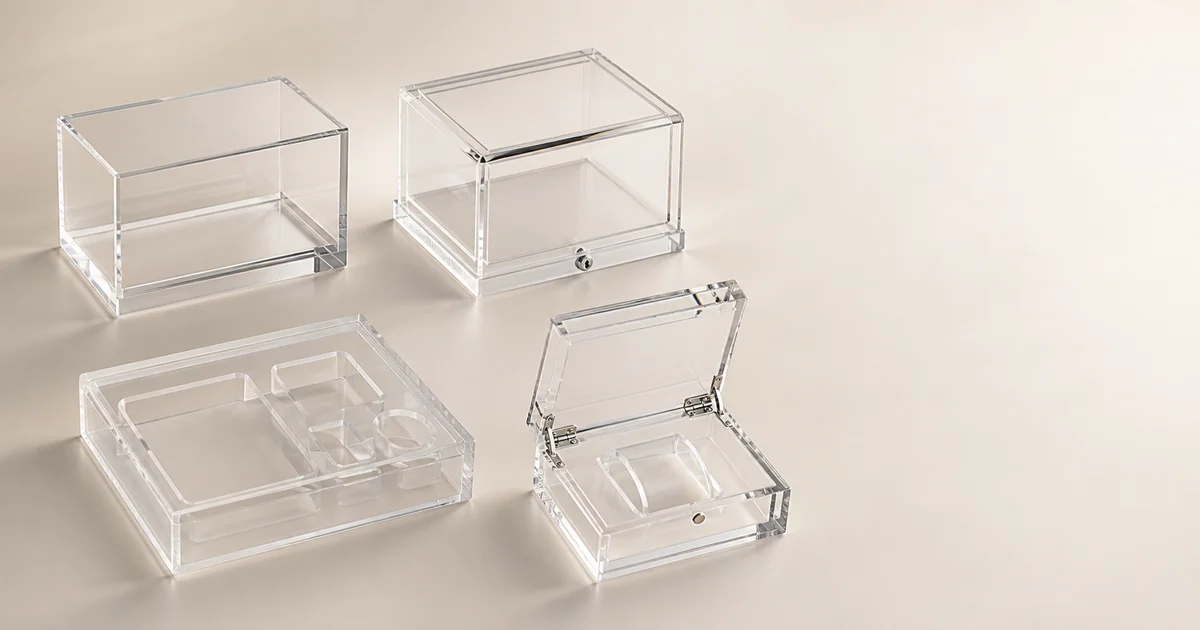
Key Takeaways
- 4 distinct buyer intents hide under 'custom made acrylic cases': display retail (countertop / wall-mount / freestanding), archival (climate-controlled / UV-grade / multi-year), OEM packaging (fit-to-product / repeatable tooling / 5,000+ unit volumes), and collector (single-set custom-fit / dust-seal / premium finish).
- Display retail intent: 4-6 mm cast PMMA, 100-1,000 unit volumes, 14-22 day production, $30-200 unit cost. Highest-volume use case.
- Archival intent: 8-10 mm UV-grade cast PMMA, single-piece commissions, 21-28 day production with bonded-corner stress relief, $400-3,000+ unit cost.
- OEM packaging intent: 4-6 mm matte-finish cast PMMA, 5,000+ unit volumes, ±0.3 mm fit tolerance to product silhouette, ISTA 3A drop-test verified, 18-22 day production, $5-25 unit cost.
- Collector intent: 5-6 mm UV-grade cast PMMA, single-set custom-fit, dust-sealed magnetic hinge, 18-22 day production, $200-650 unit cost. Smallest-volume but highest-margin use case.
On this page
- Four buyer intents hide inside “custom made acrylic cases”
- The 4 buyer intents — display, archival, OEM, collector
- Three diagnostic questions — worked examples
- Common cross-intent confusions — and how to resolve them
- Display-retail intent — countertop, wall-mount, freestanding
- Archival intent — climate-control, anti-yellow, multi-year
- OEM packaging intent — fit-to-product, repeatable tooling
- Collector intent — single-set custom-fit, premium finish
Four buyer intents hide inside “custom made acrylic cases”
‘Custom made acrylic cases’ converts well on Google Ads because the demand is real — but the phrase hides 4 distinct buyer intents that need different specs. Display retail (high-volume, 4-6 mm, $30-200/unit). Archival (single-piece, 8-10 mm UV-grade, $400-3,000+/unit). OEM packaging (5,000+ units, ±0.3 mm fit tolerance, $5-25/unit). Collector (single-set custom-fit, UV-grade + magnetic dust-seal, $200-650/unit). The 3 diagnostic questions in the framework — where it sits, how many, how long — point cleanly to one intent on most projects.
I get ‘custom made acrylic cases’ inquiries about 6-8 times a month and the conversation always starts the same way: the buyer has a use case but doesn’t have the framework to articulate which intent it falls under. The five sections below cover what each intent actually requires.
The 4 buyer intents — display, archival, OEM, collector
Each intent has a different operational profile that drives the spec.
Display retail. Cases for retail-floor product display. Primary driver: handling-load resistance for retail-floor use. Volume: 100-1,000 units. Lifetime: 1-3 years before refresh. Substrate: 4-6 mm cast PMMA. Construction: bonded-corner or through-bolt depending on size. Finishing: clear or branded (UV-print). Unit cost: $30-200.
Archival. Cases for museum or private archive. Primary driver: artifact preservation across multi-year display life. Volume: single-piece commissions. Lifetime: 5-50 years (case may need reseal at year 5; substrate holds for case life). Substrate: 8-10 mm UV-stabilized cast PMMA. Construction: bonded-corner with stress-relief cycle, EPDM gasket at 75% compression, silica-cassette integration. Finishing: anti-reflective coating decision based on lighting environment. Unit cost: $400-3,000+ depending on dimensions and complexity.
OEM packaging. Cases as part of product unboxing experience. Primary driver: visual moment + scale + fit-to-product. Volume: 5,000+ units typical. Lifetime: single-use (ships with the product, recipient discards). Substrate: 4 mm matte-finish cast PMMA. Construction: die-cut to product silhouette ±0.3 mm, foam-stack pairing layer. Finishing: matte (no fingerprint visibility). Unit cost: $5-25.
Collector. Cases for individual collector pieces. Primary driver: dust-sealing + premium finish + custom-fit to specific item. Volume: single-set custom-fit (1-50 units typical for any single buyer). Lifetime: 5-15 years. Substrate: 5-6 mm UV-grade cast PMMA. Construction: magnetic dust-sealed hinge, silicone-cradle insert if appropriate. Finishing: premium polished, often with felt or velvet interior treatment. Unit cost: $200-650.
The intents don’t overlap effectively. A case optimized for OEM packaging (matte finish, single-use, low unit cost) can’t pivot to archival use (needs UV-grade substrate, climate control). A case optimized for archival can’t pivot to retail-floor display (over-engineered, costs ~10× more than necessary).
Three diagnostic questions — worked examples
The 4-intent framework collapses to three diagnostic questions. Run them in order; the answers usually point cleanly to one intent before you ever specify substrate or construction.
Question 1 — Where does the case sit? Retail floor, museum gallery, inside a shipping carton, or an individual collector’s display? The venue determines almost everything about substrate, construction, and finishing. Retail floor → display retail. Museum or private archive → archival. Inside a shipping carton (the case ships with the product) → OEM packaging. Individual collector’s display → collector.
Question 2 — How many do you need? A single piece, 100-1,000 units, 5,000+ units? Volume drives whether tooling investment pays back, which substrate grade is cost-effective, and what production timeline looks like. 100-1,000 units typically points to display retail. Single piece typically points to archival or collector (decide which by re-reading the venue from Q1). 5,000+ units points to OEM packaging almost every time.
Question 3 — How long does it need to last? 1-3 years before refresh, 5-50 years preservation, single-use unboxing, or 5-15 years collector display? Lifetime determines substrate grade (UV-stabilized vs standard cast), construction approach (bonded vs gasketed vs sealed), and finishing complexity. 1-3 year retail life → display retail. 5-50 year archival life → archival. Single-use unboxing → OEM packaging. 5+ year collector life → collector.
Worked example — “We need 200 cases for a watch brand pop-up at three department-store concessions.” Q1: retail floor. Q2: 200 units. Q3: an 8-week pop-up that the brand wants to reuse for next season’s program — about 1-2 years of retail life. Three answers converge on display retail intent. Spec direction: 4-6 mm cast PMMA, freestanding format with internal silicone cradle, $40-90 / unit at 200-unit volume, 14-18 day production.
Worked example — “We’re commissioning a single case for a museum’s loaned 17th-century manuscript exhibit, 24-month run.” Q1: museum gallery. Q2: single piece. Q3: 24-month active display, but the artifact’s preservation requirements force a multi-year-rated substrate regardless of exhibit length. Three answers converge on archival intent. Spec direction: 8-10 mm UV-grade cast PMMA with anti-reflective coating, EPDM-gasketed climate seal with silica integration, $1,500-$2,500 for the case.
Worked example — “We’re launching a flagship phone in Q3 — 10,000 unboxing experiences across 3 markets.” Q1: inside the shipping carton. Q2: 10,000 units. Q3: single-use unboxing (recipient discards within minutes of opening the carton). Three answers converge on OEM packaging intent. Spec direction: 4 mm matte cast PMMA with CAD-defined product silhouette, ±0.3 mm fit, foam-stack pairing layer, ISTA 3A verified, $8-14 / unit at 10,000-unit volume.
I run these three questions on every “custom made acrylic cases” inquiry I open, before I price anything. About 80% of inquiries resolve cleanly to one intent on the first pass; the remaining 20% sit in the cross-intent zone covered next.
Common cross-intent confusions — and how to resolve them
A small share of buyer scenarios produce ambiguous diagnostic-question answers. The resolution patterns below come up often enough that I’ll flag them in any opening call:
“Premium product launch — high-volume but the case stays with the customer.” Looks like OEM packaging (5,000+ unit volume, fit-to-product) but the lifetime is multi-year display rather than single-use. Resolution: a hybrid case built to collector-grade spec at OEM-volume tooling. Substrate UV-grade (not matte single-use), construction dust-sealed (not foam-pair), unit cost 2-3× the OEM-packaging baseline — $25-$60 vs $8-$14. The buyer tier is willing to pay because the case becomes part of the product’s perceived ownership value. Roughly 5-10% of “OEM-looking” inquiries actually need this hybrid treatment.
“Boutique gallery showroom — single piece but artifacts rotate quarterly.” Looks like archival (single piece, gallery venue) but the rotation cadence means individual artifacts inside don’t need 50-year preservation. Resolution: build to display-retail spec at single-piece volume rather than full archival. Saves 40-60% of unit cost without compromising the rotating-exhibition use case. Reserve archival spec for permanent or long-loan exhibits where the artifacts inside can’t tolerate spec compromises.
“Brand merchandising program with retail + collector channels.” Looks like display retail (retail-floor placement) but the collector channel has different lifetime + dust-seal requirements. Resolution: two SKU variants at the same factory tooling — display-retail spec for the retail channel, collector-grade spec for the collector channel. Tooling shares ~70% of the geometry; substrate, finishing, and gasketing differ. Brand teams running multi-channel programs treat this as standard practice rather than as a compromise.
“Trade-show booth — short program life but high handling load.” Looks like display retail (retail-style venue, multi-unit volume) but trade-show handling is harsher than retail-floor handling — cases get packed, shipped, unpacked, and reset multiple times across the program. Resolution: display-retail substrate (4-6 mm cast PMMA) but with thicker base panel and reinforced corner blocks for shipping load, plus a foam-lined road case as part of the deliverable. Adds ~15% to unit cost vs straight display-retail spec but cuts on-site failure rates dramatically across a multi-city program.
Display-retail intent — countertop, wall-mount, freestanding
The display-retail intent is the highest-volume use case for “custom made acrylic cases.” Three sub-formats:
Countertop. 4-6 mm cast PMMA, sized to fit on a retail counter or shelf-edge. Often paired with internal product positioning (silicone insert, custom-cut tray). Typical dimensions: 200-400 mm long edge. Unit cost: $35-90.
Wall-mount. 4-6 mm cast PMMA with substrate-specific back-plate (drywall / concrete / metal stud / glass-front fixture). Often used for category signage or product spotlighting. Typical dimensions: 200-600 mm long edge. Unit cost: $40-120.
Freestanding. 6 mm cast PMMA with weighted base for tip-over resistance. Often used as point-of-sale displays or category endcaps. Typical dimensions: 600-1,200 mm tall. Unit cost: $80-200.
Bulk pricing breakpoints at 250 and 1,000 units across all three formats. For brand merchandising teams scoping multi-store programs, the 1,000-unit batch is typically the cost-efficient sweet spot.
Archival intent — climate-control, anti-yellow, multi-year
Archival intent is single-piece commissions with the most stringent spec requirements, and it aligns with collections care standards set by the American Alliance of Museums1. The 4-axis archival-grade spec from our museum display case UV spec guide applies fully:
- RH control gasket (EPDM at 75% compression + silica integration)
- Off-gas-tested adhesives (Hxtal NYL-1 or Norland 65 documented)
- Anti-reflective coating decision based on lighting environment
- UV-grade PMMA with documented Δ*E thresholds at 12 / 24 / 60 month points
Unit cost reflects the spec complexity: $400-$1,200 for a small artifact case, $1,500-$3,000+ for a large gallery case, $5,000-$15,000+ for an oversize traveling-exhibit case (above 1.5 m on long edge — see extra-large acrylic display case buyer guide for that scale).
For museum curators and private archive collectors, the archival intent is rarely confused with the other three — the buyer knows they need archival from the use case alone.
OEM packaging intent — fit-to-product, repeatable tooling
The OEM packaging intent is the highest-volume use case but has the lowest per-unit cost. Specs:
- 4 mm matte-finish cast PMMA (matte = no fingerprint visibility under fulfillment-center handling)
- CAD-defined product silhouette die-cut to ±0.3 mm fit tolerance
- Foam-stack pairing layer beneath the acrylic insert for shock absorption
- ISTA 3A drop-test verification on a random sample case before bulk production
- 100% supplier QC inspection (defect rate target <0.5%) aligned with ISO 9001 quality management requirements2
Production: 18-22 days for a typical 5,000-unit launch. Unit cost: $5-25 depending on dimensions and finishing complexity. The intent is single-use packaging that ships with the product to the recipient — the recipient often discards it after unboxing, so multi-year durability isn’t a spec concern.
For brand product launch leads and packaging directors, the custom acrylic packaging insert manufacturing plan maps product-fit, finish, restraint, packout, and buyer-defined test approvals without claiming a completed launch.
Collector intent — single-set custom-fit, premium finish
The collector intent is small-volume but high-margin per unit. Specs:
- 5-6 mm UV-grade cast PMMA (collector-room display environments require UV stability for 5+ year life)
- Single-set custom-fit dimensions tuned to the collector item (watch, camera, signed memorabilia)
- Magnetic dust-sealed hinge with stainless-steel core + EPDM gasket (5,000+ opening cycle rated)
- Premium interior treatment (silicone-pillow cradle, leather lining, velvet base)
- Diamond-polished bezels on visible edges
Production: 18-22 days for a typical single-piece commission, 14-18 days for repeat orders against established tooling. Unit cost: $200-650 depending on dimensions, complexity, and interior treatment.
For collector channel buyers and individual collectors, see our watch collector display case series case study for an example of the collector intent at multi-SKU rollout scale.
For procurement teams or buyers landing on this guide because they searched ‘custom made acrylic cases’ and aren’t sure which intent fits, browse our acrylic cases product range first to orient on format options, then send the brief over to our team — we’ll classify the intent, recommend a spec tuned to that intent, and send a sample at your volume tier. The 4-intent framework is supplier-agnostic, so apply it to every quote on your shortlist. For deeper supplier-vetting context, see our acrylic display manufacturer checklist and acrylic RFQ guide.
Footnotes
-
American Alliance of Museums. Collections Care and Conservation Standards. https://www.aam-us.org/ ↩
-
International Organization for Standardization. ISO 9001:2015 — Quality management systems — Requirements. https://www.iso.org/standard/62085.html ↩
Frequently Asked Questions
What are the 4 buyer intents hiding under 'custom made acrylic cases'?
(1) Display retail: cases for retail-floor product display, typically high-volume (100-1,000 units) with handling-load resistance as the primary driver. (2) Archival: cases for museum or private archive use, single-piece commissions with climate-control + UV-grade + multi-year preservation as primary drivers. (3) OEM packaging: cases as part of a product unboxing experience, very high-volume (5,000+ units) with fit-to-product silhouette and repeatable tooling as primary drivers. (4) Collector: cases for individual collector pieces (watches, vintage cameras, signed memorabilia), single-set custom-fit with dust-sealing and premium finish as primary drivers.
How do I know which intent matches my project?
Three diagnostic questions. (1) Where does the case sit? Retail floor → display retail. Museum gallery or private archive → archival. Inside a shipping carton → OEM packaging. Individual collector's display → collector. (2) How many do you need? 100+ → display retail. Single piece → archival or collector (decide by venue). 5,000+ → OEM packaging. (3) How long does it need to last? 1-3 years retail life → display retail. 5-50 years archival life → archival. Single-use unboxing → OEM packaging. 5+ years collector life → collector. The combination of answers usually points cleanly to one of the 4 intents.
Can a single case satisfy more than one intent?
Rarely effectively. The substrate, construction, and finishing decisions for each intent are different enough that a case optimized for retail-display intent doesn't perform well as an archival case, and vice versa. The exception: a high-end collector display case can be specced with archival-grade substrate (UV-stabilized cast PMMA) and dust-sealed construction, which crosses into archival intent at the cost of about 30-40% additional unit cost.
What goes into the OEM packaging intent at 5,000+ unit volumes?
Matte-finish cast PMMA (typically 4 mm) with CAD-defined product silhouette die-cut to ±0.3 mm tolerance, foam-stack pairing layer beneath for shock absorption, ISTA 3A drop-test verification before bulk production, 100% supplier QC inspection (defect rate target <0.5%), 18-22 day production. Unit cost runs $5-25 depending on dimensions, volume, and finishing complexity. The intent is the product unboxing moment — every operational decision optimizes for that visual quality at scale.
Not sure which intent fits your project?
Send us a brief description of your use case (where the case will sit, what's inside it, who interacts with it, and how long it needs to last). We'll come back with an intent classification, a substrate / construction recommendation tuned to that intent, sample case spec, and a unit-cost projection at your volume tier. The 4-intent framework is supplier-agnostic — apply it to every quote on your shortlist.