Display Cases for Collectibles — Beyond LEGO and Card Slabs
Specialty collectors and curated retailers ask for collectible display cases and find LEGO + card-slab heavy results. The 8 sub-verticals covered here have different spec axes — height ratio, dust seal, UV grade, LED placement — that decide which format actually serves the collection.
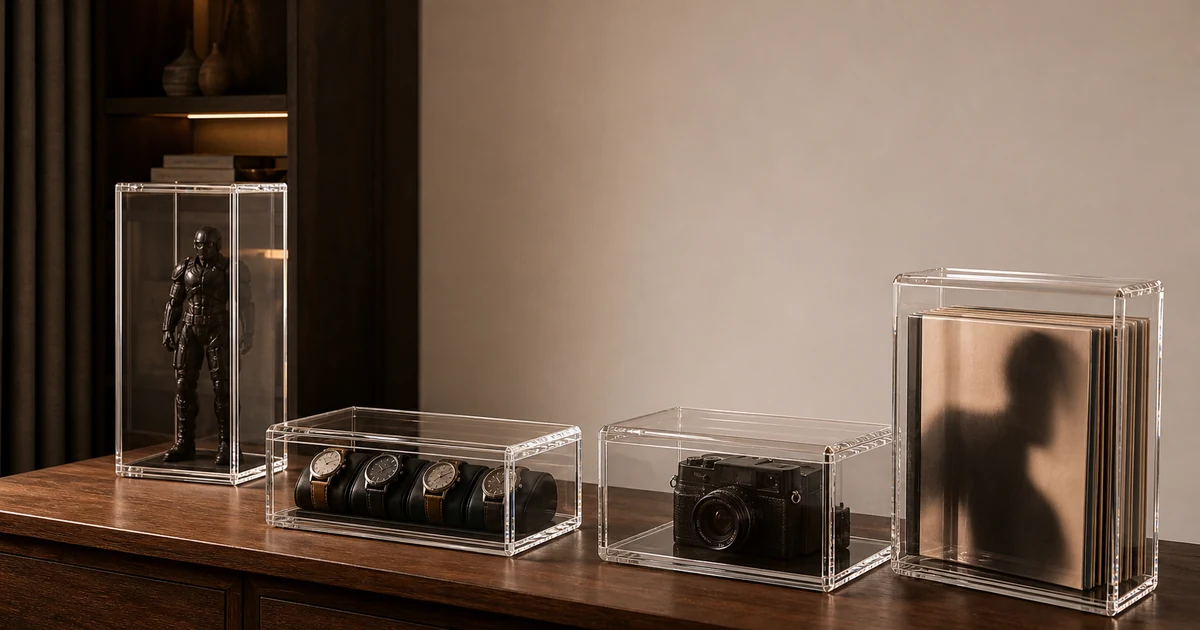
Key Takeaways
- 8 collectible sub-verticals each have different spec axes: LEGO + card slabs (vertical / dust-sealed), action figures (vertical with internal supports), watches (horizontal / silicone-pillow / dust-seal), cameras (horizontal / soft cradle / UV-grade), pens (small horizontal / felt-lined), vinyl (vertical sleeve / wide format), signed memorabilia (variable / archival-grade).
- Height-to-base ratio decides vertical vs horizontal format: above 1.5 ratio (case taller than wide) wins for action figures and vinyl; below 1.0 (case wider than tall) wins for watches, cameras, pens, signed memorabilia.
- Dust-seal vs ventilated decision: dust-sealed for action figures, watches, and pens (where dust accumulation degrades the collectible). Ventilated acceptable for cameras and vinyl (where dust matters less than temperature stability).
- UV-grade decision: required for color-sensitive collectibles (vintage paper memorabilia, fabric collectibles, dyed components). Standard cast PMMA acceptable for metal, plastic, and ink-printed collectibles.
- LED placement: bottom-rim wins for action figures + LEGO + Technic; top-mounted wins for watches + cameras (illuminate the collectible from above to highlight features); edge-lit wins for vinyl (frame the album cover); none wins for archival paper memorabilia (LED dwell heat accelerates degradation).
On this page
- A watch case is not a poster case — 8 sub-verticals, 4 spec axes
- Sub-vertical map — 8 collectible categories and 4 spec axes
- Height-to-base ratio — vertical vs horizontal
- Dust-seal vs ventilated — what each sub-vertical needs
- UV-grade — when 5-year color preservation justifies the premium
- LED placement — bottom-rim / top / edge-lit / none, by sub-vertical
- Worked examples — sub-vertical to spec
- Failure modes — what goes wrong when sub-vertical is mis-classified
- Multi-collectible collector-room program — sequencing the build
- Boutique vs chain pricing — when custom-fit pays off
A watch case is not a poster case — 8 sub-verticals, 4 spec axes
Display cases for collectibles divide into 8 sub-verticals, each with different spec needs. Height-to-base ratio: above 1.5 for action figures, vinyl, some LEGO; below 1.0 for watches, cameras, pens, signed memorabilia. Dust-seal: required for action figures, watches, pens; acceptable for cameras and vinyl; non-negotiable for archival paper. UV-grade: required for color-sensitive (vintage paper, fabric, dyed plastic); optional for metal and ink-printed. LED placement: bottom-rim for figures and LEGO; top for watches and cameras; edge-lit for vinyl; none for archival paper. The framework is supplier-agnostic. Browse our collectible display cases for standard-format starting points.
“Collectible display case” is the most over-generalized RFQ phrase in our intake. The same words land on my desk for a watch collector who needs dust seal and top-mount LED, a vinyl figure rollout that needs height clearance and a bottom-rim glow, a vintage poster archive that needs UV-grade substrate and humidity stability, and an action-figure customer who needs none of those. They are not the same product, and treating them as one is what produces a case that looks fine in the warehouse and fails the collector at month nine. The five sections below cover the framework that sorts the call into a buildable spec — eight sub-verticals, four spec axes, breakpoints at each.
Sub-vertical map — 8 collectible categories and 4 spec axes
The 4 spec axes that change between collectible sub-verticals:
| Sub-vertical | Format | Sealing | UV grade | LED placement |
|---|---|---|---|---|
| LEGO sets | Vertical (variable ratio) | Dust-sealed gasket front | Standard cast (UV optional for color sets) | Bottom-rim |
| Card slabs | Vertical or horizontal | Dust-sealed | UV-grade for color preservation | None or edge-lit |
| Action figures | Vertical (ratio > 2.0) | Dust-sealed top | UV-grade (dye fade prevention) | Bottom-rim |
| Watches | Horizontal (ratio < 0.6) | Dust-sealed magnetic | UV-grade for collector room | Top-mounted |
| Cameras (vintage) | Horizontal (ratio 0.5-1.0) | Ventilated acceptable | UV-grade for vintage leather / paper | Top-mounted |
| Pens (vintage / luxury) | Horizontal (ratio < 0.4) | Dust-sealed (felt-lined) | Standard cast | None or top-mounted |
| Vinyl records | Vertical sleeve (ratio 1.0-1.5) | Ventilated | UV-grade (color sleeve preservation) | Edge-lit |
| Signed memorabilia | Variable | Archival-grade dust-seal | UV-grade required | None or museum-spec |
Each sub-vertical’s spec set produces a different finished case. A case optimized for action figures doesn’t serve watches well. A case optimized for vinyl doesn’t serve cameras well. The 8-sub-vertical framework ensures the buyer arrives at the spec that matches the actual collectible.
Height-to-base ratio — vertical vs horizontal
The format decision is driven by the collectible’s geometry and presentation intent.
Vertical format (height-to-base ratio above 1.5). Tall cases that emphasize the collectible’s vertical proportions. Best for: action figures (showcase pose), vinyl records (display sleeve face), tall LEGO sets (Star Wars Architecture, UCS Falcon vertical orientation), 1:6 scale figures. Vertical format adds height presence to the display. The LEGO Technic enclosure manufacturing plan lists the model-envelope, support, center-of-mass, access, sample, inspection, and packing questions for an asymmetric vertical brief; it is not a shipped example or a fixed enclosure architecture.
Horizontal format (height-to-base ratio below 1.0). Wide cases that lay the collectible flat to show face / body / lens. Best for: watches (display the dial face), cameras (show the body and lens together), pens (lay horizontally to show the full pen length), most signed memorabilia. Horizontal format keeps the visual emphasis on the collectible rather than the case. For jersey, ball, and COA-pocket builds specifically, our sports memorabilia display cases page covers the standard formats and spec options.
Square / mid-ratio (1.0-1.5). Card slabs (PSA / BGS standard slab dimensions), Pokemon-format collectibles, smaller LEGO sets, mid-scale action figures. Mid-ratio cases work in either orientation but typically display vertical for retail-floor presentation. For card slabs the UV-grade axis carries hard numbers — transmission percentages and fade timelines are in our UV-filtering acrylic for trading cards guide.
For multi-collectible collector walls (mixed sub-verticals on the same display wall), the height-ratio variation across cases creates visual rhythm. Vertical action figure cases alongside horizontal watch cases produces a curated-collection aesthetic that single-format walls don’t achieve.
Dust-seal vs ventilated — what each sub-vertical needs
Dust accumulation affects different collectibles differently.
Dust-sealed required. Action figures (paint scratches under dust during cleaning), watches (dust visible on dial face at any inspection), pens (dust collects in nib / cap area and degrades writing), card slabs (dust on the slab face affects grading-protective seal), LEGO (dust on brick surface degrades color presentation).
Ventilated acceptable. Vintage cameras (dust matters less than temperature stability for the bellows / leather), vinyl records (sleeve face accepts occasional dust without operational issue, ventilation helps prevent moisture buildup that’s worse than dust).
Dust-sealed non-negotiable. Signed memorabilia (paper-based) — dust + handling oils accelerate degradation, archival-grade dust-seal with off-gas-tested adhesives is required1.
The dust-seal mechanism is typically EPDM gasket at 75% compression on the case lid or front. The combined dust ingress over 5 years is roughly 100× lower on a 75% gasket-sealed case vs a non-sealed case.
UV-grade — when 5-year color preservation justifies the premium
UV-grade substrate (UV-stabilized cast PMMA) blocks 90%+ of incident UV vs ~10-15% on standard cast, per the optical-property classifications in ASTM D48022. The 18-22% substrate cost premium is justified for color-sensitive collectibles.
UV-grade required. Vintage paper memorabilia (signatures fade under UV), fabric collectibles (jersey color, patches, vintage clothing), dyed plastic (action figure paint, vintage toy plastic that yellows), color-sensitive trading cards.
UV-grade optional. Metal collectibles (no UV degradation issue), ink-printed collectibles where the print is UV-stable, modern plastic collectibles with UV-stable polymers.
UV-grade not justified. Pure metal items, glass-based collectibles, ceramic collectibles. The 18-22% premium produces no operational benefit at the substrate level.
For collector-room display environments (sustained 8+ hr/day LED dwell), UV-grade is the right call for any collectible with mixed materials or color-sensitive components. For retail-display environments (intermittent lighting, frequent collection rotation), standard cast is acceptable.
LED placement — bottom-rim / top / edge-lit / none, by sub-vertical
Each sub-vertical has a different optimal LED placement.
Bottom-rim LED. Action figures + LEGO + LEGO Technic. Illuminates the collectible from below, highlighting detail without bleeding onto color reads. The light direction emphasizes vertical features and creates depth.
Top-mounted LED. Watches + cameras + pens. Overhead lighting illuminates the dial / lens / nib features that the collector wants to see. Creates the “spot-lit jewel” effect for watches specifically.
Edge-lit LED. Vinyl records. Frames the album cover with subtle ambient glow at the case edges, mimicking the way vinyl is displayed in record-store environments.
No LED (gallery ambient only). Archival paper memorabilia. LED dwell heat accelerates degradation of paper substrates and fades inks. Rely on gallery-ambient lighting (typically diffused 200-400 lux at 3000-3500 K) without case-internal LED.
For mixed-collection collector walls, the LED choice can vary by individual case — bottom-rim on the action figure cases, top-mounted on the watch cases, edge-lit on the vinyl case, none on the archival paper case. The variety produces a curated lighting design rather than uniform LED treatment.
Worked examples — sub-vertical to spec
The framework gets concrete when you walk an actual collector profile through it. Three examples I see often:
“Vintage 1:6 scale action-figure collector — 24 figures across G.I. Joe, Marvel Legends, Hot Toys.” Sub-vertical: action figures. Format: vertical (figure heights 280-320 mm, base widths 100-130 mm — ratio above 2.0). Sealing: dust-sealed top with magnetic hinge (paint scratches under dust during cleaning are the failure mode that ends collector relationships with cases). UV grade: required (mid-2000s Hot Toys paint famously fades under sustained UV without protection). LED: bottom-rim warm-white at 3000 K, ~50 lm/case. Spec: 5 mm UV-grade cast PMMA, 320×130×130 mm internal, $180-260 / unit at 24-piece order. The 24-piece order benefits from family-fit tooling — 3 SKU sizes covering the figure range.
“Watch collector — 12-piece rotation including 2 vintage Patek references.” Sub-vertical: watches with mixed-era. Format: horizontal (watch diameter 38-44 mm; case 180×140×60 mm — ratio 0.43). Sealing: dust-sealed magnetic (dust on dial face is the most-cited collector frustration). UV grade: yes for the vintage references (vintage dial lume can fade under sustained UV; modern lume is more stable but still benefits). LED: top-mounted spot at 3500 K, 30-40 lm aimed at the dial. Interior: silicone-pillow cradle with felt-lined cuff. Spec: 5-6 mm UV-grade cast PMMA, dust-sealed magnetic hinge with EPDM gasket at 75% compression, $300-450 / unit. At 12-piece volume the per-piece cost is high but consistent with the underlying watch values.
“Vintage paper memorabilia — single-piece signed Hemingway letter for a private archive.” Sub-vertical: archival paper memorabilia. Format: variable (letter dimensions drive the case; typically wider than tall). Sealing: archival-grade dust-seal with off-gas-tested adhesives — Hxtal NYL-1 or Norland 65 documented. UV grade: non-negotiable (signature inks fade under sustained UV; standard cast PMMA is not enough alone — full archival spec is the floor). LED: none (LED dwell heat accelerates paper degradation; rely on gallery-ambient lighting at 200-400 lux). Spec: 8 mm UV-stabilized cast PMMA with anti-reflective coating, EPDM gasket at 75% compression, silica-cassette integration, $1,200-2,500 for the single-piece commission. This is a lifetime-of-the-archive purchase and the spec reflects that.
Failure modes — what goes wrong when sub-vertical is mis-classified
About 1 in 5 collector inquiries arrives with a spec assumption that doesn’t match the actual sub-vertical, and the failure modes are predictable. Catching them in the brief stage saves a re-order:
Vertical case for a horizontal collectible. Buyer requests a tall vertical case for a watch collection because the collector saw vertical action-figure cases on a forum. Watches lay flat to show the dial face — vertical orientation either tilts the watch awkwardly or hides the dial behind the strap. Resolution: rotate to horizontal during the brief conversation; the collector almost always agrees once the dial-face point is made.
Standard cast PMMA on color-sensitive collectibles. Buyer requests “clear acrylic” without specifying UV grade for a vintage paper or fabric collection. After 18-24 months under collector-room LED + ambient daylight, color-sensitive components show measurable fade. Resolution: spec UV-grade as the default for any collection containing paper, fabric, or dyed plastic. The 18-22% substrate premium is small relative to the collectible’s value preservation.
Bottom-rim LED on watches or cameras. Buyer assumes “the LED should be on the bottom because that’s how the LEGO display I saw was lit.” Bottom-rim LED on watches creates upward glare into the dial that washes out the timing graphics; on cameras it bleeds into the lens and causes uneven exposure if the collection is photographed. Resolution: top-mounted LED for any horizontal-format collectible.
Ventilated case for a dust-sensitive collectible. Buyer requests vented case “for air circulation” on action figures or watches. Ventilation accelerates dust ingress and operational cleaning frequency rises from quarterly to monthly. Resolution: dust-sealed gasket on any collectible where dust is the primary degradation mode; reserve ventilated construction for camera leather and vinyl-record sleeves where temperature stability outranks dust.
Multi-collectible collector-room program — sequencing the build
Collector-room rollouts that mix sub-verticals (action figures + watches + vinyl + signed paper on the same wall) benefit from a sequenced build rather than ordering all cases at once. The sequence I recommend on multi-SKU collector programs:
Phase 1 — single proof case per sub-vertical (3-4 weeks). One case from each major sub-vertical in the program. Lets the collector verify spec choices (UV grade, LED placement, sealing, format) against the actual collectibles before committing to the full set. Common adjustments at this stage: 5-10 mm dimensional tweak, LED color-temperature shift (3000 K vs 3500 K), interior-cradle change.
Phase 2 — full sub-vertical batch (4-6 weeks per sub-vertical). Once the proof case is approved, run the full batch for each sub-vertical. Manufacturing efficiency is highest when same-spec cases run together, so batching by sub-vertical rather than mixing all SKUs into one production run reduces unit cost ~10-15% at multi-SKU volumes.
Phase 3 — installation + photographic registration (1 week). Full collector room installed, photographed under final lighting for the collector’s records. Photographic registration matters for insurance documentation on high-value collections and is best captured immediately post-install before the collection rotates.
This three-phase sequence trades 2-3 weeks of total program time for spec verification and unit-cost efficiency. For collector programs above 20 cases or covering 3+ sub-verticals it’s the default approach.
Boutique vs chain pricing — when custom-fit pays off
The custom-fit decision affects unit cost across volume tiers.
Custom-fit per collectible (single-piece commissions). Each case dimensioned to ±5 mm of the specific collectible. Production cost: 100% (baseline). Best for boutique collector channels and individual collectors at single-piece volume.
Family-fit across collectible category (multi-SKU rollout). SKU sizes covering the typical collectible range within the category. Custom-fit at category level, not individual level. Production cost: 65-75% (per-piece amortization across SKUs). Best for collector channels at 25-100 unit volumes.
Standard-fit (off-the-shelf SKU). Standard sizes covering common collectibles. No custom-fit. Production cost: 45-55% (full tooling amortization at scale). Best for retail channels at 100+ unit volumes, but often under-fits the collectible.
For collector-channel rollouts, family-fit at multi-SKU level typically wins on the cost-vs-fit tradeoff. Custom-fit per collectible is the right call only at the high-end boutique tier where unit margin supports it.
For specialty collectors and curated retailers spec’ing display cases for non-LEGO non-card sub-verticals, send the brief over to our team — we’ll classify the sub-vertical from your collectible profile, recommend a 4-axis spec, and send a sample case at your sub-vertical’s optimal configuration. For deeper context on individual sub-verticals, see our case studies on LEGO Star Wars vertical display series and LEGO Speed Champions custom display case, plus the bulk graded card display cases guide and extra-large acrylic display case buyer guide.
Footnotes
-
American Alliance of Museums. Collections Care and Conservation Standards. https://www.aam-us.org/ ↩
-
UV transmission of acrylic — UV-filtering (OP3) grade absorbs ~98% of incident UV, while standard clear acrylic transmits ~92% across the visible/near-UV band — manufacturer UV-transmission data behind the UV-grade vs standard cast difference; the grade classifications themselves follow ASTM D4802. ↩
Frequently Asked Questions
What are the 8 collectible sub-verticals and how do they differ?
(1) LEGO sets — vertical format, dust-sealed, gasket front. (2) Card slabs (sports / Pokemon) — vertical or horizontal display, UV-grade for color preservation. (3) Action figures — vertical format with internal pose supports, dust-sealed top. (4) Watches — horizontal format, silicone-pillow cradle, dust-sealed magnetic hinge. (5) Cameras (vintage) — horizontal format, soft cradle to protect bellows / leather, UV-grade. (6) Pens (vintage / luxury) — small horizontal format, felt-lined to prevent slip. (7) Vinyl records — vertical sleeve format, wide enough for 12-inch sleeves with margin. (8) Signed memorabilia — variable format depending on item, archival-grade with off-gas-tested adhesives. Each sub-vertical has different spec needs across height ratio, sealing, UV, and LED axes.
When does vertical vs horizontal format win?
Height-to-base ratio decides. Above 1.5 (case taller than wide): action figures (showcase the figure's pose), vinyl records (display the sleeve face), some LEGO (Star Wars, Architecture). Below 1.0 (case wider than tall): watches (lay flat on dial face), cameras (display the body and lens together), pens (lay horizontally to show the full pen), signed memorabilia (depending on item). Around 1.0-1.5 (square-ish): card slabs, pokemon-format collectibles, smaller LEGO sets.
When is UV-grade substrate required for collectibles?
Required for color-sensitive collectibles where 5+ year color preservation matters: vintage paper memorabilia (signatures, photographs, posters), fabric collectibles (jersey, vintage patches), dyed components (action figure paint that fades under UV, plastic that yellows). Standard cast PMMA acceptable for metal, plastic without dye-sensitivity, and ink-printed collectibles where UV degradation isn't operationally relevant. The 18-22% substrate premium is meaningful but small relative to the collectible's value preservation.
Which LED placement matches which sub-vertical?
Bottom-rim LED: action figures + LEGO + LEGO Technic (illuminates from below, highlights detail without bleeding onto color reads). Top-mounted LED: watches + cameras (overhead lighting illuminates the dial / lens features). Edge-lit LED: vinyl records (frames the album cover with subtle ambient glow). No LED: archival paper memorabilia (LED dwell heat accelerates degradation; rely on gallery ambient lighting only).
Spec'ing a display case for a collectible category beyond LEGO?
Send us your collectible category, height-to-base profile, environment lighting, target case volume (single-piece or multi-SKU), and budget tier. We'll come back with a framework recommendation tuned to your sub-vertical, sample case spec, and unit-cost projection. The 8-sub-vertical framework is supplier-agnostic — apply it to any quote on your shortlist.