Delivered project · Collector Displays · Premium Channel
UCS Star Wars Acrylic Enclosure for a 6-SKU Series
A collector retailer needed clear enclosures for six UCS-scale models.
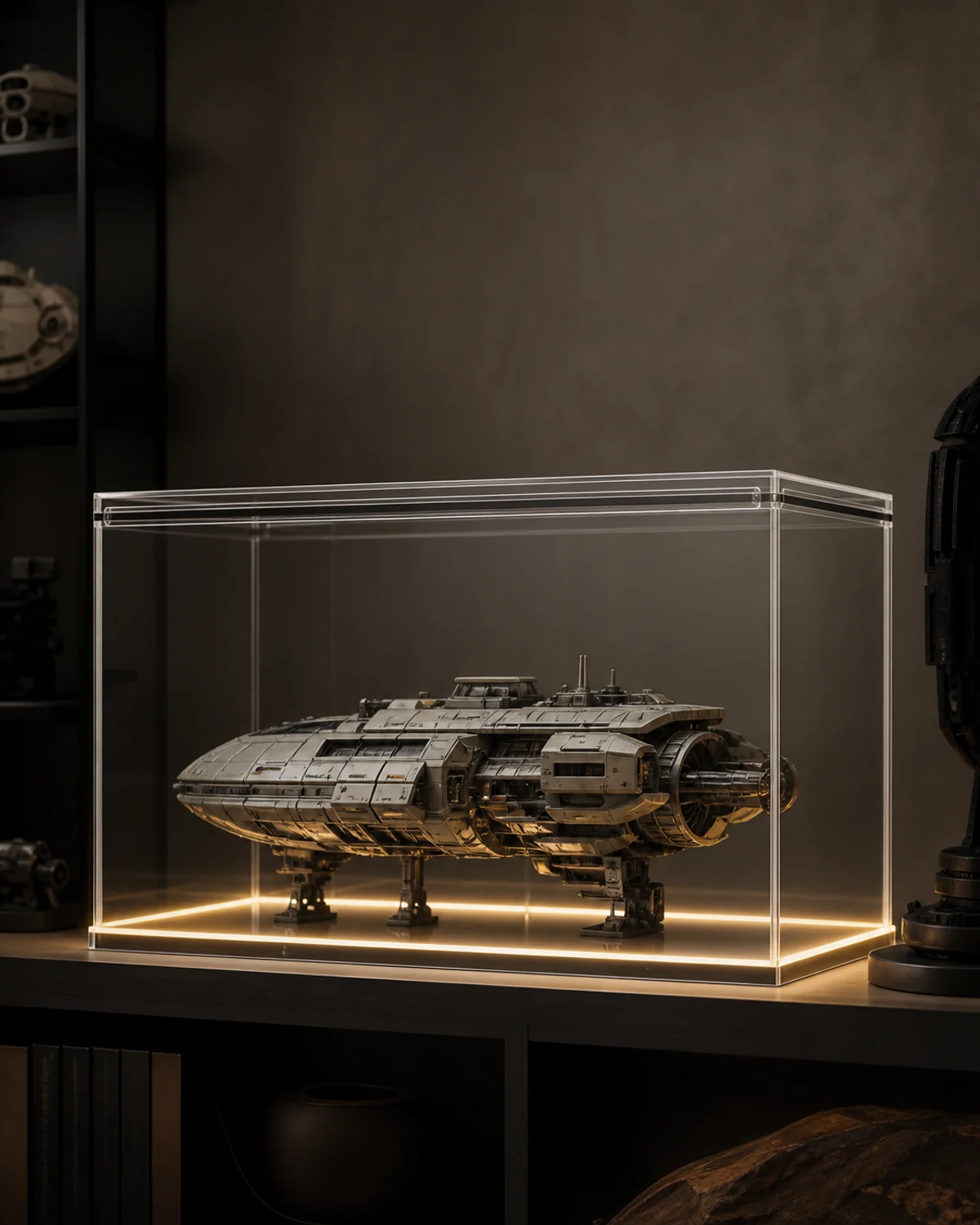
We measured each assembled model, drew six non-electrical enclosures with a removable front and lower support rail, proved fit on a paid sample, then shipped the six SKUs flat-packed. Delivered: a six-SKU collector-enclosure family with measured fit, front access, closure, base stability, inspection and flat-pack protection. This run was unlit. Brand names identify model fit; Wetop is an independent custom-acrylic manufacturer.
- enclosure fit
- 6 SKUs
- panel thickness
- 5 mm
Ordering a similar project
A standard paid sample takes 3–5 days. The sample fee is paid separately and never credited to production. Standard production takes 15–20 days after the sample, drawing, material, finish, and packing are approved; Wetop responds to a complete quotation brief within 24 hours.
Closest published price: this order was quoted per SKU from the six envelopes. The nearest public reference on the acrylic cases hub is a 150 × 100 × 100 mm magnetic-lid case in 3 mm clear acrylic at 500 pieces, from $6 per unit FOB Shenzhen; large enclosures with longer spans, a removable front and a base price well above that.
Key Takeaways
- A collector retailer asked us for enclosures for six UCS-scale models; we measured six envelopes and the buyer confirmed each assembled model, stand, antenna and access space before we released a drawing.
- We sampled in 5 mm cast PMMA and set the approved thickness from panel span, opening method, base support and packing.
- One physical sample proved placement, front access, closure force, base stability, visible-edge finish and packing.
- This run was unlit: acrylic enclosures, panels, rails and hardware only, no lighting on this order.
The Challenge
A collector retailer came to us with six large UCS-scale models and wanted one family of clear enclosures, one per model. A catalog label such as “Falcon” or “Star Destroyer” could not be cut: each assembled model had its own stand, antenna, wing position or added plaque, and those set the real envelope. So our first job was measurement, not picking a nominal case size.
The buyer gave us the maximum length, width and height of each display arrangement, the direction the model went in and came out, the shelf or plinth it stood on, and the clearance needed for occasional removal. The retailer also wanted a front that opened without lifting a tall cover above the shelf, a base that stayed stable with the front off, and packing that kept large clear panels from rubbing in transit.
This run was unlit. We fabricated the acrylic enclosures, panels, rails and hardware; a lit version would be built to the buyer's own drawing and lighting spec.
Our Approach
We split what the family could share from what had to stay specific to each model. Material documentation, edge-finish wording, the closure test, protective film, carton labels and inspection records used one format. Internal dimensions, panel span, support points, opening clearance and pack-out size stayed per SKU.
We measured the displayed arrangement
The buyer supplied a dimensioned envelope for each model exactly as displayed, including its stand and anything that stuck out past the main body. We turned each envelope into a drawing with internal clearance and had the buyer approve access as well as appearance. Clearance was set per model: a fragile antenna, a broad wing or a removable stand each needed a different path than a compact model.
We set thickness from span and access
We started the sample in 5 mm cast PMMA. Before naming the production thickness we reviewed the longest unsupported span, panel orientation, bonded and removable joints, base geometry and handling. Where the buyer required a specific material grade, it went on the drawing, backed by the sheet maker’s datasheet.
We proved the removable front on the sample
A soft closure strip narrowed the gap at the removable front. Its profile, compression, pull force and replacement method depended on the hardware and channel, so we tested them on the sample: the front seated evenly, opened without disturbing the model and suited the buyer’s cleaning routine. We made no dust-seal percentage or service-life claim.
The Results
We released a drawing packet for the order. Each of the six SKUs had its own envelope, internal dimensions, panel thickness, opening direction, base support, closure profile, visible-edge finish, protective-film note and packing drawing, plus one approved drawing and bill of materials. The buyer’s written approval tied each model-fit decision to the cutting file used for the sample.
The sample carried the acceptance work. The buyer placed and removed the actual model, checked sightlines on the shelf, opened and closed the front, and confirmed fingers could reach the support points without touching delicate parts. We checked panel fit, bonded joints, front seating, base stability, edge finish, protective film and the carton. Where an access check failed, we changed the drawing before production.
Once sample, drawing, material, finish and packing were approved, production ran 15–20 days. Quantity by SKU, material, hardware, inspection scope, carton count and freight were set on the quotation and production schedule, and all six design runs shipped flat-packed with protective film to the approved packing drawings.
Release checkpoint: six model names became six production drawings, and we released each SKU only after its envelope, access path, closure and base support passed the physical sample.
If You're Planning Something Similar
Send the assembled model or a signed envelope drawing with photos of the extreme points, plus shelf limits, opening direction, quantity per SKU, destination and packing preference. A new model can reuse an approved document format, but it still needs its own drawing and fit sample; a retained cutting file does not prove a newly assembled model or stand is identical. The display-case dimensions guide walks through the measuring, and the LEGO Technic enclosure case covers support for asymmetric models. See custom acrylic cases.
Need enclosures for a set of collector models?
Send the assembled-model envelopes, shelf constraints, opening direction, quantities by SKU, destination, and packing preference. Wetop will return the open questions, a non-electrical enclosure drawing and a written quotation.
Paid sample in 3–5 days, separately paid and never credited · Quote response within 24 hours