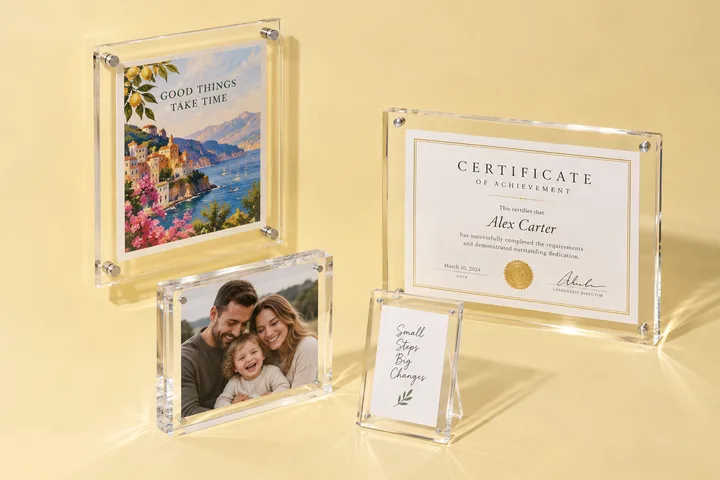
Custom Acrylic Trays with Logo: Etch vs Bottom Print vs Insert
\"Can you put our logo on the tray?\" is three different production methods wearing one sentence.
Need this made?Custom acrylic trays →
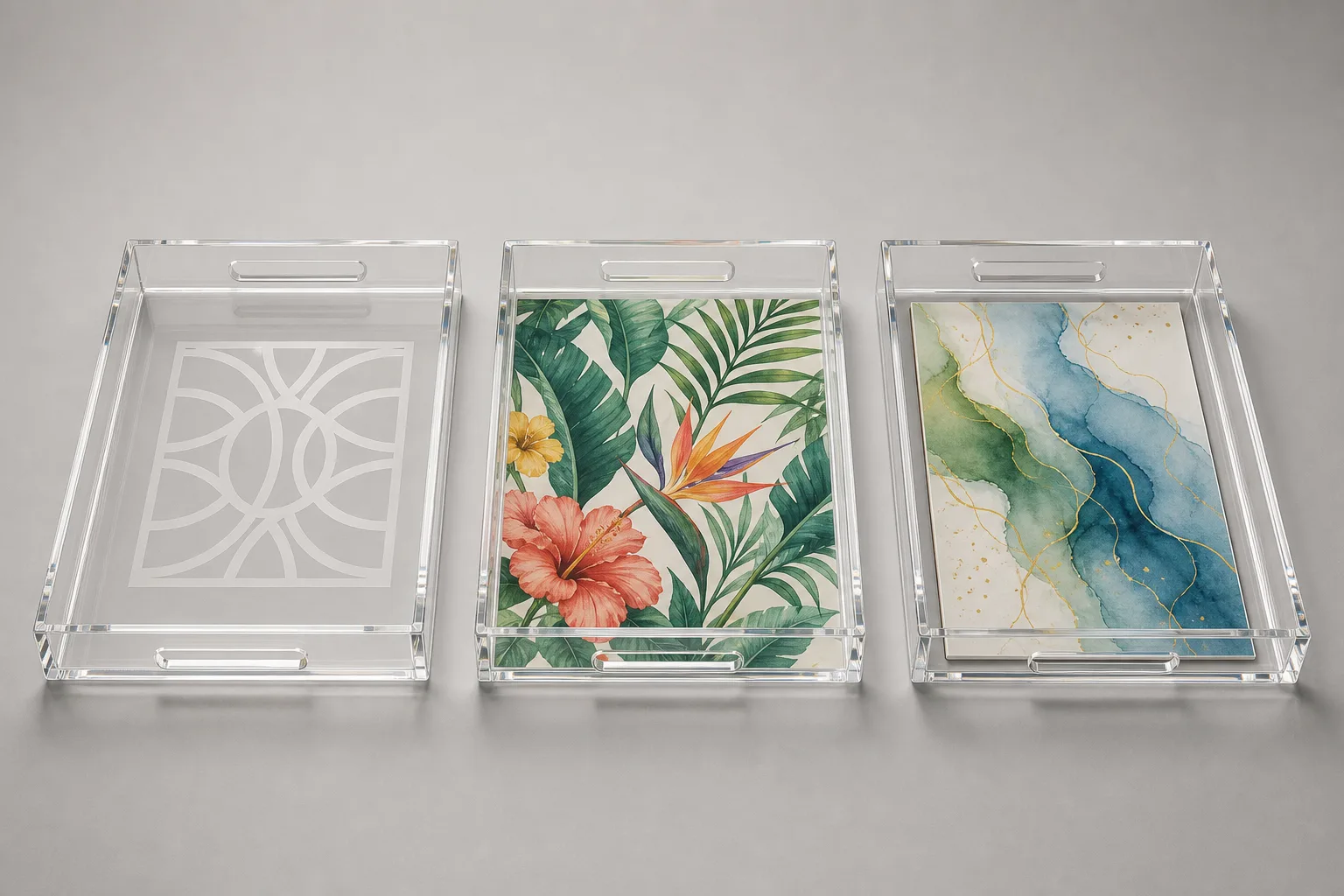
Three questions — color, wear, artwork change — route every brief to the right one.
Key Takeaways
- Every "logo on tray" brief routes to one of three production methods: laser etching (material removed from the surface), second-surface bottom printing (ink sealed under the tray floor), or a printed bottom insert (a separate replaceable sheet).
- Three questions decide the route: does the logo need brand color, how much wear will the tray see, and will the artwork ever change. Answer those and the method picks itself.
- Laser etch is the permanence pick — a frosted tone-on-tone mark that lasts the life of the tray, with paint-fill available at a Pantone register of ΔE 2–3 when one brand color is required.
- Bottom printing is the color pick — full-color artwork sealed under the acrylic, so the serving face stays bare PMMA and the ink never meets a cleaning cloth.
- A bottom insert is the only changeable option: seasonal artwork swaps without re-ordering trays, and a tooling library cuts repeat-order timelines from about 21 days to 14.
On this page
- Which method your brief routes to
- What each method physically is
- Axis 1 — does the logo need brand color?
- Axis 2 — wear, washing, and where each method fails
- Axis 3 — will the artwork ever change?
- Bottom insert spec: file checks, ink stack, and the brief
- Artwork prep — the gate all three routes share
- Writing the RFQ line — and what happens next
Which method your brief routes to
Custom acrylic trays with logo come down to three production methods: laser etching cuts a permanent frosted mark into the surface; bottom printing seals full-color ink under the tray floor; a bottom insert slides a replaceable printed sheet beneath the tray. Route by three questions — does the logo need color, how hard is the wear, will the artwork change.
The “can you put our logo on the tray?” email is never the brief — the follow-up answers are. A hotel group with a monochrome crest, a cafe chain with a four-color illustrated pattern, and a corporate-gift program that re-themes every quarter all ask the same question and need three different production lines. This guide is the routing layer: it tells you which method your program actually needs and why, then hands you to the deep spec guide for that method. Bottom print has its own full spec sheet in our bottom-print quality specs; the bottom-insert spec and the laser-etch essentials are on this page, so the goal here is to get you into the right route on the first read.
What each method physically is
The three routes to custom acrylic trays with logo are different physical objects, not different print settings. An etched logo is geometry — material removed by a laser. A bottom-printed logo is ink bonded to the underside of the tray floor, viewed through the acrylic. An insert is a second part: a printed sheet the tray sits over. A stitched-canvas insert follows a different capture brief, covered in the needlepoint acrylic tray blank guide. If a brief calls the body Lucite, the Lucite versus acrylic tray terminology guide explains why the approved PMMA grade still controls the production specification.
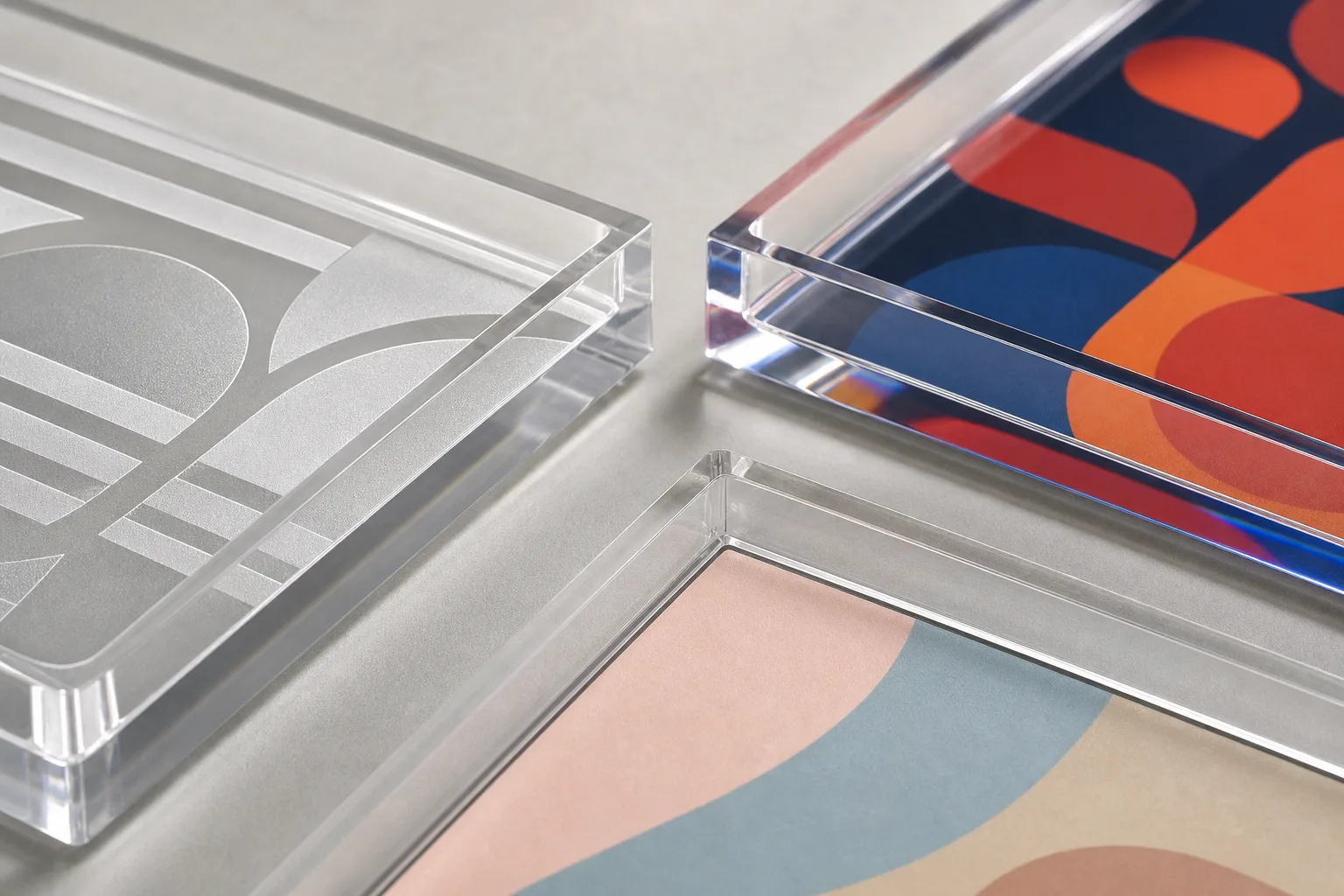
That physical difference is what drives every downstream property, so it is worth thirty seconds of mechanics. Laser etching vaporizes a controlled depth of the surface — typically 0.05 to 0.2 mm — leaving a frosted mark that reads by contrast against the gloss around it; there is no ink involved unless the recess is deliberately paint-filled. Second-surface bottom printing lays UV-cured ink on the underside of the tray, reversed, usually backed with an opaque white layer and a sealing layer — so the logo has glossy acrylic above it and sealing below it, and the serving face stays bare PMMA. An insert is printed on its own sheet and laminated or placed beneath the tray floor, which makes it the only method where the branding and the tray are separable objects. One method removes material, one bonds ink to the tray, one adds a part — three different failure modes, three different strengths.
| Method | What it physically is | Color capability | Wear path | Artwork changeable? | Deep spec guide |
|---|---|---|---|---|---|
| Laser etch | Frosted recess cut into the surface | None (frost) or one paint-fill color at ΔE 2–3 | None — no ink layer to wear | No — permanent | This guide — see the durability axis |
| Bottom print | Reversed ink sealed under the tray floor | Full color, photographic | Protected — the tray body covers the ink | No — permanent | Bottom-print quality spec |
| Bottom insert | Separate printed sheet beneath the tray | Full color, 85%+ ink opacity spec | Sealed in the assembly | Yes — swap the insert | This guide — see the insert spec |
All three run under one roof here, which changes the buying conversation more than buyers expect. We run the laser line, the UV print line, and the insert lamination step in the same facility, so we quote the three routes against each other honestly instead of steering every brief toward the one machine we own. It also means a mixed program is one purchase order, not three suppliers: the same tray geometry can ship as an etched version for the flagship stores and a printed version for volume locations, cut from the same tooling and inspected to the same standard.
When a program combines two methods
Some of the strongest branded trays we build use two routes on one tray, because the methods answer different jobs. The recurring hotel pattern is an etched crest on the rim — permanent, tactile, tone-on-tone — over a full-color printed insert in the floor that carries the seasonal artwork. The hotel amenity and vanity tray program guide shows how that choice fits a room-count and reorder brief. The crest never changes; the floor changes every quarter. A corporate-gift variant runs the reverse: a bottom-printed signature pattern as the permanent base, with an etched recipient monogram added per batch. Combining methods adds a production step, not a redesign — the etch pass and the print or insert pass are separate stations anyway — so the surcharge logic stays per-method. If your brief has both a permanent identity element and a rotating one, say so in the RFQ; splitting the two jobs across two methods usually costs less than forcing one method to do both badly.
Axis 1 — does the logo need brand color?
Color is the first fork because etching cannot produce it. A clear etch is tone-on-tone: frosted white-ish contrast against gloss, elegant and permanent, but carrying zero color information. If the brand identity lives in its color — most do — the route runs through printing or an insert.
The nuance worth knowing is paint-fill, because it rescues one common case: the single-color brand that wants etch durability. A deeper etch (0.15–0.2 mm) becomes a channel that holds screen-printable pigment, matched to a Pantone Solid Coated reference within ΔE 2–3 — the range Pantone’s published guidance treats as acceptable for commercial work.1 The pigment sits recessed below the surface, mechanically shielded from abrasion, which is why etch-fill outlasts any surface-applied mark. For multi-color and photographic artwork, second-surface printing is the ceiling: the ink reads through the acrylic with a depth and gloss that surface printing cannot reach, and a white backing layer keeps the colors vivid rather than translucent. Inserts carry full color too, with one spec that decides whether they look premium or washed out: ink-stack opacity above 85%, because under warm, dim hospitality lighting a thinner ink stack lets the background read through and desaturates the brand color. When I quote a color-critical program, the Pantone reference and the lighting environment are the two things I ask for before anything else — they decide the method faster than budget does.
Axis 2 — wear, washing, and where each method fails
Rank the three by wear resistance and the order is: clear etch, paint-filled etch and sealed bottom print roughly together, then insert — and all four beat a surface-printed logo, which is why surface print on the serving face is not one of the routes we recommend for trays. We still get asked for it, and we still talk buyers out of it: a logo that lives where the glassware slides is a logo with a countdown on it.
The reasoning sits in where each mark lives. A clear etch is the tray surface, so nothing can chip, peel, or fade; dishwasher chemistry can still craze the acrylic itself, but the logo has no separate life to lose. Etch-fill pigment sits below the wear plane. A bottom print never touches the working side at all — glassware, cutlery, and cleaning cloths meet bare PMMA while the ink hides underneath — but it inherits a sealing requirement: the underside stack must be sealed against wash water, which is a spec to confirm in writing, not assume. The industry vocabulary for verifying that cured ink stays bonded to a substrate is the cross-cut tape-adhesion test per ASTM D3359,2 and a supplier who can tell you how their ink stack is sealed and verified is a supplier who has failed one before. Inserts are sealed inside the assembly and hold up well; their wear question is really a tolerance question — a loose insert that shifts a millimeter reads as a defect even when nothing has worn. On washing, all three routes obey the same acrylic care rules as any tray: hand-wash, mild soap, no dishwasher — the method changes where the logo hides, not what PMMA tolerates.
Axis 3 — will the artwork ever change?
If the artwork rotates — seasonal themes, campaign branding, a licensed design with an end date — the insert is not just the best option, it is the only one. Etched and printed logos are permanent by construction. An insert program changes artwork by printing new sheets while the tray fleet stays in service.
This decision belongs in the first artwork review: bottom printing fixes that approved design on the tray body, while a removable insert can support later artwork changes. The economics of the insert route can improve on reorders. Because the register calibration, ink-stack profile and cut paths can be archived after approval, a repeat quote can reuse released geometry while new artwork still requires review. The bespoke printed tray project covers fixed-artwork approval. A separate artist tray brand repeat-order record documents another 1,000 4 × 4 inch engraved trays and a buyer-requested decrease in engraving size, showing why changed decoration still needs explicit approval.
Bottom insert spec: file checks, ink stack, and the brief
A bottom insert reproduces cleanly when four things are right before the quote: the artwork survives the reduction to insert scale, the ink stack is opaque enough for the venue’s light, the insert window and print register hold tight tolerances, and the brief names the lighting and reorder plan. Hospitality and corporate-gift programs are the heaviest insert buyers, and most of their rework traces to the file, not the press.
Scale is what breaks the file. A logo printed 60 mm wide on a 200–400 mm insert shrinks everything in the source file. A 0.5 px stroke lands at roughly 0.25 mm, too thin to print crisply, so insert strokes need at least 0.3 mm. Decorative serifs, fine internal patterning, and multi-element marks lose detail below about 0.5 mm at that size. Gradients step visibly at typical 300–600 dpi insert print resolution, and RGB brand colors shift when the file goes to a CMYK plus spot-color workflow. Keep a separate production master with thickened strokes, flat fills, and CMYK plus Pantone references, or use a simplified logo variant for small inserts. We check every incoming file and flag each of these issues before quoting, but the corrected file comes from your team: we print from buyer-supplied, production-ready artwork and do not redraw or vectorize logos.
Ink stack sets how the color reads under warm light. Hospitality lighting (3,000–3,500 K, 200–400 lux) is dim next to retail spot lighting, and thin ink lets the acrylic behind it wash the color out.
| Ink stack | Typical opacity | Use it for |
|---|---|---|
| Single-layer CMYK | 60–75% | Retail and office light only |
| CMYK + white underprint | 85–92% | Hospitality and any venue below about 500 lux |
| CMYK + Pantone spot + white underprint | 92–97% | Color-critical luxury and brand programs |
The full stack adds roughly $0.40–$0.80 per tray at typical sizes, and on programs of 500+ trays the white underprint is the minimum.
Tolerances that keep the insert looking intentional. We work to ±0.2 mm on the insert window so the visible gap around the insert stays even, and hold multi-color print register within ±0.2 mm by calibrating against a reference mark at the start of the run and spot-checking every 100 prints. After approval, the register profile, ink-stack profile, and cut path are archived, which is how a repeat insert order drops from about 21 days to 14.
Insert brief checklist. Send these and the file review usually clears on the first pass:
- Production-master vector file: strokes of 0.3 mm or more, flat fills, CMYK plus Pantone spot references
- Tray dimensions and the insert window size
- Venue lighting (warm white around 3,000 K, cool white around 4,000 K, or daylight around 5,000 K), which sets the ink-stack recommendation
- Unit volume for the first run and the expected reorder cadence
- One sign-off contact for the printed proof who was part of the spec discussion
Artwork prep — the gate all three routes share
Whichever method you route to, the artwork gate is the same: vector files, outlined fonts, Pantone references, and stroke widths above the method’s minimum. Most failed first samples across all three methods trace to the file, not the machine — so the file check happens before quoting, not after sampling.
The rejection patterns repeat so reliably that we run a design-for-manufacturing review on every incoming file. Hairline strokes are the classic: below about 0.15 mm they break up in an etch, and below about 0.3 mm they blur at insert-print scale. Gradient fills render as stepping in print workflows and cannot etch at all. RGB-only files shift when converted for production — send CMYK plus Pantone references. And raster logos pasted inside a vector container are still rasters, whatever the file extension says. If your logo exists only as a PNG, have it converted to vector before the sample gate: we print and engrave from buyer-supplied, production-ready files and do not redraw artwork. The full customization options page covers how these branding methods combine with color, finish, and shape choices across products; the per-method spec guides linked above carry the exact stroke, depth, and opacity numbers for the route you land on.
Writing the RFQ line — and what happens next
For custom acrylic trays with logo, a complete RFQ line reads like this: tray dimensions and format, method (or the three-question answers so the supplier can route it), vector artwork with Pantone references, quantity, and deadline. With those, a quote and a DFM file check come back in one pass — no spec ping-pong.
From our side the frame is identical across all three routes: MOQ 100 pieces per design, samples in 3–5 days after artwork approval, production in 15–20 days after sample sign-off, 100% inspection in our ISO 9001-certified factory. What the sample stage checks differs by route, and we build that into the approval: on an etched sample we confirm depth and how the mark reads under the buyer’s own lighting photos; on a bottom print we confirm color against the Pantone reference and inspect the ink stack for bubbles and pinholes; on an insert we confirm register, opacity under warm light, and the fit that keeps the sheet from shifting. Approving the right things at sample is what makes the production run boring — which is the goal.
Pricing behaves differently per route — etching is surcharged by etch area (roughly $0.40–0.80 per piece at one square inch of etch), printing by coverage and color count, inserts by the second part they add — which is one more reason the routing question comes before the budget question. The decoration step itself normally adds no tooling fee, because the laser and the printer are digital and your artwork file is the tooling that reorders inherit; if an unusual tray shape needs its own setup, the quote states it. Tray formats, sizes, and thickness options live on our acrylic trays hub, with the service-tray specifics on the acrylic serving trays page. When you are ready, send the RFQ line above with your artwork — I will come back with the routing recommendation and the file check within 24 hours, and the first physical sample will show your logo in the method your program actually needs.
Footnotes
-
Pantone — color matching reference system — the industry-standard spot-color system used for brand color on manufactured goods; Pantone’s published guidance treats ΔE 1–3 as acceptable commercial color match, the register band quoted for paint-filled etching. ↩
-
ASTM D3359 — Standard Test Methods for Rating Adhesion by Tape Test — the cross-cut tape-adhesion protocol that is the industry vocabulary for verifying cured ink stays bonded to a substrate, referenced for how sealed bottom-print ink stacks are specified and checked. ↩
Frequently Asked Questions
What are the options for putting a logo on an acrylic tray?
Three production methods cover nearly every branded tray program: laser etching, which removes material to leave a permanent frosted mark; second-surface bottom printing, which seals full-color ink under the tray floor; and a printed bottom insert, a separate sheet placed beneath the tray that can be swapped. They differ on color capability, wear behavior, and whether artwork can change later — not simply on price.
Which acrylic tray logo method lasts longest?
Laser etching — the mark is cut into the acrylic itself, so there is no ink layer to wear, chip, or fade, and a clear etch lasts the life of the tray. Paint-filled etching is close behind because the pigment sits recessed below the surface, mechanically shielded from abrasion. A sealed second-surface print is also protected — the tray body itself covers the ink — while a surface-printed logo on the serving face is the wear-path we steer buyers away from.
Which method shows brand color best?
Second-surface bottom printing, for full-color and photographic artwork — the ink reads through the acrylic with a glossy depth print-on-top cannot match. A printed bottom insert also carries full color and needs an ink-stack opacity above 85% to stay saturated under warm hospitality lighting. Etching alone has no color; etch-fill adds a single Pantone-matched color at a register of ΔE 2–3.
Can I change the tray artwork later without buying new trays?
Only with a bottom insert. The insert is a separately printed sheet that sits beneath the tray, so a seasonal or campaign artwork change is a new set of inserts, not a new tray order. Etched and bottom-printed logos are permanent — that permanence is their durability advantage and their limitation. Programs that rotate artwork quarterly are insert programs by definition.
What artwork files do I need for a branded acrylic tray?
Vector artwork (AI, EPS, or vector PDF) with fonts outlined, plus Pantone references for any color-critical elements. The common rejection patterns are hairline strokes too fine for the method, gradient fills where flat fills were intended, RGB-only files, and raster logos embedded in vector containers. Send the file with your quote request: we check it before sampling and flag any issue, and your team supplies the corrected production file. We do not redraw or vectorize artwork.
Explore Custom Acrylic Products
Browse product categories to compare formats, materials, and customization options before choosing the closest fit for your project.