




Acrylic Frame Mounting: 4 Methods Compared
Standoffs, magnets, easels, or a cleat — the right answer depends less on the frame than on how often the artwork changes and whose wall it hangs on.
Need this made?Custom acrylic frames →
Key Takeaways
- Four mounting methods cover nearly every acrylic frame program: wall standoffs (permanent, premium), magnetic two-piece (fast art changes), easel back (no wall at all), and French cleat (large, heavy formats).
- Pick by art-change frequency first: standoffs take minutes and a step stool to re-open; a magnetic two-piece frame swaps a print in seconds without tools.
- Weight, wall substrate, anchor, fastener, safety factor, and installation method decide the hardware; the approved hardware data and project drawing control the load rating.
- No-drill systems must stay within the hardware maker's rating for the tested wall surface and finished assembly, with the installer applying the required safety factor.
- Every method is an order-time spec: standoff holes, embedded magnets, easel geometry, and cleat rails must appear on the approved drawing before production.
On this page
- Four mounting methods, one vocabulary trap
- Wall standoffs: the permanent statement
- Magnetic two-piece: built for rotation
- Easel backs and desktop formats: no wall at all
- French cleats: the large-format answer
- Renters and no-drill walls: know the ceiling
- The decision framework
- Ordering: mounting is a production spec
Four mounting methods, one vocabulary trap
Acrylic frame mounting comes down to four methods: wall standoffs, magnetic two-piece frames, easel backs, and French cleats. To hang an acrylic frame, weigh the finished frame, pick the method by how often the artwork changes, then fix hardware rated for the wall substrate. Standoffs suit permanent art; magnets suit rotating prints; cleats carry large formats.
Buying mounted frames for a store, office, or event program? Our acrylic floating frames with standoff or magnetic mounting are made to size from 100 pieces per design, with an 11 × 14 in frame at $11–20 per unit at 100 pieces, FOB Shenzhen. Send the frame size, wall type, and quantity, and we will quote the frame and its mounting hardware together.
Mounting is specified with the frame itself: holes, magnet pockets, and cleat rails are cut into our custom acrylic frames during production. Start with the acrylic frame size chart, then match the panel stack and finished weight to the wall substrate, approved hardware, and installation plan. If the job is a removable paper-insert system rather than a picture frame, compare the dedicated wall sign holder mounting formats.
“Wall-mounted acrylic frames” can mean different systems to different teams. Marketing may picture floating prints on polished standoffs, store operations may need panels staff can change without a screwdriver, and facilities may limit holes in a leased wall. Resolve that vocabulary by asking how often the artwork changes, what the wall substrate is, and who approves the installation.
| Method | Art change | Wall | Planning formats | Drilling | Look |
|---|---|---|---|---|---|
| Wall standoffs | Minutes, needs tool | Any, anchored | A4 to ~60 x 90 cm | 4+ holes | Premium floating |
| Magnetic two-piece | Seconds, no tool | Wall or none | A5 to ~A2 | 2-4 holes or none | Clean sandwich |
| Easel back / desktop | Instant | None | A6 to ~A3 | None | Counter display |
| French cleat | Minutes | Studs / masonry | 60 x 90 cm and up | Cleat rail | Flush, hidden |
Mounting provisions may require holes, pockets, bonded parts, magnets, or a separate rail, so define them on the drawing rather than assuming a later retrofit.
How to hang an acrylic frame on a wall
- Weigh the finished frame. Include both panels, the print, spacers, magnets, and any rail. Cast acrylic is about 1.2 g/cm³, so a 60 x 90 cm two-panel frame in 4.5 mm sheet carries roughly 5.8 kg of acrylic alone.
- Pick the method. Standoffs for permanent art, a screwed back panel with a magnetic face for rotating prints, a French cleat for large or heavy formats, an easel if the wall is off-limits.
- Mark with a template. Use a paper template of the drilled hole pattern or cleat rail, and level it before marking.
- Anchor into the substrate. Choose anchors and fasteners rated for drywall, studs, masonry, or tile and for the finished weight with the installer’s safety factor.
- Fix and level. Mount the barrels, back panel, or wall rail, hang the frame, and remove the protective film last.
Wall standoffs: the permanent statement
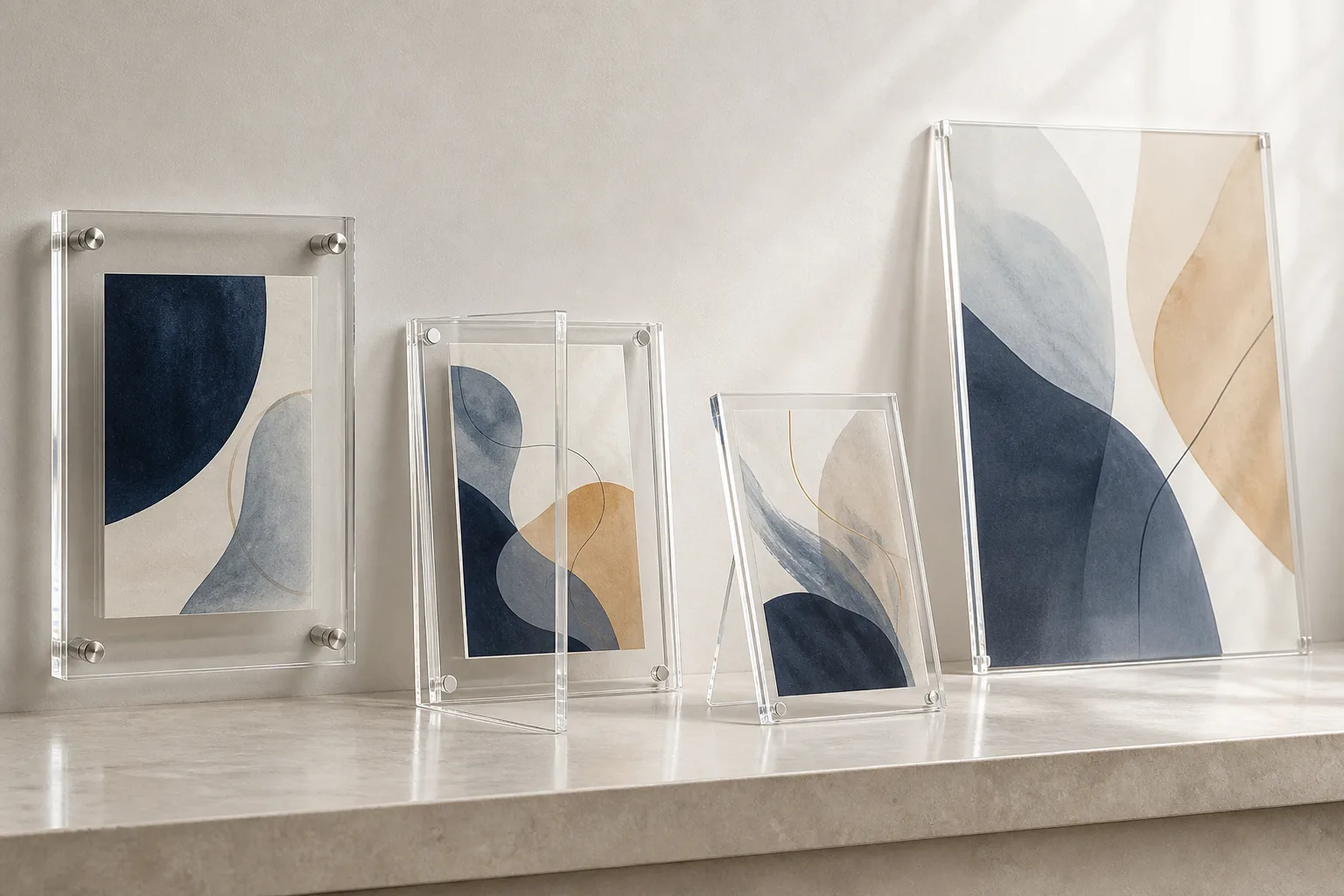
Standoff mounting clamps the acrylic through four (or more) pre-drilled corner holes with metal barrels screwed into wall anchors, holding the frame 15-25 mm off the wall. It is the most architectural of the acrylic frame mounting options — a floating panel with visible polished hardware — and the least convenient to re-open.
The barrel carries the load into the wall anchor, a threaded cap clamps the acrylic face, and the offset creates the shadow gap. The hardware supplier or mounting engineer must approve the barrel, anchor, fastener, wall substrate, hole pattern, finished weight, and safety factor as one system.
What buyers underestimate is the change cycle. Swapping the print in a standoff frame means unscrewing four caps — a step stool, a few minutes, and two hands per frame. For a lobby brand statement or a diploma wall on our certificate frame format, that is irrelevant; the content never changes. For a merchandising wall that rotates monthly across 40 stores, those minutes multiply into a labor line item, and a magnetic format starts paying for itself.
Two specification notes from coordinating frame orders since 2020. First, hole position tolerance matters more than hole count: four holes CNC-drilled to the drawing means the wall template matches every frame in the batch, and hole position is one of the things our QC team checks piece-by-piece during 100% inspection, because a missing or drifted mounting hole is the kind of defect that stops an entire installation crew. Second, specify the standoff finish with the frame, not after: satin stainless, black, and brass barrels all read differently against a polished acrylic edge.
Magnetic two-piece: built for rotation
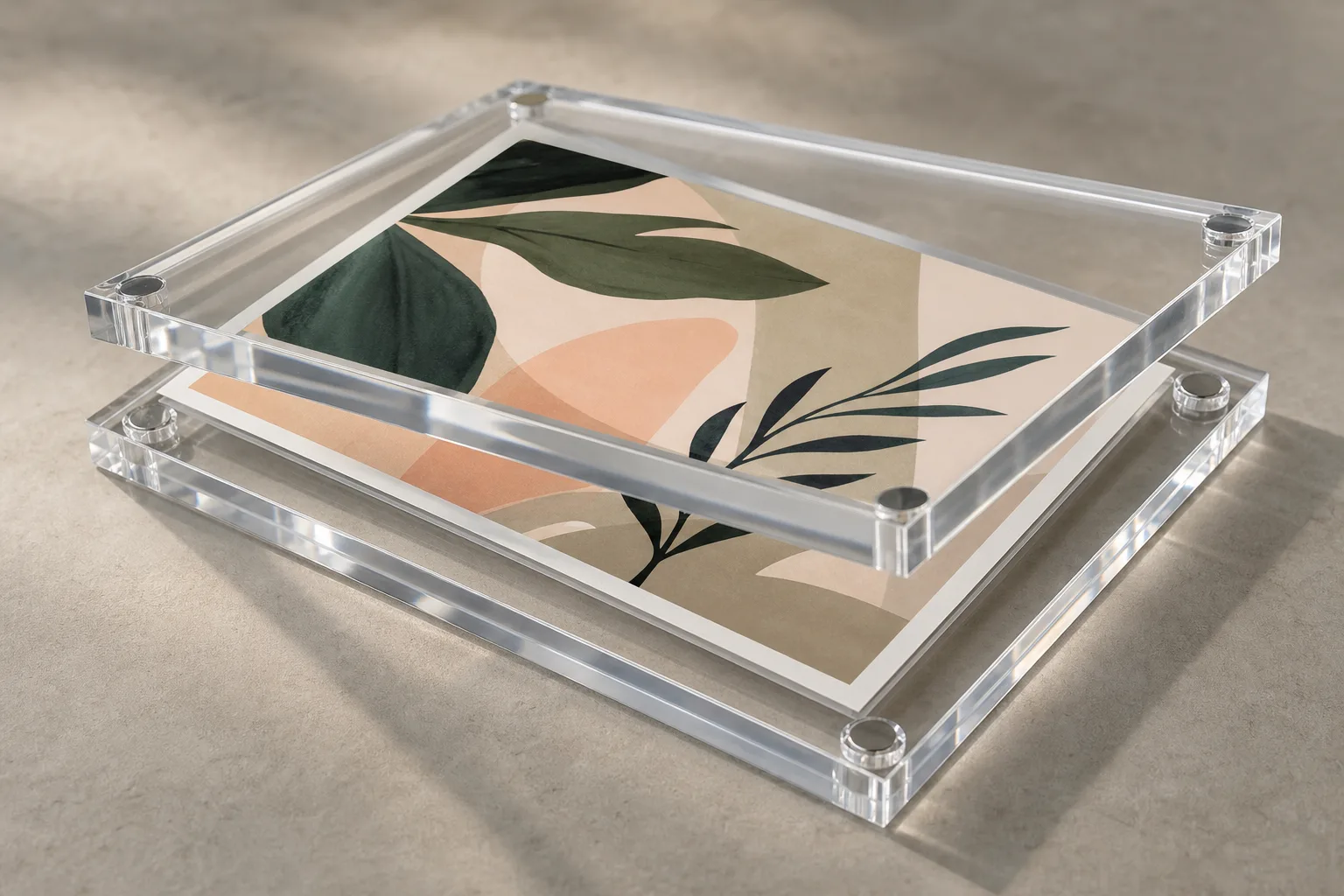
A magnetic acrylic frame is two panels — a back and a face — that sandwich the print and grip each other through embedded neodymium magnet pairs. Opening it takes seconds and no tools, which makes it the default acrylic frame mounting method wherever artwork changes on a schedule: menus, price cards, galleries, campaign walls.
Neodymium magnet grades describe maximum energy product, but grade alone does not set frame holding force. Diameter, thickness, air gap, pocket depth, polarity, pair count, panel weight, and opening force all matter.1 The drawing names the magnet geometry and count, and the paid sample verifies that the face stays closed while staff can open it without tools.
Wall-mount versions hang from two to four discreet screws through the back panel (or sit on adhesive within its rating — more on that below), while the magnetic sandwich handles all the opening and closing. That split is the method’s core advantage: the wall hardware is installed once, and every art change afterward touches only the magnets.
If your program is specifically menu- or print-rotation driven, our magnetic acrylic frames page covers the format options, and the magnetic picture frames buyer guide goes deeper on that product family. Magnet placement is embedded during fabrication — recessed and capped so nothing telegraphs through the visible face — so it has to be on the drawing before production, like every other detail on this list.
Easel backs and desktop formats: no wall at all
An easel-back or desktop acrylic frame skips the wall entirely: a hinged leg, a slanted block, or an L-shaped profile holds the frame on a counter, shelf, or desk. It is the zero-commitment acrylic frame mounting method — no drilling, no adhesive, instant repositioning — and the right answer for retail counters and reception desks.
The three desktop constructions behave differently. A slant-back L-frame is a single bent piece with the print dropped in from the top — the most economical construction, the fastest to reload, and the standard for price cards and countertop signage. A block easel is a thick machined base with a slot; it reads premium and stays put, which suits jewelry counters and award displays. A hinged easel back mimics a photo frame and folds flat for shipping.
For restaurant tables, reception counters, or aisle ends where the insert must face both directions, specify custom double-sided acrylic frames with a stable base rather than adapting a one-face easel after production.
Size discipline is the one real constraint. Past roughly A3, a freestanding acrylic frame becomes tip-prone in traffic and takes up counter real estate that retail managers guard jealously; large formats belong on a wall. The other planning note is packaging: desktop frames often ship to dozens of locations individually, so a fold-flat or slot-assembled design can cut the freight bill meaningfully — worth raising at quote stage, because as a made-to-order fabrication decision it costs nothing to change on the drawing.
When I walk a first-time retail buyer through format choice, the pattern that recurs: wall formats for brand permanence, desktop formats for point-of-sale flexibility — and most rollout programs order both against one artwork spec.
French cleats: the large-format answer
A French cleat hangs an acrylic frame from two interlocking 45-degree rails — one bonded to the frame’s back, one anchored level across the wall. The frame’s weight seats the rails together and distributes load along the rail. A 60 x 90 cm acrylic poster frame is a typical example, not a cutoff; the mounting engineer must approve the rail, bond, wall substrate, anchors, fasteners, finished weight, and safety factor.
Cast acrylic runs about 1.2 g/cm³,2 so a 60 x 90 cm frame with two 4.5 mm panels contains roughly 5.8 kg (about 13 lb) of acrylic before the print, magnets, rails, or backing. That arithmetic is an input, not a hardware selection rule. The mounting engineer must check the complete assembly and approve the load path into the wall.
The cleat can be aluminum or acrylic. If it bonds to the back panel, the drawing, named adhesive or joining route, surface preparation, cure controls, and project-specific load test must define the structural joint. Our floating acrylic frames page covers cleat-backed formats, the floating-frame specification guide lists the drawing inputs, the gallery-wall frame layout formulas help turn the approved mount into a multi-frame arrangement, and the colored acrylic floating frames case study records a related gallery program.
Renters and no-drill walls: know the ceiling
No-drill acrylic frame mounting uses an adhesive system only when the hardware maker approves the wall surface, preparation, environment, and finished assembly. A cited 3M large picture-hanging strip product publishes a 15 lb rating for its named configuration,3 but that number does not transfer to another strip count, wall coating, temperature, humidity, or installation method.
Calculate the full assembly weight before selecting hardware. The calculation must include both panels, print, spacers, magnets, rails, and any backing. Then have the hardware supplier or installer apply the required safety factor for the tested wall substrate and environment. If the evidence does not cover the finished assembly, use an easel, freestanding format, or an approved mechanical mounting system.
Two practical notes. Adhesive systems want smooth, painted, clean walls — textured and porous surfaces cut real capacity below the printed rating. And a magnetic two-piece frame pairs well with strips: install the light back panel on adhesive once, and every art change afterward happens through the magnets, never stressing the adhesive with removal cycles.
The decision framework
Choosing an acrylic frame mounting method takes three questions in order: how often does the art change, what does the frame weigh, and can you drill the wall? Answer those and the method usually picks itself — the table below maps the common scenarios.
| Your scenario | Method | Why |
|---|---|---|
| Lobby brand statement, art never changes | Standoffs | Premium floating look; change speed irrelevant |
| Restaurant menus, weekly rotation | Magnetic two-piece | Tool-free swap in seconds, staff-proof |
| Retail counter price cards | Easel / slant-back | No wall, instant reposition, easy to multiply |
| Gallery exhibition wall, monthly rotation | French cleat (+ magnetic faces) | Big formats lift on and off; wall drilled once |
| Leased office, no drilling allowed | Approved adhesive system, or easel | Follow the named hardware, wall-surface, environment, and safety-factor evidence |
| Diploma / certificate program | Standoffs | Permanent, uniform install across a wall grid |
| 50-store campaign wall rollout | Magnetic two-piece, template-drilled backs | One wall template, seconds per art change forever |
Mixed programs are normal; since 2020, I have rarely shipped a program that used only one method. The useful discipline is per-location specification: the same artwork can ship as a standoff frame for the flagship, magnetic frames for the mall stores, and easel formats for counters, all from one drawing set and one production run.
Ordering: mounting is a production spec
Every acrylic frame mounting method is built into the frame during production — drilled, embedded, or bonded — so the mounting decision belongs in the RFQ. CNC hole changes do not require an injection mold, but the quote must still identify any fixture, hardware, setup, testing, and sample cost.
What we need per format: for standoffs — frame size, panel thicknesses, hole diameter and inset, barrel finish; for magnetic — face size and how often staff will open it, so we spec magnet grade and count; for easel — the construction type and counter depth; for cleats — frame weight and wall type, so the rail and anchors match. Send what you have to our acrylic frames team even if it is a photo and a wall dimension — full drawings are welcome but not required, and every mounting option on this page is part of our standard custom acrylic fabrication scope.
Production starts at 100 pieces per design. Samples take 3–5 days and cost USD 200–500 depending on complexity, paid separately and never credited to production; production takes 15–20 days after approval, FOB Shenzhen. The drawing dimensions each hole, magnet, rail, and panel, and the sample confirms the approved mounting details before bulk production. Send us your frame spec and name the wall substrate and installer requirements; we respond within 24 hours.
Footnotes
-
Magnet Grades — K&J Magnetics — explains the neodymium N-grade system, showing that the N number tracks maximum energy product and that higher grades like N52 are proportionally stronger than N35 at the same magnet size; the basis for magnet-grade selection in two-piece frames. ↩
-
MakeItFrom — Polymethylmethacrylate (PMMA, Acrylic) — published PMMA density of ~1.2 g/cm³, the number behind the panel-weight math here. ↩
-
Command Large Picture Hanging Strips — 3M — manufacturer page for the named product and configuration. Its published rating applies only under the maker’s stated surface, preparation, strip-count, and installation conditions. ↩
Published price point
Quote the frame and mounting system together
$2 per unit published low-end reference at 500 pcs, FOB Shenzhen
Published low end for one named frame: a 5×7 inch single-panel tabletop frame in 3 mm clear acrylic with a slot-in angled stand. Standoffs, magnets, cleats, panel stacks, hardware, packing, and quantities require their own quote.
Paid samples are quoted separately and are never credited to production.
Thank you!
We've received your inquiry. Our team will reply within 24 hours — usually faster.
Frequently Asked Questions
Can screw holes or mounting details be changed on a custom acrylic frame?
Yes. Hole positions, diameters, flush-back details, and spacer bosses can change in the CNC program without an injection mold. The quote still identifies any fixture, hardware, setup, or sample cost. We confirm mounting details on the drawing and a paid 3–5 day sample before production.
What is the best way to mount an acrylic frame without drilling the wall?
Use an adhesive system only when its manufacturer approves the wall surface and the finished assembly stays within the published rating after the required safety factor. Compute the full frame weight, then have the hardware supplier or installer confirm the strip count, surface preparation, environmental limits, and installation method.
Are magnetic acrylic frames strong enough to hold prints securely?
They can be when the drawing specifies magnet geometry, grade, pair count, polarity, pocket depth, air gap, and panel weight. Grade alone does not set holding force. The paid pre-production sample verifies that the face stays closed while staff can open it without tools.
How do I choose between standoffs and a magnetic frame?
Ask how often the artwork changes. Standoffs clamp the panels with four screwed barrels — a premium, permanent look that takes minutes and a tool to open. A magnetic two-piece frame opens by hand in seconds, which is why menu programs, galleries, and rotating campaigns choose it. For unchanging brand or archival pieces, standoffs; for rotation, magnets.
How do you hang an acrylic frame on a wall?
Weigh the finished frame, choose the method (standoffs, a magnetic back panel on screws, or a French cleat for large formats), mark the holes with a paper template, set anchors rated for the wall substrate, then fix the hardware and level the frame. For no-drill walls, use an adhesive system only within its maker's rating for that surface and weight.
What does acrylic mounting mean?
It has two meanings. In framing, it means how an acrylic frame attaches to a wall or stands on a counter, which is what this guide covers. In photo printing, acrylic face mounting bonds a print to the back of a clear sheet. For printed graphics on custom acrylic we print directly on the sheet with UV printing instead.
Do acrylic frames ship ready to install?
Ours do when the order specifies it: pre-drilled standoff holes, standoff hardware packed per frame, embedded magnets, or a bonded cleat rail. Each mounting detail is confirmed on the proof drawing, cut by CNC, and checked during 100% inspection, hole position and count included, before the order leaves our ISO 9001-certified factory.
Put the mounting method on the drawing
Send the frame size, panel stack, finished weight, wall substrate, art-change schedule, quantity, and destination. We will return the hardware scope and paid-sample plan.