Custom Shadow Box Cost at 100, 500, and 1,000
A program quote is four decisions, not one number: the depth you chose, the backer behind the object, the wall hardware and the carton.
Need this made?Acrylic shadow boxes →
Key Takeaways
- The public reference is a 500 × 400 × 80 mm acrylic shadow box in 5 mm clear with wall-mount hardware included: from $18–35 per unit at 100 pieces, FOB Shenzhen. Ask for 500 and 1,000-piece lines on the same drawing.
- Depth is priced by side-wall area and bonded seam length. On a 500 × 400 face, moving from 30 mm to 80 mm deep multiplies the wall strip from 0.054 m² to 0.144 m² before any thickness step.
- Standard felt backing is included; velvet or suede adds roughly $1–3 per unit; a UV-filtering front adds 15–25 % to the front panel.
- Hanging hardware is included, but a French cleat, keyhole, wire, or standoff each changes the fit check, the packed depth, and the thickness the frame needs.
- Carton volume, not acrylic weight, sets the freight line. LCL ocean is billed by cubic meter and parcel carriers bill the greater of actual and dimensional weight.
On this page
- The quote line a shadow box RFQ usually leaves out
- Start from one named reference at 100 pieces
- Depth is priced by wall area and seam length, not by centimeters
- Backer choice moves the unit price and the reject rate
- Hanging hardware is a purchased part plus a fit check
- Carton math decides the freight line
- Read 100, 500, and 1,000 as three inventory decisions
- Send a shadow box program RFQ
The quote line a shadow box RFQ usually leaves out
Most program briefs I receive say something like “quote 300 jersey frames, 24 × 36 in, black backing.” That sentence fixes the face size and the look, but custom shadow box cost is set by four inputs the brief rarely names: the recess depth, the backer material, the hanging hardware, and the carton that carries the finished frame. Our production MOQ is 100 pieces per design, and the public reference for a 500 × 400 × 80 mm acrylic shadow box in 5 mm clear with wall-mount hardware included runs from $18–35 per unit at 100 pieces, FOB Shenzhen.
This guide prices the frame you have already specified. If the depth or face size is still open, choose it first with the shadow box frame guide, which covers standard sizes, 3, 5, and 8 cm depth tiers, and frame-style versus box-style construction. This guide assumes those decisions are made and show how each one lands on the quote at 100, 500, and 1,000 units.
The buyers who run these programs are memorabilia retailers, team dealers, framing shops reselling under their own brand, gifting brands, and florists preserving bouquets at volume. All of them buy the same object as bulk shadow boxes from a shadow box manufacturer: a clear cast-acrylic front, side walls that set the depth, a backer, a hanger, and a carton. The differences between a comfortable quote and a surprising one live in those five parts.
Start from one named reference at 100 pieces
A shadow box price only becomes comparable when every tier uses the same drawing. The reference we publish on the acrylic boxes hub is a large shadow box frame, 500 × 400 × 80 mm, 5 mm clear acrylic, wall-mount hardware included, 100 pieces: from $18–35 per unit FOB Shenzhen. Standard felt backing and standard export packing sit inside that band. Velvet or suede lining adds roughly $1–3 per unit, and a UV-filtering front panel adds 15–25 % to the front-panel material.
The band is wide on purpose. The low end is a plain rectangle with a keyhole hanger and bulk packing. The high end is the same face with 8 mm walls for a heavy object, a French cleat, a mirrored or colored acrylic backer, and gift-ready packaging. A program frame sits somewhere between those two builds, and the quote we return names which features moved it.
We do not publish 500 and 1,000-piece figures for this reference because the correct number depends on the exact drawing, and a generic figure would be a guess. What is public is the shape of the curve: the steepest break falls between the 100-piece minimum and a few hundred units, then the curve flattens into the thousands. Drawing review, fixtures, proofs, first-off inspection, and carton development spread across more frames; sheet, cutting, polishing, bonding, backer fitting, hardware, inspection, and packing stay in every unit.
| Quantity per design | What the line should show | How to read it |
|---|---|---|
| 100 pieces | Public reference band from $18–35 per unit FOB Shenzhen for the 500 × 400 × 80 mm frame | The MOQ tier; highest unit price, lowest cash and inventory exposure |
| 500 pieces | Quoted on the same drawing, packout, and Incoterm | Most of the setup spread has already happened by here |
| 1,000 pieces | Quoted on the same drawing; check sheet yield and pallet plan | Gains come from purchasing and carton planning, not from skipped steps |
Ask for all three lines in one reply, and keep your quantities by design. Three face sizes at 200 each are three designs, three samples, and three 100-piece floors, even when they share one purchase order and one production window.
Depth is priced by wall area and seam length, not by centimeters
A deeper shadow box costs more than the extra centimeters suggest because the side walls are strips whose area equals the frame perimeter multiplied by the depth. On a 500 × 400 face the perimeter is 1.8 m, so a 30 mm wall uses about 0.054 m² of sheet, a 50 mm wall about 0.090 m², and an 80 mm wall about 0.144 m². Every one of those strips is cut, polished on the visible edge, and solvent-bonded along the full seam to the front and to the backer.
Depth also changes the parts that are not acrylic, and they sit on separate quote lines. A frame that must hold more than 500 g of displayed weight steps from 5 mm to 8–10 mm side walls and from a 3 mm to a 5 mm front, which is a material and polishing change rather than a depth change. Our acrylic thickness guide covers the span and load logic behind that step; the point for costing is that the thickness decision and the depth decision are priced as two separate lines.
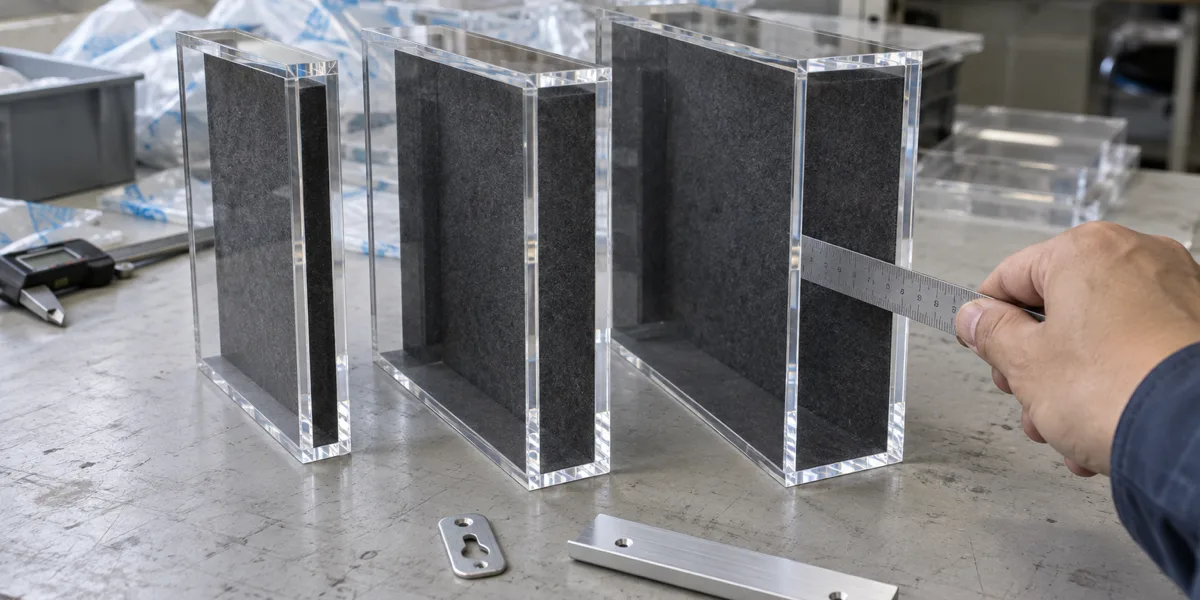
When a target price is tight, I ask the buyer whether the object really needs the depth in the brief. A flat-fold jersey at 50 mm instead of a draped jersey at 80 mm keeps the same face, the same backer, and the same hanger while removing wall material and carton volume. That is a spec conversation, not a discount, and it usually moves the quote more than negotiating the unit price does.
Backer choice moves the unit price and the reject rate
The backer is the surface the object sits against, and it is priced as material plus fitting labor plus inspection. Standard felt backing is included in the reference band. Velvet or suede adds roughly $1–3 per unit. Linen, cork, and custom fabrics are quoted per material because each one is cut, wrapped, and fixed to the backer panel by hand, and each one has a different tolerance for wrinkles, lint, and color variation across a run.
Colored or mirrored acrylic backers replace fabric with a bonded panel. They clean easily and stay flat, and a mirrored backer adds the depth illusion many memorabilia retailers want, but a mirrored sheet costs more than the fabric options and shows every fingerprint at final inspection. Printed inserts are a fourth route: a paper or acrylic insert carrying the program artwork or a customer’s caption, which works well for gifting programs because the insert can change while the frame stays identical. The acrylic photo frame repeat program case shows how printed inserts carried seasonal updates across four production runs without changing the acrylic.
Two backer variants come up in art and reseller briefs often enough to deserve their own quote lines. The first is an opaque back with clear sides, so the artwork reads as floating in front of a solid color panel while the wall strips stay transparent. That is a standard build for us; the backer panel becomes 3 mm colored acrylic and the sides stay clear, and the quote should name both materials. The gallery floating-frames case is the closest published example of a colored panel paired with clear acrylic and standoff hardware.
The second is an unglued or open frame supplied as a kit so an artist or reseller can insert artwork and close the box themselves. We can supply flat-pack kits where the design allows: the seam edges are machined, the protective film stays on, and the hardware ships in a bag. Kits cut carton volume on large formats, but they move bonding, squareness, and cleanup risk to the buyer’s bench, and a solvent joint made outside a controlled fixture will not match a factory seam. If you want that route, order a paid sample of the kit plus one factory-assembled unit and compare them before the 100-piece release.
Hanging hardware is a purchased part plus a fit check
Wall-mount hardware is included with every unit we build: a keyhole slot for lighter frames, a French cleat rated up to 15 kg for heavy items and large formats, a wire hanger where installers want adjustable positioning, or standoff mounts for a floating, off-the-wall look. Included does not mean identical in cost. A cleat is two machined bars and a fixing method; a keyhole is a machined slot and a plate; standoffs are four purchased posts plus four holes drilled through the frame with clearance for a wall anchor.
Each hanger changes three other lines. The fit check on the paid sample covers hanger position, back-panel flatness, and whether the frame hangs plumb with the object installed. The packed depth grows when a cleat bar or a standoff stands proud of the back. And the thickness decision follows the hanger, because a cleat concentrates the load along one bar while a keyhole concentrates it on one plate, and the back panel has to carry that load without bowing. The acrylic frame mounting methods guide compares the hardware options before the drawing is approved.
Freestanding formats sit outside the hardware line. A shadow box that stands on a counter or shelf needs an easel back or a base rather than a hanger, and the walls become part of the stand structure. If a program mixes wall-hung and freestanding units of the same face size, they are two designs with two samples, and the quote should say so rather than averaging the hardware into one unit price.
Send the finished weight of your object with the RFQ. We size the hardware from that weight and the frame format, then confirm it on the sample, but we do not certify the wall, the anchor, or the installer’s work. Program buyers who install across many stores usually issue their own installation sheet naming the anchor and fastener for each wall type, which is the right place for that responsibility.
Carton math decides the freight line
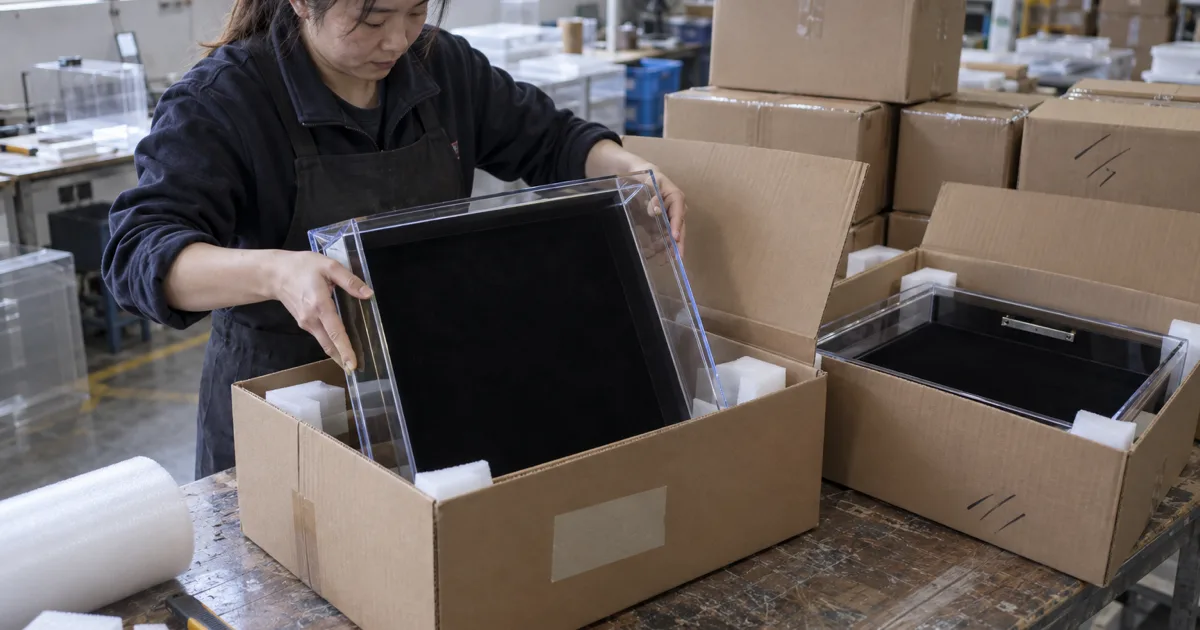
Carton volume, not acrylic weight, sets the freight cost of a shadow box program. A finished frame is mostly air inside a rigid box, so every millimeter of depth and every centimeter of foam allowance multiplies into cubic meters on a pallet. Production orders leave our factory with each frame in a foam-cornered protective carton, and we quote that packout as its own line, cartons grouped into master cartons sized to the frame format, and pallets built for LCL or FCL ocean freight.
Here is the arithmetic I walk buyers through, with the assumptions shown so a procurement team can replace them with its own. Take the 500 × 400 × 80 mm reference and add a 30 mm allowance on every face for foam corners and carton wall. The inner carton becomes roughly 560 × 460 × 140 mm, or about 0.036 m³. Two frames back-to-back in one carton share the allowance and land near 0.052 m³ for the pair, which is a saving of about 28 % per frame before the master carton is counted. Move the same face to 30 mm deep and the single carton drops to about 0.023 m³, which is why depth appears twice on the quote: once as wall material and once as freight.
Those cubic meters are what an ocean forwarder bills. LCL cost is calculated primarily by volume, usually in cubic meters, with weight taken into account only when a shipment is unusually dense.1 A 500-piece program at 0.036 m³ per single-packed frame is about 18 m³, which is already close to the point where a 20 ft container quote should be compared against the LCL rate. Parcel and air carriers use the other rule: a shipment is charged on dimensional weight or actual weight, whichever is greater,2 so a light, deep frame shipped one at a time pays for the air it encloses.
The packing spec belongs in the RFQ, not in an afterthought. If units will ship to end customers individually, ask for a carton that can pass a parcel-delivery simulation such as ISTA Procedure 3A, which covers individual packaged products of 70 kg or less moving through a parcel system,3 and expect more foam, a stronger inner carton, and a higher unit packing cost. If units go to a central warehouse and are repacked, a bulk carton with interleaves and corner blocks is the cheaper and better answer.
Flat-pack changes the equation on large formats. Where the design allows, shipping the front, walls, and backer as machined panels can cut the packed depth to a few centimeters, which is the single largest freight reduction available on a 24 × 36 in program. The trade is assembly at the destination, as described in the backer section, and it only pays off when your team has a bench and a fixture ready. For non-rush programs, the other lever is time: a 15–20 day production window plus ocean transit is usually acceptable for a planned rollout, and the quote can compare air, LCL, and FCL on the same cartons so your procurement team sees the ratio rather than a single number.
Read 100, 500, and 1,000 as three inventory decisions
The 100-piece tier suits a first release, one face size, and one backer while a buyer learns real sell-through and real installation issues. Unit cost is highest here, but cash and warehouse exposure are lowest, and the approved sample becomes the fixed reference for every later run.
The 500-piece tier suits a program with a stable drawing and a deployment plan. Most of the setup spread has already happened by this point, so the gains come from purchasing efficiency and steadier production runs rather than from a dramatic step. The question you should ask is not “how much cheaper” but “how many cartons and how many pallets,” because storage and freight now dominate the difference.
The 1,000-piece tier improves sheet yield and pallet planning when the SKU mix stays controlled. A long tail of sizes limits those gains: five sizes at 200 each is five designs, five samples, and five 100-piece floors, and each size packs into a different carton. The acrylic shadow boxes page explains how mixed sizes share one purchase order while remaining separate designs; the display stand cost guide applies the same three-tier reading to a different product, which helps when a program combines frames and stands.
Reorders repeat the approved sample from the files and fixtures we keep on record, and every production unit is inspected against that sample under ISO 9001 with 100 % inspection before shipment. The buyers I see get the most out of the larger tiers are the ones who hold the drawing still: same face, same depth, same backer, same hanger, and a printed insert or engraved plaque for the parts that need to change.
Send a shadow box program RFQ
Send your object or a photo with a ruler in frame, the outside face size, the depth you chose, the backer material and color, the hanger or freestanding format, the finished weight of the displayed item, the quantity per design, the packout (bulk, warehouse, or ship-to-customer), the destination, and the target date. Ask for 100, 500, and 1,000-piece lines on the same specification.
Wetop’s production MOQ is 100 pieces per design. Paid samples take 3–5 days, are paid separately, and are never credited to production. Production takes 15–20 days after sample approval, and we reply to a complete brief within 24 hours with material, fabrication, backer, hardware, packing, and freight assumptions as separate lines.
Use the shadow box program quote form to upload the files, or read the custom acrylic fabrication process first to see how the paid-sample path works before a production release. In my experience the more of those ten inputs arrive with the first message, the closer our first quote lands to the final one.
Footnotes
-
What is LCL shipping? — Freightos — freight marketplace explainer stating that LCL cost is calculated primarily by volume in cubic meters, with weight considered only for dense cargo. ↩
-
What is dimensional weight? — FedEx — carrier guidance stating that each shipment is charged on dimensional weight or actual weight, whichever is greater. ↩
-
ISTA test procedures — International Safe Transit Association — lists Procedure 3A as the general simulation test for individual packaged products of 70 kg or less shipped through a parcel delivery system. ↩
Frequently Asked Questions
How much does a custom shadow box cost in production quantities?
The public reference is a 500 × 400 × 80 mm acrylic shadow box in 5 mm clear with wall-mount hardware included: from $18–35 per unit at 100 pieces, FOB Shenzhen. Frame size, recess depth, backer, UV-filtering acrylic, quantity, and packaging move that band. Request 100, 500, and 1,000-piece lines on one drawing.
Why does a deeper shadow box cost more than the extra centimeters suggest?
Side walls are strips whose area equals the frame perimeter multiplied by the depth. An 80 mm wall on a 500 × 400 face uses about 2.7 times the strip area of a 30 mm wall, and above 500 g of displayed weight the walls step up from 5 mm to 8–10 mm. Packed depth also grows, which raises carton volume and freight.
Can a shadow box manufacturer supply frames unglued for buyer assembly?
Yes, as a flat-pack kit where the design allows, with the seam edges machined and protective film left on. Kits cut carton volume on large formats but move bonding, squareness, and cleanup risk to your bench. We recommend a paid sample of the kit and one assembled unit before a 100-piece release.
Are shadow box samples free, or does the sample fee come off the production order?
No. Paid samples take 3–5 days, are paid separately, and are never credited to production. The sample fixes depth clearance, backer color, hanger position, and carton fit before the 100-piece-per-design run, and every production unit is inspected against it.
How do I lower freight on a non-rush shadow box program?
Send the destination, deadline, and packed dimensions so the quote can compare air, LCL ocean, and FCL ocean on the same cartons. Ocean freight suits a program with a 15–20 day production window plus transit time; flat-pack kits and tighter carton allowances reduce cubic meters where the design permits.
Price One Shadow Box Program at Three Quantities
Send the face size, depth, backer, hardware, quantity per design, packout, and destination. We return 100, 500, and 1,000-piece assumptions as separate lines within 24 hours.