



Custom Display Stands: 7 Gates From Brief to FOB
Most supplier pages end with a contact form and a promised callback. Here is what actually happens after that email — 7 gates, day counts, and the three approvals you control.
Need this made?Acrylic display manufacturer →
Key Takeaways
- A custom display stand order passes through 7 gates — brief, quote, drawing approval, sample, production, QC proof, freight — in roughly 4–6 weeks from brief to FOB, and 3 of those gates are buyer approvals.
- Drawing sign-off before the sample is cut kills the most expensive error class: geometry mistakes that would otherwise surface after 50–500 units are already built.
- A target unit price is negotiable through design levers — wall thickness, internal structure, packaging, artwork — not just quantity; one recent program closed its gap with a $2–$2.50 per-unit option swap.
- The production clock starts at artwork lock, not at the PO date — unapproved artwork is the single most common cause of missed event deadlines.
- Wetop's reference numbers for custom display stands: samples in 3–5 days, production in 15–20 days, MOQ 100 pieces, 30% deposit with the 70% balance due before shipment.
On this page
- The custom display stand procurement path — 7 gates in 30 seconds
- Gate 1: The brief — what your RFQ needs before anyone can quote
- Gate 2: Quote and value engineering — hitting a target unit cost
- Gate 3: Drawing approval before sample — the error-proofing gate
- Gate 4: The sample loop — cost, 3–5 day turnaround, revision protocol
- Gate 5: Production — what actually happens in 15–20 days
- Gate 6: QC and the pre-ship proof — 100% inspection plus photo sign-off
- Gate 7: Packing and freight — FOB vs DDP, sea vs air, individual wrapping
- Reorders — why run 2 is faster and cheaper
- Custom vs stock displays: the cost and lead-time math
- Where custom programs go wrong — the 4 delays I see most
The custom display stand procurement path — 7 gates in 30 seconds
Custom display stands move from idea to shipped order through 7 gates: brief, quote with value engineering, drawing approval, sample, production, QC proof, and freight. The full path runs roughly 4–6 weeks from a complete brief to FOB handoff, and 3 of the 7 gates are approvals that you, the buyer, control.
Here is how a typical launch order plays out (a composite of the counter-unit RFQs I coordinate, with the details rounded). The buyer sent three things: a photo of a competitor’s counter unit, a phone sketch with two dimensions on it, and one sentence: “we need 300 of these under $9 a unit, in stores before our September launch.” That email became a shipped order in five weeks. It cleared a quote that came back $1.80 over target, a value-engineering pass that closed the gap, a production drawing she marked up twice, a sample that grew 15 mm taller after she tested it with real product, an 18-day production run, and a pre-ship photo proof she approved from an airport lounge. Every custom display stand order I coordinate passes through those same gates in the same order. This guide walks each one — what happens, how long it takes, and what you sign.
Why publish the sequence at all? Search for custom display stands and most of what comes back is a services pitch (a contact form and a promised callback) with no process visible behind the form. We take the opposite view. We have shipped 2,000+ custom projects to 25+ countries, and the programs that run smoothest are always the ones where the buyer knew the gate sequence before gate one. An informed buyer approves faster, briefs better, and never gets surprised by an invoice. Publishing the sequence costs us nothing and saves us both weeks.
One scope note before the gates. This guide covers the procurement mechanics — what you approve, when, and what it costs to change your mind at each point. If you are still choosing between fabrication methods, our acrylic fabrication guide covers those in depth; for the week-by-week reference timeline, see how acrylic production lead times break down. We will not repeat that ground here.
Gate 1: The brief — what your RFQ needs before anyone can quote
A quotable custom display stand brief has four elements: outside dimensions (or the product the stand must hold), quantity tiers, artwork status, and destination. With those four, we return a real number in 1–2 days. Without them, the first week disappears into clarification emails, the most avoidable delay in the entire process.
Dimensions come first, and there are two valid ways to give them. Either you specify the stand itself (width, depth, height, shelf count), or you send the product it has to hold and let our engineering side work backward. If the job is loose shelves rather than a complete stand, our acrylic shelves page covers the cut-to-size route. Photos of the product with a ruler in frame work. Physical samples work better, and for fit-critical designs we will ask for them at the sample gate anyway. The buyer from my September-launch story sent neither at first; her phone sketch had a width and a height but no depth, and depth is exactly what decides whether a counter unit tips forward when loaded. If you have no drawing at all, reference photos plus rough dimensions are enough for a budget estimate — we firm the number at the drawing gate.
On our side, a complete brief goes straight to an engineering review before we quote. We check the geometry for stability — base-to-height ratio, shelf load paths, whether the design needs internal bracing the sketch never shows — and we flag anything that would otherwise bite at the sample stage. I sit in on these reviews for my accounts, because half of what makes a quote accurate is the questions we send back with it: does the stand ship flat-packed or assembled, does the counter it sits on have a depth limit, is the artwork a one-color logo or a full-face print. A brief that answers those in advance gets a cleaner number, faster.
Quantity tiers matter more than most first-time buyers expect. “20–500 of each display” is a completely normal ask in this category — retail programs rarely commit to one number before seeing pricing — so ask for the quote at 3 tiers up front: for example 100 / 300 / 500 units. Per-unit price falls as quantity rises because setup and tooling amortize across more pieces; the acrylic display stand cost guide at 100, 500 and 1,000 pieces maps that curve in detail. Finally, state the artwork status plainly (“final,” “in design,” or “we need print specs first”) and name the destination port or door: Incoterms change the quote, and we default to FOB Shenzhen with EXW, CIF, and DDP available.
Gate 2: Quote and value engineering — hitting a target unit cost
Six design levers set the price of a custom display stand — wall thickness, internal structure, quantity tiers, packaging spec, artwork coverage, and Incoterms — and adjusting them is how a quote meets a target: on one recent program, a value-engineered option built from those levers came in $2–$2.50 lower per unit than the original spec. So if the budget has a ceiling, say so in the RFQ. A target unit cost turns the quote from a take-it-or-leave-it number into an engineering exercise.
I handle this conversation weekly, and the pattern is consistent: the first quote lands somewhat above target, and the buyer assumes the only fix is cutting quantity or walking away. Neither is usually necessary. The levers, one by one:
- Material thickness. Dropping a non-structural panel from 5 mm to 3 mm can trim meaningful cost across hundreds of units without changing how the stand performs. Structural panels stay thick; cosmetic ones do not have to.
- Internal structure. A glued internal divider is cheaper than a machined interlocking one. If the divider never carries load, the cheaper joint is the right joint.
- Quantity tiers. Moving from 100 to 300 units often does more for unit price than any design change — setup costs divide by three.
- Packaging spec. Bulk-packed units cost less than individually boxed ones. Individually wrapped without a retail carton is a middle option many buyers do not know to ask for.
- Artwork coverage. Full-face UV print costs more than a single logo hit. One panel of print instead of three can close a stubborn gap.
- Incoterms. An FOB quote looks cheaper than DDP because it is measuring less of the journey. Compare quotes on the same term.
The recent program mentioned above closed its gap with exactly that kind of option: same footprint, same branding surface, simplified internal structure. We built samples of both versions so the buyer could judge the difference with product loaded, not on a spreadsheet. That is the honest version of value engineering: you see exactly what the savings changes before you commit to it.
Gate 3: Drawing approval before sample — the error-proofing gate
Before any material is cut, we put a dimensioned production drawing, prepared from the files and references you sent, in front of you and wait for sign-off. We check your design for manufacturability; we don’t provide product or graphic design. This gate exists to catch geometry errors at the cheapest possible point: a wrong dimension costs one email on a drawing, one revision fee on a sample, and a five-figure dispute on 500 finished units.
New buyers sometimes push to skip this gate: the deadline is close, the sketch “already shows everything,” why add 2–3 days? I hold the gate anyway, and complex stands are the reason. A multi-shelf floor stand has shelf pitch, back-panel angle, base overhang, and slot tolerances that a phone sketch never fully specifies. The drawing forces every one of those numbers into the open where you can veto them. My September-launch buyer marked up her drawing twice (she moved a shelf 20 mm and widened the base), and both changes cost nothing because nothing existed yet except geometry on a screen.
Our drafting team turns a sketch and a quote into that drawing in 2–3 days, and we treat the signed version as a contract document. It is the reference we build the sample against, the reference the sample is judged against, and the referee that settles any later question about who pays for a revision. Hundreds of these approvals later, I have never seen a program regret the two days this gate takes; I have talked to more than one buyer who regretted skipping it at a previous supplier.
What we send at this gate is a drawing with every critical dimension called out, material thickness per panel, joint types, and print zones marked. What we need back is explicit: a reply that says approved, or a marked-up version. What stalls the gate is silence: a drawing sitting unreviewed in an inbox adds a day to the schedule for every day it waits. If several stakeholders on your side need to see it, send it to all of them at once, not in sequence.
Gate 4: The sample loop — cost, 3–5 day turnaround, revision protocol
Samples ship in 3–5 days from drawing approval. They are paid separately and not credited to production, and they exist to answer the one question a drawing cannot: how does the stand behave with real product loaded, in real lighting, handled by real people?
I tell every first-run buyer the same thing: test the sample the way stores will use it. Load it fully. Put it on an actual counter or shelf at actual height. Photograph it from customer eye level. The most common revision request we see after a first sample is a size or height change — the unit is right, but the proportions read differently in person than on screen. That is a normal, planned-for outcome, not a failure. Build one revision loop into your schedule and you will probably use it.
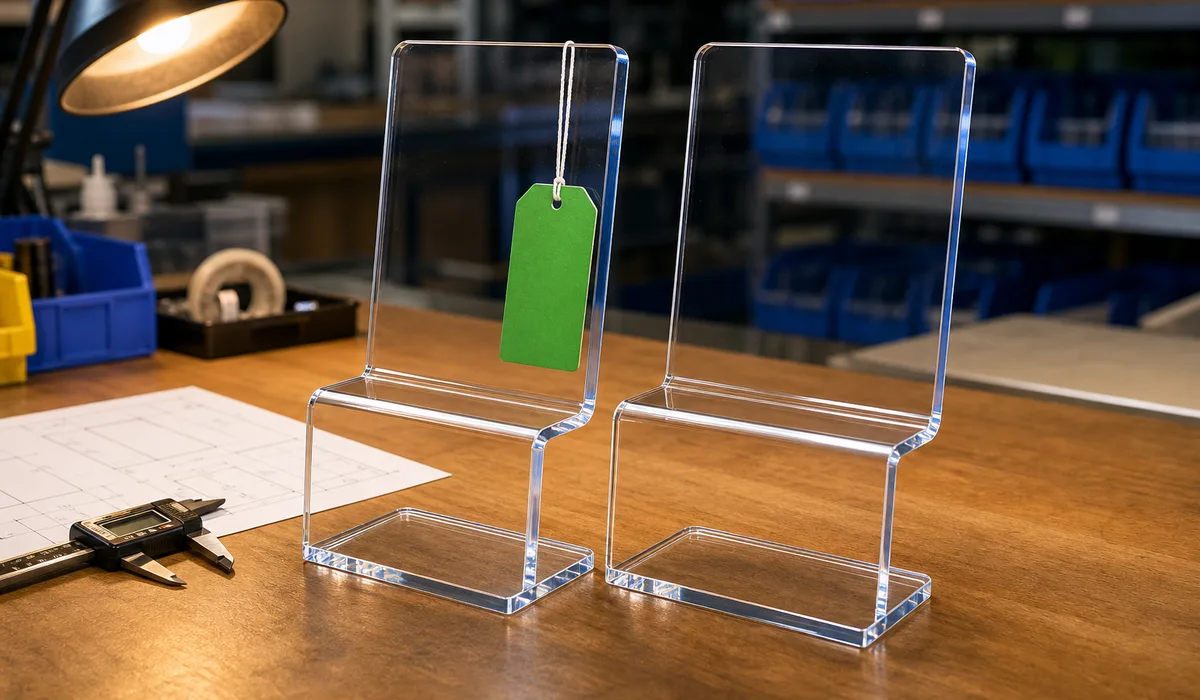
The revision protocol is worth stating plainly because it prevents disputes later. If a second sample is needed because you changed the spec (taller, wider, different pocket depth), that revision is quoted and paid like the first. If the sample deviated from the approved drawing, the re-make is on us. This is another reason Gate 3 matters: the signed drawing is the referee. Once you approve the sample, it becomes the physical quality standard for production, and we keep it on file at the factory so the inspection team has an exact reference to check the run against.
Gate 5: Production — what actually happens in 15–20 days
Production runs 15–20 days for a typical custom display stand order and follows a fixed sequence: laser or CNC cutting, edge polishing, UV printing, then assembly and any bonding or hardware work. Each stage has its own queue, which is why the calendar does not compress just because an order is small.
Here is the detail that catches more buyers than any other: the production clock starts at artwork lock, not at the PO date. A signed PO with unfinished artwork starts nothing, because printing sits in the middle of the sequence and we will not cut panels for a print file that might change. “Final artwork coming next week” is the sentence I hear most often from buyers who later ask why the schedule slipped. The schedule did not slip; it never started. If your design team is still iterating, tell us; we can sometimes sequence cutting and polishing ahead while print waits, but only when we know the panel dimensions are frozen.
Inside those 15–20 days, we run the order as a single batch wherever possible so color and finish stay uniform across every unit. We cut on 8 laser cutters and 4 CNC machines depending on edge and tolerance requirements, polish on a dedicated diamond-polishing line, and print on the UV flatbeds we have run in-house since 2020. Keeping print inside the factory is what makes the artwork-lock rule workable at all: the print queue is ours to schedule around your deadline, not a subcontractor’s.
During the run, the approved sample governs everything. Cutting tolerances, edge finish, print color, and assembly fit are all checked against it stage by stage. The carrier-retail phone display stand project covers device fit, security routing, artwork, inspection, and store allocation as buyer-approved inputs. And if you are comparing what a factory-direct process looks like against buying from a catalog, the formats and materials on our acrylic display stands hub show what the production line above actually builds. The same seven gates run on enclosed work — if the stand needs a lid, a vitrine, or a lock, that scope sits with us as an acrylic display case manufacturer on the same PO.
Gate 6: QC and the pre-ship proof — 100% inspection plus photo sign-off
Every unit in the order is inspected before packing — 100% inspection has been standard on every product we ship since 2018, under an ISO 9001 quality system. But the part of this gate that buyers value most is the proof: before anything ships, we send photos (and video where useful) of finished units against the approved sample, and the order does not leave until you confirm.
When a unit fails our inspection, we pull it and re-make it inside the same run rather than shipping it and negotiating later. A rejected panel costs us a panel; a rejected shipment costs us the account, and we have kept accounts for years on the strength of that math. It is also why we photograph the proof against the filed sample instead of against the drawing: the sample is what you approved with your own hands, so it is the fairest standard to hold us to.
For resellers and agencies there is a pattern worth copying. Several of our reseller buyers take the pre-ship proof one step further: they assemble our photos into a PDF electronic proof and route it to their own end customer for sign-off before authorizing shipment. The stand ships only after the person who will actually put it in stores has approved the finished article. It costs one extra day and removes the worst conversation in this business — the one where a container arrives and the end customer says “that is not what I pictured.”
What the proof covers: overall dimensions spot-checked against the drawing, edge finish, print color and position, assembly fit, and, where the design includes them, moving parts like doors, locks, and hinges cycled on camera. This is also when the 70% balance payment comes due under our standard 30/70 terms, so the sign-off and the payment authorization usually travel in the same email thread. Respond quickly here; finished goods waiting on an unanswered proof occupy the same calendar as production time, minus the progress.
Gate 7: Packing and freight — FOB vs DDP, sea vs air, individual wrapping
The default term is FOB Shenzhen: we produce, pack, and deliver your order to the port; the freight from there is yours to book or ours to arrange under CIF or DDP if you prefer one invoice for the whole journey. EXW is available for buyers with their own China-side forwarders.
Packing is a specification, not an afterthought. Standard export packing is bulk cartons with foam and film separation, engineered to survive transit handling: the drop, vibration, and compression events that ISTA 3A-style transit testing simulates.1 For display stands headed straight to stores or to end customers, ask for individually wrapped units without retail cartons — a real option buyers regularly spec with us that protects each stand’s polished faces from scuffing against its neighbors, without paying for printed retail packaging nobody will see. And if you book your own freight, ask for the carton dimensions and gross weights with the quote; we provide them as standard, so your forwarder can price the shipment before production ends.
Sea versus air is the question I get most at this gate, and it is a math problem that changes month to month. Sea freight moves display stands at a fraction of air cost but takes roughly 4–6 weeks door-to-door (3–5 weeks port-to-port); air closes a deadline gap at a price that only makes sense for samples, first small batches, or genuine emergencies — on one recent 50-piece order, the same cartons quoted about $330 by sea against $1,880 by air. Container rates float (check a live index like the Freightos Baltic Index rather than budgeting from last year’s number2), and remember that acrylic display stands are volume-heavy, light-weight cargo, so sea pricing usually works in your favor. For the tariff and landed-cost math at different quantities, the cost guide linked at Gate 1 runs the full calculation.
Reorders — why run 2 is faster and cheaper
A reorder skips gates 1 through 4 entirely. The drawings, artwork files, packing spec, and approved reference sample from run 1 are already on file with us, so run 2 starts at production: roughly 15–20 days plus freight, against the 4–6 weeks the first order needed.
This is the quiet payoff of doing the first order properly. Every approval you signed (drawing, sample, proof) becomes a permanent reference that removes a gate from every future run. When my September-launch buyer came back in January for 200 more units, her email was one line and a quantity; production started two days later once the deposit landed.
Price continuity is the reasonable expectation, with two caveats. A reorder at the same quantity tier holds the original per-unit price unless raw material costs have moved meaningfully, and we flag that before invoicing rather than after. A reorder at a different tier gets re-quoted on the curve: 200 units does not carry a 500-unit price. And any spec change, however small, reopens the drawing gate; a “same as last time but 20 mm taller” order is a new drawing and usually a new sample, because 20 mm is exactly the kind of change that looks trivial and shifts a center of gravity.
Custom vs stock displays: the cost and lead-time math
A custom display stand costs more per unit than an off-the-shelf clear riser at 100 pieces, reaches parity around 200–400 pieces, and usually costs less from 500 pieces up, while adding the brand color, logo, and fixture fit a catalog piece cannot. The driver is setup amortization. Most of our display stands carry no setup fee; when a complex part does need one (programming, jigs, first-run testing), the written quote states it, and it divides across the run: a $150 setup adds $1.50 per unit at 100 pieces, $0.50 at 300, and $0.15 at 1,000.
| Quantity | Custom fabrication | Setup share ($150) | Custom total per unit | Off-the-shelf clear riser |
|---|---|---|---|---|
| 100 pcs | $6.20 | $1.50 | $7.70 | about $6.00 |
| 200 pcs | $5.80 | $0.75 | $6.55 | about $6.00 |
| 500 pcs | $4.90 | $0.30 | $5.20 | about $6.00 |
| 2,000 pcs | $3.80 | $0.08 | $3.88 | about $5.50 |
Directional figures for a mid-complexity countertop riser in brand color with a logo. Dimensions, thickness, finish, and print method set the real quote. Flat-pack custom parts also ship in less carton volume than pre-assembled catalog pieces, which widens the gap on freight.
Lead time is the other half of the comparison. We make every design to order from 100 pieces, so plan against these windows:
| Route | Typical lead time | Notes |
|---|---|---|
| Logo printed or engraved on a standard riser, tray, or sign holder | 7–12 days | Dimensions stay standard; artwork must be final at start |
| Full custom, repeat order | 15–20 days production | Approved sample and files already on file |
| Full custom, first order | 3–5 days sample + 15–20 days production | Plus your approval time at each gate |
| Full custom with new tooling | 20–30 days | Tooling build and first-article approval add time |
Compressing a custom run below 10 days carries a rush surcharge of roughly 20–35%, so planning four to six weeks ahead is almost always cheaper than paying to compress.
Where custom programs go wrong — the 4 delays I see most
The four most common schedule-killers in custom display stand programs are, in order: artwork that is not final, product fit that was never validated, a stalled proof loop, and event deadlines booked with no rush buffer. Every one of them is buyer-side preventable, which is the good news.
Artwork not final. The production clock on a custom display stand starts at artwork lock, not at the PO date — and unlocked artwork is half the delayed orders I have handled in 6+ years of coordinating them. The fix is structural: do not issue the PO until the artwork is locked, or tell us the panel dimensions are frozen so cutting can start while print waits.
Product fit unvalidated. A stand designed from a spec sheet instead of a physical product is a guess. One buyer caught this the right way — before approving the drawing, he asked whether an 8–12 mm front lip would still be a deep enough well to hold his product securely. That question, asked at the drawing stage, is free. Asked after 300 units are built, it is a re-order. If product fit is critical, ship us physical samples and we validate the well depths and pocket sizes against the real thing before the drawing goes out.
The proof loop stalls. Gates 3, 4, and 6 all wait on a buyer signature, and I watch orders idle at each of them. Nominate one decision-maker with authority to approve, put the gate dates in their calendar, and route documents to all stakeholders simultaneously. Orders with a single empowered approver clear the gates days faster than orders where approval travels a chain.
Event deadlines with no buffer. If the trade show is in week 8 and the path takes 4–6 weeks plus freight, you do not have a buffer — you have a bet. Start one revision loop and one freight delay earlier than the math says you need. When the timeline genuinely cannot stretch, say so in the RFQ: knowing the hard date up front lets us sequence the gates around it instead of discovering it at Gate 6.
When you are ready to run the gates, send us your design or sketch (a napkin drawing with a target price is a perfectly good Gate 1), or request a quote and we will come back within 24 hours with the questions that get you to Gate 2.
Footnotes
-
ISTA test procedures — the International Safe Transit Association’s published transit-testing protocols; ISTA 3A is the general-simulation procedure for individually packaged parcels, covering the drop, vibration, and compression events that export packing for fragile goods like acrylic display stands is engineered against. ↩
-
Freightos Baltic Index (FBX) — live global container freight rate index; supports the claim that sea-freight rates fluctuate enough that budgets should reference current-month data rather than historical quotes. ↩
Frequently Asked Questions
Can a manufacturer hit my target unit cost for a custom display stand?
A target unit cost is usually reachable — through design levers rather than discounting. Wall thickness, internal structure, packaging spec, artwork coverage, quantity tiers, and Incoterms all move the number. On a recent program we closed the gap by quoting a value-engineered sample option that came in $2–$2.50 lower per unit than the original spec. Send the target with your RFQ and we quote toward it instead of around it.
Do I approve a drawing before the sample is made?
A dimensioned production drawing, prepared from your files, sketch or reference photos, always precedes the sample: we put it in front of you before any material is cut, and nothing moves to sample until you sign it off. For multi-part stands this gate catches geometry and fit errors at the cheapest possible point: on screen, not on 300 finished units.
How long does a custom display stand take from brief to shipment?
Plan on 4–6 weeks from a complete brief to FOB handoff: 1–2 days to quote, 2–3 days for the drawing approval, 3–5 days for the sample, 15–20 days for production, and 2–3 days for final QC and packing — plus your own approval turnaround at the three sign-off gates. Every day a proof sits unanswered adds a day to the calendar.
Who pays for the sample, and what happens if it needs changes?
Samples are paid and ship in 3–5 days; the sample fee is paid separately and is not credited to production. Revisions are normal — size and height adjustments after the first sample are one of the most common requests we handle. A revision driven by a spec change on your side is quoted as a second sample; a revision caused by our deviation from the approved drawing is on us.
Can you sign an NDA before we send design files?
We can sign a reasonable NDA after reviewing and agreeing its terms. Your artwork and project files are used only to quote, sample and manufacture your order, never published or reused for another customer. The agreement should protect your confidential project information without treating common manufacturing methods as your exclusive property. Please send the proposed agreement for review before sharing confidential files.
How much more does a custom display stand cost than an off-the-shelf one?
At 100 pieces per design, custom usually costs more per unit than a comparable catalog riser because any setup is spread across a small run. The gap narrows at 200–400 pieces, and from about 500 pieces custom often matches or beats stock pricing once brand color, logo, fixture fit, and flat-pack freight are counted. Most display stands carry no setup fee; when a complex part needs one, the quote states it.
Have specs in hand? Get a quote for your specific project.
Send us your drawings, reference photos, or a description of what you're making. We reply within 24 hours with a material recommendation, thickness, fabrication method, and a per-unit quote.