

Acrylic Display Stand Cost at 100 to 1,000
The quantity tier spreads setup, but the drawing still controls material yield, forming, assembly, branding, inspection, and carton volume.
Need this made?Acrylic display manufacturer →
Key Takeaways
- A named 250 × 180 × 220 mm two-tier stand in 5 mm clear acrylic with one-color UV branding and bulk packing is $28 at 100 pieces, $16 at 500, and $12 at 1,000 FOB Shenzhen.
- Quantity spreads drawing, fixture, proof, and carton-development work across more units.
- Panel size and sheet yield can move price more than a small material-thickness change.
- Bends, bonded joints, shelves, hardware, print, inserts, wiring interfaces, and store-ready kits add separate operations.
- Compare landed cost against one drawing, packout, Incoterm, and destination.
On this page
- Start with one named three-tier reference
- Quantity spreads pre-production work
- Sheet yield starts with the finished envelope
- Bends, joints, and shelves change labor
- Branding and versions need their own lines
- Hardware and product interfaces add risk
- Packout can move the landed cost
- Compare FOB and DDP on the same scope
- Read the three tiers as inventory decisions
- Send a three-tier display RFQ
Start with one named three-tier reference
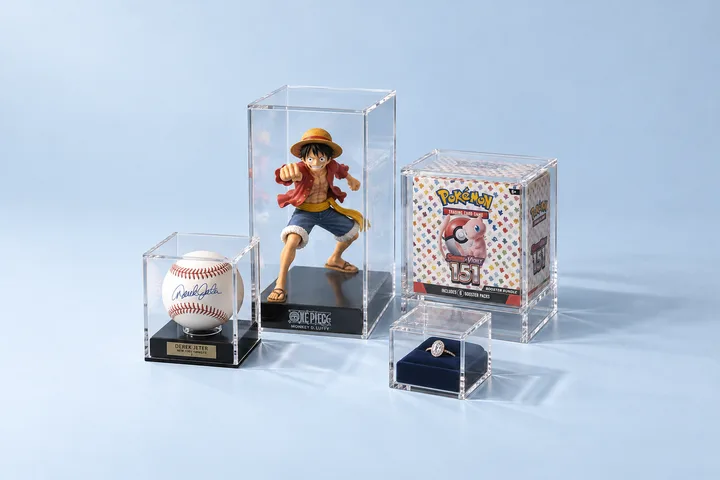
Acrylic display stand cost becomes comparable when every tier uses the same drawing. The current named reference is a 250 × 180 × 220 mm two-tier countertop stand in 5 mm clear acrylic with one-color UV branding and bulk packing: $28 at 100 pieces, $16 at 500, and $12 at 1,000, FOB Shenzhen. It is not a price list for other structures; a fixed 3 tier acrylic display stand, for example, is quoted on its own drawing.
I ask for the product, finished dimensions, quantity, and one image or drawing before discussing a band. Those four inputs reveal whether the brief resembles a simple stand or a larger assembled fixture. Artwork, hardware, packing, and destination refine the quote.
Use the band to test budget. If the target sits below it, ask which feature can change: size, panel count, thickness, print coverage, insert, hardware, assembly, or packout. If the target sits above it, the buyer may have room for a heavier base, more parts, or store-ready packing.
The acrylic display manufacturer page carries the current published price reference and product families. Attach the chosen physical format to the RFQ so the price has a clear product behind it.
Quantity spreads pre-production work
The factory reviews the drawing, creates production files, prepares fixtures, proofs artwork, checks the first unit, and develops packing before the order reaches steady repetition. At 100 pieces, each stand carries a larger share of that work than at 500 or 1,000.
Material and unit operations remain. Every stand still needs sheet, cutting, edge finishing, bending or bonding, assembly, printing, inspection, protective film, and packing. The unit price falls when repeated work and purchasing become more efficient, not because those steps disappear.
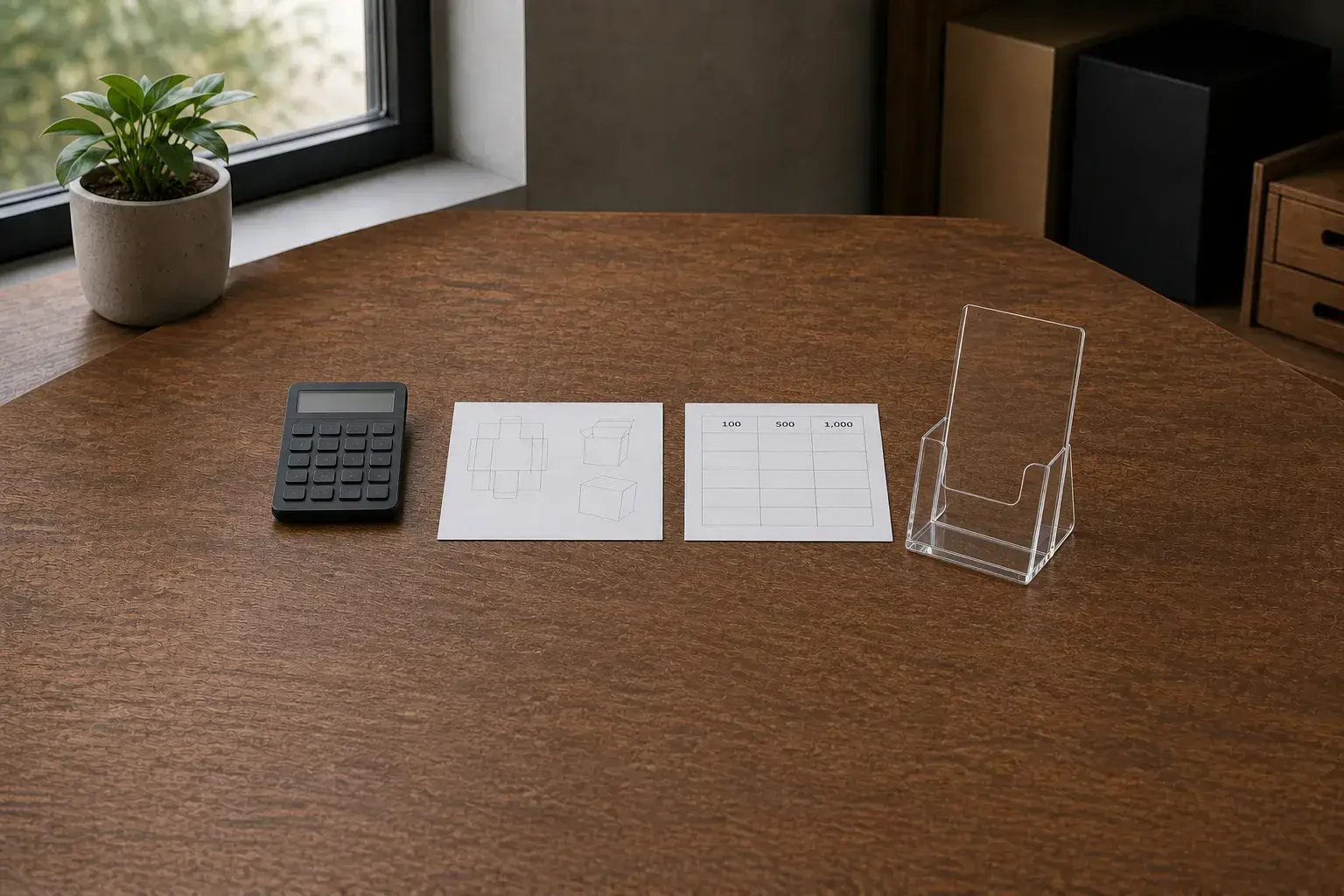
Ask for 100, 500, and 1,000 pieces on one drawing. A tier table lets your team compare the inventory commitment with the unit saving. Do not present the 1,000-piece price as available on a 100-piece PO.
Keep quantities by design. Five store messages at 100 each remain five artwork releases. Two sizes at 250 each remain two fabrication and inspection paths. The quote should state which setup can be shared.
Sheet yield starts with the finished envelope
Panel size affects the number of parts that fit on a sheet. A small change can cross a yield boundary, so price does not move in a smooth percentage. Ask the factory which panel or dimension controls material use.
State finished outside size and product clearance. A stand that looks compact in a rendering may use a wide back panel or base. The supplier needs every flat component, bend allowance, joint, and edge-finishing allowance to calculate yield.
Thickness affects material volume, bend behavior, rigidity, edge presence, and hardware. Select it from span, load, support, construction, sheet grade, and the paid sample rather than a generic premium label.
Colored, frosted, mirrored, pearlescent, or specialty grades can affect sheet purchasing and minimum mill quantities. Ask whether the quote uses standard factory material, a named specialty sheet, or a custom color path.
Bends, joints, and shelves change labor
Heat bends reduce part count but require a controlled radius, angle, and fixture. Bonded construction supports box-like forms and shelves but adds joint preparation, assembly, curing, and inspection. Mechanical fasteners can make parts replaceable while adding hardware and assembly.
The product and use should choose the construction. A countertop sign holder may need two bends. A cosmetics display may need shelves, dividers, a base, and a printed back panel. A device stand may need a machined pocket and cable path.
The cosmetics display volume cost-engineering project shows how a buyer can compare 5K, 10K, and 15K tiers while holding the drawing and version matrix constant.
Ask the supplier to return a part count and construction summary. You do not need proprietary machine settings. You do need to know whether the quote includes forming, bonding, hardware, final assembly, or flat-pack delivery.
If the target price is tight, request a value-engineering alternate on the same drawing. The factory can compare a bonded shelf with a slotted shelf, a formed base with a separate base, or a printed panel with a replaceable insert.
Branding and versions need their own lines
UV printing, screen printing, engraving, foil, decals, and replaceable inserts have different files, setups, and inspection points. Print coverage, color count, white ink, registration, and artwork size can move the quote.
Version count matters. One logo across 1,000 stands uses one proof path. Ten retailer names at 100 each need ten controlled files, proofs, labels, and version checks. Show quantity by artwork.
The display branding methods guide compares those routes. Pick the likely method before quoting, then ask for an alternate only when the buyer has a clear reason to compare.
Approve the selected method on the named acrylic. A digital proof can approve content and placement. A paid physical sample approves the interaction between artwork, material, color, finish, and viewing condition.
Hardware and product interfaces add risk
Magnets, screws, posts, shelves, locks, hinges, hooks, feet, bearings, and cable components add purchased parts and fit checks. The quote should identify buyer-nominated hardware, supplier-selected hardware, and any excluded electrical item.
Send the product or a verified drawing when fit matters. A device, bottle, tester, card, or package can reveal clearances that a rendering hides. State the insertion and removal path.
LED lighting is quoted as its own line. We build lit stands to your drawing and lighting spec, so the quote lists the LEDs, driver and power parts you specified next to the acrylic parts and hardware, and names certification marks only where your spec calls for them.
Our CPG multi-market display kit case is a related project for multiple components and artwork. Use its control questions with your own product and acceptance targets.
Packout can move the landed cost
Assembled stands may occupy far more carton volume than their acrylic weight suggests. Flat-pack designs reduce volume but add instructions and buyer assembly. Nested parts can save space only when surfaces and print remain protected.
Specify protective film, bags, interleaves, corner blocks, inner cartons, master cartons, hardware packs, labels, and store-ready allocation. Ask for carton dimensions, units per carton, gross weight, and pallet count.
UPS explains that carriers can compare dimensional and actual weight when calculating billable weight.1 A large light fixture can therefore cost more to ship than a smaller dense item. Packing decisions belong in the cost comparison.
Quote central-warehouse and store-ready packout separately when both remain possible. The first reduces factory sorting. The second may reduce downstream labor. Procurement should compare the full program rather than the factory line alone.
Compare FOB and DDP on the same scope
State the Incoterm and named place. ICC Incoterms allocate delivery tasks, costs, and risk between seller and buyer.2 They do not make two quotes comparable when one includes stronger cartons, insurance, duty, appointment delivery, or inside service.
Keep product, sample, packing, freight, duty/tax, brokerage, and final delivery on separate rows. Use the same destination, delivery condition, shipment size, and exchange rate across suppliers.
Check the complete quote, line by line
Use the same drawing revision, quantity, packing specification, and destination for every quote. A unit price alone does not show the cash needed to approve a sample and receive the production order.
| Quote line | What the buyer should be able to check |
|---|---|
| Unit price and production total | Quantity per design, drawing revision, and the total for that production quantity |
| One-time setup | Each setup charge listed separately, including whether it applies again on a repeat order |
| Paid sample | Sample charge and courier charge, separate from production; samples are never credited |
| Packing | Protective materials, pieces per carton, carton dimensions, gross weight, and any packing charge |
| Freight and delivery | Transport mode, named destination, quote validity, and included or excluded delivery services |
| Duty, tax, and other charges | Explicit inclusions and exclusions under the named trade term; mark unquoted costs as unknown |
An air-freight line by itself does not establish a duty-paid delivered total. Resolve any missing charge or delivery assumption before comparing supplier totals.
FOB can suit buyers with a forwarder and consolidated shipments. DDP can simplify a first order when the quote clearly states the destination and included service. Ask who files a cargo claim and what documentation the supplier provides.
Price validity matters. Fabrication and freight can carry different validity windows. Record both so a delayed approval does not turn the comparison into a mix of old and new rates.
Read the three tiers as inventory decisions
The 100-piece tier suits a first standard production release, one market, or one artwork while the buyer learns fit and packout. Unit cost is higher, but cash and inventory exposure are lower.
The 500-piece tier suits a stable drawing with a clear deployment plan. Setup and purchasing spread across more units. The buyer still needs storage, version control, and a release schedule.
The 1,000-piece tier can improve yield and carton planning when the SKU mix stays controlled. A long tail of small variants limits those gains. Ten designs at MOQ remain ten releases.
Compare unit saving with storage, forecast confidence, artwork obsolescence, and rollout pace. The lowest factory unit price is not the best decision when the buyer cannot deploy the inventory.
Record the total cash requirement beside the unit price. A lower 1,000-piece rate can still require more cash, warehouse space, insurance, handling, and write-off exposure than a 500-piece release. Add those internal costs before approving the larger tier.
For staged rollouts, ask whether one production order can use scheduled releases without changing the drawing or artwork. The supplier should state what remains finished, what remains as raw material, how storage is charged, and when title and risk transfer. Do not assume a blanket order receives the same economics as one uninterrupted production run.
I also ask the buyer to name the decision date for each market or store group. That turns the tier table into a deployment plan instead of a theoretical discount exercise. When forecast confidence is low, protecting working capital is often more valuable than chasing the lowest quoted unit price.
Send a three-tier display RFQ
Send the product, drawing, finished dimensions, material, construction, hardware, artwork, quantity per design, packout, destination, and target date. Request 100, 500, and 1,000-piece lines on the same specification.
Wetop’s production MOQ is 100 pieces per design. Paid samples take 3–5 days, are paid separately, and are never credited to production. Production takes 15–20 days after approvals. We reply to a complete brief within 24 hours.
Use the display quote form to upload the files. We will return material, fabrication, branding, packing, and freight assumptions as separate lines.
Compare the named reference with the acrylic display manufacturer page and countertop display stands.
Footnotes
-
UPS dimensional weight guidance — UPS explains how package dimensions can affect billable shipping weight. ↩
-
ICC Incoterms rules — ICC defines delivery obligations, cost allocation, and risk transfer for named trade terms. ↩
Frequently Asked Questions
How much does a custom acrylic display stand cost?
A named 250 × 180 × 220 mm two-tier stand in 5 mm clear acrylic with one-color UV branding and bulk packing is $28 at 100 pieces, $16 at 500, and $12 at 1,000 FOB Shenzhen. Final price depends on size, material, construction, artwork, hardware, quantity, packing, and freight.
Why does the unit price fall at 500 or 1,000 pieces?
Drawing review, fixtures, setup, proofs, first-off inspection, and packing development spread across more units. Sheet, cutting, forming, assembly, printing, inspection, and packing remain in every stand.
Can several artwork versions share one MOQ?
Production MOQ is 100 pieces per design. Artwork, size, color, hardware, or construction changes can create separate design quantities and setup lines.
Are display samples free or credited?
No. Wetop's paid samples take 3–5 days, are paid separately, and are never credited to production. The sample proves the drawing and visible finish before the bulk release.
What should a display-stand quote include?
Require material, finished dimensions, construction, artwork, hardware, quantity by design, sample, unit price, packing, carton data, Incoterm, destination, production time, and freight.
Price the Same Display at Three Quantities
Send the drawing, product, artwork, quantity per design, packout, and destination. We will return 100, 500, and 1,000-piece assumptions within 24 hours.