Delivered project · Cosmetics Retail
Cosmetics Display Cost Engineering at Three Volumes
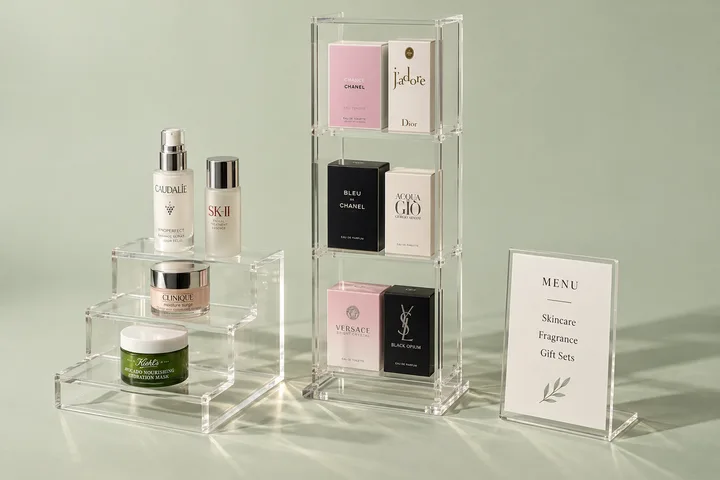
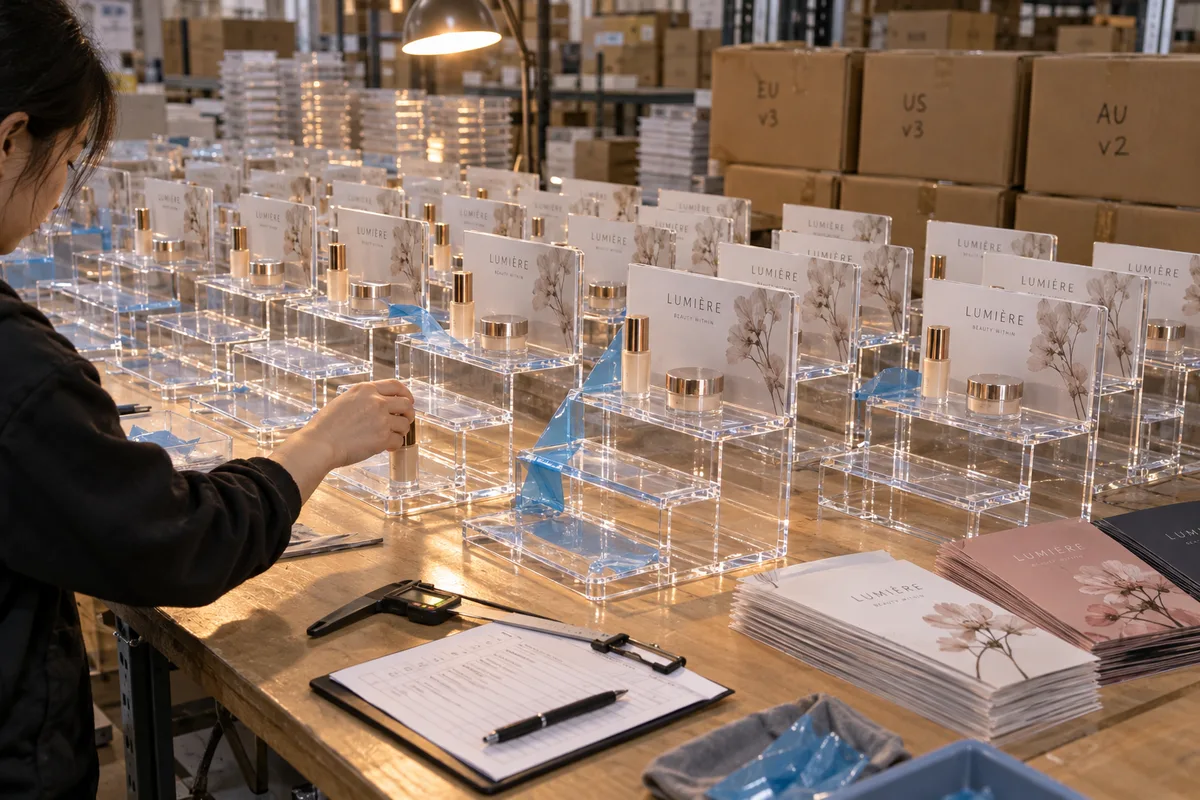
A cosmetics brand's sourcing team asked us to price a multi-part acrylic display with tester inserts and versioned graphics at 5,000, 10,000 and 15,000 pieces.

We held one drawing constant, priced material, fabrication, assembly, artwork versions, packout and freight line by line at each tier, and ran production after sample approval.
- multi-part display built
- 1
- pcs, tier 1 price
- 5K
- pcs, tier 2 price
- 10K
- pcs, tier 3 price
- 15K
Ordering a similar project
MOQ is 100 pieces per design. Paid samples normally take 3–5 days; sample fees are paid separately and never credited. Standard production takes 15–20 days after drawing, material, artwork, packing, and sample approval. Wetop responds to a complete brief within 24 hours.
Closest published price: the acrylic display manufacturer page lists a two-tier countertop stand 250 × 180 × 220 mm, 5 mm clear, one-color UV logo: $28 each at 100 pcs, $16 at 500, $12 at 1,000 (FOB Shenzhen, published reference). This multi-part cosmetics display was a larger build and was quoted from its own drawing, version matrix and packing.
Key Takeaways
- We built a multi-part acrylic display with tester inserts and versioned graphics for a cosmetics brand, and priced it for the brand at 5,000, 10,000 and 15,000 pieces before production.
- We froze 1 drawing and 1 version matrix first, so the three tiers compared the same product.
- Our quote listed material, fabrication, branding, assembly, inspection, packing and freight separately at each tier.
- We counted every country, shade, retailer and language artwork version inside the 15,000-piece headline volume.
- The paid sample approved fit, tester access, stability, print and packout; we confirmed production capacity with the final quote.
The Buyer Need
The cosmetics brand's sourcing team came to us needing real price movement across three large quantity tiers: 5,000, 10,000 and 15,000 pieces of one multi-part display. A single unit price would not have shown which savings came from setup, material purchasing, fixtures, packaging or freight. It also would not have shown the cash and inventory the largest tier tied up.
Our first step was to fix one drawing and one version matrix. If the product had changed at each quantity, the brand would have received three unrelated quotes.
Cost-Driver Review
We broke the display into flat parts, bends, bonded joints, shelves, tester inserts, purchased hardware, printed areas, assembly steps, protective packing and carton volume. Then we marked the panels that controlled sheet yield and the operations that controlled labor.
We kept artwork quantity visible. The 15,000-piece headline still held many small country, shade, retailer and language releases, and each version needed its own file, proof, label and allocation record.
Our quote showed material, fabrication, branding, assembly, inspection, packing and freight as separate lines. Each cost-saving alternative we offered changed one variable at a time, so the team could see exactly what it saved.
Three-Tier Decision
The quote laid the tiers side by side. At 5,000 pieces the brand carried less inventory but paid more setup and purchasing cost per unit. At 10,000 pieces material and carton use improved once the version mix was stable. At 15,000 pieces the unit price was lowest, but the brand needed a firmer forecast, storage, release plan and artwork life to justify it.
We put total cash, storage, deployment rate, obsolescence, market allocation and landed freight beside each unit rate. That let the brand choose its order volume on total cost rather than unit price alone.
Sample and Release
The paid sample used the production material, construction, product interfaces, artwork process and packout. The brand approved product fit, tester access, loaded stability, finish, color reference, print registration, replaceable parts, cleaning access, assembly sequence and carton handling on it.
We released production only after the drawing, material, artwork, sample, quantity allocation, packing, price and payment terms were approved in writing. Because this was a large program, we confirmed capacity and delivery dates with the final quote instead of assuming our standard 15–20 days. A first-off inspection checked the setup against the approved drawing and sample; where it showed a mismatch, we corrected that operation before the lot continued.
What We Checked Before Shipping
- Product samples fit their approved pockets and access paths.
- The display stayed stable under the brand's loaded condition.
- Print version, color and placement matched the approved proof and sample.
- Assembly and show edges met the signed cosmetic standard.
- Store and market allocation matched unit and carton labels.
- Packout protected acrylic, printed faces, hardware and removable parts.
The packout itself was part of the approved product: individual show-surface protection, restrained removable parts, market and SKU labels, and cartons allocated by destination and checked against the freight method.
Project Outcome
The brand's procurement team ended with one active drawing, one approved sample reference, a version and quantity table, signed acceptance checks, a packout specification and a written offer at all three tiers. They could compare cost across volumes on the same product, and production ran to that record.
If You're Planning Something Similar
Freeze the drawing and version list before asking for tier pricing, and count each artwork version as its own release; each physical design needs at least 100 pieces. Compare quotes on the same scope: a lower figure is not comparable if it leaves out artwork setup, hardware, assembly, inspection, protective packing or the material the sample used. You supply the product samples or models and print-ready artwork. See custom acrylic organizers and the display-stand cost by quantity guide.
Need tier pricing on a cosmetics display?
Send the drawing, quantity by version, product samples or models, artwork, packing requirement, destination and timing. We will reply with a written quote at each quantity.
Paid samples in 3–5 days · Fees paid separately and never credited · MOQ 100 pieces per design · Response within 24 hours