Shadow Box Frame Guide: Sizes, Depth & Mounting
A shadow box is a picture frame with depth. The depth decides what fits, how the object mounts inside, and how the finished box hangs on the wall.
Need this made?Acrylic shadow boxes →
Key Takeaways
- A shadow box is a deep display frame, typically 3-8 cm between the clear front and the backing, built to hold three-dimensional objects a flat picture frame cannot close over.
- Depth follows the object: 3 cm for medals, coins, and pressed flowers; 5 cm for a flat-folded jersey or dried bouquet; 8 cm or more for draped jerseys and helmets.
- Items mount to the backing, never to the front: pins for fabric, cradles for rigid objects, magnets or pressure for paper that cannot be pierced or glued.
- Face sizes follow standard frame formats from 5x7 to 24x36 inches. An acrylic front weighs about half as much as soda-lime glass at equal size.
- Wall hardware is a load specification: approve the finished weight, wall substrate, anchor, fastener, and safety factor together.
On this page
- What is a shadow box?
- Shadow box depth: measure the object first
- Standard shadow box sizes
- Acrylic front vs glass front
- Frame-style or box-style, and when you want neither
- How to mount items in a shadow box
- Hanging it: wall hardware is a load spec
- Construction specs that keep a shadow box flat
- Ordering custom shadow boxes
What is a shadow box?
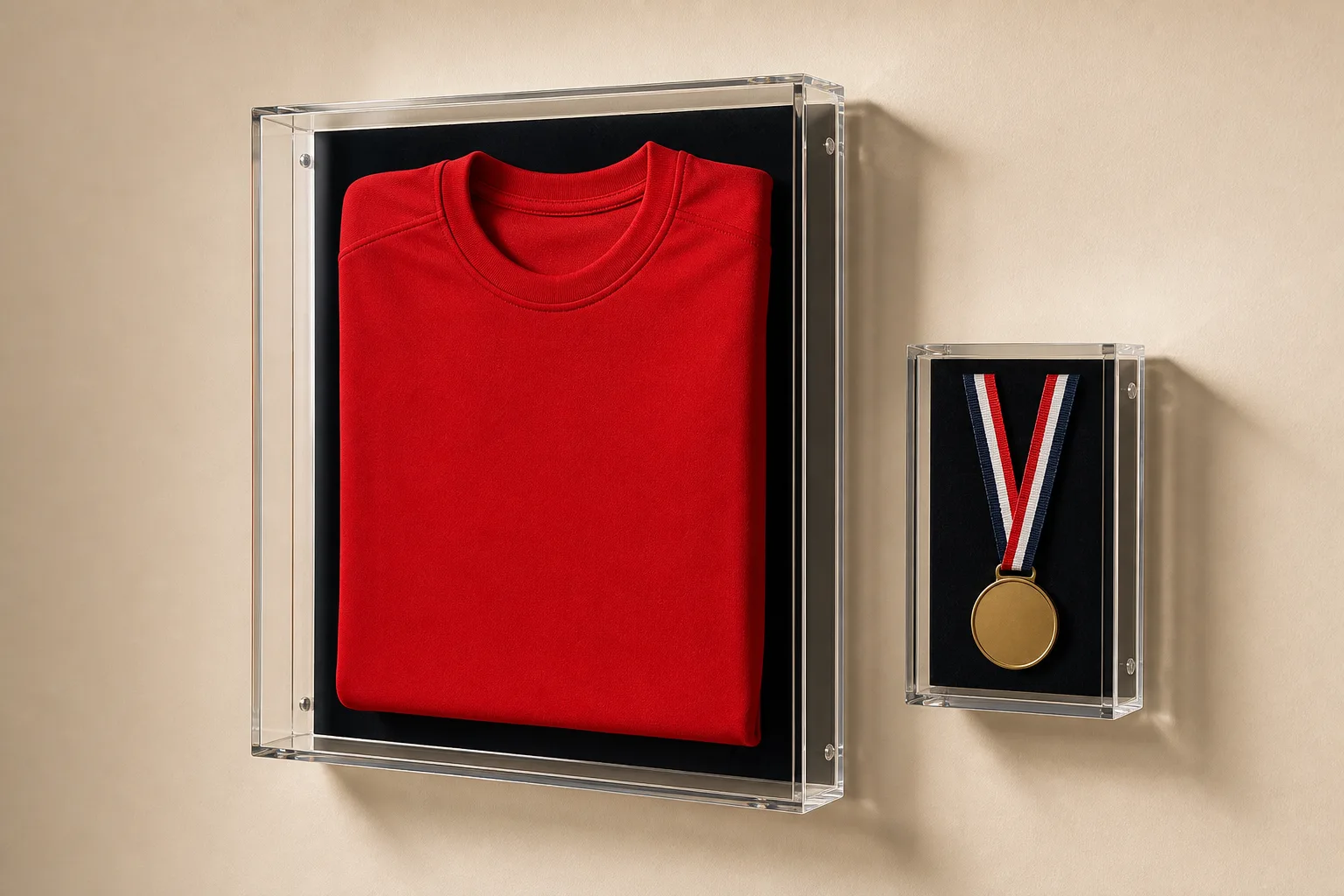
A shadow box is a deep, enclosed display frame: a clear front panel, a backing panel, and 3-8 cm of open space between them. That depth holds three-dimensional objects a flat picture frame cannot close over, such as folded jerseys, medals, dried flowers, and keepsakes. Wall-hung retail and memorabilia programs order them as custom acrylic shadow box frames; signed shirts go in jersey display cases.
The name comes from what the depth does. An object sitting in open space in front of the backing throws a soft shadow onto it, and that shadow reads as importance, the same effect a museum vitrine uses. A picture frame presses its contents flat against the glazing; a shadow box gives them room.
The market builds the same idea two ways. Frame-style shadow boxes look like a thick picture frame: a visible border profile around a shallow recess. Box-style shadow boxes are what we build most at Wetop: five bonded acrylic walls and a clear face, with the backing panel closing the back, which reads cleaner at larger sizes and deeper recesses. Both hang on a wall and both follow the same depth rule. The decisions come in this order: depth, front material, frame or box style, how items mount inside, and how the box hangs.
Shadow box depth: measure the object first
Shadow box depth is a measurement, not a style choice: take the object’s tallest point off the backing and add 1-2cm of clearance so nothing touches the front panel. That lands at 3cm for medals and pressed flowers, 5cm for flat-folded jerseys and dried bouquets, and 8cm or more for draped jerseys and helmets.
Both failure directions cost money. Too shallow and the object touches the front panel: a jersey pressed against acrylic wicks a faint contact mark into view within weeks, and a bouquet loses petals to every vibration of the wall. Too deep and the display reads hollow: a flat medal in an 8cm recess looks like it sits at the bottom of a well, and the order pays for material, freight volume, and wall projection it did not need.
For coins and small round collectibles, the coin display layout ideas extend this depth check to grouped layouts, profile-matched recesses, and felt liners.
| What you’re framing | Height off backing | Recess depth | Typical frame size |
|---|---|---|---|
| Medals, coins, patches, pressed flowers | Under 2cm | 3cm | 20x20 to 30x40cm |
| Flat-folded jersey (name and number showing) | 2-4cm | 5cm | 60x80cm |
| Dried wedding bouquet, invitation set | 2-4cm | 5cm | 40x50cm |
| Draped jersey, full-front display | 4-7cm | 8cm | 80x100cm |
| Helmet, ball, multi-item arrangement | 5cm+ | 8-10cm+ | Sized to layout |
One production note from my side: depth changes the build more than buyers expect. When my operators bond a 3cm box, the side walls behave like an ordinary frame profile. Past 5cm the walls become structural panels that carry the front, resist racking, and show every bonding flaw at eye level, which is why deeper boxes also get thicker walls (see construction below).
Standard shadow box sizes
Shadow box sizes follow standard picture-frame formats: 5x7, 8x8, 8x10, 9x9, 11x14, 12x12, 16x16, 16x20, 18x24, 20x20, and 24x36 inches are the sizes framers and retailers stock, with 8x8, 11x14, and 16x20 the most common. The acrylic frame size chart separates print, opening, and outer-panel dimensions for those shared face formats. Depth is what separates a shadow box from a picture frame at the same nominal size.
Mats, backing boards, and replacement fronts are cut to those formats, so off-the-shelf shadow boxes cluster around them. The table maps each standard size to the depth and contents the rule above would assign it.
| Nominal size (in) | ≈ Metric (cm) | Typical recess depth | Commonly framed |
|---|---|---|---|
| 5x7 | 13x18 | 3cm | Single medal or coin, small keepsake |
| 8x8 | 20x20 | 3cm | Pressed flower, baby memorabilia |
| 8x10 | 20x25 | 3cm | Medal cluster, photo + object pairing |
| 9x9 | 23x23 | 3-5cm | Square keepsake art, medal cluster |
| 11x14 | 28x36 | 3-5cm | Certificate + medal, invitation set |
| 12x12 | 30x30 | 3-5cm | Square art, baby keepsake grouping |
| 16x16 | 41x41 | 5cm | Multi-item keepsake layout |
| 16x20 | 41x51 | 5-8cm | Dried bouquet, medal career display |
| 18x24 | 46x61 | 5-8cm | Large botanical, mixed memorabilia |
| 20x20 | 51x51 | 5-8cm | Square bouquet display |
| 24x36 | 61x91 | 5-8cm | Flat-folded jersey, signed poster + memorabilia |
For a custom build the list is a reference, not a constraint. You can send a catalog format such as 16x20 or the object’s measured dimensions, in whichever unit the program uses.
Acrylic front vs glass front
Cast acrylic runs about 1.18g/cm³1 against roughly 2.5g/cm³ for soda-lime glass,2 so an equal-size acrylic panel weighs about half as much. Failure behavior depends on the named grade, thickness, support, edge condition, mounting, and finished construction; do not treat either material as unbreakable.
Weight compounds with the backing, side walls, object, and hardware. A 60x80cm front is 0.48m², so density changes the finished mass and may affect packing and mounting. Compare the complete assemblies: acrylic is generally less scratch-resistant than glass, while impact behavior varies by grade and construction. Keep protective film in place through installation and follow the named sheet maker’s approved care method.
| Spec | Acrylic (cast PMMA) front | Glass front |
|---|---|---|
| Density | ~1.18g/cm³ | ~2.5g/cm³ |
| 60x80cm x 3mm panel weight | ~1.7kg | ~3.6kg |
| Failure mode | Grade- and construction-specific; generally more impact-resistant than annealed glass | Annealed, tempered, and laminated glass fail differently |
| UV protection | UV-filtering grade available | Standard glass: minimal; UV glass: costly |
| Scratch resistance | Lower — film + microfiber care | Higher |
| Clarity | ~92% light transmission | Comparable |
UV deserves its own sentence because shadow box contents are usually irreplaceable. Signed fabric, certificate ink, and dried botanicals all fade under light exposure — the Library of Congress’s framing guidance is blunt that light damage to displayed originals is cumulative and irreversible3 — so for anything signed or sun-exposed we quote UV-filtering acrylic as the front panel. The acrylic yellowing, UV-grade, and frame-care guide explains what to request from the sheet datasheet and cleaning plan. The full glazing comparison, including the picture-frame side of the argument, is in our acrylic vs glass picture frame guide.
Frame-style or box-style, and when you want neither
Pick frame-style when the object is flat and the look should read as framing: a floating border, minimal profile, art-gallery language. Pick box-style when the object is genuinely three-dimensional and needs a fabric backing, pins, or compartments. Pick a display case instead when viewing is from multiple sides.
The frame-style build shines on flat and near-flat pieces — textile fragments, embroidered art, invitations, a single pressed arrangement — where the modern treatment is a floating presentation: the piece held between panels or against a back panel with a clear border of open acrylic around it. That’s the construction behind our acrylic floating frames, and it pairs naturally with magnetic closures for pieces that rotate. The magnetic picture-frame format and closure guide compares that assembly with other frame constructions.
The box-style build takes over as soon as the object has real depth or real weight. Five bonded walls, a velvet or felt backing panel, and interior mounting hardware make an 8cm-deep, 80x100cm jersey display rigid enough to hang for years — a border-profile frame at that depth would look like a crate. Our acrylic shadow boxes page covers the box-style formats, backing options, and jersey layouts in detail.
Sometimes the answer is neither. If people will walk around the object (sneakers, helmets, model cars on a counter or pedestal), a wall-view shadow box is the wrong product; a freestanding display case with 10cm-plus depth and hinged or lift-off access fits that viewing pattern, such as a sports memorabilia display case for helmets and balls.
How to mount items in a shadow box
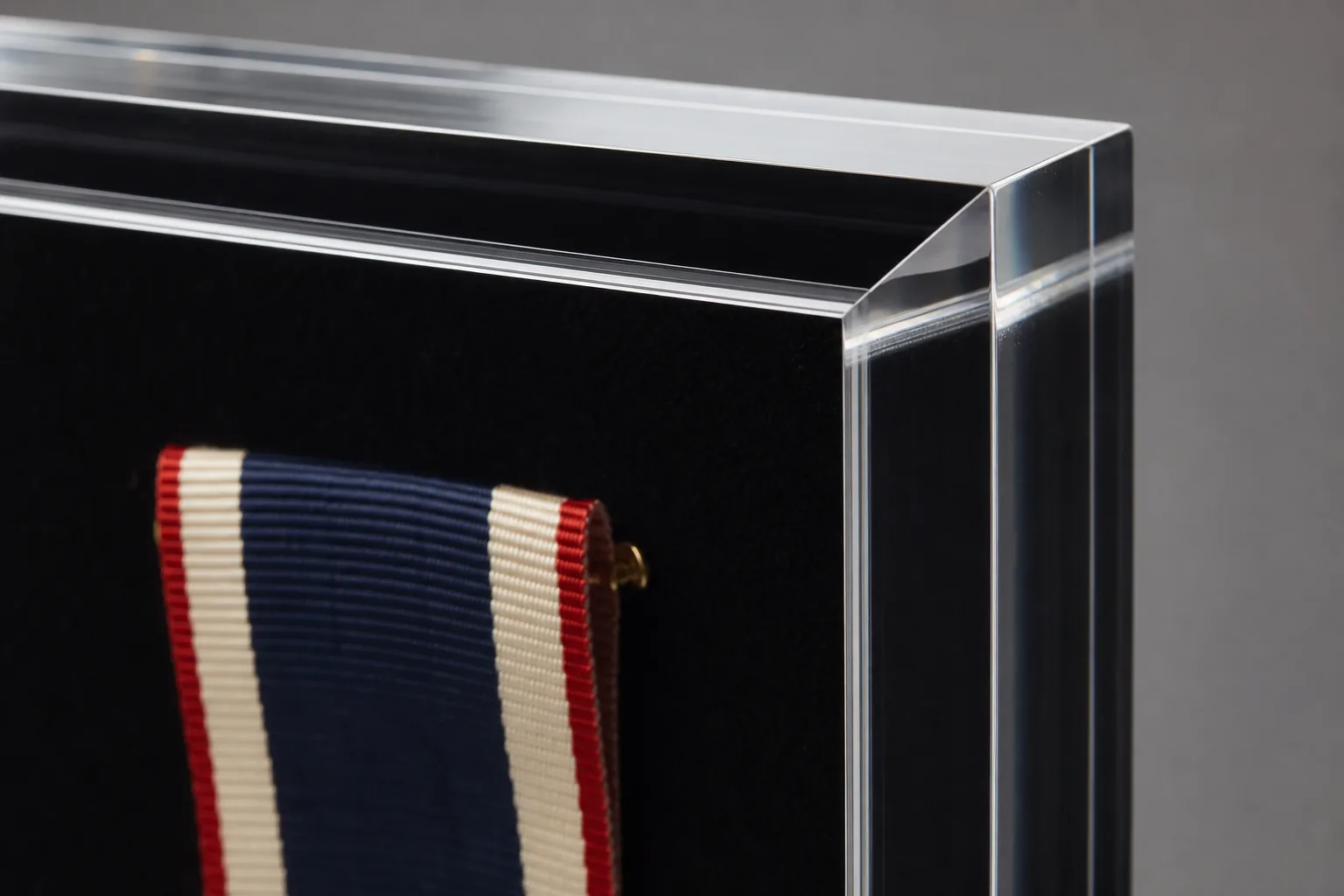
Mount items to the backing, never to the front panel. Use stainless pins or T-pins through a velvet or cork backing for fabric, sewn or magnetic strips for jerseys, bonded acrylic or wire cradles for rigid objects, and magnets or gentle pressure for paper art that cannot be pierced. The front stays a clear window.
| Item | Mounting method | Backing |
|---|---|---|
| Jersey, flag, textile | Pins or stitched strips through the backing | Velvet or felt |
| Medals, pins, patches | Pins or ribbon posts | Cork or velvet |
| Ball, flute, hardware | Formed acrylic cradle bonded to the backing | Any |
| Paper, embroidery originals | Magnets through the backing or pressure through a mat border | Rigid panel with mat |
| Dried flowers | Stem ties or small clear clips, no glue on petals | Felt or linen |
Fabric is the forgiving case. A jersey pins to a velvet backing invisibly, and velvet’s nap hides pin entry points; cork backing takes pins directly for medal groups that may be rearranged. Rigid objects — a game ball, a champagne flute, a piece of hardware — get formed acrylic cradles bonded to the backing so the object rests in shaped support instead of hanging from a fastener.
Delicate flat art is the demanding case, and it’s a request I see from museum and fine-art buyers a few times every quarter: original paper or embroidered pieces that cannot be glued, taped, or pierced. The working method is a mechanical, reversible hold. The piece sits against the backing and a magnet system through the backing panel holds mounting strips, or the front assembly applies gentle even pressure through a mat border. Two numbers make the floating look work: leave a 3-5cm clear border of open backing around the piece so it reads as floating, and keep magnet positions clear of the artwork itself so nothing presses the original. For a fragile piece, that is what the pre-production sample is for: we mount a stand-in of the same weight and size and photograph the result before the original is committed (how sample approval works). The border-and-magnet approach at gallery scale is shown in our colored acrylic floating frames for art galleries case study.
Hanging it: wall hardware is a load spec
Match the hanger to the finished weight, wall substrate, anchor, fastener, required safety factor, and installation method. The acrylic frame mounting guide compares standoffs, magnets, easels, and cleats; the rating must come from the hardware and substrate evidence, not a universal frame threshold.
Calculate the finished mass before selecting hardware. The mounting engineer or hardware supplier should evaluate the frame, object, wall substrate, anchors, fasteners, installation access, and safety factor as one system. Keyholes, cleats, standoffs, and direct-to-structure anchors can suit different projects, but this guide does not assign a universal weight cutoff to any one method.
If hardware or a drilling template is required, list it in the quote, approved sample, packing specification, and installation instructions. Do not assume those items are included unless the order documents say so.
Construction specs that keep a shadow box flat
Standard construction is a 3mm acrylic front with 5mm side walls and a 3mm backing panel. Past 60cm on the long edge, or past 500g of mounted object weight, step to a 5mm front and 8-10mm walls so the box stays flat and rigid on the wall for years.
Depth is what separates this from ordinary frame engineering. The side walls of a deep frame are beams: they hold the front panel parallel to the backing across the whole span, and any bow in them telegraphs to the front as visible distortion. Twelve years of running these builds have settled me on a simple discipline: thickness follows the long edge, not the nominal size class. A 40x50cm bouquet box is comfortable at standard spec; a 60x80cm jersey frame gets the 5mm front; an 80x100cm draped display gets 8-10mm walls without discussion. Bonded joints follow the same logic: full-length solvent-welded seams rather than spot bonds, because a wall-hung frame is a permanent static load test that never ends. The span-versus-thickness math generalizes across products — our acrylic thickness guide works the numbers if you’re speccing an unusual size.
Backing choice finishes the spec: black velvet for contrast and pin-friendly mounting, colored felt for team and brand palettes, cork for re-pinnable medal groups, and mirrored acrylic when the back of the object matters. UV-filtering front grade, engraved nameplates, and UV-printed graphics ride along in the same production run.
Ordering custom shadow boxes
Custom shadow box orders start at 100 pieces per design, with samples in 3-5 days and production in 15-20 days.
| Published reference | Specification | Price at 100 pcs |
|---|---|---|
| Large wall shadow box | 500 × 400 × 80 mm · 5 mm clear · wall mount | $18–35 each |
Depth, backing, mounting hardware, frame profile and packing move the final number; the quote is written for your object. Send the object’s dimensions, or a photo with a ruler in frame, plus quantity and backing preference, and you get a full spec and quote within 24 hours.
The sample stage matters more here than on most products because the object is usually one-of-a-kind. We build the box around a stand-in first. The sample costs USD 200-500 depending on complexity, paid separately and never credited to production. You confirm depth clearance, backing color, and mounting method on it, then the production run repeats it a hundred or five hundred times, with every piece inspected against that sample in our ISO 9001-certified factory. Team programs, memorabilia retailers, florists preserving wedding bouquets, and award programs all run on the same cadence: one approved sample, then repeatable volume, FOB Shenzhen with CIF and DDP available.
Start with the object: measure its footprint and its tallest point, decide flat-fold or draped if it is fabric, and send us the numbers. We’ll answer with depth, thickness, backing, and mounting specs already filled in: the decisions this guide just walked through, applied to your piece. For the price side of a program — how depth, backer, hanging hardware, and carton volume move the quote at 100, 500, and 1,000 units — see the shadow box program cost guide.
Footnotes
-
Polymethylmethacrylate (PMMA / Acrylic) material properties — MakeItFrom — independent materials database listing PMMA density (≈1.2 g/cm³ rounded; industry datasheets run 1.18-1.19), the value behind this guide’s front-panel weight comparison. ↩
-
Soda-lime glass material properties — Imetra — engineering reference displaying soda-lime glass density of about 2.5g/cm³, anchoring the roughly 2:1 weight ratio between glass and acrylic shadow box fronts. ↩
-
Preservation Guidelines for Matting and Framing — Library of Congress — national preservation guidance stating that light exposure causes permanent, irreversible fading and discoloration in displayed paper-based materials, the basis for recommending UV-filtering front panels over signed and printed contents. ↩
Frequently Asked Questions
What is a shadow box used for?
Displaying objects with depth: signed jerseys, military medals, dried wedding bouquets, championship memorabilia, baby keepsakes, and retail product showcases. The 3-8 cm recess lets the object sit in open space behind the clear front instead of being pressed flat, and a fabric backing frames it the way a mat frames a print.
Why is it called a shadow box?
Because the object sits in open space in front of the backing and casts a soft shadow onto it. A flat picture frame presses its contents against the glazing, so there is no shadow. The depth is what creates the effect.
How deep should a shadow box be?
Measure the object's tallest point off the backing and add 1-2 cm of clearance. In practice that lands on 3 cm for medals, coins, and pressed flowers; 5 cm for a flat-folded jersey or a dried bouquet; and 8 cm for draped jerseys, helmets, and mixed arrangements. Deeper than needed reads hollow; shallower and the object touches the front panel.
How do you mount items in a shadow box without damaging them?
Fix everything to the backing, not the front. Pin fabric through a velvet or cork backing, rest rigid objects in bonded acrylic cradles, and hold paper or embroidered originals with magnets or gentle pressure through a mat border so nothing is glued, taped, or pierced. Test the method on a stand-in of the same size and weight first.
Is an acrylic front better than glass on a shadow box?
Cast acrylic is roughly half the weight of soda-lime glass panel-for-panel. Compare the named acrylic and glazing grades, thickness, support, scratch exposure, impact behavior, and UV datasheets for the finished wall-mounted construction before choosing.
Should I pick a shadow box or a display case?
By where it lives and how it's viewed. A shadow box is wall-mounted, 3-8 cm deep, and viewed from the front, which suits jerseys, medals, and flat-ish memorabilia. A display case is freestanding or countertop, usually 10 cm or deeper with hinged or lift-off access, and viewed from several sides, which suits sneakers, helmets, and model cars.
What is the minimum order for custom shadow boxes?
100 pieces per design. Samples take 3-5 days and cost USD 200-500 depending on complexity, paid separately and never credited to production; production takes 15-20 days after approval. The quote states whether wall hardware is included.
Size a shadow-box program from the object outward
Send the object dimensions, clearance, backing, mounting method, quantity, and destination. Paid samples are quoted separately and never credited to production.