


Acrylic vs Glass Picture Frame: Buyer Guide
For one frame on your own wall, either glazing works. For 200 frames crossing an ocean, the two materials behave like different products.
Need this made?Custom acrylic frames →
Key Takeaways
- Acrylic is roughly half the weight of glass — PMMA at about 1.2 g/cm³ versus 2.47 g/cm³ for soda-lime glass — and on a 200-frame order that difference shows up directly in freight.
- Acrylic and ordinary picture glass break differently: PMMA can crack or chip under impact, while ordinary glass can break into sharp fragments. Confirm the project safety requirement before choosing either.
- Glass has the harder surface. For high-touch tabletop frames, compare glass with an acrylic sample carrying the specified protective film and edge-finish acceptance criteria.
- UV performance depends on the named glazing grade and wavelength range. Compare supplier datasheets instead of treating every acrylic or glass panel as equivalent.
- Judge a frame supplier by the sample's edge: diamond-polished edges and edge-finish acceptance criteria written into the quote separate photo-grade from commodity.
On this page
- Acrylic vs glass picture frame: which should a bulk buyer choose?
- Weight and freight — the density math at 200 units
- Break behavior in retail, hospitality, and shipping
- Optical clarity and UV — transmission and fade protection
- Scratch resistance — where glass honestly wins
- Flatness and warp on large panels — the spec conversation
- Edge finish — what a sample actually tells you
- Lifecycle cost for resellers — replacement, returns, and program math
- Decision matrix — which glazing for which frame program
Acrylic vs glass picture frame: which should a bulk buyer choose?
Choose an acrylic vs glass picture frame by the program’s weight, break-safety, scratch, UV-grade, flatness, mounting, and packing requirements.
This guide covers picture-frame glazing for a buyer ordering 200 custom acrylic frames, rather than display cases, showcases, or cabinets. Those products carry different loads and fabrication details; use the acrylic vs glass displays guide for that comparison.
On the QC bench, I start with the approved panel grade and drawing, then check the edge, surface, mounting, and pack-out. Wetop builds acrylic frames, so the sections below state where ordinary picture glass offers the stronger scratch surface and where you need project-specific safety or conservation review.
Weight and freight — the density math at 200 units
Cast PMMA has a density of about 1.2 g/cm³1; soda-lime glass, the standard picture-frame glazing, runs about 2.47 g/cm³2. Same panel, same thickness, and the glass version weighs slightly more than double. That ratio is fixed physics, and it compounds across every unit, every carton, and every freight invoice a program generates.
Here is what the ratio does to real panels. We ran the arithmetic for three common frame sizes at 3 mm glazing thickness. The numbers below are pure geometry times density, so you can re-derive them for your own sizes:
| Panel size | Volume at 3 mm | Acrylic (~1.2 g/cm³) | Glass (~2.47 g/cm³) | Saved per 200 units |
|---|---|---|---|---|
| 8×10” (20.3 × 25.4 cm) | ~155 cm³ | ~0.19 kg | ~0.38 kg | ~39 kg |
| 16×20” (40.6 × 50.8 cm) | ~619 cm³ | ~0.74 kg | ~1.53 kg | ~157 kg |
| 24×36” (61 × 91.4 cm) | ~1,673 cm³ | ~2.01 kg | ~4.13 kg | ~425 kg |
Use the table only for equal-size, equal-thickness glazing. An acrylic design may need a different thickness or support pattern to meet the same flatness target, and the frame, backing, hardware, film, and packing add weight in both versions. For a fair freight comparison, calculate the complete approved assemblies and packed cartons rather than multiplying the glazing ratio across an unmatched design.
Multiply across a 200-frame order of 16×20s and the glazing alone weighs about 149 kg in acrylic against 306 kg in glass, before frames, backing, and packaging enter the carton. Sea and air carriers price different combinations of gross weight, volume, and chargeable weight. Ask the supplier to calculate packed-carton dimensions and gross weight for the approved specification so your forwarder can price the actual lane.
Weight also follows the frame after delivery. A lighter glazing panel can reduce the load on the wall and mounting hardware, but the frame, backing, anchors, substrate, and installation method still control the approved assembly. When I compare equal-size inspection samples, the weight difference is clear before packing; the mounting drawing still needs its own load review.

Break behavior in retail, hospitality, and shipping
Acrylic and ordinary picture glass fail differently. PMMA can scratch, chip, crack, or break under enough impact; ordinary glass can break into sharp fragments. For a frame that ships in bulk or hangs in a public area, document the expected impact, mounting, and applicable safety requirement instead of calling either glazing unbreakable.
We do not publish a glass transit-breakage rate because Wetop does not manufacture or ship glass frames. If your current program uses glass, use its own claims and replacement records to set the comparison. For acrylic, approve the panel thickness, edge condition, mounting holes, protective film, and pack-out on a physical sample, then price replacement stock from the measured program risk.
After installation, the project designer or code professional must confirm whether the glazing and mounting meet the rules for that location. Acrylic can reduce ordinary-glass shard risk, but material choice alone does not establish code compliance or eliminate injury risk.
Optical clarity and UV — transmission and fade protection
Clear PMMA can transmit up to 92% of visible light, depending on grade and thickness.3 Visible transmission does not establish UV performance. Compare the named acrylic and glass products at the required wavelength range, thickness, and surface treatment; ask for the applicable supplier datasheets with the quote.
A useful datasheet comparison records four items beside each candidate: visible-light transmission, the tested UV wavelength range, glazing thickness, and any coating or additive used to reach the stated result. If one supplier reports a single percentage without the wavelength range or test method, the number cannot be compared directly with a fuller report. Put the selected manufacturer and grade on the purchase order so production cannot substitute a generic clear sheet.
Light exposure can fade and yellow displayed photographs. The Library of Congress recommends limiting exposure and notes that damage from light is cumulative and irreversible.4 For limited-edition prints, archival photographs, or long-life certificates, have the conservator set the light and UV requirement, then select a glazing grade whose datasheet covers that requirement. For diplomas and certificates, our acrylic diploma frame page lists the UV-filtering option.
A plexiglass picture frame, a Perspex frame, and an acrylic frame usually refer to PMMA, though Plexiglas and Perspex are trade names. Do not infer UV life, yellowing resistance, or surface performance from the generic name or from cast versus extruded alone. Put the manufacturer, grade, thickness, and required optical data on the approved specification.
Scratch resistance — where glass honestly wins
Glass has the harder surface, and this comparison won’t hide it. A glass-glazed frame shrugs off the daily micro-abrasion of dusting cloths, rings, and keys; acrylic will pick up fine scratches under the same treatment. For high-touch tabletop frames in a busy retail environment where staff wipe them down hourly, glass earns real consideration on this axis.
For an acrylic option, specify protective film through installation, approve the edge finish on the sample, and include care instructions for the named sheet grade. Wetop’s care baseline is a soft cloth with mild detergent followed by drying; avoid alcohol-based, ammonia, and abrasive cleaners.
Some light scratches can be polished from some uncoated acrylic grades, but polishing can change gloss and optical flatness. Confirm the repair method with the sheet supplier and test it on a sample area; coated or treated glazing may require replacement instead.
Flatness and warp on large panels — the spec conversation
Large frames need a written flatness requirement. PMMA has lower stiffness than ordinary glass at the same thickness, and both materials can deflect depending on span, support, temperature, handling, and installation. A large thin acrylic panel may show bow or ripple under raking light unless the thickness and mounting provide enough support.
If your drawing states a flatness limit such as 1 mm over a 500 mm gauge length, it must also define the support points, measurement surface, temperature, conditioning time, and panel orientation. A tolerance without the method cannot be checked consistently. Ask the fabricator to confirm the limit against the named sheet, size, thickness, and mounting before approving the quote.
The sample review should reproduce the installed support pattern. Place the panel on the specified mounting points, allow it to reach the agreed room conditions, and measure at the same locations shown on the drawing. Photograph the setup and record the gauge. That evidence gives production and receiving inspection the same method; a buyer and supplier can otherwise measure the same panel differently and both believe their result is correct.
Increasing thickness or adding support can reduce deflection, but no fixed 3 mm, 5 mm, or 8 mm rule covers every frame. Review a full-size sample when appearance under raking light matters. If the proposed panel misses the flatness target, revise the thickness, span, mounting, or acceptance method before bulk production.
Edge finish — what a sample actually tells you
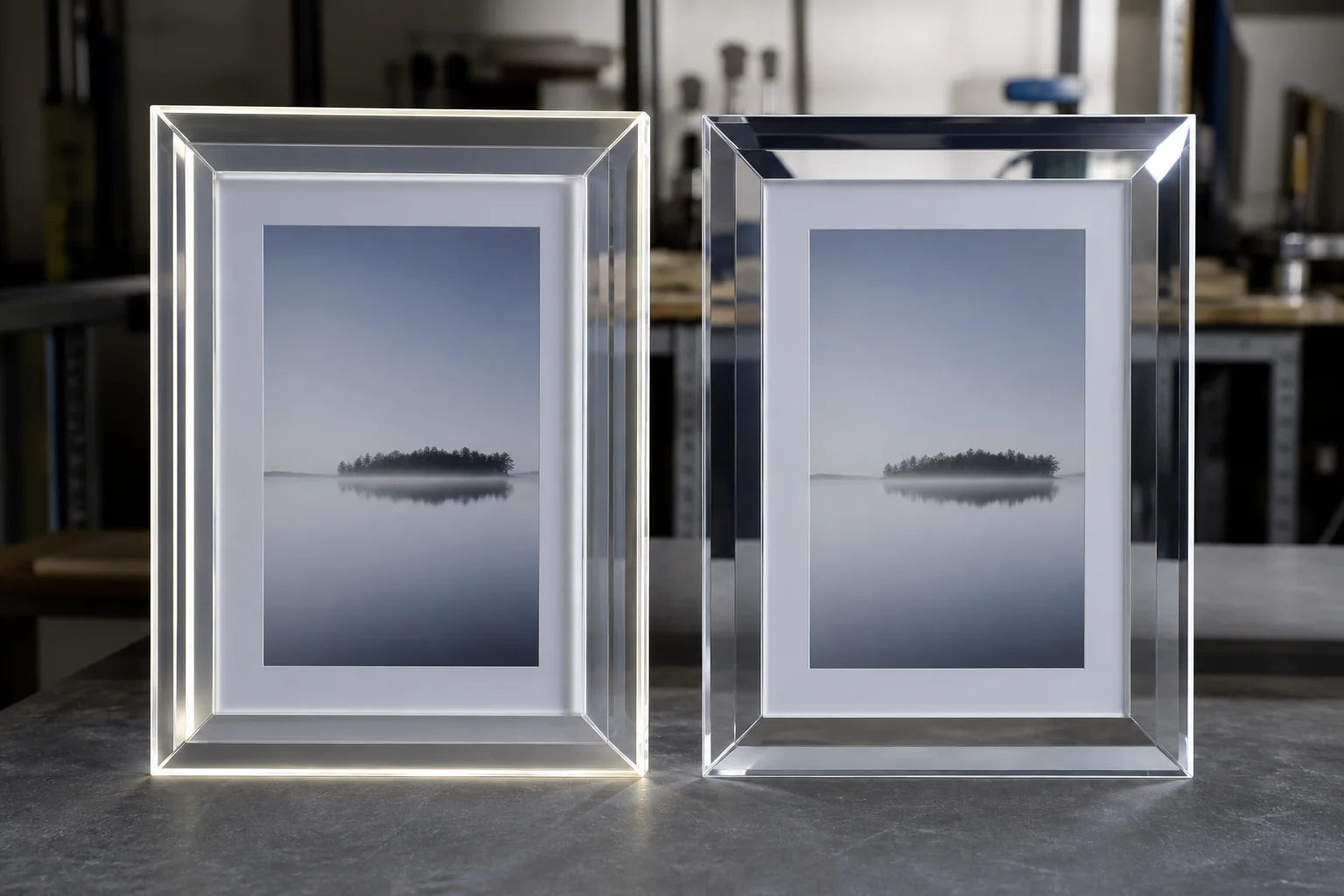
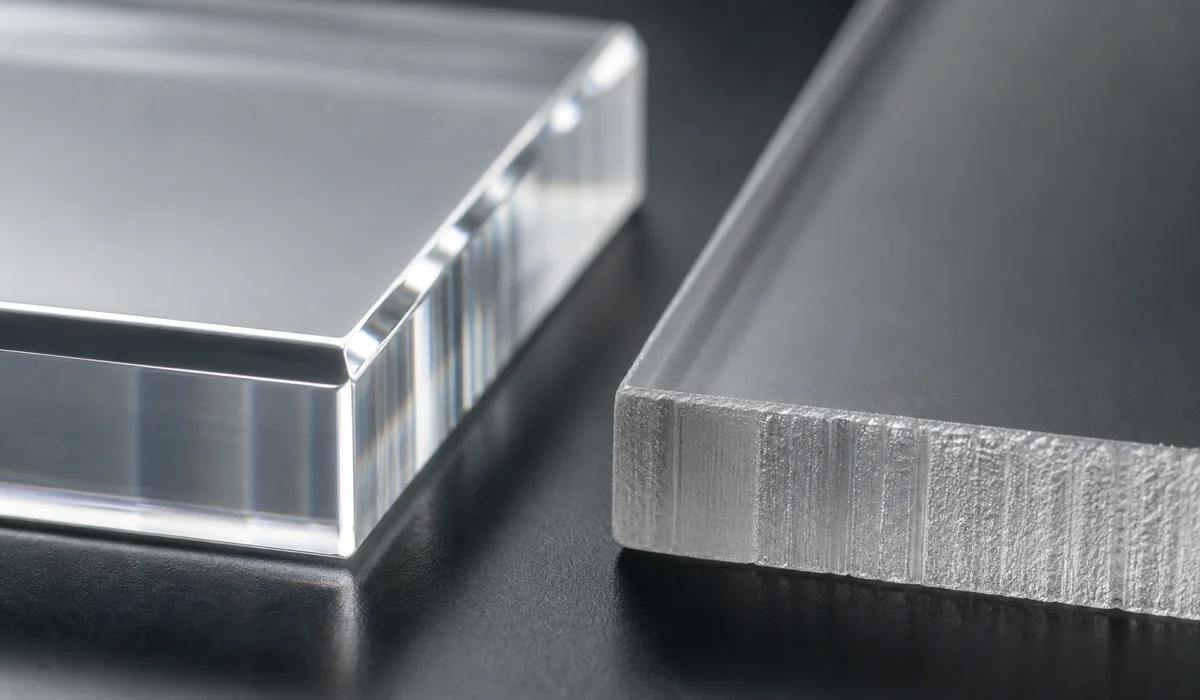
Run a fingertip along each accessible edge and inspect it under raking light. Diamond polishing, flame polishing, machining, and laser cutting can leave different appearances depending on sheet grade, thickness, setup, and operator control. Name the required process and visible acceptance limits; the word polished alone does not define the result.
Edge finish is one of the checks a physical sample can establish before bulk production. My inspection team checks the drawing’s edge requirement alongside the face condition and assembly fit. The diamond vs flame polishing guide explains how the processes differ and which visible limits belong in the approval record.
Name the edge process in the quote and write the visible limits into the sample acceptance criteria. A render cannot prove the actual edge, as the pre-production sample approval checklist explains. Wetop’s paid samples take 3–5 days, and the approved edge becomes the production inspection reference.
Lifecycle cost for resellers — replacement, returns, and program math
The lower delivered program cost depends on the actual sheet quote, packed weight, damage history, return handling, replacement stock, and service environment. A material-price comparison stops too early, while a lifecycle claim without measured program data goes too far. Put both sets of inputs into the same cost model.
For inbound freight, compare the packed gross and chargeable weights. For installation, confirm the applicable safety requirement and mounting load. During service, measure scratches, breakage, cleaning damage, and replacements for the specific location. Use those records to decide whether acrylic’s lower mass outweighs glass’s harder surface for the next order.
The colored floating-frame gallery project documents one acrylic program in a public display setting. Treat it as a project example, not a universal result for galleries; your artwork, light level, visitor access, mounting, and conservation requirements still control the glazing choice.
For reorders, keep the approved drawing, sheet grade, artwork, edge specification, color target, and packing standard under revision control. Confirm whether the original sample remains a valid appearance reference, because sheet batches and finishes can vary. That record gives the supplier a defined target instead of asking a later batch to match from memory.
Decision matrix — which glazing for which frame program
No single winner exists across every program, so here is the matrix we walk buyers through. Find your program type in the left column, and the glazing recommendation follows from which failure mode costs you more: scratches (favors glass) or weight, breakage, and UV fade (favor acrylic).
Start with the dominant risk, then check the qualification in the recommendation column. A material recommendation does not approve the final frame: the drawing still needs the panel grade, thickness, edge condition, mounting, backing, and packing. Public-facing or conservation work may also need approval from the project designer, code professional, or conservator before the fabricator releases production.
| Frame program | Dominant risk | Recommended glazing |
|---|---|---|
| Hospitality guest rooms & corridors | Impact, applicable safety rules, mounting load | Acrylic or approved safety glazing after project review |
| Shipped e-commerce / drop-ship frames | Transit damage, packed weight, replacement process | Compare tested pack-outs in acrylic and glass |
| Gallery & archival display | Light exposure, conservation, handling | Named glazing grade approved by the conservator |
| Corporate awards & certificate walls | Document light exposure, install weight | Compare named UV-grade data and mounting loads |
| High-touch retail tabletop frames | Daily surface abrasion | Glass, or sampled acrylic with film and care criteria |
| Children’s / education spaces | Impact and injury requirements | Code-approved glazing and mounting for the location |
The matrix identifies the review required; it does not declare a universal winner. Wetop’s acrylic production starts at 100 pieces per design, with paid samples in 3–5 days and production in 15–20 days after approval. Standard payment terms are 30% deposit and 70% before shipment. The paid sample is separate from the production MOQ, and its fee is never credited to or deducted from production.
Weighing glazing for a specific frame spec — size, thickness, mounting, print content? Send us the details and we’ll return a glazing recommendation with the weight math run for your actual order quantity, within 24 hours.
Footnotes
-
PMMA (acrylic) density ~1.2 g/cm³ — MakeItFrom material data — independent materials database displaying the PMMA density value used in this guide’s panel-weight and freight calculations. ↩
-
Soda-lime glass density 2.47 g/cm³ — Imetra material properties — engineering reference showing the soda-lime glass density that anchors the acrylic-to-glass weight ratio at roughly 2:1. ↩
-
Light transmission — PLEXIGLAS (Röhm) — manufacturer data showing clear-transparent PMMA transmits up to 92 percent of light in the visible range, the clarity figure this guide uses for the transmission tie between acrylic and framing glass. ↩
-
Library of Congress — Care, Handling, and Storage of Photographs — national preservation guidance recommending limited light exposure for displayed photographs, supporting the fade-protection case for UV-filtering glazing. ↩
Frequently Asked Questions
Acrylic vs glass picture frame: which is better for a bulk program?
Choose from the project risks. Acrylic lowers panel weight and avoids ordinary glass shard behavior; glass offers a harder, more scratch-resistant surface. Compare the named glazing grade, panel size, mounting, packing, and applicable safety requirements before approving either.
Do acrylic frames scratch more easily than glass?
Yes. Acrylic has a softer surface than ordinary picture glass and needs a handling plan. Specify protective film through installation, approve the cleaner and cloth for the named sheet grade, and judge any polished-edge requirement on the physical sample.
How much lighter is an acrylic picture frame than glass?
Cast PMMA runs about 1.2 g/cm³ against roughly 2.47 g/cm³ for soda-lime glass, so an identical panel weighs a little under half as much — a 16×20 inch, 3 mm acrylic panel is about 0.74 kg versus 1.53 kg in glass. Across 200 frames, that is roughly 157 kg of freight weight removed.
What should I check on a frame sample's edge finish?
Run a fingertip along every edge and inspect it under raking light. Compare the sample with the named finish on the drawing, then write measurable limits for chips, saw marks, thermal distortion, and sharp corners. A paid sample normally takes 3–5 days.
Does acrylic yellow over time in a picture frame?
Yellowing and transmission depend on the specific sheet grade, additives, light exposure, heat, and service environment. Ask for the named grade's aging and transmission data, and do not treat the words cast acrylic as a lifetime guarantee.
What acrylic thickness should replace glass in a picture frame?
No universal thickness replaces glass at every size. Panel span, mounting points, allowable bow, handling, temperature, and the supplier's sheet data determine the acrylic thickness; put the accepted flatness and support method on the drawing.
Can acrylic glazing be used in gallery picture frames?
Yes, when the gallery approves the named acrylic grade, surface, mounting, and cleaning method. For fade-sensitive work, compare the supplier's wavelength-specific UV data with the conservation requirement rather than relying on an archival label alone.
How should acrylic picture frames be packed for bulk freight?
Specify protective film, interleaving, corner protection, inner-carton quantity, orientation, and master-carton limits. Approve the pack-out with the sample because panel finish, frame hardware, and freight route change the abrasion and impact risks.
Is UV-filtering acrylic the same as standard clear acrylic?
No. UV-filtering performance belongs to a named grade and wavelength range, while standard clear acrylic is sold primarily for visible clarity. Request both datasheets and record the approved grade on the drawing and purchase order.
When is glass the better picture-frame glazing?
Glass deserves consideration where surface abrasion dominates, the frame stays in a controlled location, and the weight and break-safety requirements permit it. Use the project risk assessment and applicable code rather than a material-only rule.
Can I approve a paid acrylic frame sample before the production MOQ?
Yes. Wetop makes a paid pre-production sample before the 100-piece production MOQ per design so you can approve dimensions, flatness, edge finish, mounting, artwork, and packing. The sample fee is paid separately and is never credited to or deducted from production.
Compare your frame specification before production
Send the panel size, thickness, mounting, artwork, quantity, packing, and destination for a written acrylic quote. A pre-production sample is paid separately from the 100-piece production MOQ, and its fee is never credited to or deducted from production.