Glass vs Acrylic Display Case for Collectibles
Compare the glass cabinet, wood-frame glass case, and fitted acrylic cover against the collection, access plan, room, and order quantity.
Need this made?Collectible display cases →
Key Takeaways
- Three formats — a glass furniture cabinet, a wood-frame glass case, and a fitted acrylic cover — solve different collection, access, and installation problems.
- For light-sensitive pieces, ask for the exact glazing grade, manufacturer datasheet, and wavelength-specific claim; material names alone do not prove UV performance.
- At equal dimensions and thickness, acrylic is lighter than soda-lime glass; calculate the finished assembly and packing weight before choosing hardware or freight.
- A fitted cover can reduce open gaps, but dust performance depends on the base interface, openings, hardware, and approved sample.
- Wetop's custom program starts at 100 pieces per design, with a separately paid 3–5-day sample and 15–20-day production after approval.
On this page
- Glass vs acrylic display case: start with three formats
- What each format actually is
- UV protection: grade beats material
- Weight, safety, and living with the case
- Assembly, dust, and the seal question
- Price bands and how each format is bought
- Decision rules: which format wins when
- Ordering acrylic display cases from Wetop
Glass vs acrylic display case: start with three formats
A packaging-engineering consultancy serving a US toy manufacturer used our 2,620 three-part acrylic display cases for a national retail launch, with every unit handed to carriers within 20 days of approval. That result shows what a repeated fitted-case program can do; it does not prove that acrylic wins every material comparison.
The direct answer to glass vs acrylic display case is conditional. Use a glass cabinet when one furniture piece must hold many objects. Use a wood-frame glazing system for a flat or shallow wall display. Quote a fitted acrylic cover when one object or repeated retail set needs an item-specific enclosure, lower assembly weight, and a sample-controlled fit.
Compare the finished assembly, not just two raw materials: collection size, access, mounting, light exposure, packing, destination, and order quantity determine the useful format.
Write those inputs into one comparison sheet before asking for prices. Include the object’s measured envelope, the number of objects per enclosure, access frequency, mounting surface, approved glazing grade, cleaning method, packing route, and quantity per design. That brief exposes mismatched quotes early: one supplier may have priced a furniture cabinet, another a fitted cover, or the two may have assumed different UV grades and packouts. A fair material decision starts only after those variables match.
What each format actually is
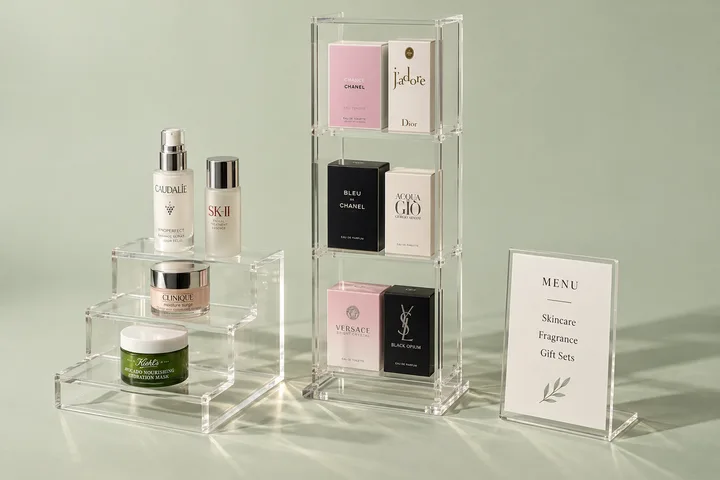
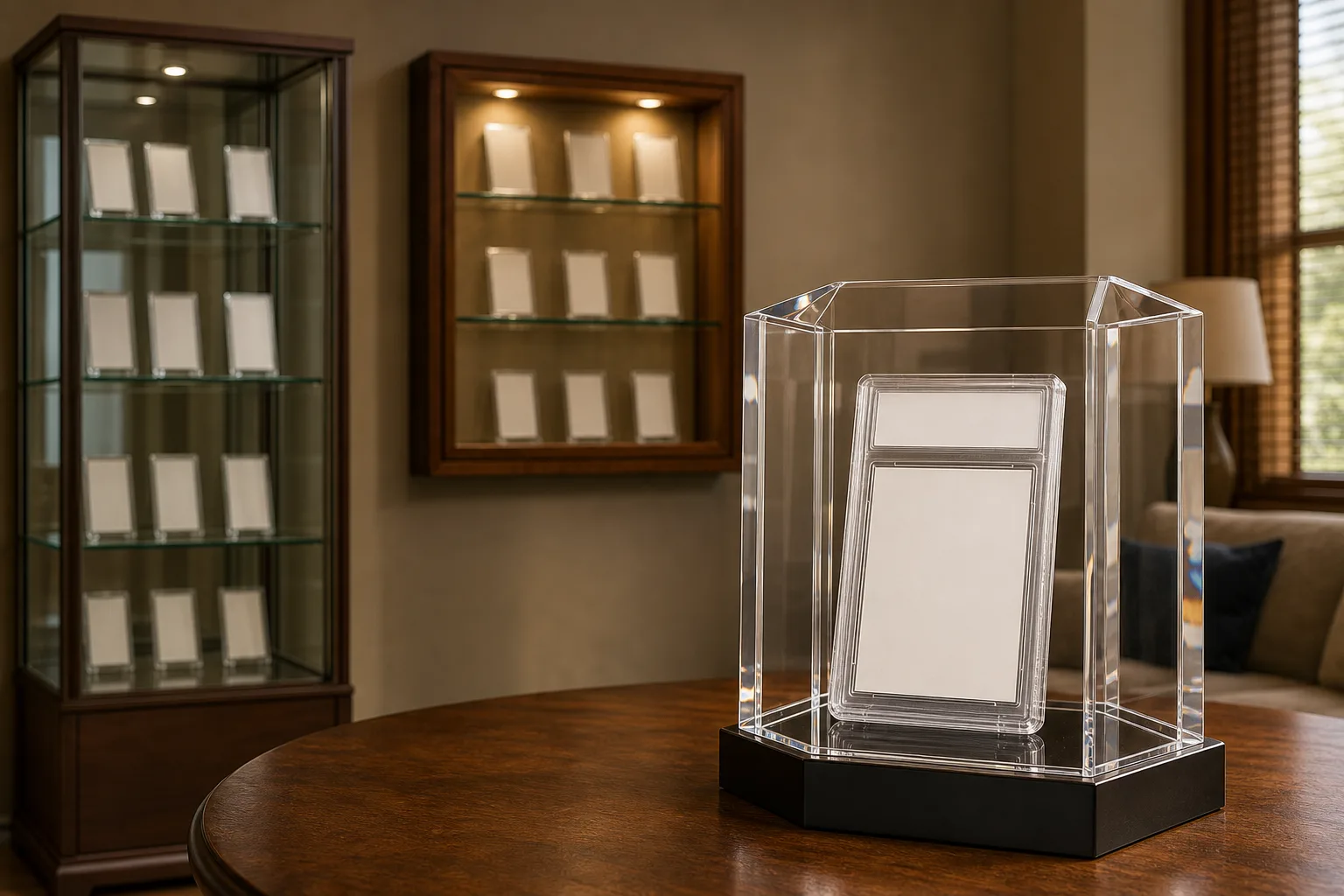
A glass display cabinet is a furniture purchase: framed glass panels, hinged or sliding doors, shelves, usually a lock. A wood-frame glass case is a shallow framed box, such as a jersey display case or shadow box. An all-acrylic case is a one-piece five-sided clear box, CNC-cut and bonded, sitting over a base.
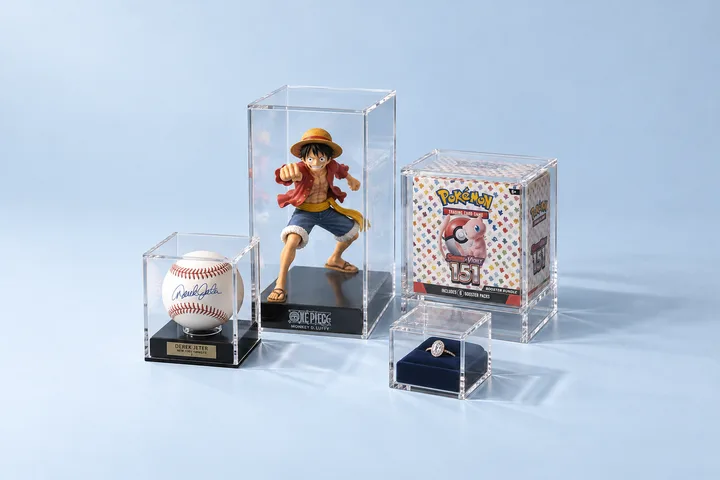
Construction explains how each format behaves. The cabinet uses large panes in a frame that carries the load. The wood-frame case uses its frame for structure and a front pane for visibility, which suits flat or shallow wall displays. The acrylic format described here bonds five faces into one clear cover sized to the object: a graded slab, helmet, sneaker, or LEGO set.
Item-specific sizing is the acrylic format’s main advantage. Sheet fabrication can avoid a molded case body, but fixtures, inserts, printed parts, or non-acrylic components may still add setup or tooling. The acrylic display cases hub shows formats from single-slab covers to large display cases; the quote must name every setup and tool included.
UV protection: grade beats material
UV performance belongs to a named glazing grade, test method, and wavelength range. The labels glass and acrylic do not provide that evidence on their own.1
Light-sensitive inks, dyes, and papers need an exposure plan that covers glazing and placement. If a quote says only clear acrylic or glass, it has not yet defined a UV requirement.
For printed color, signature ink, or other light-sensitive material, ask the supplier to identify the exact grade and attach the manufacturer datasheet. Confirm that the cited property covers the exposure and wavelength range in your brief; a visible-light transmission figure is not a UV-protection claim. Placement remains a separate control, so keep direct sunlight out of the display plan. UV, dust-seal and headroom options by collectible type are on our collectible display cases page.
Put the grade and supporting document in the quote. Two visually similar clear samples can carry different performance claims, so a photograph is not evidence for a UV specification.
Weight, safety, and living with the case
Soda-lime glass is about 2.5 g/cm³; acrylic is about 1.2.2 At equal panel dimensions and thickness, acrylic therefore contributes less material weight. A finished cabinet or case also includes its frame, base, shelves, hardware, object, and packing, so calculate the complete assembly before selecting mounts or freight.
| Factor | Glass cabinet | Wood-frame glass case | All-acrylic case |
|---|---|---|---|
| Format | Furniture, many items | Framed box, flat items | Five-sided box, one item/set |
| Material density | ~2.5 g/cm³ + framing | Frame + one glass pane | ~1.2 g/cm³, no frame |
| Failure mode | Confirm glazing type and test requirement | Confirm glazing type and mount | Confirm grade, thickness, and sample test |
| Wall mounting | Usually floor-standing; follow cabinet supplier | Anchor for calculated assembly weight | Specify hardware for calculated assembly weight |
| Rearranging / access | Doors, careful reach-in | Take down, unframe | Lift the cover |
| Shipping | Quote finished cabinet and protective packing | Quote framed assembly and protective packing | Quote bonded or knock-down construction and packing |
Safety cannot be reduced to a material slogan. Glazing grade, thickness, edge treatment, mounting, impact exposure, and the retained condition after damage all matter. Define the required failure behavior and test it on the proposed assembly. For wall-mounted memorabilia, include panel weight and hardware capacity in the sports memorabilia case brief.
For the general material comparison, our acrylic vs glass displays guide covers density, clarity, scratch care, and impact requirements. For a collectible case, calculate the full assembly weight and write the cleaning method into the brief instead of assuming how gently it will be handled.
Assembly, dust, and the seal question
A five-sided cover can reduce the number of openings compared with a cabinet door, but it is not automatically dust-tight. The base interface, cable or ventilation openings, hardware, flatness, and room conditions determine what enters the display.
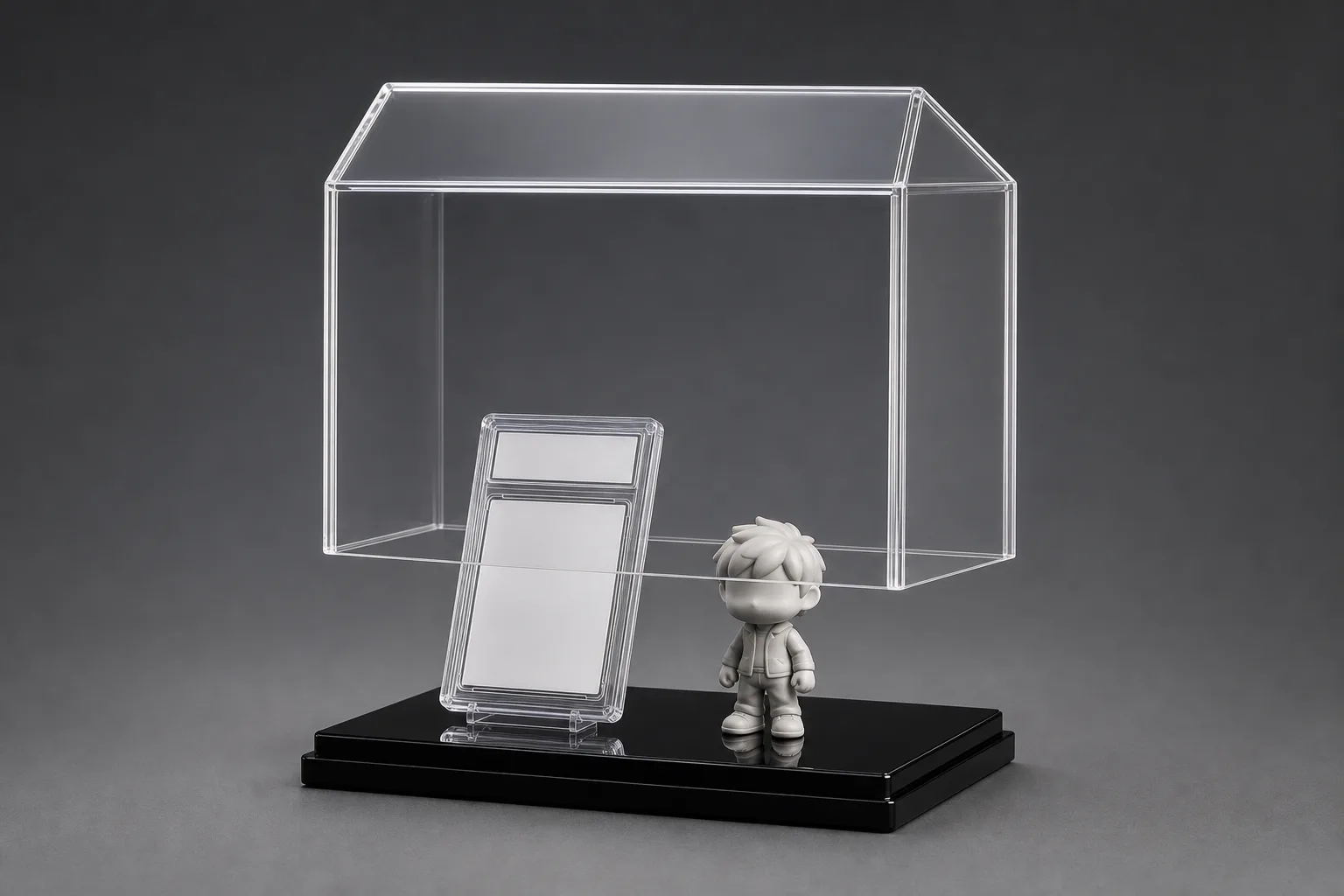
Construction method changes the assembly plan. A bonded five-sided cover arrives as one unit; a knock-down case uses panels and hardware that must be approved as an assembled sample. A cabinet may need furniture delivery, leveling, and shelf installation. A wood-frame case needs mounting hardware rated for its calculated assembly weight.
A flush interface is not airtight and does not provide archival atmosphere control. Approve the interface, any gasket, ventilation, and access method on the sample; control humidity at the room or approved enclosure-system level. In our graded-card retailer program, the slot fit was approved against the buyer’s actual slab rather than a catalog dimension.
Price bands and how each format is bought
The three formats use different cost structures. A cabinet quote includes furniture construction and hardware; a framed glazing quote includes its frame and mount; a fabricated acrylic case quote should separate sheet, cutting, finishing, bonding, base, hardware, packing, and freight. Compare equal dimensions, quantities, specifications, destination, and Incoterm.
Wetop manufactures B2B custom programs from 100 pieces per design. Paid samples run 3–5 days, are billed separately, and are never credited to production. Standard production is 15–20 days after approval; standard payment is 30% before production and 70% before shipment.
This is not a one-off consumer offer. A single collector should buy from a retailer; a retailer, brand, club, or program buyer should count each design separately against the 100-piece minimum.
Custom sizing should start with the actual item, required clearance, base interface, access method, and packing constraint. For a LEGO display case, send the assembled model dimensions and center-of-mass concern rather than relying on a product listing alone. For a video game display case, send the console, boxed game, or graded game measured the same way. Wetop can retain approved cutting files for reorders, but every repeat still needs confirmation of the current material, artwork, hardware, quantity, and schedule.
Decision rules: which format wins when
As a format decision, the glass vs acrylic display case rules are short. Quote the glass cabinet when one furniture piece must hold a collection. Quote the wood-frame glass case when a flat piece and its wall frame belong together. Quote the fitted acrylic case when one item or repeated retail set needs item-specific geometry and a sample-controlled fit.
The working split:
- The glass cabinet wins when: the collection needs many pieces in one room anchor with cabinet access and furniture-scale installation. Wetop does not manufacture furniture cabinets.
- The wood-frame case wins when: the piece is flat, the frame belongs in the room, and the anchor is sized for the finished assembly. Specify a documented glazing grade if the piece has a light-exposure requirement.
- The all-acrylic case wins when the piece is dimensional, the display moves or ships, or a buyer needs 100 or more of one fitted design for retail, events, or a brand program. Specify any UV requirement by named grade and datasheet.
- Mix formats when the collection deserves it: the cabinet holds the field, and the three pieces that matter most sit beside it under their own fitted covers.
Audit the intended installation before choosing. Count the objects per enclosure, measure the wall or surface, record access frequency, map direct light, define the cleaning method, and calculate the assembly weight. Those inputs let suppliers quote comparable formats before price obscures a specification difference.
Ordering acrylic display cases from Wetop
To quote a display case program we need the object’s measured dimensions, quantity per design, base requirement, material-grade requirement, openings or hardware, destination, and in-hands date. Send them through our contact form and we respond within 24 hours.
Current standard terms are a separately paid sample in 3–5 days, approval before bulk, 15–20-day production, and a 100-piece MOQ per design in our ISO 9001-certified Shenzhen factory. Finished pieces are inspected against the approved drawing and sample; packing is quoted for the selected route. Payment is 30% before production and 70% before shipment.
If the fitted acrylic format matches the brief, request a quote and a paid physical sample. The sample is billed separately, is never credited to production, and becomes the approval reference for the bulk order. If the brief calls for a cabinet-style unit, send the drawing: we quote the acrylic enclosure, doors and shelves to it, and the paid sample confirms fit before production.
Footnotes
-
UV transmission of acrylic sheet grades, ACRYLITE knowledge base. Manufacturer transmission curves show why the exact acrylic grade and wavelength range must be named. ↩
-
Soda-lime float glass material properties, MakeItFrom. The material database lists soda-lime glass density near 2.5 g/cm³, compared with about 1.2 g/cm³ for acrylic. ↩
Frequently Asked Questions
Glass vs acrylic display case: which is better for collectibles?
In a national toy launch, a packaging-engineering consultancy used 2,620 fitted acrylic display cases for one repeated retail format. That example does not make acrylic universally better: choose a fitted acrylic cover for repeatable item-specific cases, a glass cabinet for many items in one furniture piece, or a framed glazing system when the frame and wall installation are part of the brief.
Do acrylic display cases protect against UV?
In an 800-unit graded-card display program, the buyer specified a UV-filtering acrylic grade rather than relying on the word acrylic. For any light-sensitive collectible, ask the supplier to name the exact grade and provide its manufacturer datasheet; the supported wavelength range and test method matter more than a blanket percentage. Keep direct sunlight out of the display plan as a separate control.
What are the three main display case formats for collectors?
The 2,620-case toy program used fitted acrylic covers; other briefs may call for a glass furniture cabinet or a wood-frame glazing system. Those are the three useful starting formats: cabinet for many items, framed glazing for flat or shallow pieces, and a fitted clear cover over a base for one item or one repeated retail set.
Why do collectible retailers use acrylic cases instead of glass?
A graded-card retailer began with 800 triple-slab displays and placed four reorders across five formats. For that program, item fit, repeatable cutting files, lower material weight, and a physical approval sample supported the acrylic choice. A buyer should still compare finished weight, packing, scratch care, access, and the required failure behavior for the actual installation.
Can I order custom acrylic display cases in small quantities?
The graded-card retailer's first run was 800 units, while Wetop's standard minimum is 100 pieces per design. A paid pre-production sample is separate from that MOQ, ships in 3–5 days, and is never credited to the production order; production is normally 15–20 days after approval.
Need a quote and paid sample for a collectible case program?
Send the item dimensions, quantity, base, glazing requirement, destination, and in-hands date. The 3–5-day sample is paid separately and is never credited to production.