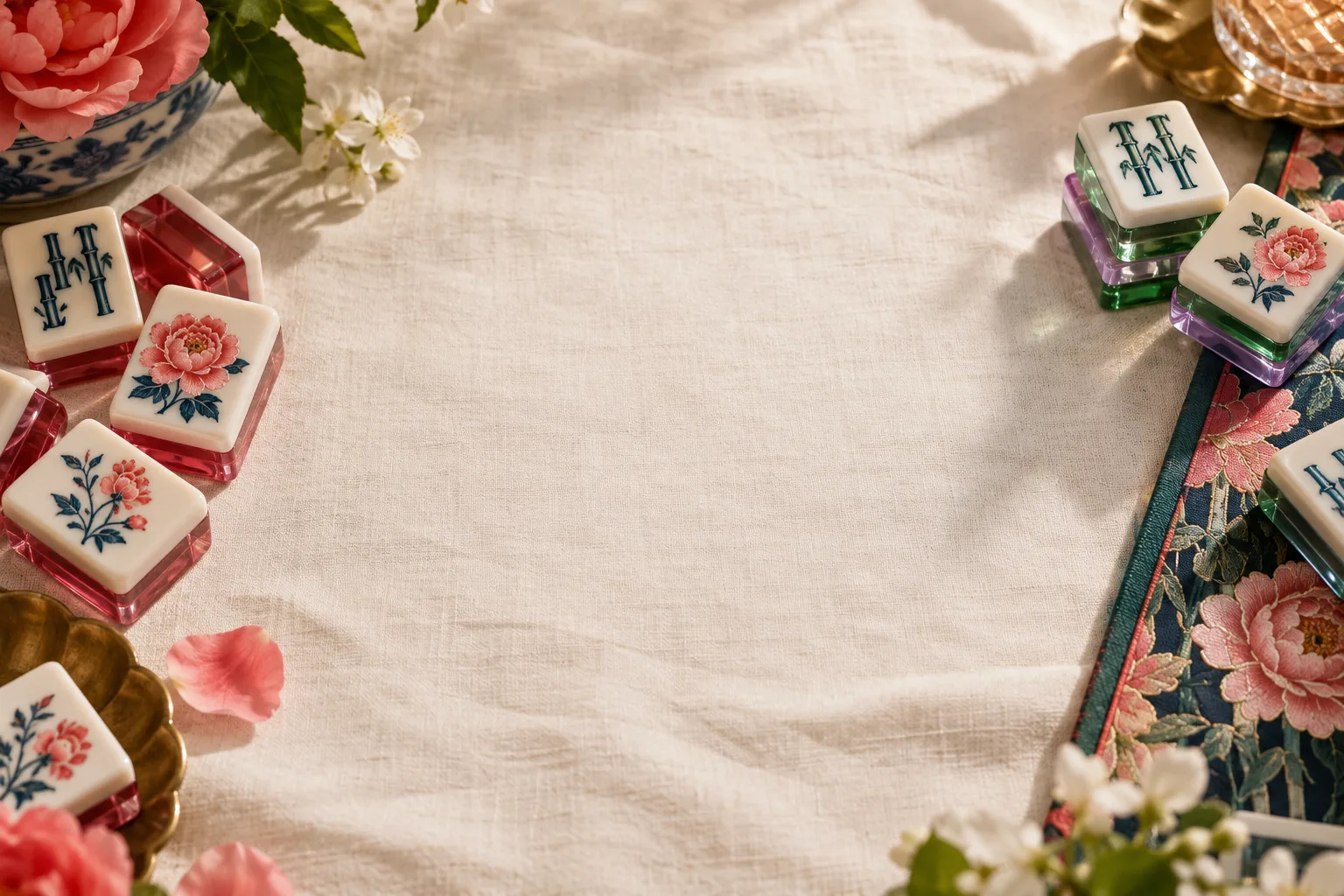
Acrylic vs Melamine Mahjong Tiles for Custom Sets
Choose the material around the American mahjong set you want to sell, then check the complete physical sample.
Need this made?Custom mahjong set configurator →
Key Takeaways
- Acrylic is a useful choice for custom American mahjong brands that want layered sheet colors, a polished edge and their own face artwork.
- Melamine molding and acrylic sheet fabrication are different manufacturing routes. Compare actual supplier specifications and samples.
- The material name alone does not establish weight, scratch resistance, engraving quality or a finished tile price.
- Wetop manufactures cast acrylic tiles from 50 complete sets per design; we do not offer melamine tile production.
On this page
- Which material fits a custom American mahjong brand?
- Compare the decisions that change the product
- Why acrylic works for layered American mahjong collections
- How the manufacturing routes differ
- Feel, sound and wear: what a sample can answer
- Budget for the collection, not just the plastic
- Keep American mahjong rules and product design separate
Which material fits a custom American mahjong brand?
For a new American mahjong collection built around distinctive layer colors and original artwork, cast acrylic gives a brand several choices within one manufacturing program. A melamine set may still suit the buyer’s preferred feel, appearance and budget. Compare the finished products against your brief; acrylic vs melamine mahjong is not a universal quality ranking.
Wetop manufactures cast PMMA acrylic tiles, so this guide explains where that route fits and what to compare before choosing it. We do not manufacture melamine tiles or publish a melamine price list. Our recommendations about brand design follow the customization we offer; they are not the results of a head-to-head laboratory test.
Start with your customer’s use: a boutique retail collection, a club’s coordinated sets, or a gift program with its own artwork. Those projects need decisions about readability, tactile feel, replacement blanks, accessories and packaging as well as material. A beautiful back color cannot compensate for confusing symbols or a rack that does not fit.
Compare the decisions that change the product
Separate the body material from the decoration method. Acrylic can have a flat UV-printed face or an engraved and filled face. “Resin,” “engraved” and “premium” do not identify a complete manufacturing specification. Ask the supplier to name the material, construction, finished dimensions and face process on the quote.
| Decision | Wetop cast acrylic route | Melamine route: what to verify |
|---|---|---|
| Material identity | Cast PMMA sheets, cut and finished to the approved body | The actual molding compound and supplier specification |
| Color design | One to four layers, with separately selected sheet colors | Available body/back constructions and color options for that supplier |
| Appearance | Opaque, translucent or effect-sheet choices, subject to sample approval | Whether the offered finish and colors match your reference |
| Face artwork | Surface UV print with coating, engraved UV fill, or engraved paint fill | Actual decoration process, fine-detail limits and sample result |
| New body dimensions | Custom dimensions reviewed with the layer construction | Whether an existing body fits or new tooling is needed |
| Small production run | From 50 complete sets per design | Supplier-specific minimum, setup and tooling charges |
| Wear and care | Confirm the finished tile, fill/coating and cleaning instructions | Compare equivalent finished samples and care instructions |
| Price | Quoted for the exact complete specification | Quote the same tile count, accessories, packing and delivery terms |
This table compares a defined Wetop offer with questions to ask another production route. It does not claim that every melamine manufacturer uses the same tooling, minimum or finish. Neither a transparent edge nor a familiar ivory color proves the chemical identity of a tile.
Why acrylic works for layered American mahjong collections
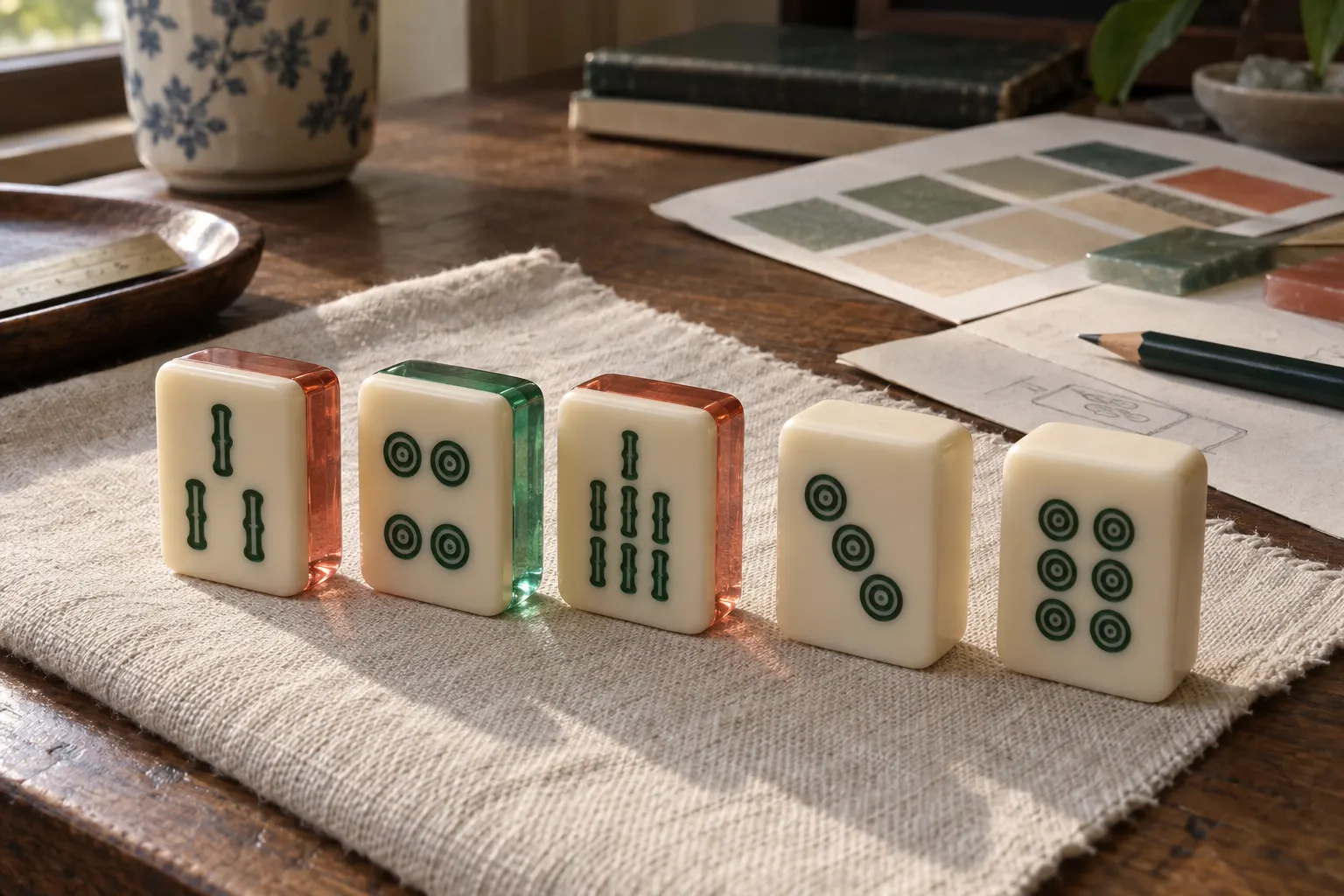
Layered sheet construction lets you choose the face, core and back separately. An ivory face can keep small symbols readable while a coral back or jade core carries the collection’s visual identity. That is especially useful when coordinating tiles with racks, a printed mat and a carry bag.
- Face artwork
- Print or engraved color fill
- Face sheet
- Choose the body material color
- Back sheet
- A separate layer color
For a retail collection, review the set at normal playing distance as well as in product photos. Keep the suits distinguishable. Check that a decorative joker still reads clearly, and that similar face colors do not merge under indoor lighting. Confirm the composition of the complete American mahjong set instead of assuming that every 160- or 166-tile offer contains the same extras.
Our color board helps shortlist sheet codes. A photograph or hex code communicates intent; the physical sample establishes the approved color. An acrylic rack and a textile mat may coordinate with the tiles without matching them exactly because the materials transmit and reflect light differently.
How the manufacturing routes differ
Cast acrylic tile production begins with sheets selected for the agreed construction. The body is fabricated and finished, and the approved face artwork follows the selected decoration route. Custom size and layer order can therefore be discussed as part of the body specification. Use the sizes and layers page to check feasible combinations.
Melamine molding compounds are supplied for shaped molded articles. Compound maker Körfez Kimya describes cellulose-filled molding powders and discusses molding-tool finish and processing conditions.1 That supports asking a melamine supplier about the actual molding system. It does not establish a universal tile price, tool charge or production minimum.
Acrylic itself also needs appropriate machining conditions. ACRYLITE’s fabrication guidance explains that laser parameters affect edge quality and stress.2 A clean-looking photograph is therefore not sufficient evidence of a finished tile’s durability. The production drawing, finishing process and approved physical sample belong together.
For your quote comparison, keep the finished body dimensions and tile count constant. If one quote covers a smaller body, fewer pieces, a different decoration method or no accessories, the material name is not the only reason for a price difference. Ask for an itemized comparison before choosing the cheaper number.
Feel, sound and wear: what a sample can answer
A physical sample answers questions that a material label cannot: how the tile sits in the hand, whether the edges feel comfortable, how the symbols read and how the pieces move on the intended mat. Test complete samples under comparable conditions. Do not infer the preferred weight or sound from “acrylic” or “melamine” alone.
| Check | A useful comparison | Record before approval |
|---|---|---|
| Dimensions and weight | Measure the actual bodies using the same method | Accepted size and observed sample mass |
| Edge feel | Handle corners and move tiles in and out of the rack | Finish and any uncomfortable edge |
| Readability | Compare similar suits, numbers and jokers in room light | Changes needed to symbol size or contrast |
| Sound | Use the same mat, table and handling | Your preference, without claiming a universal sound score |
| Surface and layers | Look at the face, side edges, joins and back | Agreed finish; any visible issue to correct |
| Packaging fit | Load the complete agreed contents | Divider clearance, rack storage and closure |
We do not publish a comparative scratch score or promise that acrylic is unbreakable. If a specific abrasion, chemical or drop-test result is needed, agree the test method and acceptance scope before the quote. Routine sample approval is not a substitute for a laboratory report.
Budget for the collection, not just the plastic
The finished price depends on tile count, dimensions, layer construction, artwork process and quantity. Accessories, printed packaging, samples and freight can change the project budget substantially. The price page shows defined reference configurations and a freight budget tool; unlisted variations require a quote. When the material choice is settled, the custom mahjong set configurator turns tile count, size, layers, colors and accessories into one itemized brief.
Wetop’s decorated tile program starts at 50 complete sets per design. One complete custom decorated sample set is USD 500 including courier, paid separately and never credited to production. Accessory samples are separate. Confirm the complete sample contents before payment; adding several samples does not leave the total fee unchanged.
If you decorate tiles in your own workshop, consider blank acrylic American mahjong tiles. The polished two-layer reference is USD 0.30 per piece at 50 complete sets of 160 pieces, totaling 8,000 pieces. Other specifications and quantities need confirmation. Blank sample fees are quoted separately, and your decoration method needs its own compatibility check.
Keep American mahjong rules and product design separate
Choose the inventory for the game your buyers play and confirm it face by face. Materials and decorative style do not determine the rules. The National Mah Jongg League supplies its official cards through its own store; direct customers there when they need the League’s current card.3
Wetop is not affiliated with or endorsed by the League, and official cards are not automatically included in a custom tile order. Original packaging inserts and customer-supplied instructions are separate production items. A decorative design should preserve the distinctions players need without reproducing a third party’s artwork or rule card.
A practical first brief names the American mahjong format, complete tile count, intended customer, body dimensions, layers, face process and planned quantity. Add any rack, mat, case or bag that must work with the tiles. Then use the sample to approve the combination rather than deciding on the material name alone.
Footnotes
-
Körfez Kimya: melamine molding compounds — compound construction and molding considerations, not a test of finished mahjong tiles. ↩
-
ACRYLITE: laser machining — machining parameters and edge-stress considerations for acrylic sheet. ↩
-
National Mah Jongg League official store — official card purchasing reference; no supplier endorsement implied. ↩
Common questions
Is acrylic better than melamine for American mahjong?
Acrylic suits a custom brand that prioritizes layered colors, translucent backs and flexible body specifications. That is a design and manufacturing fit, not proof that every acrylic tile outperforms every melamine tile. Compare complete samples for feel, readability and finish.
Are resin and acrylic the same thing in a mahjong listing?
Resin is a broad description. Ask for the actual material and construction. Wetop specifies cast PMMA acrylic; it is not melamine or hand-poured casting resin.
Is a heavier mahjong tile always better?
No. Dimensions, material, construction and the player's preference all matter. Compare measured sample weights and test the intended rack and mat rather than judging quality from weight alone.
Can I buy blank acrylic American mahjong tiles to decorate locally?
Yes. Polished, unprinted and unengraved blanks start at 50 complete sets. The two-layer reference is USD 0.30 per piece at 50 sets of 160 pieces, or 8,000 pieces. Other sizes, colors, layers and quantities need a quote; blank sample fees are confirmed separately.
Do American mahjong rules require a particular plastic?
Choose the tile inventory for the rules your customers use, then choose the material and dimensions for the product. Buy official rule cards from their issuing organization. A material choice does not imply approval or affiliation with a league.