



Is Melamine Acrylic? Cosmetics Display Guide
Melamine board builds the wall behind the counter. Acrylic sells what sits on it. Most cosmetics fixture briefs need both — in the right places.
Need this made?Custom cosmetics displays →
Key Takeaways
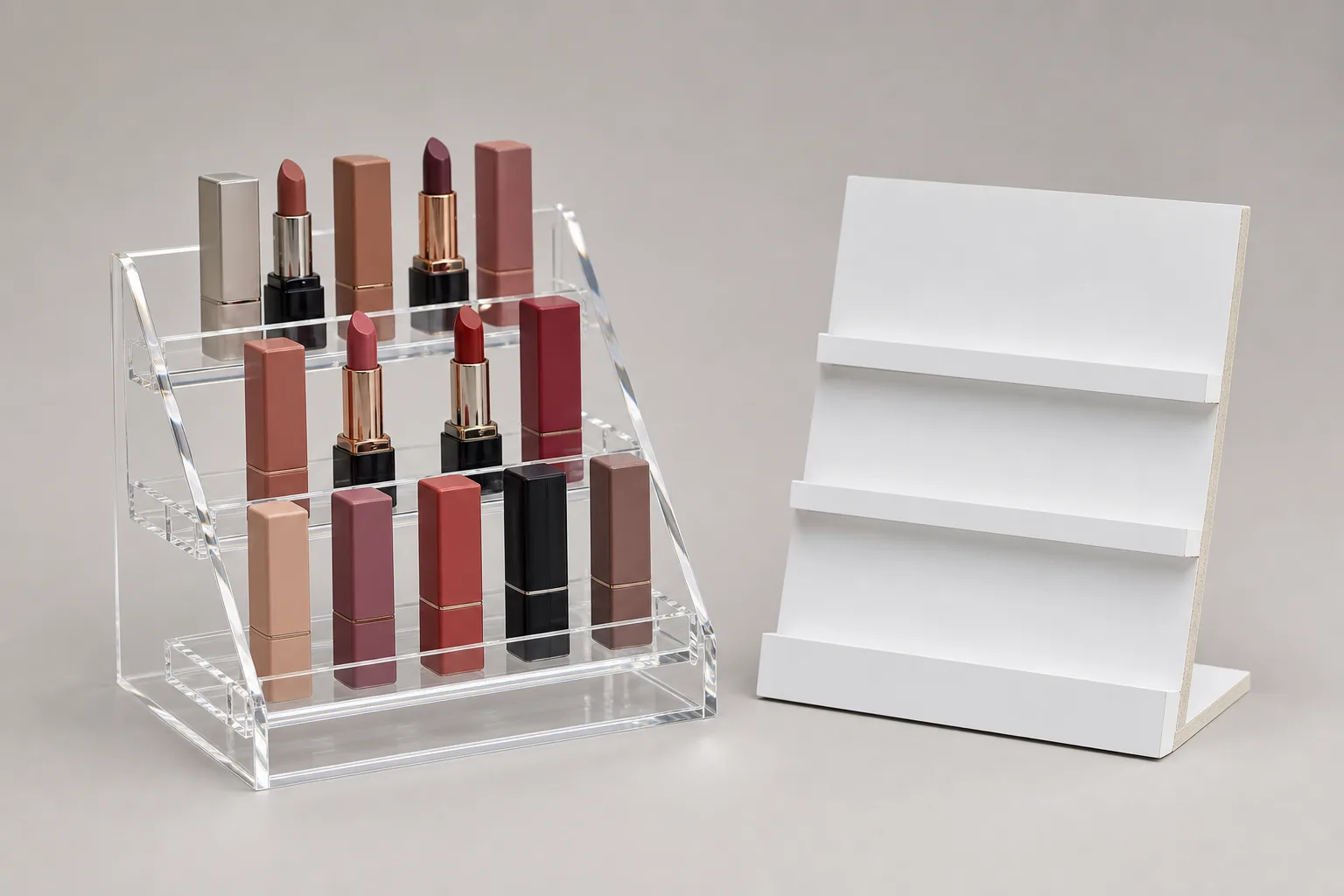
- The materials do different jobs: melamine-faced board is an opaque panel product for gondolas, back walls, and cabinetry; clear acrylic is the counter-level material that lets the product itself carry the display.
- Edges are the tell. Acrylic edges are cut and polished into finished glass-like surfaces; melamine edges are raw board covered with glued edge banding, and every chipped or lifted band exposes the chipboard core.
- For daily makeup smears both surfaces wipe clean, but they fail differently: liquid foundation working into a melamine seam swells the board core, while heavy perfume-alcohol exposure calls for prompt wiping or a laminate surface.
- Melamine board and acrylic use different cost bases; compare a live board-fixture quote with a drawing-matched acrylic quote rather than relying on a universal percentage.
- For an acrylic counter display, MOQ is 100 pieces per design, sample production is 3-5 days and production is 15-20 days after approval; compare the named cutting, printing, assembly and packing operations with a live millwork quote.
On this page
- Is Melamine Acrylic, and Which Belongs in a Cosmetics Display?
- What each material actually is
- Transparency: how the product reads on the counter
- Edges: polished surface vs edge banding
- Makeup spills, perfume, and daily cleaning
- Unit price and lifespan
- Freight and multi-door rollouts
- Decision rules: which material wins where
- Ordering acrylic cosmetics displays from Wetop
Is Melamine Acrylic, and Which Belongs in a Cosmetics Display?
2 separate materials answer the question “is melamine acrylic”: no; the acrylic order path starts at 100 pieces per design, a paid 3-5-day sample, 15-20-day production after approval, a 3-5mm starting thickness and ±0.2mm standard working tolerance, while melamine is quoted as a separate panel system.
| Published price reference | Specification | Price point |
|---|---|---|
| Generic custom acrylic display | Production quantity; final size, thickness, print, packing and Incoterm not fixed | $20/unit published low-end reference, not a cosmetics-display quote |
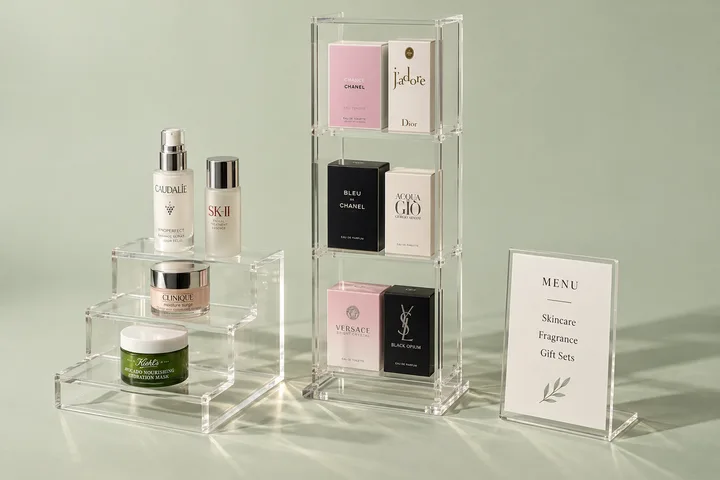
The acrylic vs melamine cosmetics display question is really two questions, because the materials compete only at the counter. Melamine-faced board is an opaque panel material for retail structure: gondolas, back walls, cabinets. Clear acrylic is a solid transparent sheet for the selling layer: testers, tiered risers, organizers, lighted logo units.
The confusion is understandable, because shopfitters quote both under one “display fixtures” line. When a cosmetics brand sends me a fixture brief that says “melamine or acrylic?”, the honest first answer is usually “which part?” A four-meter back wall in acrylic would be a strange, expensive choice; a lipstick tester bar in melamine board would be an opaque box hiding the one thing it exists to sell. Across six-plus years of display orders, the best-performing cosmetics counters I’ve seen treat this as a layering decision, not a material war.
So this guide compares the two honestly, axis by axis — what each material physically is, how edges are finished, how each survives foundation smears and perfume overspray, and what each costs to buy and to own. We fabricate custom acrylic and we do not build melamine millwork, so where melamine genuinely wins, we say so plainly.
What each material actually is
A melamine cosmetics display is engineered wood: a chipboard or MDF core faced with decorative paper saturated in melamine resin and heat-fused to the board.1 An acrylic display is cut from solid cast PMMA sheet — one homogeneous transparent material, polished at the edges, printed or tinted as the design requires.
That construction difference drives everything downstream. Melamine board is a surface over a core: the face is hard, scratch-resistant, and available in any printed color or wood grain, but it is only as durable as the seal around it. Acrylic has no core and no face — cut it anywhere and you expose more of the same water-clear material, which is why a cut acrylic edge can be flame- or diamond-polished into a finished surface rather than covered up.
It also drives the economics. Melamine board is a commodity panel, inexpensive per square meter and fast to machine into boxy carcass shapes — the right physics for big structural fixtures. Acrylic costs more per square meter but is used in 3-5mm sheet rather than 16-18mm board, cut into precise product-fitted geometry on CNC and laser lines. One is architecture, the other is merchandising.
Transparency: how the product reads on the counter
Cast acrylic transmits about 92% of visible light,2 so an acrylic tester stand visually disappears and the lipstick bullets, bottles, and compacts carry the display. Melamine board is opaque by nature — it gives you a colored or wood-grain surface, never a see-through one.
For cosmetics specifically, this is the axis that decides most counter-level briefs. Beauty products are their own best graphics: glass perfume bottles, foil-stamped compacts, gradient lipstick tubes. A clear riser presents them floating at eye level with light passing under and around each SKU. The same products on an opaque shelf read as inventory on furniture.
Opacity has its own legitimate uses, and melamine is not the only way to get it. When a design calls for a solid color block — a brand-color base under clear tiers, a frosted divider, a mirror-backed tester unit — colored, frosted, and mirror acrylic deliver the opaque look with polished edges and, when needed, a custom Pantone-matched color at a $200-300 one-time fee per color. That’s how a counter unit gets brand color and transparency in one build, something a paper-faced board can’t do. The broader material menu is covered in our cosmetics and perfume display application page.
Edges: polished surface vs edge banding
Acrylic edges are finished by machining: a sawn or CNC-cut edge is diamond- or flame-polished into a clear, glass-like surface that is part of the material itself. Melamine edges are covered: the raw board core is hidden behind a thin strip of glued edge banding, and that glue line is the fixture’s weakest point.
| Edge factor | Cast acrylic display | Melamine board fixture |
|---|---|---|
| Edge construction | Solid material, polished | Glued banding over exposed core |
| Look up close | Clear, jewel-like, catches light | Visible seam line at every edge |
| Failure mode | Fine scratches — polish out | Chips and lifting — exposes core |
| Repairability | Re-polish restores the edge | Banding replacement or panel swap |
| Curved / sculpted edges | CNC-cut to any contour | Limited by banding flexibility |
Counter-level cosmetics fixtures take constant edge contact — rings, testers, cleaning cloths, restock trays sliding across. On melamine, that traffic shows first as chipped banding corners, and a chipped corner is not cosmetic: it’s an opening into the board core. On acrylic, the same traffic shows as micro-scratches that a polishing pass removes.
Edge quality is also where shoppers subconsciously price the brand. A polished acrylic edge reads as product-adjacent — closer to the glass bottle it sits beside than to store furniture. When my clients run premium skincare lines on entry-level fixtures, the seam lines at eye level undercut the shelf price sitting two centimeters away.
Makeup spills, perfume, and daily cleaning
For routine smears — foundation, powder, lipstick swatches — both surfaces wipe clean with a soft cloth and mild soap. The real difference is what happens at the failure points: liquids that reach a melamine seam swell the chipboard core permanently,3 while acrylic is solid and non-porous with no core to protect.
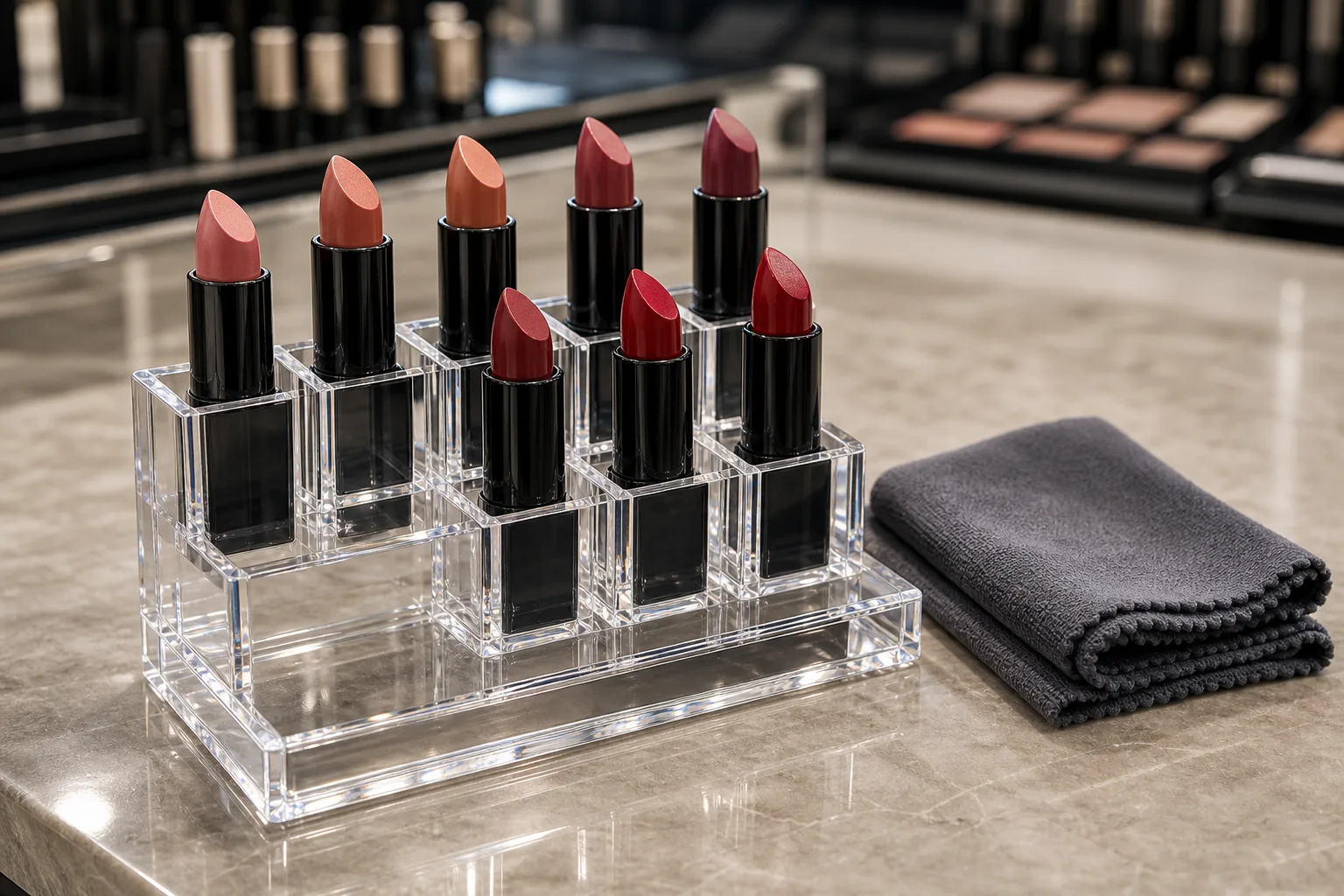
Perfume counters need a cleaner-compatibility review. Alcohol exposure can craze stressed acrylic, while a melamine finish also needs confirmation against the exact cleaner, concentration and contact time. Put the named finish, cleaning product and wipe procedure in the brief, then approve them on a sample instead of inferring resistance or service life from the material name.
Where the cleaning comparison turns one-sided is longevity of appearance. A melamine unit’s cleaning routine can’t touch its aging mechanism, because the damage happens at edges and seams below the surface. An acrylic unit’s main aging mechanism — fine surface scratching — is exactly what maintenance can reverse. Our makeup organizer line ships with care guidance for precisely this reason: soft cloth, mild soap, never ammonia- or alcohol-based glass cleaners for routine wipe-downs.
Unit price and lifespan
On cost, the acrylic vs melamine cosmetics display comparison splits by scope: melamine board is commonly quoted as panel or millwork, while acrylic is quoted as a finished unit. A live comparison must match dimensions, finish, packing, quantity and delivery term.
| Factor | Custom acrylic counter display | Melamine board fixture |
|---|---|---|
| Cost basis | Finished-unit quote to an approved drawing | Panel or installed-millwork quote |
| Tooling / setup | Quote the named cut, print and assembly operations | Quote the named panel, edge and installation operations |
| Best-value format | Counter displays, testers, risers, organizers | Gondolas, back walls, cabinets, drawers |
| Service-life review | Finish, cleaner, stress points and repair limits | Finish, seams, cleaner and repair limits |
| Schedule basis | Samples 3-5 days; production 15-20 days after approval | Supplier-specific fabrication and installation schedule |
| Freight profile | Approved unit and packout determine freight | Approved unit and packout determine freight |
Treat these as quote categories, not an automatic winner. Exact economics follow the drawing, size, material grade, finish, print, assembly, packing, quantity and delivery term for both builds.
Repeat-order control depends on retaining the approved cutting files, print settings and inspection points. A 100-piece MOQ, 3-5 day sample production and 15-20 day production window are the acrylic baseline; compare it with a live, like-for-like millwork quote rather than assuming either route has no setup or a fixed schedule. For the tray-and-tableware version of this same melamine question — a different melamine product with different chemistry — see our acrylic vs melamine serving tray guide.
Freight and multi-door rollouts
Freight depends on the approved geometry and packout. Some acrylic units can nest or ship knocked down; some board fixtures can also ship as components. Confirm carton dimensions, assembly steps, protective materials and store-level kitting on the sample before comparing delivered cost.
For a multi-door program, compare the actual cartons, handling points, installer needs and damage criteria for each approved build. Neither material name proves nesting efficiency, field repairability or deployment time.
Plan the rollout around an approved sample and written inspection criteria. Our premium cosmetics drawer organizer page is a delivered order and shows the specification questions it settled. If your calendar is tight, say so in the inquiry; the 3-5 day sample and 15-20 day production windows are the standard after approval.
Decision rules: which material wins where
The acrylic vs melamine cosmetics display decision comes down to placement. Buy melamine board for opaque structure bought by the square meter: gondolas, back-wall systems, cash desks, storage drawers. Buy acrylic for everything at counter level that presents, organizes, or lets shoppers test product. When one fixture needs both, put board in the carcass and acrylic in the selling layer.
The practical split I walk buyers through:
- Melamine wins when the piece is large, structural, and opaque by design; when budget per square meter is the binding constraint; and when the fixture lives away from high-touch zones where edge damage accumulates. A brand-color back wall in melamine is the right call, not a compromise.
- Acrylic wins when the shopper should see the product, not the fixture — tester bars, tiered lipstick displays, perfume risers, brush and palette organizers, lighted logo blocks; when the format refreshes seasonally; and when units ship to many doors, because flat small units freight far better than board furniture.
- Combine them when the brief is a full counter environment: melamine carcass, acrylic merchandising layer on top. We regularly build the acrylic layer to a shopfitter’s millwork drawings so slots, footprints, and brand colors line up on installation day.
If your brief leans opaque but still needs premium edges, price colored or frosted acrylic before defaulting to board — at counter-unit sizes the cost gap is smaller than most buyers expect, and the polished-edge finish is the visible difference.
Run the logic on a typical brief and the split falls out on its own. Picture a skincare brand entering 30 pharmacy doors with “one counter display”: a back panel, a shelf riser, and a tester tray. Quoted as all-acrylic, it prices like furniture; quoted as all-melamine, it looks like shelving. The build that makes sense is neither — the retailer’s millwork carries the opaque back panel, and the riser and tester tray come from us in clear acrylic with the brand’s Pantone color printed on the base. Per-door cost comes down, the visible layer keeps its polished edges, and the season-two reorder is a cutting-file rerun rather than a new millwork job. When you brief your next counter program, draw that line on the drawing first: everything behind the product can be board; everything around the product should earn its place.
Ordering acrylic cosmetics displays from Wetop
To quote a cosmetics display program we need five things: quantity, unit dimensions, material finish (clear, frosted, colored, mirror), branding (logo print, Pantone color), and your in-hands date. Send them through our contact form and we respond within 24 hours with pricing and a production plan.
From there the path is the one our 2,000+ projects have followed: a sample in 3-5 days — the sample fee is paid separately and is not credited to production — then 15-20 day production at a 100-piece MOQ in our ISO 9001-certified Shenzhen factory, with piece-by-piece inspection before packing. Terms are a 30% deposit with the balance before shipment.
If you’re still mapping the counter, start with the cosmetics and perfume display gallery for format ideas, the custom acrylic displays range for riser and tester-bar formats, or the acrylic makeup organizers line for back-of-counter organization. And if your project is genuinely a wall system or cash desk, send us the acrylic counter layer with your fit-out drawings and we build it to fit. Each material doing its own job is what a good cosmetics environment looks like.
Footnotes
-
Melamine faced chipboard — Wikipedia — describes MFC construction as a chipboard core faced with melamine-resin-saturated decorative paper, the basis for the surface-over-core distinction in this comparison. ↩
-
OPTIX acrylic sheet datasheet — Plaskolite — manufacturer datasheet listing acrylic total light transmission at 92% per ASTM D1003, the transparency figure cited for cast acrylic displays. ↩
-
Particle board — Wikipedia — documents chipboard’s tendency to expand and discolor with moisture exposure unless continuously protected by its facing and edge seal, the core-swelling failure mode cited for melamine fixtures. ↩
Frequently Asked Questions
Is melamine acrylic?
2 different materials are involved: melamine-faced board is an opaque resin-faced wood panel, while acrylic is solid PMMA sheet. Use the approved drawing and service conditions to assign each material to the structure or product-facing layer.
Do melamine displays hold up to makeup spills?
1 approved cleaner and spill test should be run on each named surface and edge construction. A melamine face, its edge band and its wood core are separate exposure points; acrylic compatibility also depends on the exact cleaner and residual fabrication stress.
How long do acrylic cosmetic displays last compared to melamine?
3 inputs should drive the comparison: service environment, edge construction and cleaning protocol. Do not assign a universal lifespan to either material; approve the finish and maintenance method on a sample.
Are acrylic cosmetic displays expensive compared to melamine?
$20 per unit is the published low-end reference for a generic custom acrylic display, not a cosmetics-display quote; compare it only after matching size, thickness, print, packing, quantity and Incoterm. The [custom display price reference](/products/acrylic-displays/) is a published reference, and a live drawing controls the quote.
What is the minimum order for custom acrylic cosmetics displays?
100 pieces per design is the production MOQ. Sample production is normally 3-5 days, the sample fee is paid separately and is not credited to production, and production is normally 15-20 days after approval.
Compare the same cosmetics-display drawing in the right materials.
Send the dimensions, quantities, store environment and cleaning protocol. We will quote the acrylic scope and flag any section better suited to millwork. A paid sample is separate and is not credited to production.